Punch-Marked Coin: Symbols of Ancient Indian Currency
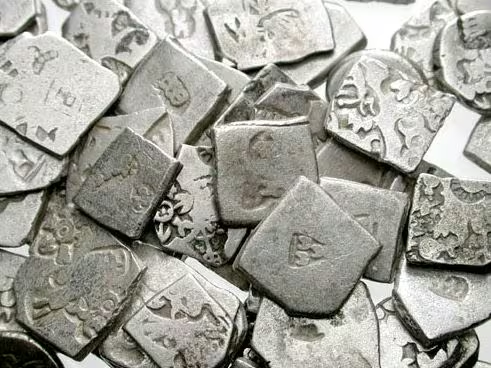
An irregular piece of silver, cut from a bar and stamped with separately applied symbols, could serve as currency across much of ancient India. Known as a karshapana or Aahat coin, the punch-marked coin belongs to a tradition dating broadly from about the 6th to the 2nd centuries BCE, although examples remained in circulation into the early centuries CE. Unlike later coins struck from prepared dies, these pieces were formed by cutting silver bars and shaving their edges until the required weight was reached. Symbols were then impressed one at a time with individual punches.
The coins reflect the emergence of regional states and organized monetary systems. They were issued by the Mahajanapadas, ancient kingdoms, and tribes, and were produced in large quantities during the Mauryan period. Their designs varied by region: a humped bull was associated with Saurashtra, a swastika with Dakshin Panchala, and Magadha issued coins bearing several symbols. Across the series, the stamps include suns, six-armed forms, geometric patterns, circles, wheels, human figures, animals, bows and arrows, hills, and trees.
Discovery and Provenance
Discovery
Punch-marked coins have been found over most parts of the Indian subcontinent. Archaeological discoveries include the Babyal Hoard near Sugh Ancient Mound in present-day Haryana, where punched coins associated with the Kuru kingdom carried a triskelion-like design. Bent bar coins from Gandhara were found at Bhir Mound mixed with Persian and Greek coins, indicating that different monetary traditions circulated together.
Other important discoveries include the Kabul hoard, the Mir Zakah hoards, the Bhir Mound finds, and the Shaikhan Dehri hoard near Pushkalavati. These discoveries contain combinations of Achaemenid, Greek, local coins, punched bars, and cast silver ingots. A small hoard found at ancient Pushkalavati in 2007 included an Athenian tetradrachm minted around 500–480 BCE alongside local coins and cast silver ingots.
Journey Through History
The earliest punch-marked coins initially carried only one or two punches. Over time, the number of impressions increased. The coins were not uniform in shape because they were cut from silver bars and adjusted by shaving. Their weights, however, were important. During the Mauryan period, examples contained on average 50–54 grains of silver, depending on wear, and weighed approximately 32 rattis. Earlier coins were flatter than later examples.
In the North, punch-marked coins were eventually replaced by cast die-struck coins as the influence of the Greco-Bactrians and Indo-Greeks increased. In other regions, however, punch-marked coins continued to circulate. The Manu Smriti and Buddhist Jataka literature mention them as currency in the North until approximately the beginning of the 1st century CE, while they lasted about three centuries longer in the South, until roughly 300 CE.
Current Home
Punch-marked coins are represented through hoards and archaeological finds rather than a single documented museum object or collection. Their widespread discovery provides evidence for long-distance circulation and the interaction of local, Persian, and Greek monetary traditions.
Physical Description
Materials and Construction
Punch-marked coins were primarily made of silver, with early Indian coins also produced in copper. The earliest examples included bent bar coins with punched impressions. Other pieces were created by cutting silver bars into smaller sections and shaving the edges to achieve the desired weight.
The technique differed from die-striking. Instead of placing a blank between two dies bearing a complete design, makers impressed symbols individually with separate punches. This method produced coins whose marks could vary in arrangement and number.
Dimensions and Form
The coins were irregular in shape. They did not have a standard circular outline, and their appearance depended partly on how the silver bar was cut and trimmed. Their weight was more consistent than their form, especially during the Mauryan period.
Condition
The archaeological record includes coins affected by wear, and Mauryan silver weights are described as varying according to wear. The available historical account does not establish a single condition for all punch-marked coins.
Artistic Details
The designs ranged from simple single symbols to groups of multiple impressions. Common motifs included the sun and six-armed symbols. Other forms included circles, wheels, geometric patterns, human figures, animals, bows and arrows, hills, and trees. Regional identities could also be expressed through distinctive symbols such as the humped bull of Saurashtra and the swastika of Dakshin Panchala.
Historical Context
The Era
The first punch-marked coins may have been minted around the 6th century BCE by the Mahajanapadas of the Indo-Gangetic Plain. Ancient Indian political communities issued coins identified in the historical record as karshapana, satamana, or Aahat. Pāṇini’s Aṣṭādhyāyī, composed around 350 BCE, categorized ancient Indian coins as marked or unmarked karshapana and referred to punch-marked coins as Aahat.
During the Mauryan period, from 322 to 185 BCE, punch-marked coins continued to be issued in large quantities. Their production formed part of the coinage of Magadha and the Mauryan Empire.
Purpose and Function
These coins served as currency. Their distribution across the subcontinent and their appearance in mixed hoards show that they circulated alongside foreign and local monetary forms. The presence of Persian and Greek coins with local punch-marked pieces at sites near the Indus demonstrates the movement of coinage across political and cultural boundaries.
Commissioning and Creation
Individual makers are not identified. The coins were produced by early Indian kingdoms, tribes, and janapadas, and later by the Mauryan state. The Kuru, Gandhara, Saurashtra, Dakshin Panchala, and Magadha traditions demonstrate that coin production was not limited to a single minting authority.
Significance and Symbolism
Historical Importance
Punch-marked coins document the early development of coinage in the Indian subcontinent. Their changing number of punches helps establish a relative chronology, with simpler examples generally preceding more heavily marked pieces. Their distribution also records the reach of political and commercial networks.
Artistic Significance
Their visual language is created through repeated impressions rather than a single unified design. This gives each coin an irregular composition. The large range of approximately 450 punch types in Mauryan coinage shows the diversity of symbols used during the period.
Religious/Cultural Meaning
The symbols included animals, plants, hills, trees, geometric forms, and human figures. The historical record identifies these motifs but does not assign a single religious meaning to the complete group of designs.
Inscriptions and Text
Punch-marked coins are defined by stamped symbols rather than written inscriptions. Their associated textual evidence comes from works such as Pāṇini’s Aṣṭādhyāyī, the Manu Smriti, and Buddhist Jataka literature, which refer to their names or circulation.
Scholarly Study
Key Research
The relative chronology of punch-marked coins has been developed through the changing number and arrangement of their punches. Finds from the Babyal Hoard, Bhir Mound, Pushkalavati, Kabul, and Mir Zakah have helped place local coinage alongside Persian and Greek examples.
Debates and Controversies
Nineteenth-century proposals placing the origin of punch-marked coins as early as 1000 BCE, independent of the introduction of coinage in Asia Minor, are no longer accepted. Scholars have also debated whether punch-marked bars originated in the Indian heartland or in the eastern provinces of the Achaemenid Empire. The discovery of similar bars in Afghanistan and the use of a Persian weight standard have contributed to this discussion.
Legacy and Influence
Impact on Art History
Punch-marked coins provide evidence for the early history of Indian metalworking, monetary standards, political authority, and regional symbolism. Their irregular forms distinguish them from later cast and die-struck coinage.
Modern Recognition
The coins remain important to the study of ancient Indian numismatics. Their survival in archaeological hoards and their mention in early literary works connect material evidence with written records of economic life.
Viewing Today
Punch-marked coins are known through archaeological hoards and excavated finds across the Indian subcontinent. Specific museum display information, accession numbers, and a single current location are not established in the historical record described here.
Conclusion
Punch-marked coins preserve an early chapter in the history of Indian currency. Made chiefly from silver, cut into irregular pieces, and stamped with symbols one at a time, they combined a flexible form with controlled weight. Their regional designs reveal the diversity of the Mahajanapadas and later Mauryan coinage, while their presence beside Persian and Greek money shows that ancient monetary systems were connected across political frontiers. From the 6th century BCE through the early centuries CE, these coins supported exchange and expressed the authority of the communities that issued them. Their symbols, hoards, and changing forms continue to illuminate the development of coinage in ancient India.