Overview
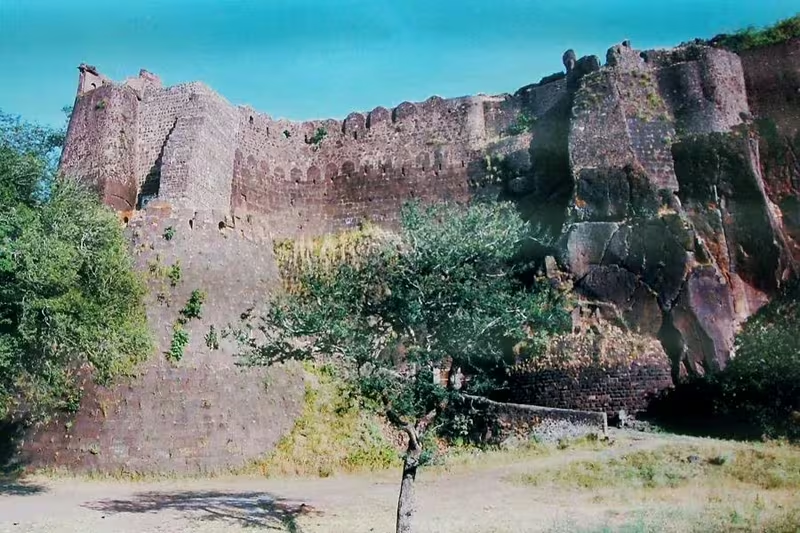
In 1601, the fall of Asirgarh ended more than two centuries of Farooqi rule in Khandesh. The fort surrendered to the Mughal emperor Akbar's forces on January 17, after Bahadur Shah, the last Farooqi ruler, had already surrendered the previous month. The event transformed Khandesh into a Mughal province, but it did not erase the political and commercial foundations established by the dynasty.
The Farooqi dynasty, also called Farooqui, Faruqi or Farooq Shahi, ruled the Khandesh Sultanate from 1382 to 1601. Its founder, Malik Ahmad—better known as Malik Raja—built his authority from the Thalner region on the Tapti River. At first he held lands granted by the Delhi sultan Firuz Shah Tughluq. By 1382, however, he had become an independent ruler.
Khandesh was a regional state situated amid the political worlds of the Deccan, Gujarat, Malwa and northern India. Its rulers alternated between conquest, tribute, alliance and submission as they dealt with stronger neighbours. Their most enduring centres were Thalner, Asirgarh and Burhanpur. Under Adil Khan II, the sultanate reached its greatest political prominence, while Burhanpur developed into an important centre of trade and textile production.
Rise to Power
The Farooqi family connected its ancestry to Umar al-Faruq, the second caliph, and this claimed descent gave the dynasty its name. Family traditions also associated Malik Raja's ancestors with a ruling house of Khorasan. One prominent ancestor identified in the tradition was Abu Bin Adham, or Sultan Ibrahim Bin Adham Balkhi, described as a ruler who abandoned the throne to become a Sufi. After the conquest of Balkh by Genghis Khan in 1220, members of the family were said to have moved toward Delhi through Uch.
The family received a place among the respected nobles of the Delhi court. Malik Raja's father, Khan-i-Jahan, also known as Khwaja-i-Jahan Faruqi, served as a minister there. Malik Raja himself first emerged in the politics of the Deccan. In 1365, he joined a rebellion by chieftains from Berar and Baglana against the Bahmani ruler Muhammad Shah I. The revolt, led by the governor of Daulatabad, Bahram Khan Mazindarani, failed. Malik Raja was forced to leave the Deccan and settled at Thalner.
His fortunes changed through an encounter with Firuz Shah Tughluq. Malik Raja assisted the Delhi sultan during a hunting expedition in Gujarat. He was first appointed an officer responsible for two thousand horsemen. In 1370, Firuz Shah granted him the fiefdoms of Thalner and Karanda, the latter corresponding to present-day Karwand, north of Thalner. In the same year Malik Raja defeated the ruler of Baglana and compelled him to pay an annual tribute to Delhi. Firuz Shah then gave him the title Sipah-salar and raised his command to three thousand horsemen.
Malik Raja's local influence grew rapidly. Within a few years, he was able to muster twelve thousand horsemen and collect contributions from neighbouring rulers. He also began developing the agriculture of Khandesh. At the time of his accession as an independent ruler, the region was described as relatively backward, with a population that included Bhils and Kolis. Asirgarh was the principal prosperous area and was associated with wealthy Ahirs.
In 1382 Malik Raja began ruling Khandesh independently. He expanded toward Gujarat and annexed Sultanpur and Nandurbar. The governor of Gujarat, Zafar Khan—later Muzaffar Shah—responded by besieging Thalner. Malik Raja was unable to hold his new conquests and returned the territories he had taken. His authority nevertheless survived, and he also brought the Gond ruler of Mandla into a tributary relationship. Malik Raja died in 1399 and was buried at Thalner.
The Making of a Sultanate
Malik Raja's elder son, Nasir Khan, succeeded him in 1399. Because Thalner was controlled by his younger brother Malik Iftikar Hasan, Nasir Khan initially ruled from Laling. Soon after taking power, he captured Asirgarh and killed its Hindu ruler. The fort became his capital and the principal defensive centre of the state.
Nasir Khan also founded Burhanpur in 1399. The new city eventually replaced Asirgarh as the dynasty's political centre. Its location helped connect the territories of Khandesh with the wider routes linking the Deccan and western India. Burhanpur's later growth as a commercial and textile centre was rooted in this transformation.
Nasir Khan's reign was marked by shifting alliances and conflict with neighbouring powers. In 1417, with assistance from the Malwa sultan Hoshang Shah, he captured Thalner and imprisoned his brother Malik Iftikar. Malik Iftikar later received asylum in Gujarat. The combined forces of Khandesh and Malwa then attacked Gujarat and occupied Sultanpur. Gujarat's general Malik Turk defeated the invaders, and Thalner was besieged. Nasir Khan ended the crisis by swearing fealty to the Gujarat sultan. Ahmad Shah of Gujarat then honoured him with the title Khan.
Nasir Khan also connected his house to the Bahmani court through marriage. In 1429, he married his daughter to the Bahmani prince Ala-ud-Din, the son of Ahmad Shah I. That same year, Raja Kanha of Jhalawar fled Gujarat and sought refuge at Asirgarh. Acting on Raja Kanha's advice, Nasir Khan helped him seek support from the Bahmani sultan at Bidar. The subsequent campaign in Nandurbar initially advanced with Khandesh and Bahmani forces, but the Gujarat army defeated the combined forces.
In 1435, Nasir Khan allied with the ruler of Gondwana and dissatisfied Bahmani officials to attack Berar. He captured the territory, and its governor fled to Narnala. The Bahmani response was severe. The army of Ala-ud-Din Ahmad Shah II, commanded by Malik-ut-Tujjar, defeated Nasir Khan at Rohankhedaghat, followed him to Burhanpur, ransacked the city and finally defeated his army at Laling. Nasir Khan died shortly afterward, on September 18, 1437, according to the principal date given in the account, and was buried at Thalner.
Golden Age
Nasir Khan's successors initially accepted the pressure of Gujarat. Miran Adil Khan I succeeded his father in 1437. When a Gujarat army reached Sultanpur in support of Khandesh, Malik-ut-Tujjar lifted his siege and withdrew. Adil Khan accepted the suzerainty of Gujarat. He was probably assassinated at Burhanpur in 1441 and was buried beside his father at Thalner.
Miran Mubarak Khan I succeeded him and ruled until 1457. He undertook no major territorial expansion apart from two campaigns against the ruler of Baglana. His successor, Miran Adil Khan II, would give the dynasty its most expansive and powerful reign.
Adil Khan II was the eldest son of Mubarak Khan I. He fortified Asirgarh and built the citadel of Burhanpur, reinforcing both the military and political foundations of the sultanate. He subdued the Gond rulers of Gondwana and Mandla and extended his campaigns as far as Jharkhand. His territorial ambitions were reflected in the title Shah-i-Jharkhand.
Adil Khan II also challenged Gujarat directly by declaring his independence and stopping the payment of tribute. Gujarat responded in 1498 by sending an army into Khandesh. Unable to resist the invasion, Adil Khan agreed to pay the arrears. This episode reveals both the strength and limits of his rule: he could project power over a broad inland region, but Khandesh remained vulnerable to the larger sultanates around it.
Adil Khan II died in 1501 without a male heir. His younger brother Daud Khan succeeded him. Although the long reign of Adil Khan II is generally regarded as the high point of Farooqi power, the succession after his death brought instability and increasing dependence on powerful neighbouring states.
Administration and Governance
The Farooqi state was a hereditary sultanate, but its rulers governed through a combination of military authority, tribute arrangements, alliances and negotiated submission. Malik Raja's early rule illustrates this pattern. He held fiefs from Firuz Shah Tughluq, defeated the ruler of Baglana and collected tribute from surrounding rulers. After declaring independence, he continued to expand his influence through military pressure and regional agreements.
Agriculture was an early concern. Malik Raja took steps to develop cultivation in Khandesh, a practical measure in a region that his reign inherited as comparatively underdeveloped. Control over agricultural territory supported the army and helped sustain the political centres of Thalner, Asirgarh and Burhanpur.
The dynasty's relations with neighbouring powers were rarely fixed. At different times Farooqi rulers acknowledged the authority of Gujarat, Malwa, Ahmadnagar or the Mughals. Such submission could be temporary and strategic. Nasir Khan accepted Gujarat's suzerainty after the siege of Thalner, while Adil Khan II later stopped paying tribute and asserted independence. Miran Mubarak Khan II acquired Sultanpur and Nandurbar through a treaty with Gujarat after earlier conflicts.
The court also depended on nobles and military commanders. The weakness of this arrangement became clear after Daud Khan's accession. Daud was dependent on the brothers Hussain Ali and Yar Ali; Hussain Ali served as wazir under the title Malik Hisam-ud-Din. At his instigation, Daud prepared to attack Ahmadnagar, but the Ahmadnagar army invaded Khandesh instead. Daud sought help from Malwa, only to be compelled to accept Malwa's subordination as well.
Succession could be contested even within the ruling family. After Daud's death, his son Ghazni Khan became sultan but survived for only ten days—or two days according to Ferishta's account—before being poisoned by Hisam-ud-Din. The nobles then placed Alam Khan on the throne, while Gujarat supported Adil Shah, a descendant of Malik Iftikar Hasan. These episodes show how dynastic legitimacy, noble influence and outside intervention interacted in the later sultanate.
Military Campaigns
Farooqi military history was shaped by the need to hold Khandesh against larger neighbours while extending influence across the surrounding uplands and river valleys. Malik Raja's first major campaigns secured the area around Thalner and brought Baglana into a tributary relationship. His attempt to annex Sultanpur and Nandurbar provoked Gujarat and ended with the return of those territories.
Nasir Khan's capture of Asirgarh was a turning point. The fort became the principal strategic anchor of the dynasty. His later capture of Thalner, the campaign against Gujarat and the invasion of Berar demonstrated the range of Farooqi military activity, but the defeat at Laling in 1435 also exposed the risks of confronting the Bahmani state.
Adil Khan II achieved the dynasty's widest territorial influence. His victories over the Gond rulers of Gondwana and Mandla carried Farooqi authority eastward, while his campaign toward Jharkhand earned him the title Shah-i-Jharkhand. His conflict with Gujarat, however, ended in the restoration of tribute.
The sixteenth century brought repeated interventions by Ahmadnagar, Gujarat and the Mughals. During the reign of Adil Khan III, Khandesh became involved in Gujarat's succession politics and campaigns against Malwa. Miran Muhammad Shah I supported a coalition that captured Daulatabad and forced Burhan Nizam Shah of Ahmadnagar to accept a humiliating treaty. He later joined Bahadur Shah of Gujarat in campaigns against Malwa and Chittaur.
Miran Mubarak Khan II confronted both Gujarat and the Mughals. After the Mughal defeat of Baz Bahadur of Malwa in 1561, the Malwa ruler took refuge in Khandesh. The Mughal general Pir Muhammad Khan pursued him, devastated the kingdom and occupied Burhanpur. Mubarak Khan sought help from Tufal Khan of Berar. The combined forces of Berar and Khandesh defeated Pir Muhammad, recovered Malwa and restored Baz Bahadur.
Miran Muhammad Shah II later fought against a Gujarat noble, Changiz Khan, who had captured Nandurbar and advanced toward Thalner. With assistance from Tufal Khan, the Farooqi ruler recovered the lost territories. He then attempted to claim the throne of Gujarat, but the campaign ended in a serious defeat. After Ahmadnagar annexed Berar in 1574, Muhammad Shah II supported a claimant there. Ahmadnagar retaliated by invading Khandesh, overrunning Burhanpur and pursuing him to Asirgarh. Peace required the payment of a large indemnity.
Under Raja Ali Khan, Khandesh moved closer to the Mughal sphere. Akbar sent an expedition in 1577 to secure its subordination. Raja Ali accepted and later received a mansab, or rank, of 5,000. In 1586, he joined Ahmadnagar in defeating Akbar's governor of Malwa, Khan Azam. Yet in 1591 he accepted Mughal suzerainty after Akbar sent Faizi to the courts of Khandesh and Ahmadnagar. Raja Ali eventually fought on the Mughal side against Ahmadnagar and died at the battle of Sonpet on February 5, 1597.
Cultural Contributions
The most clearly recorded cultural and urban achievement of the Farooqi period was the development of Burhanpur. Nasir Khan founded the city in 1399, and later rulers made it the dynasty's main capital. Under Adil Khan II, Burhanpur received a citadel, while Asirgarh was fortified as the principal stronghold of the kingdom.
Burhanpur also became a major centre for trade and textile production. This commercial role gave the city importance beyond its function as a royal residence. Its history reflects the wider character of Khandesh: a regional state whose political value was closely linked to its position between the Deccan and western India.
The dynasty's tombs and political centres were distributed between Thalner and Burhanpur. Malik Raja and several early rulers were buried at Thalner. Adil Khan II was buried near his palace in Burhanpur, and Raja Ali Khan's body was brought there after his death at Sonpet. These burial places formed part of the dynasty's continuing presence in the landscape.
Economy and Trade
The Farooqi economy rested partly on agriculture and partly on the revenues derived from towns, trade and tribute. Malik Raja's early agricultural policies aimed to strengthen a territory described as relatively backward at the beginning of his independent rule. The collection of contributions from neighbouring rulers also supported his military establishment.
Tribute was a recurring instrument of regional politics. Malik Raja imposed annual payments on Baglana, while later rulers alternately paid tribute to Gujarat, withheld it, or negotiated its restoration. Military success could enlarge revenue, but defeat often resulted in indemnities or renewed submission.
Burhanpur's rise marked the commercial development of the sultanate. Under Adil Khan II, it became a major centre for trade and textile production. The city's prominence was supported by the concentration of political authority, the construction of its citadel and its position within the routes connecting Khandesh to neighbouring powers.
Decline and Fall
After Adil Khan II's death, the dynasty faced a combination of weak succession, noble factionalism and external pressure. Daud Khan's dependence on powerful ministers was followed by the extremely brief reign of Ghazni Khan. The accession of Adil Khan III required support from Ahmadnagar and Berar and opposition from Gujarat. Although he secured the throne, his rule remained entangled in the rivalries of the surrounding sultanates.
Later rulers continued to defend Khandesh, but their choices were increasingly shaped by stronger powers. Miran Mubarak Khan II fought Gujarat and the Mughals. Muhammad Shah II faced Ahmadnagar's invasion after intervening in Berar. Raja Ali Khan accepted Mughal subordination, though he still fought alongside Ahmadnagar in 1586 and later served in the Mughal campaign against Ahmadnagar.
The final ruler, Qadir Khan or Khizr Khan, adopted the title Bahadur Shah. He resisted direct cooperation with Akbar. When Akbar's emissary Abu'l Fazl met him, Bahadur Shah refused to join the Mughal army personally. In January 1599, when Prince Daniyal reached Burhanpur, he again refused to meet the Mughal prince. He withdrew to Asirgarh and prepared for war.
Akbar reached Burhanpur on April 8, 1599. He ordered Abdur Rahim Khan-i-Khanan to besiege Asirgarh and appointed Abu'l Fazl governor of Khandesh. Bahadur Shah surrendered on December 10, 1600, but the fort remained in the hands of his general Yakut Khan. Asirgarh finally fell on January 17, 1601. Khandesh was annexed to the Mughal Empire and became a Mughal subah, with Prince Daniyal appointed its viceroy. Bahadur Shah was taken to Agra, where he died in 1624.
Legacy
The Farooqi dynasty's principal legacy lies in the political formation and urban development of Khandesh. Malik Raja transformed a set of fiefs around Thalner into an independent regional state. Nasir Khan founded Burhanpur and captured Asirgarh, creating the two centres that defined the sultanate's political geography.
The dynasty also demonstrates how medieval Indian states operated within a competitive regional system. Khandesh was neither isolated nor consistently dominant. Its rulers negotiated with Delhi, Gujarat, Malwa, the Bahmani state, Ahmadnagar, Berar and the Mughals. Tribute, marriage, military intervention and diplomatic submission were all tools of survival.
Burhanpur's growth as a centre of trade and textile production endured beyond the dynasty's fall. Asirgarh's resistance in 1600–1601 became the final military episode of Farooqi rule. Together, the city and the fort preserve the two sides of the dynasty's history: commercial development and strategic defence.