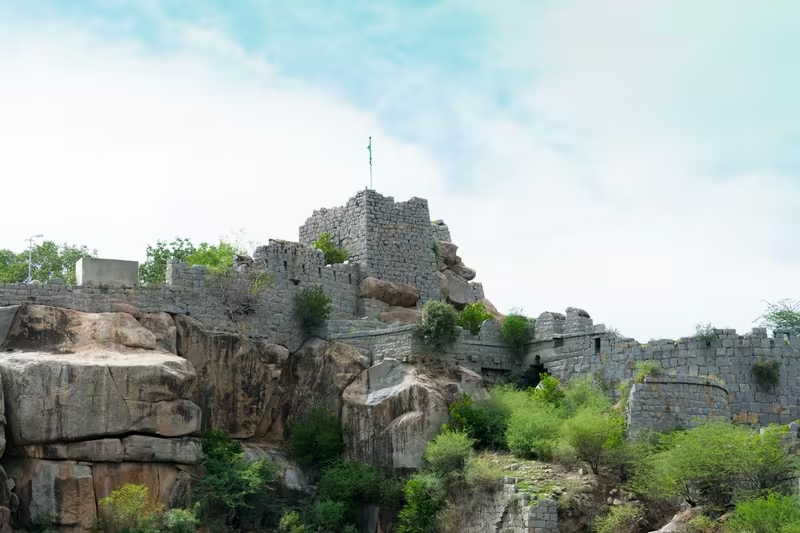
Overview
In 1520, the armies of the Vijayanagara Empire and the Sultanate of Bijapur met at Raichur, a fortified town in the Raichur Doab. The battle ended in a decisive Vijayanagara victory. Bijapur's ruler, Isma'il Adil Khan, was defeated and driven back across the Krishna River, while Krishnadevaraya's forces later captured the fort after a siege.
The victory was more than a contest for a single stronghold. Raichur had been disputed for nearly two centuries, and its possession represented the wider struggle for influence in the northern Deccan. The campaign also demonstrated the changing character of warfare. Bijapur possessed a notable artillery advantage, yet Vijayanagara prevailed through a combination of numerical strength, leadership, battlefield recovery, and Portuguese firearms used during the siege.
The battle's consequences extended beyond Raichur. Krishnadevaraya advanced into Bijapur and occupied its royal palace, while the Deccan sultans increasingly recognized the need to cooperate against Vijayanagara. Later interpretations have therefore treated Raichur both as the high point of Krishnadevaraya's power and as a victory that encouraged dangerous confidence.
Background
The fort of Raichur was built by the Kakatiya king Prataparudra in 1294. After the decline of the Kakatiyas, the fort passed to the Vijayanagara Kingdom. In 1323, Muhammad bin Tughluq captured Raichur and other parts of the northern Deccan. The Bahmani Sultanate then took the fort in 1347.
Raichur remained a contested possession after these changes of rule. Saluva Narasimha Deva Raya, a Vijayanagara ruler, attempted to recover the city from the Bahmanis but failed. The long dispute reflected the strategic importance of the area, though the surviving account does not provide a detailed explanation of its economic or geographical value beyond identifying it as part of the Raichur Doab.
By the early sixteenth century, the Bahmani political order had given way to successor sultanates, including Bijapur. Vijayanagara, under Krishnadevaraya, was powerful enough to challenge these states directly. Raichur consequently became the focus of a major confrontation between the empire and Bijapur.
Prelude
The immediate crisis began when Krishnadevaraya sent Seyed Maraikar, a Muslim in Vijayanagara service, to Goa with a large sum of money to buy horses. Maraikar betrayed Krishnadevaraya, went to Adil Khan, and offered his services along with the money. When Krishnadevaraya demanded that Maraikar and the funds be returned, the demand was refused.
The refusal helped turn an existing territorial dispute into an immediate military confrontation. During the period of peace, Krishnadevaraya made extensive preparations for an attack on Raichur Doab. The scale of those preparations suggests that the campaign was planned as a major operation rather than a limited raid.
When Adil Shah moved to relieve Raichur, he brought a force that included cavalry, elephants, infantry, and artillery. The figures preserved in different accounts do not agree. One set of figures gives Bijapur 7,000 cavalry and 250 elephants, while another describes Adil Shah's army as containing 18,000 horses, 150 elephants, and 120,000 foot soldiers. The Vijayanagara army is likewise described in varying terms, particularly regarding its infantry.
The Event
The main Vijayanagara commander was Saluva Timmarusu, also known as Saluva Timma. The vanguard was initially led by Pemmasani Ramalinga Nayaka, with 30,000 infantry, 1,000 cavalry, and several war elephants. Other commanders included Timmappa Nayaka, Adapa Nayaka, Ganda Raya, Jagadeva, Rayachuri Rami Nayudu, and Kumara Virayya.
Contemporary figures give Krishnadevaraya's army 32,600 cavalry and 551 elephants. Some accounts also claim that his infantry numbered slightly more than 700,000. These figures should be treated cautiously because contemporary and modern writers disagree substantially about the infantry strength of both armies.
Adil Shah moved towards the Krishna River to relieve Raichur. When he arrived, Vijayanagara troops blocked the crossing. He nevertheless crossed the river and advanced towards Krishnadevaraya's camp. The two armies prepared for battle and spent the night armed and ready.
Key Phases
The next morning, Krishnadevaraya ordered an attack on the Bijapuri forces. The first phase went in Vijayanagara's favour, but the advance encountered intense artillery fire from the Bijapuris. The Hindu forces were thrown into disorder and began to retreat.
Krishnadevaraya then rallied his soldiers and organized a counter-attack. In an address to his remaining troops, he encouraged them to die as soldiers rather than flee. He called for loyal officers and charged with them against the enemy. The unexpected attack disrupted the Bijapuri army and caused it to retreat in confusion.
The fighting produced heavy losses on both sides. Vijayanagara casualties were reported as more than 16,000 dead. Among the Bijapuri losses was Mirza Jehangir. Salabut Khan and five other important captains were taken prisoner.
When the Bijapuri army began to withdraw, Krishnadevaraya's generals asked for permission to continue the pursuit. He chose instead to prioritize peace and ordered his troops to withdraw. After capturing the enemy camp, he found 100 elephants, 400 cannons, tents, horses, oxen, and other animals among the spoils.
The account also describes Krishnadevaraya releasing captured women, arranging funeral rites for the dead, and distributing alms. These actions formed part of the conduct attributed to him after the field victory, before the campaign returned to the siege of Raichur.
Turning Points
The decisive turning point was the Vijayanagara recovery after the initial retreat. Bijapur's artillery had disrupted the first attack, but Krishnadevaraya's personal intervention restored cohesion and produced a counter-attack. The retreat that followed transformed a difficult engagement into a major Vijayanagara victory.
The second turning point came during the siege. A Portuguese contingent commanded by Cristóvão de Figueiredo supported the Vijayanagara operation with firearms. Portuguese arquebusiers picked off defenders on the walls, allowing besiegers to approach the fortifications and pull down stones. Matchlocks obtained through contact with the Portuguese were also probably used by Vijayanagara forces, although the probability of their use is not the same as firm evidence for every detail of deployment.
The garrison was eventually driven to desperation. After its governor was killed, it surrendered. Portuguese accounts emphasize that Bijapur used cannons extensively, while Vijayanagara used them minimally, at best. The capture of Raichur therefore followed a victory achieved despite a disparity in firepower.
Participants
Vijayanagara Empire
Krishnadevaraya directed the campaign and personally rallied his army at its most dangerous moment. Saluva Timmarusu served as the principal commander. Pemmasani Ramalinga Nayaka led the vanguard, while Timmappa Nayaka, Adapa Nayaka, Ganda Raya, Jagadeva, Rayachuri Rami Nayudu, and Kumara Virayya held other commands.
The army included large numbers of cavalry and elephants, with infantry figures varying widely between accounts. Portuguese support was especially important during the siege rather than the initial field engagement. Cristóvão de Figueiredo commanded that contingent.
Sultanate of Bijapur
Isma'il Adil Khan led Bijapur. His army attempted to relieve Raichur after crossing the Krishna River. It possessed a significant artillery advantage, along with cavalry, elephants, and infantry. That advantage was not enough to prevent defeat after the Vijayanagara counter-attack.
Mirza Jehangir was among the Bijapuri dead. Salabut Khan and five important captains were captured. The defeat weakened Adil Shah's prestige and forced him to retreat before Krishnadevaraya's advance.
Aftermath
After Raichur surrendered, Krishnadevaraya entered the city in triumph. The account describes harsh treatment of Bijapuri generals, many of whom lost their lands. Krishnadevaraya declared that Adil Shah could have his lands restored if he came, paid homage, and kissed the king's foot. Adil Shah did not submit.
Later, an embassy from Isma'il Adil Khan requested the return of captured items, including the fort of Raichur. Krishnadevaraya agreed on the condition that Adil Khan pay homage. A meeting was arranged at Mudgal, but Adil Khan failed to appear when Krishnadevaraya arrived. Enraged, Krishnadevaraya advanced on Bijapur. Adil Shah fled, and Krishnadevaraya occupied the royal palace. Bijapur was damaged, although the account states that Krishnadevaraya did not originally intend to sack the city.
The diplomatic crisis deepened when Adil Shah's ambassador, Asad Khan Lari, blamed Salabat Khan for the failed meeting. Believing the accusation, Krishnadevaraya ordered Salabat's execution. Asad Khan then achieved his purpose and fled.
Krishnadevaraya continued to campaign in the region, winning battles at Sagar, Shorapur, and Kemba in the Kalaburagi district. He also captured three sons of a former Bahmani king who had been held by Adil Shah. The eldest was proclaimed king of the Deccan in an effort to challenge the authority of the five sultans who had established themselves after the breakup of the single Bahmani sovereignty.
Historical Significance
Raichur changed the balance of power in the Deccan. The victory weakened the authority and prestige of Adil Shah, but it also encouraged the other Deccan sultans to cooperate against Vijayanagara. A triumph that expanded Krishnadevaraya's influence thus helped create the political conditions for a broader anti-Vijayanagara alignment.
The battle also affected Portuguese fortunes on the west coast. Goa's rise and decline were closely connected with Vijayanagara because Portuguese trade depended on Hindu support. The Portuguese role at Raichur shows that the campaign was connected to wider networks of commerce, diplomacy, and military exchange.
Richard Eaton has offered a further interpretation. In his view, Krishnadevaraya's success against an army with technologically superior weapons may have led him to underestimate the importance of continued investment in firearms. The Deccan sultans, by contrast, continued improving their arms and learned how to deploy them more effectively. This interpretation connects the immediate victory at Raichur with the longer-term military competition that followed.
Legacy
Raichur remains associated with the height of Krishnadevaraya's military power and with the rivalry between Vijayanagara and the Deccan sultanates. Its historical importance lies not only in the capture of the fort but also in the campaign's combination of field warfare, siege operations, diplomacy, and foreign military assistance.
The battle is also a reminder that sixteenth-century Deccan politics cannot be reduced to a simple religious confrontation. Vijayanagara's army included Muslim personnel such as Seyed Maraikar, whose defection helped trigger the crisis, while Portuguese fighters supported the Hindu-ruled empire during the siege. Political allegiance, territorial ambition, military technology, and diplomatic calculation all shaped the conflict.
Historiography
Older Orientalist and nationalist historians presented Raichur as part of a broad clash between Hindus and Muslims. Contemporary scholars reject that characterization as too simplistic. The political alliances and military relationships surrounding the battle crossed religious boundaries, and the campaign was driven by disputes over territory, authority, prestige, and strategic advantage.
Modern interpretations also stress the role of firearms. Bijapur's artillery was superior in the field, while Portuguese arquebuses assisted Vijayanagara at the fort. The contrasting performance of these weapons complicates any account that treats numerical strength alone as the reason for victory.