Overview
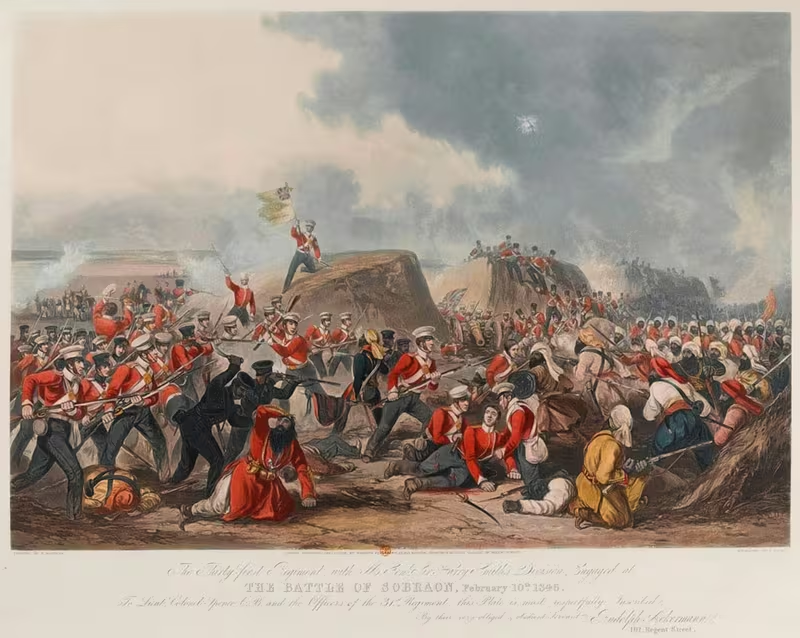
On 10 February 1846, the East India Company army attacked the Sikh Khalsa Army at Sobraon, a fortified bridgehead on the Sutlej River. The battle ended in a complete Sikh defeat and became the decisive engagement of the First Anglo-Sikh War. Sikh losses were reported at between 8,000 and 10,000 men, including the respected veteran leader Sham Singh Attariwala.
The position was dangerous because the Sikh encampment stood east of the Sutlej and was connected to the Punjabi, western bank by a single pontoon bridge. Heavy rain had swollen the river during the three days before the battle. When the bridge broke under the pressure of retreating soldiers, nearly 20,000 Sikh troops were trapped on the eastern bank. Many fought until they were killed, while others attempted to cross the river under fire.
The victory opened the road to Lahore. Within three days, the British army was only 30 miles from the Sikh capital, and the Sikh durbar was compelled to negotiate. The resulting Treaty of Lahore imposed territorial, political, and financial terms that greatly weakened the Sikh Empire.
Background
The First Anglo-Sikh War began in late 1845. Its deeper setting was the disorder that followed the death of Ranjit Singh in 1839. Ranjit Singh had built and led the Sikh Empire, but after his death political instability increased. At the same time, relations between the Sikh state and the East India Company deteriorated. British provocations and the movement of the Sikh Khalsa Army led to an invasion of British territory.
The British had already won the first two major battles of the war. These victories were attributed in the account of the war to a combination of luck, the steadiness of British and Bengal units, and the alleged treachery of the Sikh commanders Tej Singh and Lal Singh. The Sikh defeat at Ferozeshah temporarily unsettled the Khalsa Army, and most of its forces withdrew across the Sutlej.
The Sikh regent, Jind Kaur, who ruled in the name of her young son, Maharaja Duleep Singh, responded harshly to the earlier defeat. She accused 500 officers of cowardice and reportedly flung one of her garments in their faces. The Khalsa Army was then reinforced by troops from districts west of Lahore. It moved back across the Sutlej and established a fortified bridgehead at Sobraon.
The British army also recovered its strength. Sir Henry Hardinge, the Governor-General, had been disturbed by the direct tactics of the British commander-in-chief, Sir Hugh Gough, and had wanted him removed. No commander senior enough to replace Gough could arrive from England for several months. Meanwhile, British morale improved after Sir Harry Smith's victory at Aliwal, which removed a threat to the army's communications. Reinforcements arrived as well, including heavy artillery and two Gurkha battalions.
Prelude
The Sikh position at Sobraon was strengthened by the presence of Sham Singh Attariwala, a respected veteran leader. His arrival helped dispel uncertainty caused by the earlier defeats. Yet Tej Singh and Lal Singh continued to exercise overall direction of the Sikh forces.
The defensive position had a serious weakness. Its connection to the western bank depended on one pontoon bridge. Three days of continuous rain caused the Sutlej to rise, threatening the bridge even before the battle began. The army's ability to withdraw or receive support therefore depended on a crossing already placed under pressure by the river.
Gough wanted to attack as soon as Harry Smith's division returned from Ludhiana. Hardinge insisted that the army wait until a heavy artillery train had arrived. Once the guns were available, the British army moved forward early on 10 February. Heavy fog delayed the beginning of the battle, but the fighting started after the mist lifted.
The Event
Key Phases
The opening phase was an artillery bombardment. Thirty-five British heavy guns and howitzers opened fire, and Sikh cannon replied. The exchange continued for two hours but produced little visible effect on the Sikh defences. Gough was told that the heavy guns were running short of ammunition. According to the account, he replied, “Thank God! Then I’ll be at them with the bayonet.”
The British then attacked across the Sikh front. Two divisions, commanded by Harry Smith and Major General Sir Walter Gilbert, carried out feint attacks against the Sikh left. The main assault fell on the right, where the Sikh defences were lower and weaker. The ground there consisted of soft sand, unlike the stronger parts of the entrenchments.
Major General Robert Henry Dick led the attack on the Sikh right. His troops initially gained footholds inside the Sikh lines, but Sikh counter-attacks drove them back. Dick was killed during the fighting. As the British withdrew, some Sikh soldiers attacked British wounded who had been left in the ditch before the entrenchments. This action intensified the anger of the British troops and formed part of the later British description of the battle.
The British, Gurkha, and Bengal regiments renewed their assault along the entire fortified line. They broke through at several points. On the Sikh right, engineers created a breach in the defences. British cavalry and horse artillery moved through the opening and entered the centre of the Sikh position.
Turning Points
The decisive turning point came when the Sikh line was breached while the army's bridge of retreat failed. Tej Singh had left the battlefield early. Sikh accounts allege that he deliberately weakened the pontoon bridge, either by loosening a boat at its centre or by ordering artillery on the western bank to fire upon it under the pretext of preventing a British pursuit. British accounts instead state that the swollen river caused the bridge to break beneath the weight of the retreating soldiers. The precise explanation remains disputed.
Whatever caused the collapse, the result was disastrous. Nearly 20,000 Sikh soldiers were trapped on the eastern bank. No large detachment attempted to surrender. Some groups, including one led by Sham Singh Attariwala, continued fighting until they were killed. Other soldiers charged the British regiments with swords, while some tried to ford or swim the Sutlej.
British horse artillery positioned along the riverbank fired into the crowds in the water. By the time the firing ended, Sikh losses were estimated at between 8,000 and 10,000 men. The British also captured 67 guns.
Participants
East India Company Forces
Sir Hugh Gough commanded the British army in the field, while Sir Henry Hardinge exercised senior political authority as Governor-General. The force included British regiments, Bengal Army cavalry and infantry, heavy artillery, and two Gurkha battalions. The attack depended on combined operations: artillery opened the action, infantry assaulted the entrenchments, engineers breached the defensive line, and cavalry and horse artillery exploited the opening.
The British order of battle included the 3rd King's Own Light Dragoons, the 9th Queen's Royal Light Dragoons, the 16th Queen's Lancers, and infantry regiments such as the 9th, 10th, 29th, 31st, 50th, 53rd, and 80th Foot. Bengal and Gurkha units formed an important part of the wider force.
Sikh Khalsa Army
The Sikh army occupied the fortified bridgehead and possessed artillery, infantry, and cavalry. Its position was strengthened by reinforcements from districts west of Lahore and by the presence of Sham Singh Attariwala. Tej Singh and Lal Singh retained overall command, although accounts differ about their conduct during the battle.
Sham Singh became associated with the final resistance at Sobraon. A number of Sikh detachments fought to the death after the bridge collapsed, rather than surrendering or remaining inactive behind the broken line of retreat.
Aftermath
The destruction of the bridge did not delay Gough's advance. British units began crossing the Sutlej on the evening of 10 February. By 13 February, the British army stood only 30 miles from Lahore. Sikh detachments remained intact in outlying parts of the Punjab, but they could not be concentrated rapidly enough to defend the capital.
The central durbar nominated Gulab Singh, the effective ruler of Jammu, to negotiate terms. Under the Treaty of Lahore, the Sikhs ceded the valuable agricultural territory of the Bist Doab, also called the Jullundur Doab, between the Beas and Sutlej Rivers. They accepted a British Resident at Lahore, supported by subordinate Residents or Agents in other principal cities. These officials would exercise indirect influence through Sikh sardars.
The Sikh state was also required to pay an indemnity of 1.2 million pounds. Since the full sum could not readily be found, Gulab Singh was allowed to acquire Kashmir from the Punjab by paying 750,000 pounds to the East India Company.
Historical Significance
Sobraon transformed a British military victory into a political settlement imposed on the Sikh Empire. Earlier battles had not ended Sikh resistance. At Sobraon, however, the defeat destroyed the army's position, severed its retreat, and placed Lahore within immediate reach of the British.
The battle also demonstrated the importance of military organization and battlefield coordination. The British assault combined artillery, infantry, engineers, cavalry, and horse artillery. The Sikh defences were formidable enough to withstand two hours of bombardment, but their weaker right and vulnerable river connection created openings that the British exploited.
Its consequences extended beyond the battlefield. The Treaty of Lahore reduced Sikh territorial control, introduced a permanent British political presence at Lahore, and imposed a major indemnity. Kashmir's transfer through the financial arrangements surrounding the treaty was another direct consequence of the defeat.
Legacy
A monument was erected at the battlefield at Rhodawala in 1868. The battle also survived in personal memories, military traditions, and literature.
Gough later described the fighting as a scene of “awful slaughter, confusion and dismay.” He praised the gallantry of the Khalsa while accusing Sikh troops of killing and mutilating wounded British soldiers during the early stages of the action. This account reflects the bitterness of the battle and the way conduct during the fighting shaped later British memory.
According to a personal account, the wife of Sham Singh Attariwala immolated herself on a funeral pyre after hearing of the battle, believing correctly that her husband would not return alive. The conduct of Lal Singh is also disputed: some accounts place him on the battlefield with Tej Singh, while others state that he commanded irregular cavalry some distance away and failed to attack the British communications.
The 10th Lincolnshire Regiment and the 29th Worcestershire Regiment developed a long-standing friendship said to have been cemented when their battalions met in the captured Sikh trenches. For years afterward, officers and sergeants of the two regiments were treated as honorary members of each other's messes, and their adjutants addressed one another as “My Dear Cousin.”
Sobraon also entered popular culture. It appears in George MacDonald Fraser's novel Flashman and the Mountain of Light and is mentioned in Rudyard Kipling's Stalky & Co. The battle inspired Charlotte Brontë's poem Passion and Elizabeth Anne Ogilvy's poem Sobraon.
Historiography
Interpretations of the battle focus especially on the conduct of the Sikh commanders and the collapse of the bridge. Sikh accounts have alleged deliberate betrayal by Tej Singh, arguing that he weakened the crossing or ordered fire against it. British accounts present a different explanation: the bridge, already threatened by the swollen Sutlej, broke under the weight of retreating troops.
The role of Lal Singh is similarly disputed. Some accounts describe him as retreating with Tej Singh, while others place him with irregular cavalry away from the battlefield. These disagreements have shaped the memory of Sobraon as not only a hard-fought military defeat but also a disaster intensified by disputed command decisions and alleged treachery.
Timeline
Death of Ranjit Singh
Disorder increases within the Sikh Empire after the death of its ruler.
First Anglo-Sikh War Begins
The Sikh Khalsa Army invades British territory amid deteriorating relations and political instability.
Battle of Sobraon
British forces attack the Sikh fortifications on 10 February; the Sikh bridge of retreat breaks and the army is defeated.
Advance to Lahore
British troops begin crossing the Sutlej on the evening of the battle and reach within 30 miles of Lahore by 13 February.
Treaty of Lahore
The Sikh durbar negotiates territorial, political, and financial terms with the East India Company.
Battlefield Monument
A monument is erected at Rhodawala to commemorate the battle site.