Overview
On the left bank of the Pravara River, a tributary of the Godavari, lies Daimabad, a deserted village and archaeological site in Maharashtra’s Ahmednagar district. Excavations here revealed a five-metre-thick occupational deposit containing evidence of five Chalcolithic cultural phases. Together, these layers record long-term changes in settlement form, pottery, agriculture, craft production, burial customs, and material exchange on the Deccan Plateau.
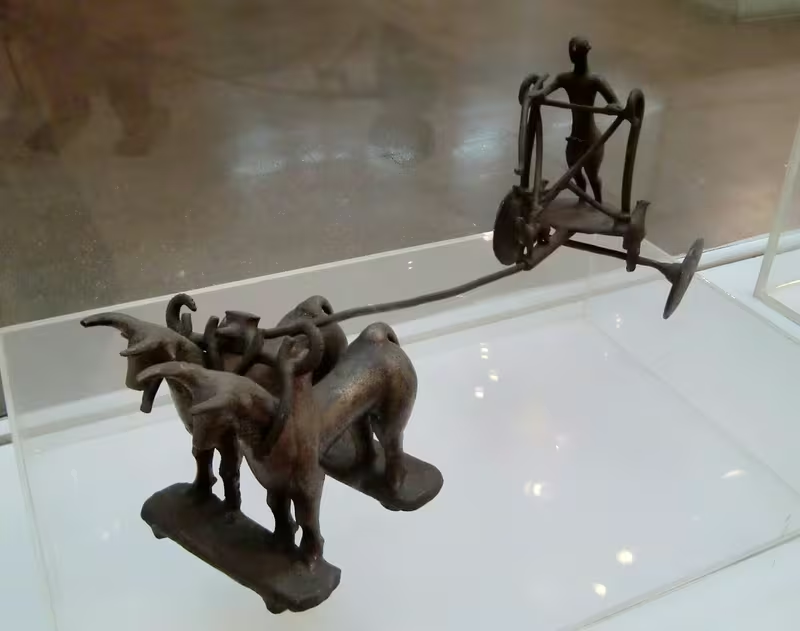
Daimabad is especially important because one phase has been identified with the Late Harappan culture. Terracotta seals bearing Harappan writing and inscribed potsherds indicate that cultural influences associated with the Indus tradition reached far beyond its better-known northwestern heartlands. The site also produced the celebrated Daimabad bronze hoard, although the date of its sculptures remains disputed.
The excavated sequence runs from the Savalda culture, dated before approximately 2300/2200 BCE, through Late Harappan occupation, the Daimabad and Malwa cultures, and finally the Jorwe culture, which continued until approximately 1000 BCE. There was a break of about half a century between the Late Harappan and Daimabad phases.
Etymology and Names
The archaeological site is known as Daimabad, after the present-day village. The historical record preserved in the excavated material does not provide an earlier name for the settlement. The pottery and settlement phases are therefore identified by archaeological culture names rather than by recorded ancient names.
“Daimabad culture” refers specifically to the third cultural phase identified at the site, dated approximately to 1800–1600 BCE. It should not be used as a name for the entire occupation, which also includes Savalda, Late Harappan, Malwa, and Jorwe phases.
Geography and Location
Daimabad stands beside the Pravara River, which flows into the Godavari system. Its location on a riverbank provided access to water, cultivable land, and a natural setting for a settled community. The site is part of the Deccan Plateau, a region in which Chalcolithic communities developed distinctive pottery traditions and agricultural economies.
The archaeological evidence shows that Daimabad’s inhabitants cultivated several crops over time. Barley, lentils, peas, grass peas, black gram or green gram, wheat, finger millet, and other pulses were found in different phases. Horse gram appeared during the Late Harappan phase, while hyacinth bean was added in the Daimabad phase. During the Jorwe period, the crop range expanded to include kodon millet, foxtail millet, and jowar.
Ancient History
Daimabad was first identified archaeologically by B. P. Bopardikar in 1958. The Archaeological Survey of India subsequently carried out three major excavation campaigns. M. N. Deshpande directed the first excavation in 1958–59, S. R. Rao led the second in 1974–75, and S. A. Sali directed excavations between 1975–76 and 1978–79.
The earliest excavated settlement belongs to the Savalda culture. Its houses had mud walls and rounded or trilateral ends. Excavators identified single-room, two-room, and three-room structures, along with hearths, storage pits, jars, courtyards, and a lane. These remains suggest an organized village community rather than a temporary camp.
Savalda pottery was generally made on a slow wheel. The vessels had a thick slip that often developed crackles and appeared in light brown, chocolate, red, and pink shades. Most painted decoration was ochre-red, with occasional black and white pigment. Other wares included burnished grey pottery, black burnished corrugated pottery, and handmade coarse red ware with incised or applied decoration.
The Savalda phase also yielded copper-bronze rings, shell and stone beads, carnelian and agate ornaments, microliths, bone arrowheads, stone mullers, and querns. A phallus-shaped agate object was found inside one house. These objects point to craft activity, food processing, ornament production, and the use of both stone and metal technologies.
Historical Timeline
Savalda Culture
The Savalda phase dates to before approximately 2300/2200 BCE. The settlement consisted of mud-walled houses supported by hearths, storage facilities, and domestic spaces. Agriculture formed an important part of life, with barley and several pulses represented among the plant remains.
Late Harappan Period
During the second phase, dated approximately to 2300/2200–1800 BCE, the settlement expanded to about 20 hectares. Houses were built with black clay, and some had finely plastered floors. A substantial black-clay wall ran through the settlement, with houses arranged on either side.
A mud-brick-lined grave contained a skeleton laid out in an extended position. Fibres adhering to the skeleton suggest that the body may originally have been covered with reeds or other fibrous plant material.
The most important finds from this phase were two terracotta button-shaped seals with Harappan writing and four inscribed potsherds. Fine red pottery decorated with linear and geometric designs in black was characteristic of the phase. Other finds included microlithic blades, gold, stone and terracotta beads, shell bangles, and a terracotta measuring scale.
Daimabad Culture
The third phase, dated approximately to 1800–1600 BCE, is distinguished by black-on-buff-and-cream pottery. Most vessels were made on a slow wheel, although some were turned on a fast wheel. Their thin exterior slip often flaked away, revealing the surface beneath.
The phase produced microlithic blades, bone tools, beads, a worked elephant-tusk fragment, and fragments of graduated terracotta rings that may have functioned as measuring devices. Part of a copper-smelting furnace provides direct evidence of metallurgical activity.
Three different forms of burial were identified: a pit burial, a post-cremation urn burial, and a symbolic burial. This variety suggests that funerary customs were not uniform within the community.
Malwa Culture
The Malwa phase, dated approximately to 1600–1400 BCE, saw the construction of spacious rectangular mud houses. These buildings had mud-plastered floors, wooden posts embedded in their thick walls, and steps leading from the exterior to the entrance.
Some structures appear to have been associated with specialized work. One house containing furnaces and another with a copper razor were interpreted as parts of a coppersmith’s workshop. Fire altars led excavators to tentatively identify certain structures as religious buildings. One elaborate complex included residential rooms, an approximately 18-metre-long mud platform, fire altars of several shapes, and an apsidal mud-wall structure that may have been connected with sacrificial activity.
Sixteen burials from this phase were either pit or urn burials. Plant remains included barley, three types of wheat, finger millet, lentils, and other pulses. Sugandha bela, or Pavonia odorata, may have been used in preparing perfumes.
Jorwe Culture
During the Jorwe phase, dated approximately to 1400–1000 BCE, Daimabad grew to about 30 hectares. Excavators uncovered 25 houses and identified structures associated with a butcher, lime maker, potter, bead maker, and merchant. These interpretations indicate a settlement with specialized occupations and differentiated economic activity.
Five structural sub-phases were identified. The earliest included 11 houses, two kilns, and a butcher’s hut. Later phases contained smaller groups of structures. Traces of a mud fortification wall with bastions were also found.
Jorwe Ware in the lower levels was deep red, highly finished, and similar in appearance to Lustrous Red Ware. Burnished grey ware and thick handmade coarse ware were also present. A terracotta cylinder seal depicted a procession through a forest, including a horse-drawn cart, a deer, and a long-necked animal possibly representing a camel.
Forty-eight burials were identified in the Jorwe phase. Forty-four were urn burials, three were extended pit burials, and one was an extended burial within an urn. The crop assemblage continued earlier agricultural traditions while adding kodon millet, foxtail millet, and jowar.
Political Significance
Daimabad was not identified as the capital of a known kingdom or state. Its importance lies instead in the evidence it provides for cultural connections and settlement development. The Late Harappan material demonstrates that traditions associated with the Indus world reached the Deccan Plateau.
The settlement’s changing size is also significant. It covered about 20 hectares during the Late Harappan phase and expanded to roughly 30 hectares under the Jorwe culture. The presence of fortification remains during the Jorwe period suggests attention to protection or settlement boundaries, although the excavated evidence does not establish the reason for their construction.
Religious and Cultural Importance
The site offers evidence for varied ritual and funerary practices. The Malwa phase included fire altars and an apsidal structure tentatively associated with sacrificial activity. The same phase contained both pit and urn burials, while the Daimabad phase included pit, post-cremation urn, and symbolic burials.
The Jorwe phase was notable for its large number of urn burials. These changing customs reveal that ideas about death and commemoration developed over time. However, the excavated structures do not permit all their meanings to be identified with certainty.
Economic Role
Daimabad’s economy combined agriculture, animal-related activity, craft production, and metalworking. Querns and mullers point to grain processing. Beads of shell, carnelian, agate, gold, faience, terracotta, and other materials indicate ornament production and exchange.
Copper-working is visible in several phases. A copper-smelting furnace belonged to the Daimabad phase, while Malwa-period structures were interpreted as coppersmith workshops. Jorwe-period buildings associated with potting, bead making, lime production, and butchery show the presence of specialized occupations.
Monuments and Architecture
Daimabad’s architecture was largely made from mud and mud brick. Early houses had rounded or trilateral forms, while Malwa-period structures were generally spacious and rectangular. Some included plastered floors, wooden posts, and steps.
The site’s most elaborate architectural remains belong to the Malwa phase: a long mud platform, several fire altars, residential rooms, and an apsidal structure. During the Jorwe period, traces of a mud fortification with bastions were identified. These remains are important not for monumental stone architecture, but for showing how prehistoric communities organized domestic, workshop, ritual, and defensive spaces.
Famous Personalities
B. P. Bopardikar discovered Daimabad as an archaeological site in 1958. M. N. Deshpande, S. R. Rao, and S. A. Sali directed the major excavation campaigns.
The bronze hoard was found in 1974 by Chhabu Laxman Bhil, a local farmer, while digging at the base of a shrub. He gave the objects to Lal Hussein Patel, a respected village social worker, who informed the Archaeological Survey of India. The hoard was later acquired by the Archaeological Survey of India.
The Daimabad Bronze Hoard
The hoard consists of four large bronze sculptures. One is a 45-centimetre-long chariot, 16 centimetres wide, yoked to two oxen and carrying a standing driver 16 centimetres high. Another is a 31-centimetre-high water buffalo mounted on a four-legged platform with four solid wheels.
The third sculpture represents an elephant, 25 centimetres high, standing on a platform 27 centimetres long and 14 centimetres wide. It resembles the buffalo sculpture, although its axles and wheels are missing. The fourth is a 19-centimetre-high rhinoceros, 25 centimetres long, standing on two horizontal bars attached to axles with solid wheels.
The sculptures are widely associated with Daimabad, but archaeologists disagree about their date. Deshpande, Rao, and Sali considered circumstantial evidence to support a Late Harappan date. D. P. Agarwal, however, examined their elemental composition and argued that they might belong to the historical period because they contain more than 10 percent arsenic. No other Chalcolithic artefacts are reported to show this kind of arsenical alloying.
The hoard is now associated with museum collections in Mumbai, while the chariot sculpture is in the National Museum in New Delhi.
Modern Status
Daimabad is now a deserted village and archaeological site. Its importance comes from the material preserved beneath the settlement: painted ceramics, houses, burials, agricultural remains, tools, ornaments, metalworking evidence, inscriptions, seals, and the bronze hoard.
Rather than representing a single civilization, Daimabad preserves a sequence of communities whose technologies and customs changed across more than a millennium. Its Late Harappan inscriptions connect the site to the wider Indus cultural sphere, while its later Malwa and Jorwe remains document the distinctive development of Chalcolithic society in the Deccan.
Timeline
Savalda Phase
The earliest identified phase at Daimabad, with mud houses, painted pottery, agriculture, and copper-bronze objects.
Late Harappan Occupation
The settlement expanded to about 20 hectares and produced terracotta seals with Harappan writing.
Daimabad Culture
Black-on-buff-and-cream pottery, varied burials, and copper-smelting evidence characterized the phase.
Malwa Culture
Spacious mud houses, coppersmith workshops, fire altars, and an elaborate structural complex appeared.
Jorwe Culture
The settlement grew to about 30 hectares, with specialized occupations, kilns, and a possible fortification.
Archaeological Discovery
B. P. Bopardikar identified Daimabad as an archaeological site.
Bronze Hoard Found
Local farmer Chhabu Laxman Bhil discovered the famous group of bronze sculptures.
See Also
- Late Harappan culture
- Savalda culture
- Malwa culture
- Jorwe culture
- Archaeological Survey of India
- Chhatrapati Shivaji Maharaj Vastu Sangrahalaya
- National Museum, New Delhi