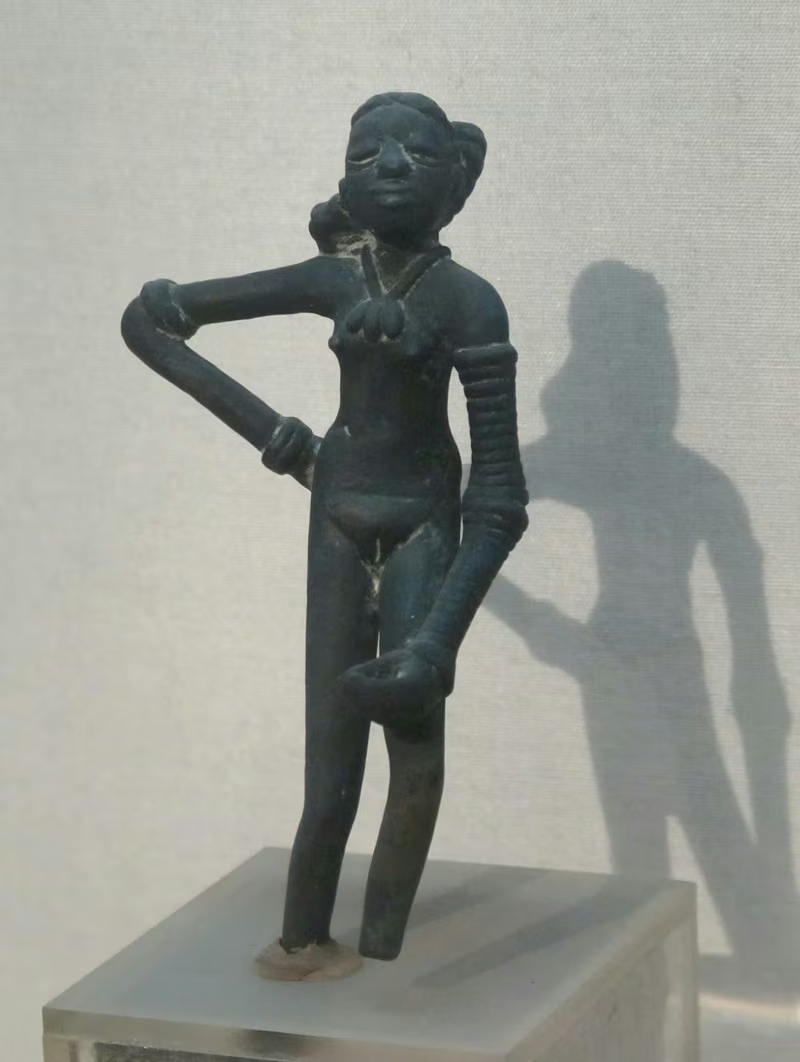
Dancing Girl of Mohenjo-daro: Bronze Testament to Ancient Indian Artistry
In the ruins of Mohenjo-daro, one of the greatest cities of the ancient world, archaeologists in 1926 discovered a bronze figurine barely larger than a human palm. Yet this small sculpture, dating to approximately 2500 BCE, would become one of the most celebrated artifacts of the Indus Valley Civilization. The "Dancing Girl," as she has come to be known, stands as remarkable evidence of the sophisticated metallurgical and artistic capabilities of Bronze Age India. At just 10.5 centimeters tall, this prehistoric sculpture demonstrates mastery of the lost-wax casting technique and offers a rare glimpse into the aesthetic sensibilities of one of the world's oldest urban civilizations. Today, housed in the National Museum in New Delhi, the Dancing Girl remains an iconic symbol of India's ancient cultural heritage and continues to captivate scholars and visitors alike.
Discovery and Provenance
Discovery
The Dancing Girl was discovered in 1926 during systematic archaeological excavations at Mohenjo-daro, located in present-day Sindh province of Pakistan. Mohenjo-daro, meaning "Mound of the Dead," was one of the largest settlements of the Indus Valley Civilization, flourishing between approximately 2500 and 1900 BCE. The excavations at this site revealed a remarkably planned ancient city with sophisticated drainage systems, multi-storied buildings, and numerous artifacts that shed light on one of the world's earliest urban civilizations.
The discovery of this bronze figurine was significant not only for its artistic merit but also for what it revealed about the technological capabilities of Indus Valley artisans. The sculpture was found among other artifacts that collectively painted a picture of a highly developed society with advanced knowledge of metallurgy, trade, and artistic expression.
Journey Through History
Following its discovery, the Dancing Girl became part of the collections managed by the Archaeological Survey of India, which conducted extensive excavations at Indus Valley sites during the British colonial period. The artifact represented one of the most important finds from Mohenjo-daro, alongside other significant discoveries such as the famous "Priest-King" sculpture and numerous seals bearing the undeciphered Indus script.
After India's independence in 1947, the partition of the subcontinent created complex questions about the ownership and location of artifacts from archaeological sites that now fell within Pakistan's borders. However, the Dancing Girl, having been moved to museums in India before partition, remained in Indian collections.
Current Home
The Dancing Girl is currently housed in the National Museum in New Delhi, India's premier institution for preserving and displaying the nation's cultural heritage. As one of the museum's most prized possessions, it occupies a prominent place in the galleries dedicated to the Indus Valley Civilization. The sculpture is displayed in a climate-controlled environment to ensure its preservation for future generations.
The artifact has become one of the most recognizable symbols of ancient Indian art and is frequently featured in exhibitions, publications, and educational materials about the Indus Valley Civilization. Its status as a national treasure means that it rarely travels for international exhibitions, though its image is widely reproduced and studied by scholars worldwide.
Physical Description
Materials and Construction
The Dancing Girl is cast in bronze, a copper alloy that was among the most sophisticated materials available to Bronze Age artisans. The sculpture's creation using the lost-wax (cire perdue) casting technique represents a remarkable technological achievement for its time. This complex process involves creating a wax model, encasing it in clay, heating it to melt away the wax, and then pouring molten metal into the resulting cavity.
The successful execution of lost-wax casting requires precise control of temperatures, knowledge of alloy compositions, and considerable artistic skill. The fact that Indus Valley craftsmen had mastered this technique by 2500 BCE places them among the earliest metalworkers to achieve this level of sophistication, contemporary with similar developments in Mesopotamia and Egypt.
Dimensions and Form
Standing at just 10.5 centimeters in height and approximately 5 centimeters in width, the Dancing Girl is remarkably small yet intricately detailed. Despite its diminutive size, the sculpture conveys a strong sense of presence and personality. The figure depicts a young female in a standing position, with her body slightly tilted and her weight resting on one leg in a naturalistic contrapposto pose that would not appear in Western art for millennia.
The figure's proportions are stylized rather than strictly realistic, with elongated limbs that emphasize grace and movement. This artistic choice suggests that the sculptor was more interested in capturing an impression of vitality and attitude rather than anatomical precision.
Condition
Given its age of approximately 4,500 years, the Dancing Girl is in remarkably good condition. The bronze has developed the characteristic green patina common to ancient copper alloys, which ironically has helped preserve the metal beneath from further corrosion. While there are some minor surface irregularities and signs of age, the overall form and details of the sculpture remain clearly discernible.
The artifact's survival through millennia is itself remarkable, as bronze objects were often melted down and recast in ancient times when metal was valuable. That this small sculpture survived intact suggests it may have been lost or deliberately buried, protecting it from recycling or destruction.
Artistic Details
The most striking features of the Dancing Girl are the numerous bangles adorning her left arm—as many as 24 or 25 bracelets are depicted, covering her arm from wrist to shoulder. This extraordinary ornamentation suggests that such jewelry was highly valued in Indus Valley society and may indicate the figure's social status or role. The right arm hangs naturally at her side, and the figure's hand rests on her hip in a pose that conveys confidence and perhaps defiance.
The figure's head is slightly tilted, and while facial features are minimal due to the sculpture's small scale, the overall impression is one of personality and attitude. The hair appears to be tied back or styled in some fashion. The figure appears nude except for the elaborate bangles and possibly a small piece of jewelry around the neck, though interpretations of these details vary among scholars.
The naturalistic pose, with weight shifted to one leg and the hip thrust to the side, creates a sense of movement and life that is unusual for art of this period. This dynamic quality, combined with the figure's apparent self-assurance, has contributed to the sculpture's enduring appeal and its popular designation as a "dancing girl," though this interpretation remains debated.
Historical Context
The Era
The Dancing Girl was created during the mature phase of the Indus Valley Civilization, also known as the Harappan Civilization, which flourished from approximately 3300 to 1300 BCE. The period around 2500 BCE, when this sculpture was made, represents the civilization's peak, characterized by remarkable urban planning, advanced architecture, and extensive trade networks stretching from Central Asia to Mesopotamia.
Mohenjo-daro, where the sculpture was found, was one of the largest cities of this civilization, covering approximately 250 hectares and supporting an estimated population of 35,000 or more. The city featured sophisticated infrastructure including a complex drainage system, public baths (including the famous Great Bath), granaries, and residential areas with multi-storied buildings made of fired brick.
This was a highly organized society with apparent social stratification, specialized crafts, and long-distance trade connections. However, unlike contemporary civilizations in Mesopotamia and Egypt, the Indus Valley Civilization has left no deciphered written records beyond the enigmatic seals bearing the Indus script, which remains undeciphered. This absence of textual evidence makes artifacts like the Dancing Girl even more valuable as windows into this ancient culture.
Purpose and Function
The original purpose of the Dancing Girl remains a subject of scholarly debate and speculation. The conventional name "Dancing Girl" suggests one interpretation—that the figure represents a dancer or entertainer. The pose, with its implied movement and confident bearing, certainly supports this reading. Dancing was undoubtedly an important part of religious rituals and social ceremonies in ancient societies, and the figure's apparent youth and elaborate ornamentation might indicate a professional dancer or ritual performer.
However, other scholars have questioned this interpretation, noting that the term "dancing" may impose modern cultural assumptions on an ancient artifact. Alternative theories suggest the figure might represent:
- A deity or divine figure
- A ritual object used in religious ceremonies
- A high-status individual, possibly a priestess or noble woman
- A toy or decorative object
- A representation of ideal beauty or feminine power in Harappan culture
The elaborate bangles might indicate wealth, status, or a specific ceremonial role. In many South Asian cultures, bangles carry significant symbolic meaning related to marriage, prosperity, and social status. However, without written records from the Indus Valley Civilization, these interpretations remain speculative.
Commissioning and Creation
The identity of the artist who created the Dancing Girl and the circumstances of its commissioning are unknown. However, the technical sophistication of the lost-wax casting technique and the artistic sensibility evident in the work suggest a skilled craftsperson working within an established tradition of bronze casting.
The Indus Valley Civilization showed clear evidence of specialized craft production, with distinct areas of cities dedicated to different industries including bead-making, pottery, metallurgy, and other crafts. The creation of the Dancing Girl would have required not only artistic skill but also technical knowledge of metalworking, access to copper and tin for the bronze alloy, and facilities for the complex casting process.
The small size of the sculpture might indicate it was a personal possession rather than a public monument, though its exact original context remains unknown. The quality of workmanship suggests it was created by a master craftsperson, possibly working for a wealthy patron or as part of a workshop producing fine metalwork for the city's elite.
Significance and Symbolism
Historical Importance
The Dancing Girl holds immense importance as one of the earliest known bronze sculptures from the Indian subcontinent and among the oldest anywhere in the world to demonstrate such sophisticated lost-wax casting technique. Its creation around 2500 BCE places it contemporary with early bronze work from Mesopotamia and Egypt, establishing the Indus Valley Civilization as an independent center of metallurgical innovation.
As one of the very few three-dimensional representations of human figures from the Indus Valley Civilization, the Dancing Girl provides rare visual evidence of how these ancient people saw themselves or wished to be represented. Most Indus Valley art consists of seals, pottery designs, and small terracotta figurines; large-scale sculpture is virtually absent. The Dancing Girl, despite its small size, stands out for its naturalism and artistic sophistication.
The sculpture challenges earlier assumptions that ancient Indian art was primarily concerned with religious iconography and formal representation. The apparently secular nature of the Dancing Girl, its naturalistic pose, and its sense of individual personality suggest a more diverse artistic tradition than previously understood.
Artistic Significance
From an art historical perspective, the Dancing Girl represents a remarkable achievement in naturalistic representation for its time period. The contrapposto pose—with weight shifted to one leg causing the hips and shoulders to tilt in opposite directions—would not become a standard feature of Western sculpture until Greek art of the Classical period, nearly 2,000 years later. While the Dancing Girl's pose may not represent a fully developed contrapposto, it shows a sophisticated understanding of how the human body balances and moves.
The sculpture's sense of movement and personality, conveyed through posture and gesture rather than detailed facial features, demonstrates advanced artistic sophistication. The artist was able to capture something essential about human presence and attitude in bronze using minimal means—a skill that marks truly accomplished artistry in any era.
The technical achievement of the lost-wax casting should not be underestimated. This process requires controlling multiple variables including wax modeling, clay mold-making, temperature control during casting, and metal alloy composition. The successful execution of such fine detail in bronze at this early date places Indus Valley metalworkers among the most skilled craftspeople of the ancient world.
Cultural and Symbolic Meaning
While we cannot know with certainty what the Dancing Girl meant to its creators, the sculpture offers tantalizing clues about Indus Valley culture and values. The figure's apparent confidence, the elaborate display of bangles, and the naturalistic treatment of the human form all suggest a society that valued artistic expression, personal adornment, and perhaps individual personality or achievement.
The prominent display of jewelry, particularly the numerous bangles, indicates that personal ornamentation was highly valued in Indus Valley society. Archaeological evidence from Indus sites confirms that various forms of jewelry including beads, bangles, and ornaments were widely produced and used. The Dancing Girl's bangles might indicate status, wealth, age, marital status, or occupational role—all meanings that bangles continue to carry in South Asian cultures today.
For modern India, the Dancing Girl has become a powerful symbol of cultural continuity and ancient achievement. The sculpture represents evidence of sophisticated artistic and technical capabilities in prehistoric India, countering colonial-era narratives that portrayed ancient Indian civilization as derivative or less advanced than Western cultures. The artifact has been widely reproduced in textbooks, museums, and popular media, serving as an icon of India's ancient heritage.
Scholarly Study
Key Research
Since its discovery in 1926, the Dancing Girl has been the subject of extensive scholarly attention from archaeologists, art historians, and anthropologists. Early researchers, including the excavators of Mohenjo-daro, immediately recognized the sculpture's significance as evidence of advanced metallurgical and artistic capabilities in the Indus Valley Civilization.
Technical studies of the bronze alloy and casting technique have confirmed that Indus Valley metalworkers possessed sophisticated knowledge of copper-tin alloy composition and temperature control necessary for successful lost-wax casting. Comparative studies with other bronze artifacts from contemporary civilizations have established that the Indus Valley developed bronze working independently and achieved results comparable to or exceeding those of other Bronze Age cultures.
Art historical analysis has focused on the sculpture's stylistic characteristics, including its naturalistic pose, proportions, and artistic choices. Scholars have noted both similarities and differences between the Dancing Girl and other Indus Valley figurines, most of which are made of terracotta and tend to be more stylized or abstract in form.
Anthropological research has attempted to understand what the Dancing Girl might reveal about Indus Valley society, including questions about social organization, gender roles, religious practices, and cultural values. The figure's apparent confidence and the prominence of jewelry have sparked discussions about the status of women in Indus Valley society, though firm conclusions remain elusive given the limited evidence available.
Debates and Controversies
Several ongoing debates surround the Dancing Girl, reflecting broader challenges in interpreting Indus Valley civilization without the benefit of deciphered written records:
The "Dancing" Interpretation: Not all scholars accept that the figure represents a dancer. Some argue that the pose might indicate a ritual gesture, a moment of rest, or simply an artistic choice to create visual interest. The name "Dancing Girl" may reflect more about modern observers' expectations than ancient realities.
Age and Identity: While commonly called a "girl," suggesting youth, the figure's age is not entirely clear from the sculpture alone. Some scholars have suggested it might represent a young woman or even a symbolic rather than realistic representation of a human figure.
Cultural Continuity: Debates exist about whether the Dancing Girl shows cultural continuities with later Indian civilization or represents a distinct tradition that ended with the decline of the Indus Valley Civilization. Some scholars see connections to later Indian artistic traditions and cultural practices, while others emphasize the discontinuities.
Purpose and Context: Without knowing where exactly in Mohenjo-daro the sculpture was found or what accompanied it, debates about its original purpose and significance remain speculative. Was it a religious object, personal possession, decorative item, or something else entirely?
These debates reflect the broader challenge of interpreting a sophisticated ancient civilization that left no deciphered written records. Each artifact, including the Dancing Girl, must bear the weight of considerable interpretive speculation, even as it provides valuable evidence about this remarkable ancient culture.
Legacy and Influence
Impact on Understanding Ancient Indian Art
The Dancing Girl has fundamentally shaped modern understanding of artistic capabilities in ancient India. Before its discovery, relatively little was known about prehistoric Indian sculpture, particularly in metal. The sophistication of this small bronze challenged assumptions about the development of art in South Asia and established that advanced sculptural traditions existed on the subcontinent by the third millennium BCE.
The sculpture has influenced how scholars approach Indus Valley art more broadly, encouraging appreciation for the aesthetic sophistication and technical achievement of Harappan craftspeople. It has also raised questions about what other artistic traditions might have existed in the Indus Valley Civilization but left little archaeological trace.
Modern Recognition and Cultural Impact
The Dancing Girl has achieved iconic status in modern India as a symbol of ancient cultural achievement. The sculpture appears in countless textbooks, museums displays, and popular media representations of ancient Indian history. It has become one of the most recognizable artifacts from prehistoric India, alongside the famous Indus seals and the "Priest-King" sculpture.
The image of the Dancing Girl has been reproduced in various forms, from scholarly publications to popular jewelry, textiles, and decorative arts. This widespread reproduction, while testifying to the sculpture's cultural significance, also raises questions about how ancient artifacts become contemporary symbols and how their meanings evolve through reproduction and recontextualization.
In contemporary discourse about Indian history and identity, the Dancing Girl often features in discussions about ancient Indian achievement in art, technology, and culture. The sculpture serves as tangible evidence of sophisticated prehistoric Indian civilization, contributing to national pride and cultural identity.
The artifact has also played a role in broader discussions about cultural heritage in South Asia, particularly regarding artifacts from archaeological sites that now lie in Pakistan but are held in Indian institutions. While the Dancing Girl itself remains in India's National Museum, questions about the stewardship and display of Indus Valley artifacts reflect ongoing post-colonial complexities in the region.
Viewing Today
Museum Display
The Dancing Girl is prominently displayed in the National Museum in New Delhi, located near India Gate in the heart of the capital city. The museum, founded in 1949, houses one of the world's most comprehensive collections of Indian art and artifacts spanning several millennia.
Within the museum, the Dancing Girl occupies a place of honor in the galleries dedicated to the Indus Valley Civilization. The sculpture is displayed in a carefully controlled environment designed to preserve the bronze and prevent further deterioration. Interpretive materials provide context about the Indus Valley Civilization, the discovery of Mohenjo-daro, and the significance of the artifact.
Visitors to the museum can view the sculpture as part of a broader exhibition that includes other important Indus Valley artifacts such as seals, pottery, tools, and jewelry. This contextualization helps viewers understand the Dancing Girl within the broader framework of Harappan material culture and artistic traditions.
The National Museum is open to the public throughout the week, with varying hours depending on the day. Photography policies within the museum should be confirmed at the time of visit, as they may vary. The museum provides guided tours and educational programs that often feature the Dancing Girl as a highlight of the ancient Indian collections.
Accessibility and Education
Beyond physical viewing at the National Museum, the Dancing Girl is accessible through numerous digital resources. The museum has made images of its collections available online, allowing virtual visitors from around the world to examine the sculpture. Educational websites, academic databases, and digital humanities projects frequently feature the Dancing Girl, contributing to its role in global education about ancient civilizations.
The sculpture appears in documentaries about ancient India and the Indus Valley Civilization, often serving as a visual symbol for discussions of Harappan culture and achievement. Educational materials at various levels, from school textbooks to university courses, regularly include the Dancing Girl as a key example of prehistoric Indian art.
Conclusion
The Dancing Girl of Mohenjo-daro, cast in bronze approximately 4,500 years ago, continues to captivate and intrigue viewers in the twenty-first century. This small sculpture—barely larger than a human hand—stands as monumental testimony to the artistic sophistication and technical achievement of the Indus Valley Civilization. Its naturalistic pose, elaborate ornamentation, and apparent personality make it far more than an archaeological curiosity; it is a masterwork of ancient art that transcends its time and culture to speak to universal human concerns with beauty, movement, and self-expression.
As one of the earliest bronze sculptures from the Indian subcontinent, the Dancing Girl provides crucial evidence of advanced metallurgical capabilities in prehistoric India and contributes to our understanding of the remarkable civilization that flourished in the Indus Valley. While many questions about its original purpose and meaning remain unanswered—and may remain forever unanswered given the absence of deciphered written records from this civilization—the sculpture continues to reward careful study and contemplation.
Today, housed in the National Museum in New Delhi, the Dancing Girl serves multiple roles: as an artifact of immense archaeological importance, as a masterpiece of ancient art, and as a symbol of India's rich cultural heritage extending back millennia. It reminds us that sophistication in art and technology has ancient roots in South Asia and that the human impulse to create beauty and capture life in lasting form spans all cultures and ages. In its small bronze form, the Dancing Girl dances still, a testament to the enduring power of art to transcend time and speak across millennia.