Didarganj Yakshi: The Enigmatic Masterpiece of Ancient Indian Sculpture
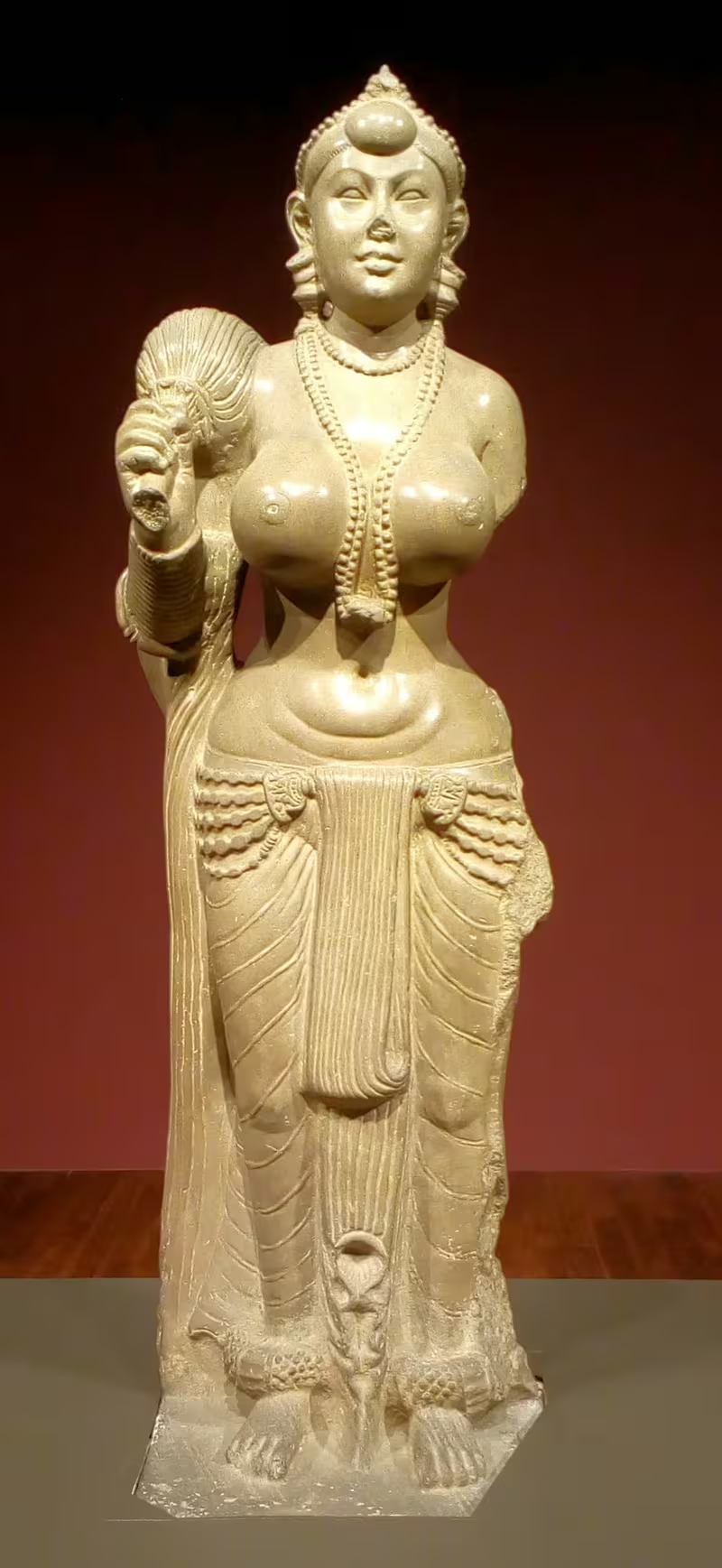
Standing 2.13 meters tall with a mirror-like polish that has survived millennia, the Didarganj Yakshi represents one of the most extraordinary achievements in ancient Indian sculpture. This magnificent sandstone figure of a female chauri-bearer (fly-whisk holder) combines technical virtuosity with aesthetic perfection, creating an artwork that continues to captivate scholars and visitors alike. Discovered in 1917 near Patna, Bihar, this sculpture has sparked intense scholarly debate about its dating—ranging from the Mauryan period (3rd century BCE) to the Kushan period (2nd century CE). Regardless of its precise age, the Didarganj Yakshi stands as a testament to the sophisticated artistic traditions of ancient India and remains one of Bihar's most treasured cultural artifacts.
Discovery and Provenance
Discovery
The Didargani Yakshi was discovered in 1917 in Didarganj, a location on the banks of the Ganges River near Patna, Bihar. The statue was found by chance, buried in the soil, likely having remained hidden for centuries. The circumstances of its discovery suggest it may have been deliberately buried or lost during political upheaval or natural disasters that affected the ancient city of Pataliputra, the capital of several major Indian empires.
The discovery occurred during a period of renewed archaeological interest in India's ancient past, and the statue immediately attracted attention for its exceptional quality and state of preservation. Unlike many ancient sculptures that show significant wear or damage, the Didarganj Yakshi was found in remarkably good condition, with its famous polish still largely intact.
Journey Through History
After its discovery, the Didarganj Yakshi was initially housed in the Patna Museum, where it became one of the institution's most important and popular exhibits. For nearly a century, the statue remained at the Patna Museum, drawing visitors from around the world who came to admire this masterpiece of ancient Indian art.
The sculpture's journey from its original context remains largely mysterious. Whether it originally stood in a temple, palace, or public space is unknown. The style and iconography suggest it may have served a dual purpose—as a religious image of a yakshi (a nature spirit associated with fertility and prosperity) and as a representation of a royal court attendant, given the chauri (fly-whisk) she holds, which was a symbol of royalty and high status in ancient India.
Current Home
In 2015, the Didarganj Yakshi was transferred to the newly established Bihar Museum in Patna, where it now serves as the centerpiece of the museum's collection. The Bihar Museum was specifically designed to showcase Bihar's rich archaeological and cultural heritage, and the Didarganj Yakshi occupies a place of honor, displayed in a climate-controlled environment that ensures its preservation for future generations.
The statue's prominent position in the Bihar Museum reflects its status not just as an archaeological artifact, but as a symbol of Bihar's ancient glory and artistic achievement. It continues to attract thousands of visitors annually, including scholars, art enthusiasts, and tourists, many of whom come specifically to see this iconic sculpture.
Physical Description
Materials and Construction
The Didarganj Yakshi is carved from Chunar sandstone, a fine-grained stone quarried from the Chunar region near Varanasi. This particular sandstone was favored by ancient Indian sculptors for its workability and ability to take an extraordinarily high polish. The choice of material demonstrates the sculptor's understanding of stone properties and their relationship to the desired aesthetic effect.
The most remarkable technical feature of the sculpture is its mirror-like polish, achieved through a laborious process of grinding and polishing that ancient Indian craftsmen had perfected. This lustrous surface is known as the "Mauryan polish" when attributed to that period, though the technique may have been employed in later periods as well. The polish is so refined that it reflects light brilliantly, giving the stone an almost metallic appearance and creating the illusion of smooth, living skin.
Dimensions and Form
Standing 2.13 meters (approximately 7 feet) tall, the Didarganj Yakshi is a life-size-plus representation that would have commanded impressive presence in its original setting. The statue depicts a young woman in the tribhanga (three-bend) pose, a classical Indian sculptural stance where the body bends at the neck, waist, and knee, creating an elegant S-curve that suggests grace and movement.
The figure holds a chauri (fly-whisk) in her right hand, resting it on her shoulder. The chauri, made from yak-tail hair, was a symbol of royalty and luxury in ancient India, typically held by royal attendants. Her left hand is positioned at her side. The statue stands on a circular pedestal, which may or may not be original to the sculpture.
Condition
The Didarganj Yakshi is in excellent condition, particularly remarkable given its age and the circumstances of its discovery. The famous polish remains largely intact, though it has naturally dulled somewhat over the centuries. There is some minor damage to the figure, including the loss of the left forearm and portions of the chauri, but these losses do not significantly detract from the sculpture's overall impact and beauty.
The preservation of the polish is especially noteworthy, as this surface treatment is extremely delicate and susceptible to weathering, scratching, and chemical degradation. The fact that it has survived suggests the statue may have been sheltered or buried relatively soon after its creation, protecting it from environmental damage.
Artistic Details
The sculpture exhibits exceptional attention to anatomical detail and ornamental decoration. The figure wears elaborate jewelry including a multi-strand necklace, armlets, bracelets, anklets, and a girdle. Her hair is styled in an intricate updo, secured with ornamental pins or ribbons. The rendering of these details is both precise and delicate, demonstrating the sculptor's mastery of the medium.
The drapery is minimal—the figure wears only a lower garment (dhoti or antariya) that clings to the body, rendered with such skill that the fabric appears almost transparent. This treatment of cloth as diaphanous and form-revealing is characteristic of the finest ancient Indian sculpture and demonstrates sophisticated understanding of how to suggest texture and weight through stone carving.
The facial features are serene and idealized, with downcast eyes, full lips, and a gentle expression that conveys both majesty and approachability. The overall effect is one of youthful beauty, dignity, and grace—qualities associated with both yakshis in religious contexts and aristocratic women in courtly settings.
Historical Context
The Era
The precise dating of the Didarganj Yakshi remains one of the most contentious issues in Indian art history. Scholars have proposed dates ranging from the Mauryan period (3rd century BCE) to the Kushan period (2nd century CE), a span of approximately 500 years. This debate reflects the challenges of dating sculptures based on stylistic analysis alone, particularly when an object is discovered without archaeological context.
If the sculpture dates to the Mauryan period, it would have been created during or shortly after the reign of Ashoka the Great, when Pataliputra served as the capital of one of the largest empires in ancient India. This was a period of remarkable artistic achievement, characterized by the creation of polished stone pillars, sculptures, and architectural elements. The Mauryan period saw extensive patronage of Buddhist art and architecture, though pre-Buddhist traditions continued to flourish.
If instead the sculpture belongs to the Kushan period, it would represent the continuation and evolution of earlier artistic traditions under a dynasty known for its cultural synthesis and artistic patronage. The Kushan period saw significant developments in Buddhist art, but also the continued vitality of Hindu and folk religious traditions.
Regardless of the precise date, the sculpture was created during a period when Pataliputra was a major cultural and political center, home to sophisticated artistic workshops and skilled craftsmen who served royal, religious, and wealthy private patrons.
Purpose and Function
The Didarganj Yakshi likely served a dual purpose, embodying both religious and secular symbolism. As a yakshi, the figure represents a class of nature spirits venerated in pre-Buddhist and Hindu traditions. Yakshis were associated with fertility, prosperity, trees, and water—benevolent supernatural beings who could bestow blessings on devotees. Such figures were commonly placed at the entrances to sacred spaces, along roads, or at significant public locations.
Simultaneously, the figure's role as a chauri-bearer connects it to royal court imagery. Fly-whisk bearers were attendants in royal courts, and their depiction in art symbolized the presence of royalty or divine authority. The sculpture may have adorned a palace or been associated with royal ceremonial contexts.
This dual nature—combining folk religious imagery with courtly symbolism—is characteristic of ancient Indian art, where religious, political, and cultural meanings often intersected and reinforced each other.
Commissioning and Creation
The identity of the patron who commissioned the Didarganj Yakshi and the name of the sculptor who created it are unknown. However, the quality of the workmanship indicates that both patron and artist were individuals of considerable sophistication and resources. The size of the sculpture, the quality of the stone, and the extraordinary level of finish all suggest this was a major commission, likely funded by royal or wealthy religious patronage.
The creation of such a sculpture would have required not only artistic skill but also significant technical knowledge, including quarrying expertise, transportation logistics for moving the massive stone block, and mastery of the polishing techniques that gave the sculpture its distinctive appearance. The work likely involved a team of craftsmen working under a master sculptor over an extended period.
Significance and Symbolism
Historical Importance
The Didarganj Yakshi is recognized as one of the masterpieces of ancient Indian sculpture and serves as a crucial reference point in the study of Indian art history. Its importance lies not only in its aesthetic quality but also in what it reveals about the technical capabilities, artistic standards, and cultural values of ancient India.
The sculpture provides evidence of highly developed stone-working traditions in ancient Bihar, demonstrating that the region was home to workshops capable of producing art of the highest quality. This counters any tendency to view ancient Indian art as primitive or unsophisticated, revealing instead a mature artistic tradition with rigorous technical standards and refined aesthetic sensibilities.
Artistic Significance
From an art historical perspective, the Didarganj Yakshi represents a pinnacle of achievement in stone sculpture. The combination of naturalistic anatomy, graceful pose, detailed ornament, and especially the mirror-like polish demonstrates a complete mastery of the medium. The sculpture shows sophisticated understanding of proportion, balance, and the representation of the human form.
The polishing technique, in particular, has fascinated scholars and craftsmen for decades. The process of creating such a polish would have required extensive grinding with progressively finer abrasives, followed by polishing with materials that could achieve the final lustrous surface. Some researchers have attempted to replicate the technique using traditional materials and methods, with varying degrees of success, but the exact process remains somewhat mysterious.
The sculpture's style has been compared to other known works from ancient India, including the pillars and capitals created during the Mauryan period and various yakshi figures from sites like Bharhut. These comparisons have informed the dating debate, with some scholars seeing strong stylistic connections to confirmed Mauryan works, while others point to features they consider more characteristic of later periods.
Religious/Cultural Meaning
As a yakshi figure, the Didarganj sculpture embodies concepts central to ancient Indian religious and cultural thought. Yakshis were viewed as manifestations of natural fertility and abundance, often associated with specific trees or water sources. They represented the feminine divine principle in its nurturing, life-giving aspect. The veneration of such beings predates the major organized religions of India and represents a continuous thread of folk religious practice.
The figure's beauty and adornment also reflect cultural ideals of feminine grace and prosperity. The elaborate jewelry, careful grooming, and elegant pose all conform to descriptions found in ancient Sanskrit texts of the ideal woman, combining physical beauty with dignified bearing.
The chauri she holds adds another layer of meaning, connecting the religious symbolism of the yakshi with the secular authority of kingship. This fusion suggests the sculpture may have been intended to honor both divine and earthly power, or to suggest that royal authority was sanctioned by divine forces.
Scholarly Study
Key Research
The Didarganj Yakshi has been the subject of extensive scholarly study since its discovery. Art historians, archaeologists, and conservation scientists have all examined the sculpture, producing numerous publications and contributing to ongoing debates about its dating, original context, and cultural significance.
One major area of research has focused on the polishing technique. Scientific analysis of the surface has revealed that the polish was achieved through mechanical means rather than chemical treatment, but the exact sequence of steps and materials used remains incompletely understood. Some researchers have suggested that beeswax or other organic materials may have been used in the final stages of polishing.
Stylistic analysis has compared the Didarganj Yakshi to other sculptures from ancient India, including confirmed Mauryan works and later pieces. These studies have examined details such as the treatment of anatomy, the style of jewelry and hair, the rendering of drapery, and the overall proportions and pose. While these analyses have provided valuable insights, they have not definitively resolved the dating controversy.
Debates and Controversies
The central controversy surrounding the Didarganj Yakshi concerns its date. Traditionally, the sculpture was attributed to the Mauryan period (c. 3rd century BCE) based on its polished surface—a characteristic feature of known Mauryan stone works—and certain stylistic similarities to other sculptures from that era. This dating was widely accepted for decades and appears in many standard art history texts.
However, some scholars have challenged this attribution, arguing that certain features of the sculpture—including the style of jewelry, the treatment of the face and body, and specific details of the carving—are more consistent with works from the Kushan period (c. 2nd century CE) or even later. These scholars suggest that the polishing technique may have been employed over a longer period than previously thought, and that dating based on this feature alone is unreliable.
The debate remains unresolved, and the sculpture is sometimes described with qualified dating such as "Mauryan or later" or "3rd century BCE to 2nd century CE." The lack of archaeological context from the discovery site means that traditional dating methods based on stratigraphy or associated artifacts cannot be applied, leaving stylistic analysis as the primary tool—a necessarily subjective approach that can lead to different conclusions.
This controversy highlights broader challenges in Indian art history, where many important works lack secure archaeological contexts and must be dated through stylistic comparison—a method that requires making assumptions about the evolution of styles and the consistency of regional traditions over time.
Legacy and Influence
Impact on Art History
The Didarganj Yakshi has significantly influenced how scholars understand ancient Indian sculpture and the capabilities of ancient Indian craftsmen. Its existence demonstrates that sophisticated stone-carving traditions flourished in ancient India, producing works that rival sculptural achievements from any contemporary civilization.
The sculpture has become an icon of ancient Indian art, frequently reproduced in books, exhibitions, and educational materials about Indian cultural heritage. Its image is widely recognized among those interested in Indian art and archaeology, serving as a representative example of the artistic sophistication of ancient India.
For students and scholars of Indian art, the Didarganj Yakshi serves as an important point of reference for understanding sculptural traditions, stone-working techniques, and the representation of the female form in Indian art. It demonstrates principles that would continue to influence Indian sculpture for centuries, including the idealization of the human form, the use of ornamentation, and the sophisticated rendering of texture and surface.
Modern Recognition
The Didarganj Yakshi is recognized as one of India's most important archaeological treasures. While it has not received specific national or international heritage designations in the same way that monuments might, it is understood by the archaeological and art historical communities as an object of exceptional significance.
The statue's move to the Bihar Museum in 2015 was accompanied by significant media attention, reflecting its status as a cultural icon. The museum has made the sculpture a centerpiece of its presentation of Bihar's heritage, and it features prominently in promotional materials for the institution.
In popular culture, the Didarganj Yakshi has become something of a symbol of Bihar's ancient glory and continues to inspire regional pride. Modern visitors to the museum frequently photograph themselves with the statue, as evidenced by the contemporary images showing "selfie takers" and "admirers" around the sculpture—a testament to its continued ability to captivate viewers more than two millennia after its creation.
Viewing Today
The Didarganj Yakshi is on permanent display at the Bihar Museum in Patna, Bihar, where it occupies a prominent position in the galleries devoted to ancient art. The museum is a modern, purpose-built facility designed to international standards, with climate-controlled display areas that protect the sculpture while making it accessible to visitors.
The Bihar Museum is open to the public throughout the week, with varying hours. The statue is displayed in a way that allows viewers to appreciate it from multiple angles, though physical access is controlled to protect the sculpture from damage. Interpretive materials provide context about the statue's discovery, artistic features, and historical significance, though the dating controversy is noted.
Visitors to Patna interested in ancient Indian art and archaeology should plan to spend several hours at the Bihar Museum, which houses numerous other significant artifacts from Bihar's rich history in addition to the Didarganj Yakshi. The museum is located in Patna's Bailey Road area and is easily accessible from the city center.
For those unable to visit in person, high-quality photographs of the sculpture are available through various online resources, including museum websites and digital archives, though these cannot fully convey the impact of standing before the actual statue and experiencing its impressive size and lustrous surface firsthand.
Conclusion
The Didarganj Yakshi stands as one of ancient India's supreme artistic achievements—a sculpture that combines technical mastery with aesthetic perfection to create a work of timeless beauty and power. Whether it was carved in the Mauryan period or several centuries later, it represents the culmination of sophisticated stone-working traditions and demonstrates the high cultural achievements of ancient Indian civilization. The mirror-like polish that still gleams after two millennia, the graceful pose that conveys both majesty and approachability, and the intricate details that reward close examination all testify to the skill and artistic vision of its unknown creator.
As it stands in the Bihar Museum today, the Didarganj Yakshi continues to fulfill what was likely its original purpose—to inspire wonder and admiration in those who behold it. It serves as a tangible link to India's ancient past, reminding contemporary viewers of the sophisticated cultures that flourished in the Indian subcontinent thousands of years ago. For scholars, it remains a crucial reference point in understanding ancient Indian art; for the people of Bihar, it is a source of regional pride; and for all who encounter it, it offers the opportunity to experience directly the artistic genius of ancient India. The ongoing scholarly debates about its dating, far from diminishing its significance, underscore its importance as an object that continues to challenge and engage our understanding of India's rich artistic heritage.