Pashupati Seal: Window into Ancient Indian Spirituality
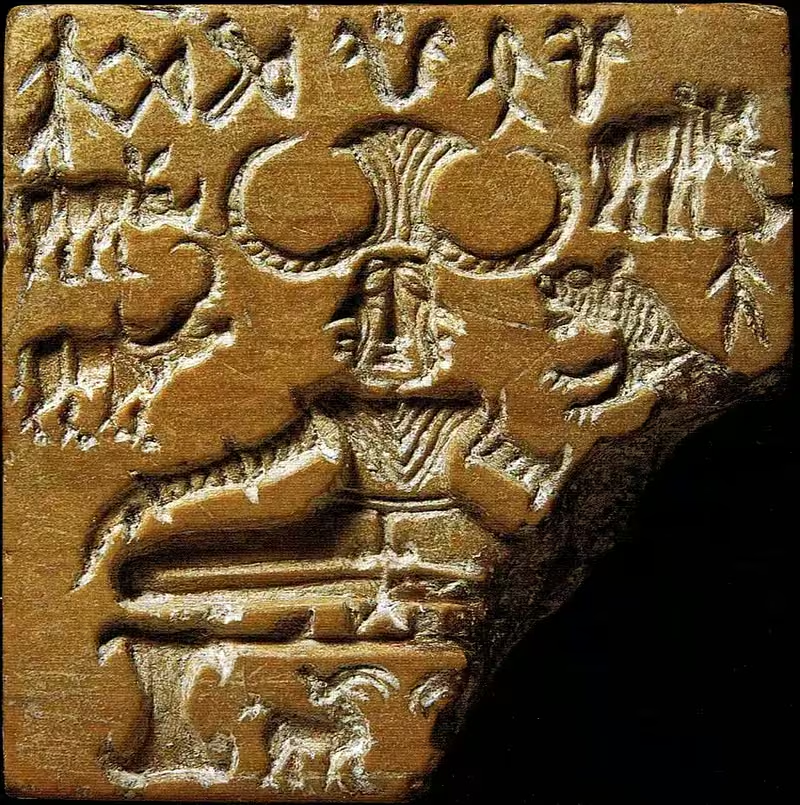
The Pashupati seal, officially designated as Seal 420, stands as one of the most enigmatic and significant artifacts recovered from the ancient Indus Valley Civilization. This small steatite seal, measuring just 3.56 by 3.53 centimeters, depicts a horned figure seated in what appears to be a yogic posture, surrounded by animals including an elephant, tiger, rhinoceros, and buffalo. Discovered at the archaeological site of Mohenjo-daro in present-day Pakistan during excavations in 1928-29, this seal has sparked decades of scholarly debate about its meaning and significance. Named after the Hindu deity Pashupati—a form of Shiva known as the "Lord of Animals"—the seal has become central to discussions about religious continuity between the Indus Valley Civilization and later Hindu traditions. Its discovery fundamentally challenged previous assumptions about the origins of Indian religious practices and continues to fascinate archaeologists, historians, and religious scholars worldwide.
Discovery and Provenance
Discovery
The Pashupati seal was unearthed during systematic archaeological excavations at Mohenjo-daro, one of the largest settlements of the Indus Valley Civilization. The excavations were conducted under the direction of Ernest John Henry Mackay (1880-1943), a British archaeologist who worked extensively at the site between 1927 and 1931. The seal was found in the archaeological layers dated to the mature Harappan period, approximately 2350-2000 BCE, making it over 4,000 years old.
Mohenjo-daro, whose name means "Mound of the Dead" in Sindhi, was one of the world's earliest major urban settlements and represents the height of Indus Valley urban planning and craftsmanship. The site was rediscovered in the 1920s and has since yielded thousands of artifacts, but few have captured scholarly and public imagination like the Pashupati seal.
Journey Through History
After its creation in the mid-third millennium BCE, the seal likely served administrative and possibly religious functions within Indus Valley society. Seals from this civilization were typically used to stamp clay tags attached to goods, indicating ownership or origin—a crucial element of the sophisticated trade networks that characterized Harappan culture.
Following the decline of the Indus Valley Civilization around 1900 BCE, the seal remained buried in the archaeological layers of Mohenjo-daro for nearly four millennia. Its rediscovery in 1928-29 by Mackay's expedition marked the beginning of its modern journey as a key artifact in understanding ancient Indian civilization.
Current Home
Today, the Pashupati seal resides in the National Museum in New Delhi, India, where it is displayed as part of the museum's extensive Indus Valley Civilization collection. The seal remains one of the most visited and photographed artifacts in the museum, drawing scholars and tourists alike who seek to glimpse this remarkable window into ancient Indian spirituality and craftsmanship. As Seal 420, it is carefully preserved and displayed under controlled conditions to ensure its survival for future generations.
Physical Description
Materials and Construction
The Pashupati seal is carved from steatite, also known as soapstone—a metamorphic rock composed primarily of talc that was the preferred material for Indus Valley seal-makers. Steatite was chosen for its softness when freshly quarried, which made it relatively easy to carve with copper or bronze tools, and its subsequent hardening upon exposure to air and firing, which made the finished seals durable.
The craftsmanship demonstrates the high level of artistic and technical skill achieved by Harappan artisans. The seal was created through a combination of carving and engraving techniques. First, the steatite was cut into a square shape and smoothed. The design was then carefully carved in intaglio (recessed), meaning the image appears in reverse on the seal itself but correctly when pressed into clay or wax.
Dimensions and Form
The seal is nearly perfectly square, measuring 3.56 centimeters in height and 3.53 centimeters in width. This compact size is typical of Indus Valley seals, which needed to be portable and easy to use in commercial transactions. The seal's modest dimensions belie its enormous historical and cultural significance.
The reverse side of the seal features a perforated boss—a raised knob with a hole through it—which would have allowed the seal to be worn on a cord or strap, making it easily accessible to its owner and preventing loss or theft.
Condition
The seal is in remarkably good condition considering its age of over 4,000 years. The steatite material has proven extremely durable, and the carved details remain sharp and clear. While there may be minor surface wear consistent with both ancient use and archaeological recovery, the seal's imagery is well-preserved enough to allow detailed study and interpretation. The clarity of the carving testifies to both the skill of the original craftsman and the protective conditions under which the seal was buried for millennia.
Artistic Details
The seal's central image depicts a male figure seated in a distinctive posture. The figure wears an elaborate horned headdress, which may have three or possibly five projections—a detail that has been subject to scholarly debate. The figure's arms are adorned with bangles or bracelets, and the overall posture suggests a seated meditation or yogic position, with what some scholars interpret as the legs in a form resembling the lotus position used in yoga practice.
Surrounding the central figure are four wild animals positioned at the cardinal points: an elephant and a tiger on the right side, and a rhinoceros and a water buffalo on the left. Below the platform or throne on which the figure sits are two deer or antelopes, shown in profile. This arrangement of the "Lord of Animals" surrounded by beasts has led to the seal's identification with Pashupati.
Above the scene are seven characters in the still-undeciphered Indus script, adding an additional layer of mystery to the artifact. The entire composition is framed within the square border of the seal, demonstrating sophisticated artistic planning and execution.
Historical Context
The Era
The Pashupati seal was created during the mature Harappan phase of the Indus Valley Civilization, a period spanning approximately 2600-1900 BCE. This was one of the world's earliest urban civilizations, contemporary with ancient Mesopotamia and Egypt, and it covered a vast geographical area across what is now Pakistan and northwestern India.
The Indus Valley Civilization was characterized by sophisticated urban planning, with cities featuring grid-pattern streets, advanced drainage systems, standardized weights and measures, and extensive trade networks reaching as far as Mesopotamia. The society demonstrated remarkable uniformity in material culture across its vast territory, suggesting strong cultural cohesion despite the absence of obvious centralized political control.
This was a highly organized society with specialized craftspeople, including the skilled artisans who created thousands of seals like the Pashupati example. The civilization's writing system, visible on the seal, remains undeciphered, leaving many aspects of Harappan culture—including religious beliefs and practices—open to interpretation based on material evidence alone.
Purpose and Function
The Pashupati seal likely served multiple functions within Indus Valley society. Primarily, such seals were administrative tools used to stamp clay tags or bullae that were attached to goods for trade or storage. The unique design on each seal functioned much like a signature or trademark, identifying the owner or the origin of the goods.
However, the Pashupati seal's elaborate religious or mythological imagery suggests it may have held special significance beyond purely commercial use. It might have belonged to a person of high status—perhaps a religious leader, priest, or merchant-prince—whose identity or authority was intimately connected with the spiritual symbolism depicted on the seal. The seal could have served as a badge of office or a symbol of religious authority.
The depiction of what appears to be a deity or divine figure suggests the seal may also have had ritual or devotional purposes, possibly used in religious ceremonies or as an amulet offering spiritual protection to its owner.
Significance and Symbolism
Historical Importance
The Pashupati seal has become one of the most important artifacts for understanding the religious and cultural foundations of South Asian civilization. Its discovery fundamentally challenged the previously held view that Hinduism and its associated practices emerged only with the arrival of Indo-Aryan peoples around 1500 BCE. Instead, the seal suggests possible roots of Hindu traditions in the pre-Aryan Indus Valley Civilization.
The seal represents one of the earliest pieces of evidence for organized religious practices in the Indian subcontinent and has become central to debates about cultural continuity and religious evolution in South Asia. It demonstrates that sophisticated religious symbolism and practices existed in the region thousands of years before the composition of the Vedas, the oldest Hindu scriptures.
Artistic Significance
From an artistic standpoint, the Pashupati seal exemplifies the high level of craftsmanship achieved by Indus Valley artisans. The precise carving of multiple figures and intricate details within such a small space demonstrates remarkable technical skill and artistic vision. The composition shows sophisticated understanding of balance, proportion, and narrative storytelling through visual means.
The seal's artistic style is distinctively Harappan, characterized by naturalistic animal depictions combined with more stylized human forms. This artistic vocabulary was shared across the entire Indus Valley Civilization, appearing on seals, pottery, and other artifacts, suggesting a unified cultural identity expressed through artistic conventions.
Religious and Cultural Meaning
The seal's most profound significance lies in its possible religious symbolism. The identification of the central figure with Pashupati—an epithet of the Hindu god Shiva meaning "Lord of Animals" or "Lord of Beasts"—suggests remarkable continuity in religious traditions. Several features support this interpretation:
The Yogic Posture: The seated figure appears to be in a meditative posture possibly resembling the yogic mulabandhasana, suggesting early forms of yoga practice. This would make it one of the earliest representations of yoga, predating textual references by nearly two millennia.
The Horned Headdress: Shiva is often depicted with a crescent moon in his hair, and horns are associated with divinity and power in many ancient cultures. The elaborate headdress may indicate divine or royal status.
Lord of Animals: The positioning of wild animals around the central figure directly parallels the concept of Pashupati as the lord and protector of all creatures, a key aspect of Shiva's identity in later Hindu tradition.
The Ithyphallic Figure: Some interpretations suggest the figure displays erect genitalia, connecting it to Shiva's role as a fertility deity and the later worship of the linga (phallic symbol) as Shiva's aniconic representation.
The Three Faces: Some scholars interpret the headdress as indicating a three-faced figure, which would connect to the Trimurti concept in Hinduism and Shiva's various aspects.
However, it is crucial to note that these interpretations remain debated among scholars. Without the ability to read the Indus script, definitive identification remains impossible. Alternative interpretations suggest the figure might represent a shaman, a ruler, a different deity entirely, or a mythological figure whose meaning has been lost to time.
Inscriptions and Text
Above the central scene on the Pashupati seal are seven characters in the Indus script, arranged in a horizontal line from right to left (the presumed reading direction of this writing system). These symbols add another dimension of meaning to the seal, though frustratingly, they remain undeciphered.
The Indus script appears on numerous seals, pottery, and other artifacts from the civilization, typically in short sequences of characters. Despite decades of scholarly effort and numerous proposed decipherments, the script remains one of archaeology's great unsolved mysteries. The main challenges include the short length of most inscriptions, the lack of a bilingual text (like the Rosetta Stone that unlocked Egyptian hieroglyphics), and uncertainty about what language the script represents.
Proposed interpretations of the Indus script range from it representing a Dravidian language (related to modern Tamil and other South Indian languages), an early Indo-European language, or something entirely different. Some scholars have even questioned whether the symbols constitute a true writing system at all, suggesting they might be purely symbolic or ideographic markers.
For the Pashupati seal specifically, the inscription might represent the name of the seal's owner, a title or epithet for the figure depicted, a prayer or invocation, or an administrative notation. The first character resembles a fish-like symbol common in Indus inscriptions, which some researchers have connected to fertility or prosperity symbolism.
Until the Indus script is deciphered—if it ever can be—the full meaning of the Pashupati seal will remain partially hidden, adding to its mystique and continuing appeal to researchers and the public alike.
Scholarly Study
Key Research
The Pashupati seal has been the subject of extensive scholarly analysis since its discovery. The seal was first published and described by John Marshall, the Director-General of the Archaeological Survey of India, in his comprehensive 1931 work on Mohenjo-daro. Marshall was the first to propose the identification of the figure with Pashupati/Shiva, an interpretation that has shaped subsequent scholarship.
Archaeological studies have focused on dating the seal through stratigraphy and comparison with other Harappan artifacts, firmly placing it in the mature Harappan period (c. 2350-2000 BCE). Material analysis has confirmed the seal's steatite composition and revealed details about manufacturing techniques used by Indus Valley craftspeople.
Comparative religious studies have examined parallels between the seal's imagery and later Hindu iconography, exploring possible continuities in religious practice and belief. Iconographic analysis has compared the Pashupati seal with other Indus Valley seals showing seated figures, animals, and religious scenes, revealing patterns in Harappan visual culture.
Art historical research has examined the seal within the broader context of Indus Valley artistic conventions, analyzing its composition, style, and symbolism. These studies have revealed sophisticated artistic principles underlying Harappan visual culture, including standardized proportions, hierarchical scaling (where important figures are shown larger), and symbolic use of animals.
Debates and Controversies
The Pashupati seal remains at the center of several ongoing scholarly debates:
Proto-Shiva Identification: While Marshall's identification of the figure as an early form of Shiva has gained wide acceptance, some scholars urge caution. Critics argue that the gap between the Indus Valley Civilization and the earliest textual references to Shiva (in the Vedas and later texts) is too great to confidently assume continuity. They suggest the seal might represent a completely different religious tradition that left no literary traces.
The Yogic Posture: Debate continues over whether the figure is actually seated in a recognizable yoga position. Some scholars see clear parallels with later yogic practices, suggesting yoga's roots extend back to Harappan times. Others argue the posture might represent a ritual or ceremonial pose with no connection to later yoga traditions, or simply be a conventional way of depicting seated figures in Harappan art.
Cultural Continuity vs. Discontinuity: A broader debate concerns the relationship between Indus Valley culture and later Vedic/Hindu civilization. Some scholars see strong continuities, using the Pashupati seal as evidence that core Hindu concepts and deities have roots in pre-Aryan indigenous traditions. Others emphasize the differences between Harappan and Vedic cultures, arguing that any similarities might be coincidental or the result of much later religious synthesis rather than direct continuity.
The Gender Question: While most interpretations assume the figure is male (partly based on apparent phallic imagery), some scholars have questioned this assumption, suggesting alternative readings of the figure's gender and identity.
Script Interpretation: Attempts to link the Indus script characters on the seal to specific words or concepts in various languages remain highly speculative and controversial, with no scholarly consensus emerging.
These debates reflect both the seal's importance and the challenges of interpreting material evidence in the absence of written records that can be definitively understood.
Legacy and Influence
Impact on Understanding Ancient India
The Pashupati seal has profoundly influenced how scholars and the public understand the origins of Indian civilization and religion. Its discovery helped establish that the Indus Valley Civilization possessed sophisticated religious beliefs and practices, challenging earlier assumptions that South Asian religion began only with the Vedic period.
The seal has become iconic in discussions about the indigenous roots of Hinduism and the possible pre-Vedic origins of major Hindu deities and practices. It features prominently in academic works, textbooks, and popular books about ancient India, serving as a tangible connection to religious practices from over 4,000 years ago.
Impact on Indus Valley Studies
Within Indus Valley archaeology, the Pashupati seal has become one of the most recognizable and frequently analyzed artifacts. It has inspired more careful attention to religious and ritual aspects of Harappan culture, encouraging archaeologists to look beyond purely economic and administrative interpretations of seals and other artifacts.
The seal has also highlighted the importance of iconographic analysis in understanding pre-literate or non-deciphered civilizations, demonstrating how visual evidence can provide insights into belief systems even in the absence of readable texts.
Modern Recognition
The Pashupati seal has achieved a level of recognition rare for archaeological artifacts. It appears frequently in:
- Academic publications: Featured in countless books and articles about ancient India, archaeology, and religious history
- Educational materials: Reproduced in textbooks and online resources about ancient civilizations
- Museums and exhibitions: Displayed prominently in the National Museum and featured in traveling exhibitions about ancient India
- Popular culture: Referenced in discussions about yoga history, Hindu origins, and ancient wisdom traditions
- Scholarly conferences: Regular subject of papers and discussions at archaeological and historical conferences
The seal has become a symbol of India's ancient cultural heritage and the sophistication of the Indus Valley Civilization, appearing on stamps, in documentaries, and in various cultural celebrations of India's historical legacy.
Viewing Today
The Pashupati seal is permanently housed in the National Museum in New Delhi, one of India's premier cultural institutions. The museum, located on Janpath near India Gate, houses the country's largest and most comprehensive collection of Indian art and artifacts, spanning thousands of years of history.
The seal is displayed in the museum's Harappan Gallery, which features an extensive collection of artifacts from the Indus Valley Civilization. Visitors can view the original seal in a climate-controlled display case designed to protect the ancient steatite from environmental damage while allowing clear viewing of its intricate details.
The museum provides contextual information about the seal, including its discovery, dating, and various interpretations of its meaning. High-quality replicas and enlarged images help visitors appreciate the fine details of the carving that might be difficult to see on the small original.
The National Museum is open to visitors throughout the year (except Mondays and national holidays), with specific hours varying by season. The Harappan Gallery, including the Pashupati seal, is among the museum's most popular sections, attracting scholars, students, and tourists from around the world who wish to see this remarkable artifact in person.
For those unable to visit in person, the National Museum has made efforts to digitize its collections, and high-quality images of the Pashupati seal are available through various online databases and educational resources. However, seeing the original artifact remains a powerful experience that connects viewers directly with the craftspeople and culture of the ancient Indus Valley.
Conclusion
The Pashupati seal endures as one of the most enigmatic and significant artifacts from ancient India. This small square of carved steatite, created over 4,000 years ago by an unknown artisan in the bustling city of Mohenjo-daro, continues to fascinate and challenge our understanding of early Indian civilization and religion. Whether it truly depicts proto-Shiva, represents an entirely different religious tradition now lost to time, or holds meanings we have yet to fathom, the seal stands as powerful testament to the sophistication and spiritual depth of the Indus Valley Civilization.
The ongoing debates about the seal's meaning reflect both its importance and the tantalizing gaps in our knowledge about this ancient culture. Until the Indus script is deciphered—if it ever can be—the Pashupati seal will retain its mysteries while continuing to serve as a crucial link connecting the present to humanity's distant past. It reminds us that the roots of Indian culture reach back far beyond recorded history, deep into the urban civilizations of the Bronze Age, where skilled artisans created works of art that still speak to us across the millennia, even if we cannot fully understand their language.