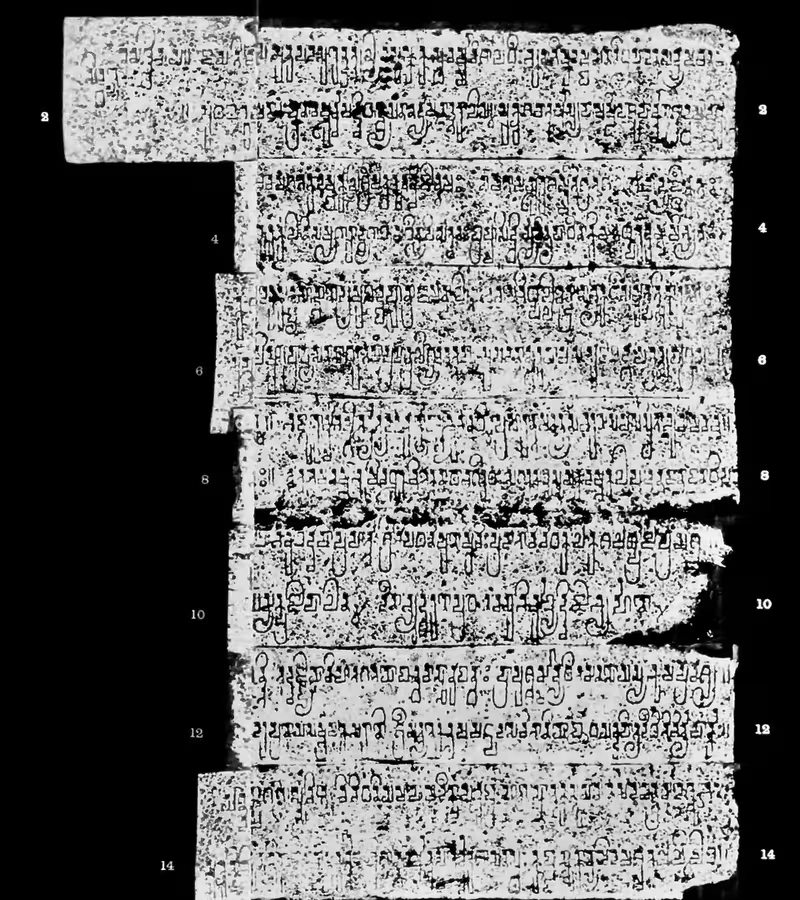
Talagunda Pillar Inscription: A Kadamba History Carved in Granite
Standing 1.635 metres high beside the ruined Pranavalingeshwara Shiva temple at Talagunda, Karnataka, the Talagunda pillar inscription preserves a 34-verse account of Kadamba power, learning, warfare, and religious patronage. Its hard grey granite shaft is octagonal, slightly tapering, and engraved on every face. Dated between 455 and 470 CE, the record is associated with King Kakusthavarman and his son, the celebrated Kadamba ruler Śāntivarma. It opens with “Siddham” and an invocation of Shiva, then moves through an elaborate Sanskrit genealogy and political narrative.
The inscription’s historical value lies partly in what it says and partly in how it says it. Its language is excellent classical Sanskrit, its script is Kannada, and its verses follow the rules of Sanskrit poetic metre. The first 24 verses are described as the earliest known use of the matrasamaka metre. The text recounts how Mayurasarman, a learned Brahmin student, became a warrior after a confrontation involving Pallava forces, and how his descendants developed a regional kingdom. It also records Kakusthavarman’s association with a great water tank at a sacred Shaiva site.
Discovery and Provenance
Discovery
The pillar was discovered in 1894 by B. L. Rice, then Director of Archaeological Researches in Mysore. Rice was a pioneer of historical studies in Karnataka. After finding the record, he gave a photograph to the colonial-era Indologist Buhler, who published it in 1895. The inscription’s historical importance soon attracted the attention of the epigraphist Fleet, who published notes on it.
The pillar stood in front of the ruined Pranavalingeshwara temple, also called the Prāṇaveśvara or Pranavalingeshwara Shiva temple. The temple is associated with the fifth century, but much of it had been destroyed by the time the pillar was rediscovered. The survival of the inscribed granite monument made it possible to recover a detailed record of the Kadamba dynasty and the religious landscape of northwest Karnataka.
Journey Through History
The inscription was created in the period of Kakusthavarman and was installed in front of the Shiva temple at Talagunda. Its final verse states that Kubja wrote the poem on the stone while following the excellent commands of Śāntivarma, Kakusthavarman’s son. The record therefore belongs to a royal and temple setting, even though the available historical account does not provide a continuous chain of custody for the pillar after its original installation.
The pillar remained associated with the temple until its rediscovery in the nineteenth century. By then, the temple had survived largely as ruins, while the pillar remained sufficiently intact for its text to be photographed, read, translated, and studied.
Current Home
The pillar remains at Talagunda, in front of the ruined and partially restored Pranavalingeshwara Shiva temple. Talagunda is in Shikaripur taluk of Shimoga district, Karnataka. The site lies close to Karnataka State Highway 1, approximately 90 kilometres west of Davanagere and 80 kilometres northwest of Shivamogga city.
The pillar has also entered the field of digital conservation. The Mythic Society’s 3D Digital Conservation Project team has scanned it, and images of the resulting three-dimensional model have been uploaded for study and documentation.
Physical Description
Materials and Construction
The inscription is engraved on hard grey granite. Rather than appearing on a flat slab, the text occupies the faces of a tall, free-standing pillar. Its shaft is octagonal and narrows slightly toward the top. The use of a durable stone surface helped preserve a long literary and historical text in an exposed temple environment.
The pillar’s form combines architectural presence with epigraphic function. It was not simply a portable document: it was installed before a Shiva temple and made visible as part of a sacred and political setting. The text’s placement on the shaft required the reader to encounter the inscription across several vertical faces.
Dimensions and Form
The pillar is 1.635 metres high, or approximately 5.36 feet. Its top is a square measuring 0.4 metres, or about 1.3 feet, across. The octagonal shaft has faces approximately 0.178 metres, or 0.58 feet, wide.
The inscription appears on all eight faces. Seven faces contain two vertical lines beginning at the bottom of the pillar. The eighth face carries only one short line. This arrangement reflects the physical limitations of the pillar while allowing a substantial poetic record to be distributed across its surface.
Condition
The pillar survived the destruction of much of the temple complex and was still present when B. L. Rice rediscovered it in 1894. The text has been read and translated in detail, although different scholars have produced different readings and interpretations. The temple around it was largely ruined when the pillar came to scholarly attention.
Artistic Details
The pillar’s principal artistic feature is the organization of writing across its octagonal form. The inscription begins with “Siddham,” a formula found in numerous early Indian inscriptions, and invokes Shiva with the words “Namo Shivaya.” The record is written in a floral box-type Kannada script.
Its literary design is unusually elaborate. The 34 verses use a mixture of Sanskrit metres, including Pushpitagra, Indravajra, Vasantatilaka, Prachita, and others. Every verse contains four padas. The first 24 verses are identified as the earliest known use of the matrasamaka metre. These details show that the composition was shaped by writers deeply familiar with classical Sanskrit and Vedic prosody.
Historical Context
The Era
The inscription belongs to the middle of the fifth century CE, a period in which regional dynasties articulated their authority through temple patronage, genealogies, ritual practice, military achievement, and literary culture. The record concerns the Kadamba dynasty in northwest Karnataka and presents its rulers through a combination of sacred ancestry, political action, and public responsibility.
The inscription also refers to relations with the Pallava lords and to Kanchipuram as a centre of advanced learning. Its account connects education, conflict, dynastic foundation, and kingship across southern India. It portrays the Kadamba lineage as one that drew authority from learned traditions while also demonstrating the ability to wage war and protect territory.
Purpose and Function
The pillar served as a commemorative royal inscription. It praises the Kadamba lineage, explains its origin, celebrates Kakusthavarman, and records the creation of a great tank or reservoir for the supply of abundant water. The text places this act at a sacred home of the primeval god Bhava, a site frequented by Siddhas, Gandharvas, and Rakshas and associated with religious recitation, vows, sacrifices, and initiation rites.
The record also identifies the temple site as one worshipped by earlier pious kings, including Satakarni and others seeking salvation. By associating the water tank with the sacred centre, the inscription links royal construction, religious devotion, and public provision.
Commissioning and Creation
Kakusthavarman is the central king praised in the inscription. Its final verse states that Kubja wrote the poem while obeying the commands of Śāntivarma, Kakusthavarman’s son. The inscription therefore represents a royal project completed during the authority of the next generation.
Its language and metre indicate a highly trained literary composition rather than a brief administrative note. The poem presents genealogy through a carefully controlled sequence of praise, origin stories, military episodes, and religious references. The Kannada script records this Sanskrit literary work on granite, demonstrating the combination of regional writing practice and the prestige of classical Sanskrit.
Significance and Symbolism
Historical Importance
The Talagunda pillar inscription is a major source for the history of the Kadamba dynasty. It provides a dynastic narrative beginning with Mayurasarman and continuing through Kangavarman, Bhagiratha, Raghu, Kakustha, and Kakusthavarman. The text describes Mayurasarman as a learned figure who travelled with his preceptor Virasarman to the city of the Pallava lords to study sacred knowledge.
At a ghatika, or advanced centre of learning, Mayurasarman became involved in a fierce quarrel with a Pallava horseman. The inscription presents his response as a dramatic transformation. He reflects on the weakness of Brahmins in the Kali age, then takes up a sword despite his previous familiarity with kusa grass, sacrificial fuel, ritual stones, ladles, clarified butter, and offering vessels.
Mayurasarman defeats frontier guards, occupies a forest extending toward the gates of Sriparvata, and levies taxes from kings headed by the Great Bana. When the kings of Kanchi come against him, he attacks their army during marches and periods of rest. The Pallava rulers eventually recognize his strength, valour, and lineage, choosing friendship rather than destruction. He enters their service, wins honour in battle, and receives territory bordered by the western sea.
This narrative is important because it presents political foundation through both learning and armed action. The Kadamba identity described in the inscription is not limited to one social or religious role. It combines sacred knowledge, ritual authority, military skill, royal service, and territorial sovereignty.
Artistic Significance
The inscription is composed in what the Sanskrit scholar Sheldon Pollock described as “wonderful literary Sanskrit.” Its polished language and complex metrical structure demonstrate the level of Sanskrit literary culture in South India by the fifth century. The record is therefore significant not only for its political content but also for the history of language and poetry.
The pillar confirms that classical Sanskrit had spread into South India by about 455–470 CE. It also shows how a Sanskrit poem could be written in Kannada script and installed at a regional temple. The monument thus joins language, script, stone carving, and architecture in a single historical object.
Religious and Cultural Meaning
The inscription begins by praising Sthanu, a form of Shiva, and invokes “Namo Shivaya.” It repeatedly frames the site through Shaiva devotion. The temple is described as the home of the primeval god Bhava, a place visited by supernatural beings and praised by Brahman students devoted to vows, sacrifices, and initiatory rites.
The record also describes ideals of rulership. Kakusthavarman is praised for warfare against stronger opponents, compassion for the needy, protection of the people, relief of the distressed, and generous honour shown to leading learned men. These qualities are called the rational ornaments of a ruler who wishes to adorn his family.
The inscription compares Kakusthavarman with Kakutstha, identified in the record with the divine Rama of the Ramayana tradition. It uses images of shelter and prosperity to express royal virtue: relatives and dependants who are threatened by stronger forces find relief when they enter his territory, just as deer suffering from heat find comfort in the shade of trees.
The text also evokes music, the goddess of wealth, marriage alliances between northern and southern royal families, and the relationship between political authority and religious generosity. Its portrait of the dynasty is at once sacred, martial, charitable, and culturally refined.
Inscriptions and Text
The Talagunda pillar inscription contains 34 poetic verses in classical Sanskrit. It is written in Kannada script using a floral box-type font. Its opening formulas are:
Siddham. Namo Shivaya.
The opening verses praise Shiva, learned ritual specialists, and Kakusthavarman, described as a king resembling the moon in the great lineage of Kadamba leaders. The following verses describe a family of learned people associated with the gotra of Manavya and the sons of Hariti. They are presented as practitioners of the three Vedas and participants in sacrifices, offerings, rites of the new and full moon, and śrāddha observances.
The central narrative concerns Mayurasarman. He travels with Virasarman to the Pallava city to study sacred knowledge and enters the ghatika as a mendicant. After his quarrel with a Pallava horseman, he takes up arms, defeats Pallava frontier guards, establishes control over territory, and ultimately enters into an alliance with the Pallava rulers.
The genealogy continues through Kangavarman, Bhagiratha, Raghu, Kakustha, and Kakusthavarman. Kakusthavarman is praised for his beauty, deep voice, intelligence, generosity, protection of subjects, compassion, and military authority. The inscription describes neighbouring rulers bowing before him even while he remains seated.
The final verse records the construction of a great tank at the sacred site. It then identifies Kubja as the writer of the poem and Śāntivarma as the king whose commands were followed. The inscription closes with an obeisance to Mahadeva at Sthanakundura and a blessing for the people:
May joy attend this place, inhabited by men come from all the neighbourhood! Blessed be the people!
Scholarly Study
Key Research
B. L. Rice published a translation in 1902 in volume 7 of Epigraphia Carnatica. F. Kielhorn later published a more accurate reading, a detailed interpretation, and a verse-by-verse translation in Epigraphia Indica in 1906. Sircar included the record in Select Inscriptions. Later collections also reproduced the inscription, including works associated with B. R. Gopal and G. S. Gai.
The history of publication reflects the inscription’s importance for the study of early Karnataka. Its literary Sanskrit, Kannada script, dynastic narrative, and account of a temple water tank made it valuable to historians, epigraphists, Sanskrit scholars, and students of South Indian religious institutions.
Debates and Interpretations
The inscription’s account of Kanchipuram is significant for the history of education. It presents the ghatika as a centre where Mayurasarman went to study the whole of the sacred lore. Other inscriptions and literary evidence associate such institutions with Hindu temples and monasteries and describe them as places where hundreds of students could study different fields of knowledge with royal support.
M. G. S. Narayanan has interpreted the conflict with Pallava cavalry as evidence that the higher-learning centre at Kanchi may also have been connected with military arts. In this interpretation, Mayurasarman may have acquired weapons and martial skills there before founding and establishing a kingdom.
Another interpretation concerns the social identity represented in the record. Hampa Nagarajaiha argues that the inscription reflects Jain-Brahmana, or Bamana, traditions rather than a specifically Vedic-Brāhmaṇa identity. In Jain philosophy, a learned layperson with vows could be described as a Brahman. Nagarajaiha maintains that Bamana could refer to a deeply learned individual, scholar, or pandit, rather than to a caste or religious affiliation in the later sense. He therefore regards the identification of the figures as Vedic Brāhmaṇas as a later retrospective interpretation and argues that the inscription does not itself establish a distinct Brāhmaṇa caste as understood in later periods.
Legacy and Influence
Impact on Art History
The Talagunda pillar demonstrates how a monument could function simultaneously as architecture, religious dedication, royal communication, and literary composition. Its octagonal granite body created a durable surface for a long poem, while its position before a Shiva temple connected the text to ritual space and public memory.
The inscription is also important for the study of early South Indian writing. Classical Sanskrit was carved in Kannada script, showing how the language of elite literary expression operated within a regional epigraphic form. The pillar’s metres and poetic conventions further reveal the expertise of its authors.
Modern Recognition
The record has remained central to discussions of the Kadamba dynasty, early Karnataka, Sanskrit literary culture, South Indian temples, and ancient educational institutions. Its rediscovery by B. L. Rice and subsequent publication by Buhler, Kielhorn, and others made it accessible to modern historical scholarship.
The pillar has also been documented through three-dimensional scanning by the Mythic Society’s 3D Digital Conservation Project. This work extends the monument’s modern record beyond printed readings and photographs, preserving its form for further study.
Viewing Today
Visitors can see the pillar in front of the ruined and partially restored Pranavalingeshwara Shiva temple at Talagunda, Karnataka. The site is in Shikaripur taluk, in the former Shimoga district, and lies close to Karnataka State Highway 1.
The pillar remains an in-situ monument rather than a detached museum object. Its relationship with the temple is essential to understanding the inscription: the record praises Shiva, refers to the sacred character of the site, and records the creation of a large water tank associated with the temple complex. Digital scans and model images produced by the Mythic Society provide an additional way to examine the monument.
Conclusion
The Talagunda pillar inscription preserves far more than a list of Kadamba rulers. Engraved on a granite pillar beside a Shiva temple, it brings together dynastic memory, Sanskrit poetry, Kannada script, sacred geography, education, warfare, public works, and ideals of kingship. Its story of Mayurasarman presents learning and military action as intertwined forces in the making of a kingdom, while its praise of Kakusthavarman defines the ruler through courage, generosity, compassion, and protection of the people. The record’s sophisticated metres and classical language demonstrate the strength of Sanskrit culture in South India by the fifth century. Its account of a temple water tank also connects royal authority with religious patronage and public benefit. For these reasons, the Talagunda pillar remains a major monument of early Karnataka history and Indian epigraphy.