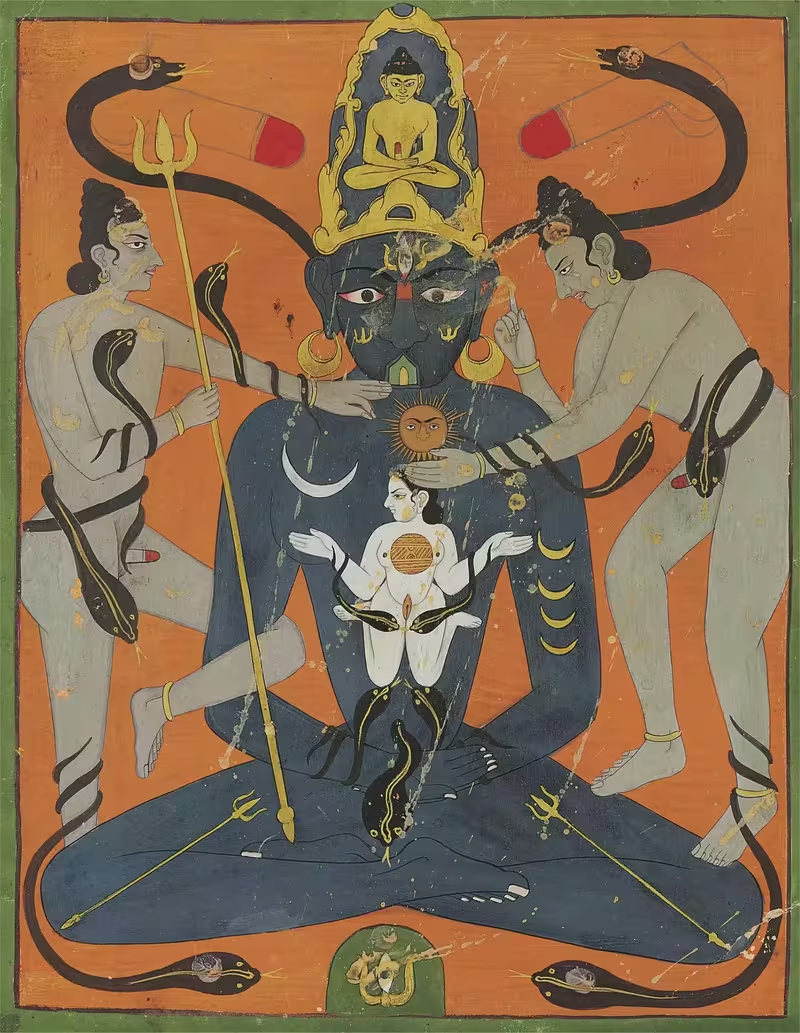
Tantra: The Esoteric Path to Divine Realization
Tantra represents one of the most fascinating yet frequently misunderstood dimensions of Indian spiritual traditions. Far from the simplistic associations often made in popular culture, Tantra encompasses sophisticated esoteric systems within Hinduism and Buddhism that emerged around the middle of the first millennium CE. These traditions developed elaborate practices involving rituals, mantras, meditation, yoga, and deity visualization aimed at spiritual transformation and liberation. Tantra offered alternative paths to enlightenment that emphasized direct experience, guru-disciple transmission, and practices sometimes transgressing orthodox religious boundaries. Its influence shaped temple worship, monastic practices, artistic traditions, and yogic systems throughout South and East Asia, while continuing to evolve in contemporary global contexts.
Etymology and Meaning
Linguistic Roots
The term "Tantra" derives from the Sanskrit root "tan," meaning to weave, extend, or expand. The word itself carries multiple layers of meaning—it can refer to a loom or weaving, suggesting the interconnection of all reality, or to a systematic treatise or doctrine. In religious contexts, Tantra denotes both the texts that transmit esoteric teachings and the practices these texts describe.
The broader term "tantrism" refers to the religious movements and traditions that developed around these texts and practices. Practitioners are sometimes called "tantrikas," while "tantric" serves as an adjective describing practices, texts, or elements associated with these traditions.
Related Concepts
Tantra connects intimately with several key concepts in Indian spiritual traditions. "Mantra" (sacred sound formulas) and "yantra" (geometric sacred diagrams) form essential components of Tantric practice. The concept of "shakti" (divine feminine power) plays a central role, particularly in Hindu Tantra. "Guru" (spiritual teacher) represents the indispensable guide who initiates and instructs practitioners. "Sadhana" refers to the spiritual discipline and daily practice regimen prescribed in Tantric traditions.
Historical Development
Origins (c. 500-900 CE)
Tantra emerged during the early medieval period as distinctive religious movements within both Hindu and Buddhist traditions. The earliest Tantric texts appeared approximately from the 5th century CE onward, though scholars debate precise dating. These texts presented themselves as new revelations offering powerful practices for spiritual attainment in the current degenerate age (Kali Yuga in Hindu cosmology).
The historical emergence of Tantra coincided with the decline of classical Vedic ritualism and the rise of devotional (bhakti) movements. Tantric traditions offered alternative spiritual paths that emphasized direct experience of the divine through elaborate ritual, visualization, and yogic practices. Unlike orthodox Vedic religion restricted to upper castes, some Tantric movements proved more inclusive, though others maintained strict hierarchies and secrecy.
Classical Tantric Flourishing (900-1400 CE)
Between the 9th and 14th centuries, Tantric traditions reached their classical peak of textual production, philosophical systematization, and institutional establishment. Hindu Tantric schools developed elaborate classifications of texts and practices, with major traditions including Shaiva (Shiva-focused), Shakta (Goddess-focused), and Vaishnava (Vishnu-focused) Tantra.
In Buddhism, Tantric practices became increasingly central, particularly in the Vajrayana (Diamond Vehicle) tradition that came to dominate in Tibet, Nepal, Bhutan, and Mongolia. Buddhist Tantra developed its own extensive literature, ritual systems, and monastic institutions. The great Buddhist universities of India, including Nalanda, became important centers for Tantric learning before their destruction during Islamic invasions.
This period witnessed the integration of Tantric elements into mainstream religious practice. Hindu temples incorporated Tantric worship methods, while Buddhist monasteries established Tantric meditation and ritual programs. Royal courts patronized Tantric practitioners, and the traditions influenced architecture, sculpture, painting, and poetry.
Transformations and Continuities (1400-1900 CE)
The Islamic conquest of much of northern India disrupted some Tantric institutions, though practices continued and adapted. In regions less affected by conquest, such as southern India, Nepal, and Tibet, Tantric traditions maintained stronger continuity. Shaiva Siddhanta in Tamil Nadu, Shakta traditions in Bengal and Assam, and Vajrayana Buddhism in the Himalayan regions preserved vital Tantric lineages.
During this period, Hatha Yoga developed as a distinct system heavily influenced by Tantric conceptions of the subtle body, including chakras (energy centers), nadis (energy channels), and kundalini (dormant spiritual energy). Texts like the Hatha Yoga Pradipika synthesized Tantric yoga techniques with broader yoga traditions.
Modern Era (1900-Present)
The colonial encounter brought Western attention to Tantra, though often through distorted lenses. Early Western interpretations frequently sensationalized Tantric sexuality while ignoring the broader philosophical and spiritual frameworks. Simultaneously, some Indian reformers distanced themselves from Tantra, viewing it as superstitious or embarrassing.
The late 20th century saw renewed scholarly and practical interest in Tantra. Academic research has deepened understanding of historical Tantric traditions in their diversity and complexity. Contemporary practitioners in India and globally engage with Tantric yoga, meditation, and ritual, though often with significant reinterpretations. Some modern approaches emphasize psychological and therapeutic dimensions, while others seek to preserve traditional lineages and practices.
Key Principles and Characteristics
Ritual Complexity
Tantric traditions developed extraordinarily elaborate ritual systems. These ceremonies might involve construction of mandalas (sacred diagrams), offerings to deities, recitation of mantras, performance of mudras (ritual gestures), and visualization practices. Tantric rituals aimed to invoke divine presence, purify consciousness, and transform the practitioner's perception of reality.
The complexity of Tantric ritual served multiple purposes: it required focused attention that concentrated the mind, it symbolically enacted cosmological principles, and it created conditions for transformative spiritual experiences. Many rituals remained secret, transmitted only through direct guru-disciple instruction.
The Subtle Body
Tantric traditions, particularly in their yogic dimensions, developed sophisticated models of human subtle anatomy. This system posited energy channels (nadis) throughout the body, with three primary channels running along the spine. Energy centers (chakras) marked key points, traditionally numbered as seven from the base of the spine to the crown of the head.
Kundalini, envisioned as dormant spiritual energy coiled at the base of the spine, could be awakened through yogic practices to rise through the chakras, ultimately leading to enlightenment. These conceptions profoundly influenced Hatha Yoga and continue to shape contemporary yoga practice worldwide.
Deity Yoga and Visualization
Both Hindu and Buddhist Tantra emphasized practices involving deities. In Hindu Tantra, practitioners might worship specific forms of Shiva, Shakti, Vishnu, or other divinities through elaborate rituals. Buddhist Tantric practice involved visualization of buddha figures and identification with their enlightened qualities.
These deity practices served not merely as worship but as methods for transforming consciousness. By visualizing oneself as the deity and identifying with divine attributes, practitioners aimed to realize their own buddha-nature or divine essence. The distinction between worshiper and worshiped ultimately dissolved in the recognition of non-dual awareness.
Guru-Disciple Transmission
Tantric traditions consistently emphasized the absolute necessity of proper initiation and guidance from a qualified guru. The complexity and potential dangers of Tantric practices made expert instruction essential. The guru-disciple relationship formed the core of Tantric lineages, with teachings transmitted orally and through direct demonstration.
Initiation (diksha) marked formal entry into Tantric practice, conferring authorization to perform specific rituals and meditations. Different levels of initiation corresponded to increasingly advanced practices. This emphasis on lineage and transmission continues in contemporary Tantric and Vajrayana Buddhist communities.
Transformation Rather Than Renunciation
Unlike ascetic traditions emphasizing world-renunciation, many Tantric paths proposed transformation of ordinary experience into spiritual realization. Rather than fleeing from the body, emotions, or worldly life, Tantric practice aimed to recognize their divine nature. This principle manifested in practices that sometimes deliberately transgressed orthodox norms, using transgression itself as a tool for transcending limited conceptions.
Religious and Philosophical Context
Hindu Tantra
Within Hinduism, Tantric traditions developed distinct schools. Shaiva Tantra focused on Shiva as supreme reality, with major branches including Kashmir Shaivism and Shaiva Siddhanta. These traditions produced sophisticated non-dual philosophies alongside their ritual and yogic practices.
Shakta Tantra emphasized the Goddess (Devi or Shakti) as ultimate divine power. Texts like the Tantraloka and various Puranas articulated Shakta theology and practice. Regional goddess worship traditions, particularly in Bengal, Assam, and South India, incorporated Tantric elements.
Vaishnava Tantra, though less prominent, developed around worship of Vishnu and his avatars, particularly Krishna. The Pancharatra tradition represented an important Vaishnava Tantric school influencing South Indian temple worship.
Buddhist Tantra
Buddhist Tantra (Vajrayana) emerged from Mahayana Buddhism, incorporating Tantric methods while maintaining Buddhist philosophical frameworks. Vajrayana developed extensively in India before becoming the dominant form of Buddhism in Tibet, where it produced vast commentarial literature and diverse practice lineages.
Buddhist Tantric practice organized texts and practices into hierarchical classifications. The highest yogic tantras emphasized practices involving subtle body yoga, visualization of buddha-forms, and cultivation of wisdom realizing emptiness. Sexual symbolism in Buddhist Tantra represented the union of wisdom and compassion, with debates continuing about whether such imagery remained purely symbolic or involved actual practices.
Practical Applications
Historical Practice
Historically, Tantric practice required initiation into specific lineages and ongoing guidance from qualified teachers. Practitioners typically maintained daily sadhana (spiritual practice) involving prescribed rituals, mantras, and meditations. Some practitioners lived as householders integrating practice with ordinary life, while others adopted renunciant lifestyles.
Tantric communities sometimes formed around temples, monasteries, or pilgrimage sites. Cremation grounds held special significance in some Tantric traditions, with practitioners meditating in these spaces to confront mortality and transcend fear. Secret assemblies gathered initiated practitioners for elaborate group rituals.
Contemporary Practice
Modern Tantric practice takes diverse forms. Traditional lineages continue in India, Nepal, Tibet, and globally, maintaining classical practices with varying degrees of adaptation. Tibetan Buddhist communities preserve extensive Vajrayana traditions through monasteries and teaching centers worldwide.
Contemporary yoga frequently incorporates elements derived from Tantra, particularly concepts of chakras, kundalini, and subtle body work, though often disconnected from broader Tantric philosophical and ritual contexts. Some modern teachers attempt to recover and teach authentic Tantric practices, while others develop new approaches influenced by but not identical to traditional forms.
Western appropriations of Tantra have created controversy, particularly approaches emphasizing sexuality while ignoring or minimizing other dimensions. Scholars and traditional practitioners often critique these modern interpretations as fundamental distortions of Tantric traditions.
Regional Variations
Tantric traditions manifested differently across South and Southeast Asia. In Kashmir, Kashmir Shaivism developed sophisticated non-dual philosophy and aesthetic theory. Tamil Nadu's Shaiva Siddhanta maintained elaborate temple-based practices. Bengal became a major center for Shakta Tantra, with goddess worship deeply embedded in regional culture.
Nepal preserved both Hindu and Buddhist Tantric traditions, with the Kathmandu Valley serving as an important meeting point of these streams. Tibetan regions developed distinctive forms of Buddhist Tantra integrated with indigenous Bon traditions. Southeast Asian countries including Indonesia showed Tantric influence in Hindu-Buddhist synthesis traditions before the spread of Theravada Buddhism and Islam.
Influence and Legacy
On Indian Society
Tantric traditions influenced multiple dimensions of Indian religious and cultural life. Temple architecture and iconography incorporated Tantric elements, with deity images often reflecting Tantric visualization practices. Worship methods in many temples derive from Tantric ritual systems.
The concept of divine feminine power (Shakti) central to Tantric thought profoundly shaped goddess worship traditions. Regional festivals and pilgrimage practices often show Tantric influence. Bengali Durga Puja, for instance, contains elements from Shakta Tantra.
On Art and Literature
Tantric thought and practice inspired significant artistic and literary production. Miniature paintings depicting chakras, deities, and yogic practices circulated as teaching aids. Temple sculpture often portrayed Tantric deities in characteristic iconographic forms.
Poetry drew on Tantric symbolism and philosophy, with writers like Abhinavagupta in Kashmir producing works of aesthetic theory informed by Tantric thought. Devotional poetry in various Indian languages frequently employed Tantric imagery and concepts.
Global Impact
Tantric traditions spread beyond South Asia primarily through Vajrayana Buddhism's transmission to Central and East Asia. Tibetan Buddhism carried Tantric practices to Mongolia, China, and beyond. The Tibetan diaspora following Chinese occupation created global Vajrayana Buddhist communities, making Tantric practices accessible worldwide.
Western interest in yoga and meditation has brought selective attention to Tantric concepts, though often in simplified or altered forms. The global wellness industry has appropriated Tantric terminology, chakra systems, and practices, disconnecting them from original contexts. Academic study of Tantra has expanded understanding of these complex traditions, challenging earlier misconceptions while documenting their historical diversity and sophistication.
Challenges and Debates
Authenticity and Appropriation
Contemporary debates address questions of authenticity and cultural appropriation. Traditional practitioners and scholars often critique Western adaptations of Tantra for emphasizing sexuality while ignoring or distorting philosophical, ethical, and ritual frameworks. The commodification of Tantric practices in wellness industries raises concerns about exploitation and misrepresentation.
Conversely, some argue for creative adaptation, viewing Tantra as a living tradition that has always evolved. Tension exists between preserving traditional lineages and developing practices relevant to contemporary contexts. These debates reflect broader questions about tradition, modernity, and cross-cultural exchange.
Academic Understanding
Scholarly study of Tantra has advanced significantly in recent decades, with researchers developing more nuanced understandings of diverse Tantric traditions. Academic work has challenged earlier characterizations of Tantra as uniform, marginal, or primarily sexual. Current scholarship emphasizes regional variations, historical developments, and the sophistication of Tantric philosophical and practical systems.
Debates continue regarding Tantric origins, the relationship between Hindu and Buddhist Tantra, and the interpretation of transgressive practices. Access to previously unstudied texts continues to refine historical understanding.
Practice and Ethics
Questions persist regarding the ethical dimensions of Tantric practice, particularly concerning guru-disciple relationships and potential for abuse. Cases of misconduct by teachers claiming Tantric authority have prompted calls for accountability and clearer ethical guidelines. Balancing traditional guru authority with contemporary values of consent and autonomy remains challenging.
The status of women in Tantric traditions generates ongoing discussion. While some Tantric texts and practices valorized feminine power and included women practitioners, patriarchal structures also shaped these traditions. Modern practitioners and scholars examine both liberating and limiting aspects of Tantric attitudes toward gender and sexuality.
Conclusion
Tantra represents one of Indian civilization's most complex and influential spiritual traditions. Far from the reductive popular stereotypes, historical Tantric traditions developed sophisticated philosophical systems, elaborate ritual and yogic practices, and distinctive paths to enlightenment within both Hindu and Buddhist frameworks. These traditions profoundly influenced temple worship, artistic production, yoga development, and religious thought across South and East Asia. While maintaining living lineages, particularly in Vajrayana Buddhism and various Hindu schools, Tantra has also undergone significant transformations and reinterpretations in modern global contexts. Understanding Tantra requires appreciating its diversity, recognizing the gap between historical traditions and contemporary adaptations, and respecting the depth and complexity of practices developed over more than a millennium of spiritual experimentation and philosophical reflection.