
Abhijnanasakuntalam: Kalidasa's Masterpiece of Sanskrit Drama
Kalidasa's Abhijnanasakuntalam, a 4th century CE Sanskrit play dramatizing Shakuntala's story from the Mahabharata, considered classical Indian drama's finest work.
Gallery
Gallery

Raja Ravi Varma's iconic 19th-century interpretation of Shakuntala, showing the heroine in contemplation

Shakuntala composing a letter, another celebrated painting by Raja Ravi Varma
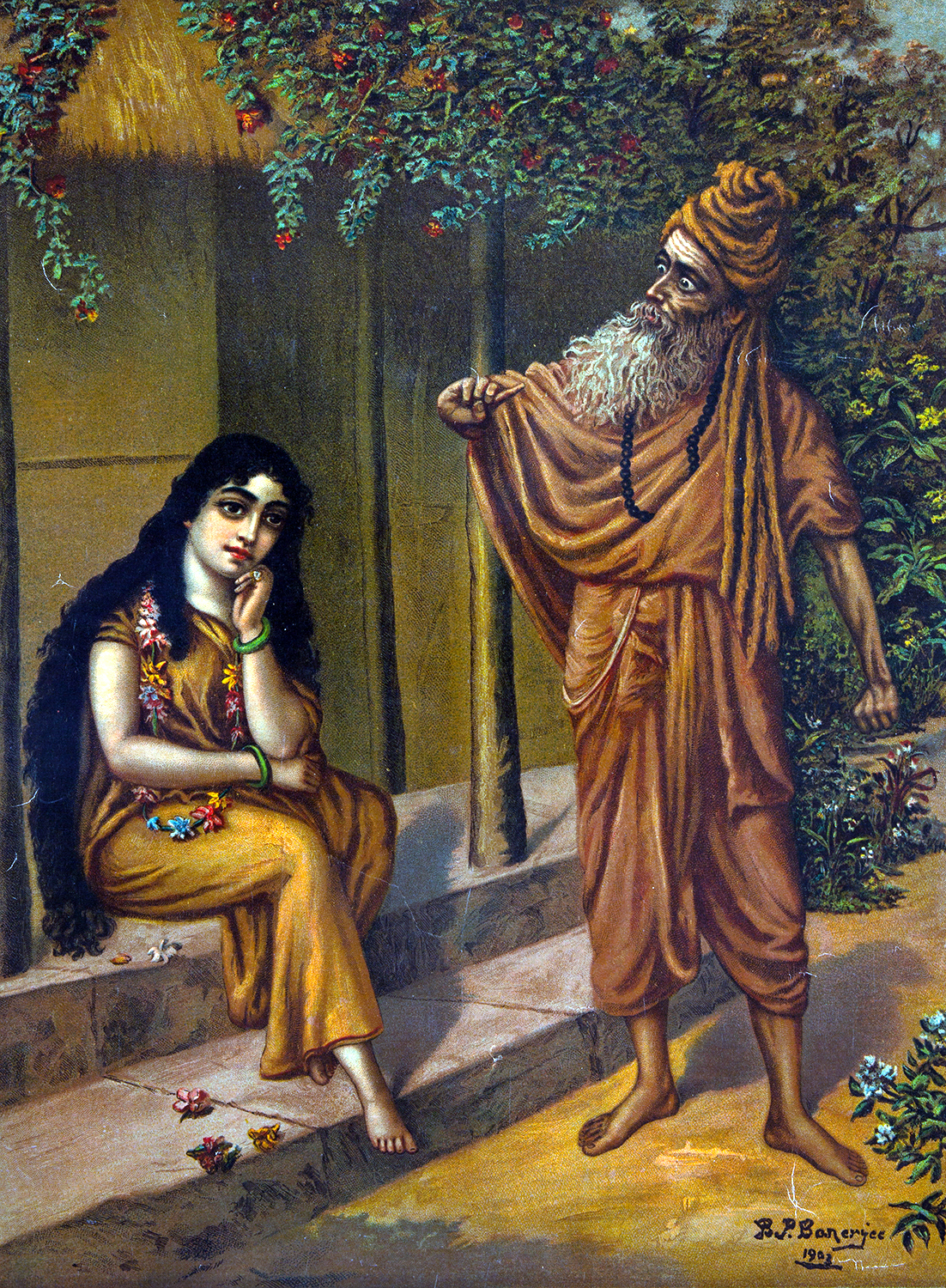
The critical moment when Sage Durvasa curses Shakuntala for her inattention, illustrated by Bamapada Banerjee

Upper cover of Monier Williams' pioneering 1855 English translation of Shakuntala, published in Hertford

Modern interpretation: Nirupama Rajendra Dance Theater's musical adaptation of Shakuntala
Abhijnanasakuntalam: The Pinnacle of Sanskrit Drama
In the pantheon of world literature, few works command the universal acclaim accorded to Kalidasa’s Abhijnanasakuntalam (The Recognition of Shakuntala). This seven-act Sanskrit drama, composed approximately in the 4th century CE, represents not merely the zenith of its author’s creative genius but stands as the crowning achievement of classical Indian theatrical tradition. When the German polymath Johann Wolfgang von Goethe first encountered the play in translation, he was moved to compose a celebrated couplet asking: “Wouldst thou the young year’s blossoms and the fruits of its decline, / And all by which the soul is charmed, enraptured, feasted, fed? / Wouldst thou the earth and heaven itself in one sole name combine? / I name thee, O Shakuntala! and all at once is said.”
The play dramatizes the romantic legend of Shakuntala and King Dushyanta, a story originally told in a single episode of the Mahabharata. Yet what Kalidasa achieves transcends mere adaptation. He transforms a straightforward narrative into a profound meditation on love, memory, recognition, and the interplay between human emotion and cosmic order. Through exquisite poetry, masterful characterization, and sophisticated dramatic structure, Abhijnanasakuntalam has captivated audiences and readers for over sixteen centuries, influencing theatrical traditions across Asia and, following its translation into English in 1789, inspiring European Romantic literature.
The play’s title, Abhijnanasakuntalam, literally means “The Token-Recognition of Shakuntala,” referring to the ring that serves as the crucial device for the heroine’s recognition by her forgetful husband. This recognition (abhijnana) operates on multiple levels—personal, spiritual, and cosmic—making the work a profound exploration of identity, memory, and destiny.
Historical Context and the World of Kalidasa
Though the exact dates of Kalidasa’s life remain uncertain, scholarly consensus places him during the Gupta period, often called the “Golden Age” of classical Indian civilization. The 4th century CE, during the reign of either Chandragupta II or his father Samudragupta, represents the most probable timeframe for the composition of Abhijnanasakuntalam. This was an era of remarkable cultural efflorescence, when Sanskrit literature, art, architecture, and scientific inquiry reached unprecedented heights.
The Gupta court provided ideal conditions for literary creation. Royal patronage supported poets, dramatists, and scholars, creating an environment where artistic excellence flourished. Sanskrit had evolved into a highly sophisticated literary language, capable of expressing subtle philosophical concepts and profound emotions with equal facility. The dramatic arts (natya) enjoyed immense popularity, with established theatrical conventions providing both structure and flexibility for creative innovation.
The play reflects the cultural synthesis characteristic of Gupta civilization. It seamlessly blends elements from Vedic tradition, epic narrative, courtly refinement, and folk culture. The hermitage (ashrama) setting of the opening acts represents the spiritual and natural heritage of Vedic India, while the court scenes showcase the sophisticated urban culture of the Gupta capital. This synthesis creates a work that speaks to multiple levels of Indian society while maintaining artistic unity.
Sanskrit drama during this period followed well-established conventions codified in treatises like the Natyashastra. Abhijnanasakuntalam belongs to the nataka genre—the most prestigious dramatic form, characterized by a well-known story, a hero of royal or divine status, and themes of love and heroism culminating in a happy ending. Kalidasa demonstrates mastery of these conventions while infusing them with unprecedented poetic brilliance and psychological depth.
Creation, Authorship, and Kalidasa’s Literary Genius
Kalidasa stands as the supreme poet (mahakavi) of classical Sanskrit literature. His name, meaning “Servant of Kali,” and the legends surrounding his life have been embellished over centuries, but his works speak unambiguously to his unparalleled literary genius. Beyond Abhijnanasakuntalam, he composed two epic poems (mahakavya)—Kumarasambhava and Raghuvamsha—the lyric masterpiece Meghaduta, and two other plays—Vikramorvasiya and Malavikagnimitra.
Yet even among these celebrated works, Abhijnanasakuntalam occupies a special position. The play demonstrates Kalidasa’s unique ability to blend various elements of Sanskrit literary tradition into a harmonious whole. His handling of meters reflects technical virtuosity—the play employs various Sanskrit verse forms alongside prose passages, with each chosen to suit the emotional tenor of particular scenes. The shloka (anushtubh) meter predominates for narrative passages, while more complex meters like vasantatilaka, malini, and mandakranta enhance moments of heightened emotion or description.
Kalidasa’s treatment of his source material reveals his creative approach. The Mahabharata presents Shakuntala’s story in relatively brief compass within the Adi Parva. The epic version emphasizes Dushyanta’s initial rejection of Shakuntala and focuses on establishing Bharata’s lineage. Kalidasa transforms this into a romantic drama centered on the protagonists’ emotional journey. He introduces the curse of Sage Durvasa as the reason for Dushyanta’s forgetfulness, thus preserving the king’s honor and deepening the play’s exploration of fate versus free will.
The dramatist’s genius particularly shines in his nature poetry and his psychological characterization. The hermitage scenes in Acts I-IV are suffused with descriptions of the natural world that serve both aesthetic and symbolic purposes. Nature mirrors and magnifies human emotions—the anxious deer, the jasmine creepers embracing mango trees, the peacocks dancing at monsoon clouds. This is not mere ornamentation but integral to the play’s vision of harmony between humanity and the natural order.
Synopsis and Structure: The Seven-Act Architecture
Abhijnanasakuntalam unfolds across seven acts (anka), following the classical dramatic structure while achieving remarkable emotional and thematic complexity within this framework.
Act I (Prathamaankah) opens with King Dushyanta hunting near the hermitage of Sage Kanva. Pursuing a deer, he is stopped by hermitage residents who remind him that the ashram is a sanctuary. There he first glimpses Shakuntala, the foster daughter of Kanva, tending the ashram’s plants with her two friends, Priyamvada and Anasuya. The sight of her instantly captivates the king. Through masterful dialogue, Kalidasa establishes both characters’ nobility while depicting the spontaneous arising of love. The act concludes with Dushyanta deciding to remain near the hermitage.
Act II (Dvitiyaankah) develops the romantic relationship. The king’s trusted companion, the jester Madhavya, provides comic relief while serving as confidant. Dushyanta overhears Shakuntala confessing her love to her friends, and through a bee metaphor—one of Sanskrit literature’s most celebrated passages—he reveals his own feelings. Their mutual attraction deepens despite Shakuntala’s modesty and the obstacles of their different social positions.
Act III (Tritiyaankah) brings the romance to consummation. Shakuntala’s lovesickness becomes apparent, concerning her friends. Sage Kanva, though away, has intuited the situation through his spiritual insight. The king and Shakuntala are married in the gandharva form—a love marriage by mutual consent, legitimate according to dharmic law. This act beautifully balances romantic passion with dharmic propriety, showing Kalidasa’s ability to satisfy both emotional and moral dimensions.
Act IV (Chaturthankah) introduces the dramatic crisis. Sage Durvasa, known for his quick temper, arrives at the hermitage seeking hospitality. Shakuntala, lost in thoughts of her now-departed husband, fails to notice him. Enraged by this perceived disrespect, Durvasa curses that the person occupying her thoughts will forget her entirely. Her friends’ pleas modify the curse: recognition will return when Dushyanta sees the signet ring he gave Shakuntala. Kanva returns and, learning of Shakuntala’s marriage and pregnancy, prepares to send her to the royal court.
Act V (Panchamaankah) depicts Shakuntala’s journey to the capital, beautifully rendered through her emotional farewells to the hermitage. The scenes of her parting from the ashram’s trees, deer, and birds rank among the most poignant in Sanskrit literature. Upon reaching the court, disaster strikes: Shakuntala has lost the ring while bathing in the sacred Sachi tirtha, and the curse takes effect. Dushyanta, with no memory of their relationship, cruelly rejects her. The Earth goddess Aditi mercifully causes Shakuntala to vanish, transporting her to the celestial realm.
Act VI (Shashthaankah) occurs after a year has passed. A fisherman finds the ring in a fish’s belly and brings it to the palace. The moment Dushyanta sees the ring, his memory floods back with overwhelming force. The act powerfully depicts his anguish, remorse, and desperate longing. Despite his recovery of memory, Shakuntala’s whereabouts remain unknown, deepening his suffering. Kalidasa’s psychological portrayal of the king’s guilt and grief demonstrates sophisticated understanding of human emotion.
Act VII (Saptamaankah) provides the long-awaited resolution. Years later, Dushyanta visits the celestial hermitage of sage Maricha while returning from assisting the gods in battle against demons. There he encounters a noble child playing with a lion cub—his son Bharata. The recognition scene unfolds gradually, building to the emotional reunion of husband and wife. The sage Maricha explains the curse and validates their son’s legitimacy. The play concludes with the family united, cosmic order restored, and Dushyanta prepared to return to earth with his wife and son, who is prophesied to become a great emperor.
Themes and Philosophical Dimensions
Abhijnanasakuntalam operates on multiple thematic levels, weaving together personal, social, and cosmic concerns into a unified artistic vision.
Love and Separation form the play’s emotional core. Kalidasa explores love (kama) as one of life’s fundamental values (purusharthas), neither dismissing it as mere sensuality nor elevating it above dharmic considerations. The love between Shakuntala and Dushyanta is portrayed as natural, noble, and spiritually significant. Their separation—caused by the curse—intensifies rather than diminishes their bond, demonstrating love’s transcendence of circumstance.
The theme of Recognition (abhijnana) extends beyond the plot device of the signet ring. Recognition operates on multiple levels: Dushyanta’s recognition of Shakuntala restores their relationship, but the play also explores recognition as spiritual awakening. The king must recognize not only his wife but his own failure, his dharmic obligations, and the deeper patterns of cosmic justice. Shakuntala’s recognition by the court, initially denied, is ultimately established through divine intervention, suggesting that true worth reveals itself despite temporary obscurity.
Memory and Forgetting receive profound treatment. The curse-induced amnesia represents more than a plot mechanism; it explores the fragility of human consciousness and identity. What are we without our memories? How does memory constitute the self? Dushyanta’s forgetfulness makes him, temporarily, less than himself—a powerful meditation on consciousness and continuity of identity. The ring serves as an external anchor for memory, suggesting that material objects can bridge the gap between past and present selves.
Nature and Harmony pervade the play’s imagery and structure. The hermitage represents humanity’s ideal relationship with the natural world—respectful, sustainable, and spiritually enriching. Shakuntala’s deep connection with plants and animals reflects this harmony. Her name itself, derived from shakunta (bird), connects her to the natural order. The disruption caused by the curse parallels ecological and cosmic disorder, while the resolution restores natural harmony at all levels.
The play explores Dharma (righteous duty) and its complexities. Multiple dharmic considerations intersect: Dushyanta’s royal duties, the dharma appropriate to hermitage life, the validity of different marriage forms, and obligations to progeny. Kalidasa presents these not as rigid rules but as nuanced principles requiring wisdom to apply. The gandharva marriage, while legitimate, creates complications precisely because it lacks public witness and ceremony—a subtle commentary on the relationship between private truth and social recognition.
Fate and Free Will emerge as intertwined rather than opposed forces. Durvasa’s curse represents fate or divine will, yet it operates through human actions (Shakuntala’s distraction, Dushyanta’s forgetting). The characters exercise agency within constraints, suggesting a sophisticated view of determinism and freedom. The curse’s conditional nature (broken by the ring) indicates that fate itself may be subject to modification through appropriate action.
Characterization and Psychological Depth
Kalidasa’s characters transcend the stock types of conventional Sanskrit drama, achieving psychological complexity that explains the play’s enduring appeal.
Shakuntala herself evolves from innocent forest maiden to dignified queen, her character arc reflecting her growth through suffering. In early acts, she embodies natural grace and unaffected virtue, her beauty enhanced by simplicity rather than ornament. Her love awakens gradually, portrayed with delicacy and psychological realism. The famous bee scene (Act II) where Dushyanta protects her from a bee’s attention demonstrates her mixture of modesty and nascent awareness of her own desire.
Her transformation occurs through adversity. When rejected at court, Shakuntala displays unexpected dignity and strength, defending her honor with eloquent arguments about dharma and justice. Her appeal to the king’s conscience, even while under the curse’s influence, reveals moral courage. By the final act, she has matured into a figure of serene nobility, her suffering having refined rather than diminished her character.
King Dushyanta represents the ideal of righteous kingship (rajarshi) complicated by human vulnerability. Initially presented as the heroic hunter-king, he reveals sensitivity and poetic sensibility during the courtship. His love transforms him, making him willing to delay royal duties to remain near Shakuntala. The curse’s effect on him raises profound questions: Is the cursed Dushyanta the same person as the lover? His cruel rejection of Shakuntala, while operating under the curse, still carries moral weight, and his subsequent anguish demonstrates recognition of this.
His character achieves its fullest depth in Act VI, where recovered memory brings not relief but intensified suffering. His self-recrimination, desperate attempts to find Shakuntala, and inability to forgive himself create a portrait of genuine psychological complexity. The resolution finds him chastened and deepened by suffering, more worthy of the reunion granted him.
Sage Kanva, though appearing primarily in Acts III-V, embodies the spiritual dimension balancing the play’s romantic elements. His foster-father’s love for Shakuntala is profound yet non-possessive. He recognizes her marriage as dharmic despite initial concerns about its secrecy, demonstrating wisdom that transcends conventional propriety. His emotional farewell to Shakuntala (Act V) ranks among the play’s most moving passages, revealing that spiritual advancement and human affection need not conflict.
The Companion Characters—Shakuntala’s friends Priyamvada and Anasuya, the king’s jester Madhavya—provide more than comic relief or plot functions. They reveal the protagonists through contrast and interaction while contributing their own perspectives. Priyamvada and Anasuya’s genuine affection for Shakuntala and their skillful encouragement of the romance show understanding and agency. Madhavya’s earthy pragmatism grounds the king’s poetic flights while his loyalty demonstrates Dushyanta’s ability to inspire friendship.
Minor Characters like Sage Durvasa and the fisherman serve specific dramatic functions while reflecting broader themes. Durvasa’s curse, though seemingly capricious, actually enforces dharmic law (proper attention to guests). The humble fisherman’s honesty in returning the ring demonstrates dharma operating across social classes.
Poetic Excellence and Aesthetic Achievement
Abhijnanasakuntalam represents the pinnacle of Kalidasa’s poetic artistry. The play’s language displays the full resources of classical Sanskrit literary expression while maintaining dramatic effectiveness.
Nature Poetry constitutes one of the play’s distinctive glories. Kalidasa’s descriptions transcend mere ornamentation, using natural imagery to externalize internal states and create symbolic resonances. The hermitage setting allows extensive nature poetry that serves multiple functions. When Shakuntala prepares to leave the ashram, her emotional state projects onto the natural world:
“The tender vine, as if understanding her grief, Sheds its blossoms like tear-drops, And the female chakravaka bird, Though surrounded by her mate, cries piteously.”
This pathetic fallacy, far from being a poetic cliché, expresses the play’s vision of interconnection between human consciousness and the natural order.
The Bee Scene in Act II demonstrates Kalidasa’s ability to charge natural imagery with erotic significance while maintaining decorum. As Dushyanta protects Shakuntala from a persistent bee, his words operate on two levels—addressing the bee while declaring his own feelings:
“Bee, you may touch the mango blossom; You may embrace the tender lotus; But do not touch this forbidden bloom For she belongs to another!”
The passage exemplifies Sanskrit poetry’s capacity for suggestion (dhvani), where explicit meaning carries implicit emotional and symbolic dimensions.
Emotional Landscapes receive sophisticated treatment throughout. Dushyanta’s anguish in Act VI employs varied images to express his inner state—he sees Shakuntala in clouds, hears her voice in the wind, finds her form in beautiful women. This psychological realism, conveyed through poetic imagery, creates powerful emotional identification.
The Sanskrit Language itself becomes an aesthetic element. Kalidasa exploits Sanskrit’s flexibility, using compound words (samasa) to create concentrated meaning and employing various meters to match emotional tone. The mixture of verse and prose allows realistic dialogue while reserving poetic passages for heightened moments.
Specific passages have become celebrated anthology pieces. Shakuntala’s farewell to the ashram (Act V) achieves extraordinary pathos:
“O farewell, you banks of the river Malini, Where I spent happy hours gathering flowers! Farewell, you trees that I have watered, Now treat your new caretaker as you have treated me!”
The simplicity and directness of emotion, combined with concrete specificity, create genuine feeling rather than mere rhetorical display.
Dramatic Structure and Theatrical Dimensions
As theater, Abhijnanasakuntalam demonstrates sophisticated understanding of dramatic construction and stagecraft, working within classical conventions while achieving distinctive effects.
The Seven-Act Structure allows extended character development and thematic exploration. Unlike Western five-act structure, the Sanskrit seven-act form permits more gradual pacing and greater scenic variety. Kalidasa uses this expansiveness effectively, allowing relationships to develop naturally rather than hastily.
Act Division follows logical dramatic units while creating effective act conclusions. Each act except the last ends with a moment of completed action or emotional culmination. Act III concludes with the marriage, Act IV with the curse, Act V with the rejection—each creating anticipation for the continuation while providing temporary closure.
The Recognition Scene (Act VII) employs the pratyabhijna device central to the nataka genre, but with distinctive handling. Rather than immediate recognition, Kalidasa structures a gradual revelation through the child Bharata, building emotional intensity before the final reunion. The scene balances various recognitions—father and son, husband and wife, king and future emperor—creating a complex culminating moment.
Theatrical Conventions of Sanskrit drama are skillfully employed. The sutradhara (stage manager) and his wife appear in the prologue, establishing theatrical frame. The vidushaka (jester) provides comic relief and serves as confidant. Regional languages (Prakrit) distinguish female and lower-status characters from Sanskrit-speaking nobles, creating linguistic variety appropriate to the characters’ social positions.
Stagecraft demands sophisticated production. Kalidasa’s stage directions indicate flying characters, magical appearances and disappearances, and multiple locations requiring effective scenic suggestion. The hermitage setting demands representation of the natural world, while court scenes require regal splendor. Traditional productions employed elaborate conventions for depicting these elements, while modern adaptations have found varied approaches.
The Play as Literature versus Performance creates ongoing interpretive questions. Written in an age when drama was performed, Abhijnanasakuntalam has survived primarily as a literary text. Modern productions must reconstruct or reimagine staging conventions that were once living traditions. Yet the play’s poetic richness ensures its effectiveness as literature even apart from theatrical realization.
Manuscripts, Editions, and Textual Tradition
The textual history of Abhijnanasakuntalam reflects the complex transmission of Sanskrit literature across centuries and geographical regions.
Manuscript Traditions exist in two major recensions—the shorter Devanagari version preserved in northern India, and the longer Bengali recension from eastern India. These differ in number of verses and specific readings, raising questions about original composition versus interpolation. Modern editions typically follow one or synthesize both traditions.
Early Manuscripts include palm-leaf copies from Nepal dating to the 11th-12th centuries, among the oldest physical witnesses to the text. A palm-leaf manuscript cover from 12th-century Nepal, preserved and illustrated with scenes from the play, provides valuable evidence of the work’s early reception and artistic interpretation. These manuscripts demonstrate the play’s geographical spread and continuing cultural significance across different regions of greater India.
Commentaries on the play began appearing relatively early. Notable commentators include Raghavabhatta (10th century) and Katayavema (date uncertain), whose glosses explain difficult passages, suggest interpretive possibilities, and preserve performance traditions. These commentaries reveal how successive generations of scholars and performers understood the work.
Printed Editions began appearing in the 19th century as European scholars undertook systematic publication of Sanskrit literature. The text edited by Monier Monier-Williams (1853) became influential in both scholarly and popular reception. Modern critical editions by Indian and international scholars continue refining the text and elucidating its complexities.
Western Discovery and Global Influence
The translation of Abhijnanasakuntalam into English by Sir William Jones in 1789 marked a watershed moment not only in Western understanding of Indian literature but in the emergence of European Romanticism.
Sir William Jones, the British philologist and jurist serving in Calcutta, possessed the rare combination of Sanskrit learning and literary sensitivity needed to convey Kalidasa’s poetry to English readers. His translation, published as Sacontala; or, The Fatal Ring, introduced European intellectuals to classical Sanskrit drama. Jones’s enthusiastic preface proclaimed the play’s excellence, comparing Kalidasa favorably to European dramatists.
European Reception was immediately enthusiastic. The translation appeared at the perfect historical moment—the late 18th century’s growing dissatisfaction with neoclassical literary conventions and increasing interest in non-European cultures. German intellectuals proved particularly responsive. Johann Gottfried Herder quickly translated Jones’s English into German (1791), making the work accessible to the German-speaking world.
Goethe’s Response represents the apex of European appreciation. The great German writer composed his famous couplet expressing his profound admiration. His engagement with Shakuntala influenced his own dramatic work, particularly the prologue to Faust, which echoes the play’s prologue. Goethe saw in Kalidasa a kindred spirit—a poet who united classical restraint with romantic emotion, integrated human experience with cosmic order.
Romantic Movement writers found in Shakuntala validation for their aesthetic principles. The play’s nature poetry, celebration of emotion, combination of realistic and supernatural elements, and flexible dramatic structure all appealed to Romantic sensibilities. Writers including Friedrich Schlegel, Novalis, and Samuel Taylor Coleridge engaged with the work, finding in Indian literature alternatives to Greco-Roman classical tradition.
Translation History continued expanding. By the mid-19th century, the play existed in most major European languages—German, French, Italian, Russian, Spanish. Each translation reflected the translator’s cultural context and literary goals. Monier Monier-Williams’s 1855 English version attempted greater fidelity to the Sanskrit original, providing both prose and verse translations that aimed for scholarly accuracy while maintaining literary quality.
Beyond Europe, translations appeared throughout Asia. Chinese, Japanese, Thai, Tibetan, and Indonesian versions demonstrate the play’s pan-Asian significance. Modern translations into numerous Indian languages have made Kalidasa’s Sanskrit accessible to contemporary Indian readers, ensuring the work’s continuing vitality in its culture of origin.
Adaptations and Artistic Influence
Abhijnanasakuntalam’s influence extends far beyond literary translation, inspiring adaptations across multiple artistic media and cultural traditions.
Traditional Indian Performance traditions incorporated the play into various regional theatrical forms. Kutiyattam, the Sanskrit theater tradition of Kerala, preserved elaborate productions of Shakuntala using ancient staging conventions. Kathakali, the dance-drama form, created distinctive versions emphasizing dramatic and emotional elements. These adaptations demonstrate the play’s flexibility across performance styles while maintaining connection to its Sanskrit original.
Classical Dance forms, particularly Bharatanatyam, Odissi, Kathak, and Kuchipudi, have choreographed scenes from Shakuntala, using the story as vehicle for exploring navaras (the nine emotional essences). The bee scene, the curse, the rejection, and the recognition provide powerful dramatic material for solo and ensemble dance compositions. Contemporary dance companies, like Nirupama Rajendra’s theatrical musical adaptation, continue creating new interpretations.
Visual Arts have found rich inspiration in Shakuntala. The 19th-century Indian painter Raja Ravi Varma created multiple celebrated paintings depicting scenes from the play, particularly Shakuntala’s contemplative moments and her letter-writing. These paintings, blending European realistic technique with Indian subject matter and aesthetic sensibility, became enormously popular, shaping popular visual imagination of the story. The Gupta-period Shakuntala sculptures from Mathura represent early visual interpretations. Contemporary artists continue engaging with the work, finding in it archetypal images of feminine beauty, natural harmony, and emotional depth.
Theater Productions worldwide have staged Shakuntala in diverse styles. European productions in the 19th and early 20th centuries often emphasized spectacle and exoticism. Peter Brook’s famous 1960s production sought to transcend cultural specificity through minimalist staging and universal themes. Indian directors have created productions ranging from traditionally styled Sanskrit performances to experimental modernist interpretations. Each production negotiates between fidelity to the text and adaptation to contemporary theatrical language.
Film and Television adaptations began in early Indian cinema. Silent film versions appeared in the 1920s, followed by sound films in multiple Indian languages. Television serializations have introduced the story to mass audiences. These adaptations often emphasize the romantic and spectacular elements while sometimes simplifying the play’s psychological and philosophical dimensions.
Opera and Musical Theater have provided another adaptive medium. Franco Alfano composed the opera Sakuntala (1921), while other composers have created musical settings of the story. Contemporary musical theater productions blend Indian classical music and dance with theatrical elements, creating hybrid performance forms.
Cultural Significance and Enduring Relevance
Abhijnanasakuntalam’s significance extends beyond literary merit to encompass broader cultural, philosophical, and humanistic dimensions.
Indian Cultural Identity finds powerful expression in the play. It represents the synthesis of various elements of classical Indian civilization—Vedic spirituality, epic narrative, courtly refinement, dramatic theory, and poetic excellence. The work embodies Indian aesthetic principles, particularly the concept of rasa (emotional essence) and dhvani (suggestion), demonstrating these theoretical concepts in practice. For modern India, Kalidasa and Shakuntala serve as sources of cultural pride and connection to classical heritage.
Feminine Archetypes receive nuanced treatment. Shakuntala represents neither passive victim nor merely idealized beauty. Her character combines strength and vulnerability, dignity and tenderness. She exercises agency in accepting Dushyanta’s love, demonstrates courage in confronting rejection, and achieves wisdom through suffering. Modern feminist readings have found both problematic elements (patriarchal structures) and empowering dimensions (Shakuntala’s moral authority) in the portrayal.
Environmental Consciousness emerges as increasingly relevant. The play’s extensive nature imagery and its vision of harmonious human-nature relationship speak to contemporary ecological concerns. Shakuntala’s deep connection with the ashram’s plants and animals, Kanva’s sustainable forest management, and the overall integration of human community with natural environment offer alternative models to destructive environmental relationships.
Cross-Cultural Understanding has been fostered by the play’s global reach. As one of the first substantial works of Asian literature to reach Western audiences, Shakuntala challenged Eurocentric literary assumptions and demonstrated the universality of great art. The play’s themes—love, memory, recognition, forgiveness—transcend cultural specificity while remaining rooted in particular Indian contexts, modeling how art can be both culturally specific and universally meaningful.
Philosophical Dimensions continue engaging thinkers. The play’s treatment of dharma, karma, memory, identity, and cosmic order invites philosophical reflection. Questions it raises remain vital: How do we balance competing duties? What constitutes authentic selfhood? How do individual actions relate to larger patterns of cosmic order? Can human error be redeemed?
Scholarly Reception and Interpretative Debates
Academic engagement with Abhijnanasakuntalam has generated rich interpretive traditions and ongoing scholarly debates.
Dating Controversies remain unresolved. While the 4th century CE represents consensus opinion for Kalidasa’s floruit, some scholars argue for earlier (3rd century) or later (5th-6th century) dates. Evidence includes linguistic analysis, cultural references within the works, and comparison with dated inscriptions and other literature. The uncertainty reflects the general difficulty of dating classical Sanskrit literature, where internal evidence is ambiguous and external corroboration scarce.
Authorship Questions, while less intense than for some ancient works, have occasionally surfaced. The extreme excellence of Shakuntala compared to other plays attributed to Kalidasa has prompted some to question whether all could be by the same author. Current scholarly consensus affirms single authorship while recognizing that Abhijnanasakuntalam represents Kalidasa at his creative peak.
Textual Criticism continues refining understanding of the play’s original form. The relationship between the Devanagari and Bengali recensions raises questions about interpolation, regional adaptation, and authorial revision. Some scholars argue the shorter version represents earlier composition, while others see it as abbreviated. Digital humanities methods are providing new analytical tools for textual comparison.
Source Studies examine Kalidasa’s transformation of the Mahabharata episode. Scholars analyze what he retained, what he altered, and what he added, seeking to understand his creative method and interpretive goals. The introduction of Durvasa’s curse, the expansion of romantic elements, and the elevation of Shakuntala’s character reveal systematic adaptation toward specific aesthetic and thematic ends.
Performance History research reconstructs how the play was originally staged and how staging practices evolved. This includes analyzing stage directions, studying commentaries describing performance, and examining references in dramatic theory texts. The relationship between Shakuntala as performed drama versus literary text continues generating scholarly discussion.
Comparative Literature studies place the play in global dramatic tradition. Comparisons with Greek tragedy, Shakespearean drama, and modern theater illuminate both distinctive features and universal dramatic elements. These studies contribute to understanding world theater history and challenging Eurocentric literary paradigms.
Cultural Studies approaches examine the play’s role in constructing Indian cultural identity, particularly during the colonial and nationalist periods. How was Shakuntala used to articulate Indian civilization’s excellence? How did colonial interpretations differ from nationalist readings? These questions connect literary study to broader issues of culture, power, and identity.
Gender Studies perspectives analyze representations of femininity, masculinity, and their relationship. Shakuntala’s agency and passivity, the power dynamics between characters, and the play’s resolution all invite feminist analysis. These readings produce diverse conclusions, reflecting both the text’s complexity and contemporary theoretical plurality.
Legacy and Continuing Influence
Over sixteen centuries after its composition, Abhijnanasakuntalam continues exerting influence on literature, performing arts, and culture globally.
Sanskrit Literary Tradition regards the play as the supreme achievement of classical drama, the standard against which other works are measured. Subsequent Sanskrit dramatists worked in Kalidasa’s shadow, his influence shaping dramatic conventions and aesthetic expectations. The play’s excellence simultaneously inspired emulation and discouraged competition, contributing to Sanskrit drama’s eventual decline as a living literary form.
Indian Regional Literatures have repeatedly adapted and reinterpreted the story. Versions exist in Hindi, Bengali, Tamil, Telugu, Kannada, Malayalam, Marathi, and other Indian languages, each adapting the story to regional literary conventions and cultural contexts. These adaptations demonstrate the story’s continuing vitality and its capacity for cultural translation.
Modern Indian Literature engages with Shakuntala through various strategies—reverential continuation, ironic subversion, feminist reinterpretation, postcolonial critique. Contemporary authors both honor the classical tradition and interrogate its assumptions, creating dialogues between past and present.
World Literature Canon firmly includes Abhijnanasakuntalam among humanity’s literary masterpieces. Anthologies, university courses, and scholarly studies regularly feature the play alongside works of Homer, Sophocles, Shakespeare, and other canonical authors. This global recognition represents both genuine appreciation of literary merit and the historical processes by which canons form.
Popular Culture references appear in varied contexts. Film titles, business names, cultural organizations, and educational institutions invoke Shakuntala, drawing on its associations with classical excellence, romantic love, and cultural heritage. The story’s archetypal elements ensure its continuing resonance in popular imagination.
Contemporary Adaptations continue appearing. Modern playwrights create new versions addressing current concerns—gender equality, environmental crisis, cultural identity. These adaptations demonstrate that great literature remains relevant not by unchanging timelessness but through capacity for meaningful reinterpretation across changing contexts.
Conclusion: The Eternal Recognition
Abhijnanasakuntalam endures because it achieves that rarest of artistic accomplishments—perfect fusion of form and content, local specificity and universal significance, aesthetic pleasure and philosophical depth. Kalidasa’s masterpiece offers readers and audiences multiple levels of engagement—as romantic drama, nature poetry, dharmic exploration, psychological study, and meditation on memory and recognition.
The play’s central metaphor—recognition (abhijnana)—operates as its defining principle. Just as Dushyanta must recognize Shakuntala, each generation of readers and audiences must recognize the work’s continuing relevance. This recognition is never automatic or complete; it requires active engagement, cultural translation, and interpretive creativity.
What Goethe recognized in the late 18th century remains true today: in Shakuntala, Kalidasa combined “heaven and earth” in a single artistic vision. The play integrates spiritual and material dimensions, courtly and natural settings, romantic passion and dharmic duty, individual psychology and cosmic order. This integration, achieved through supreme poetic artistry and profound human insight, explains why Abhijnanasakuntalam transcends its historical origins to speak to universal human experience.
For contemporary readers, the play offers multiple rewards. Its poetry provides aesthetic pleasure of the highest order. Its story engages emotions while satisfying intellectual and moral sensibilities. Its vision of human-nature harmony speaks to urgent ecological concerns. Its psychological insight illuminates the complexities of memory, identity, and relationship. Its affirmation of love’s power and dharma’s ultimate justice offers hope without naivety.
Abhijnanasakuntalam ultimately represents the possibility of recognition itself—recognition of beauty, goodness, and truth; recognition of our shared humanity across cultural and temporal distances; recognition that great art, while rooted in particular times and places, can illuminate universal human experience. In recognizing Shakuntala, we recognize ourselves—our capacity for love and loss, error and redemption, suffering and wisdom. This recognition, like that which reunites the play’s separated lovers, restores what seemed irrevocably lost, confirming that art’s power lies in its capacity to make us more fully human.
The signet ring that precipitates Dushyanta’s recognition of Shakuntala serves as the play’s central symbol. Like that ring, Abhijnanasakuntalam itself functions as a token—a material artifact that connects us to transcendent values, a specific work that opens onto universal truths. Each reading or performance renews the recognition, proving that great literature does not merely survive but lives, continuing to speak across the centuries to those willing to listen with ears and heart attuned to poetry’s enduring voice.