

Overview
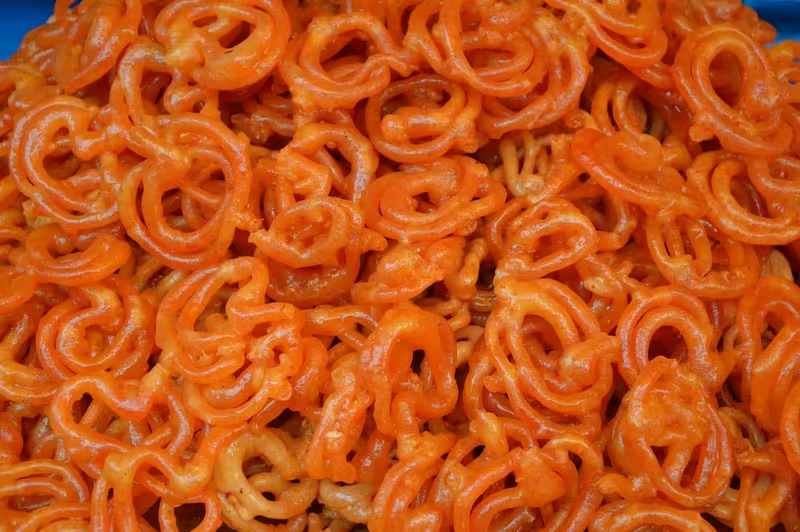
Jalebi is one of the most recognizable and beloved sweets across a vast geographical expanse stretching from North Africa through West Asia to the Indian subcontinent and East Africa. Distinguished by its characteristic bright orange or golden spiral shape and crispy-yet-syrupy texture, jalebi represents a remarkable example of culinary diffusion and regional adaptation. This deep-fried sweet, made from fermented batter and soaked in sugar syrup or honey, has transcended its West Asian origins to become an integral part of South Asian food culture, where it graces everything from festival celebrations to everyday street food stalls.
The enduring popularity of jalebi across such diverse cultures and regions speaks to its universal appeal and adaptability. Despite being known by many different names—jilapi in Bengal, zoolbia in Iran, meshabbek in Egypt, and pani walalu in Sri Lanka—the essential character of this sweet remains recognizable: spiral or pretzel-like shapes, a crispy exterior giving way to a syrup-soaked interior, and a bright, festive appearance that makes it instantly appealing.
What makes jalebi particularly significant in the context of Indian culinary heritage is its demonstration of how food traditions travel and transform. While originating in West Asia, jalebi has been so thoroughly embraced in the Indian subcontinent that many consider it quintessentially Indian. It appears at religious festivals, wedding celebrations, street corners, and sweet shops throughout India, Pakistan, Bangladesh, Nepal, and Sri Lanka, each region adding its own distinctive touch to this ancient recipe.
Etymology and Names
The sweet is known by a remarkable variety of names across its geographic range, reflecting the linguistic and cultural diversity of the regions where it has taken root. The name "jalebi" itself likely derives from the Arabic "zalabia" or "zalabiyeh," which in turn may have Persian roots in "zoolbia" or "zulbiya." These names share a common etymology that traveled along ancient trade routes connecting the Middle East, Central Asia, and the Indian subcontinent.
In the Indian subcontinent, regional languages have adapted the name in various ways. In Bengali, it becomes "jilapi" or "jilipi," while in some parts of India, it's called "jilebi" or "jilbi." The Nepali adaptation "jerry" represents a more significant phonetic shift, though the sweet itself remains recognizable.
Across West Asia and North Africa, the variations continue: "z'labia" in parts of North Africa, "mushabak" or "meshabbek" in Egypt and some Arab regions (meaning "latticed" or "netted," referring to its shape), "mushebek" in Ethiopia, and "zinghol" in Syria. In Turkey, it's known as "zulbiye," while Azerbaijan calls it "zülbiyə" or "zilviyə." Sri Lanka's "pani walalu" represents a completely independent naming tradition in Sinhala.
This linguistic diversity reflects not just translation but cultural adaptation—each name carrying with it slightly different connotations, preparation methods, and cultural associations specific to its region.
Historical Origins
Jalebi's origins lie in West Asia, though pinpointing an exact place and time of origin remains challenging due to the ancient nature of the sweet and its widespread early distribution. The dessert appears to have been known in the medieval Islamic world, from where it spread both westward into North Africa and eastward into Persia and eventually the Indian subcontinent.
Trade and Cultural Exchange
The spread of jalebi follows the ancient trade routes that connected the Mediterranean world with South Asia. Persian and Arab traders, travelers, and later, various ruling dynasties, played crucial roles in disseminating culinary traditions across vast distances. The techniques of deep-frying in oil and preserving foods in sugar syrup or honey were well-established in West Asian cuisine, and jalebi represents a sophisticated application of both methods.
The sweet likely entered the Indian subcontinent through multiple routes: via Persian cultural influence in northern India, through Arab maritime trade with the western and southern coasts, and through Central Asian connections. Once established in the region, it was enthusiastically adopted and adapted by local communities, becoming integrated into indigenous food traditions and celebration customs.
The remarkable uniformity of the basic preparation method—fermented batter piped in spiral shapes, deep-fried, and soaked in syrup—across such a wide area suggests that the fundamental recipe was well-established before regional variations developed. At the same time, local adaptations in ingredients, size, shape variations, and serving methods demonstrate how communities made this foreign sweet their own.
Ingredients and Preparation
Key Ingredients
Traditional jalebi requires a surprisingly simple set of core ingredients, though regional variations add complexity. The base is typically maida (refined wheat flour) or, in some variations, rice flour. The batter is mixed with water or yogurt and allowed to ferment, sometimes with the addition of yeast to accelerate the process. This fermentation is crucial, as it develops the characteristic slightly tangy flavor and creates the texture that becomes crispy when fried.
Ghee (clarified butter) is the traditional frying medium, though vegetable oil is commonly used as well. Some regional variations specifically call for sesame oil, which adds a distinctive nutty flavor. The sugar syrup, made by dissolving sugar in water and sometimes adding honey, may be enhanced with saffron for color and flavor, cardamom for aroma, or a touch of lemon juice to prevent crystallization. The vibrant orange-yellow color often comes from saffron or, in modern preparations, food coloring.
Optional ingredients include yogurt in the batter for tanginess and to aid fermentation, sesame seeds for texture and flavor, and spices like cinnamon or cardamom. Some premium versions use pure honey instead of sugar syrup, creating a more complex flavor profile.
Traditional Preparation
The preparation of jalebi is as much art as technique. The batter, after fermentation (which can take anywhere from a few hours to overnight), must achieve the right consistency—thick enough to hold its shape but fluid enough to pipe smoothly. Traditionally, the batter is placed in a cloth with a small hole or a specialized piping bag with a small nozzle.
The cooking process requires skill and timing. Hot ghee or oil is brought to the correct temperature—too hot and the jalebi burns before cooking through; too cool and it absorbs excessive oil and becomes soggy. The cook then pipes the batter directly into the hot oil in a continuous spiral or pretzel-like motion, creating the characteristic shape. The shape itself is not merely decorative; the multiple loops and curves increase the surface area, allowing for better syrup penetration while maintaining structural integrity.
The jalebi fries until crispy and golden, usually taking just a minute or two. Timing is critical—overcooking makes them hard, while undercooking leaves them doughy. Once fried, they are immediately transferred to warm sugar syrup where they soak for several seconds to a few minutes, depending on the desired level of sweetness and moisture. The hot jalebi absorb the syrup readily, creating the characteristic sweet, sticky, yet crispy texture.
Some versions are served immediately while hot and crispy with syrup-soaked interiors. Others are allowed to cool, developing a different but equally appealing texture where the exterior remains relatively crisp while the interior becomes softer and more uniformly sweet.
Regional Variations
The basic technique remains remarkably consistent across regions, but significant variations exist. In parts of India, particularly in Rajasthan and Uttar Pradesh, jalebi are often larger and thicker, with a more pronounced crispy texture. The Bengali jilapi tends to be smaller and more delicate, sometimes made with rice flour for a different texture.
Chhena jalebi represents a significant departure from the traditional recipe, using chhena (cottage cheese) as the base instead of flour batter. This creates a softer, more fudge-like texture while maintaining the spiral shape and syrup-soaked character. Shahi jilapi or "royal jalebi" are considerably larger and more elaborate versions, sometimes as big as a plate, often served at special occasions.
The Persian zoolbia, while similar in concept, often features slightly different proportions and may be served alongside bamieh (another syrup-soaked sweet). In some North African variations, the shapes may be more free-form rather than perfect spirals, and honey is more commonly used than sugar syrup.
The shape itself can vary from tight spirals to loose pretzel shapes to more irregular lattice patterns, each regional style having its own aesthetic and textural preferences. Some versions incorporate sesame seeds sprinkled on top, adding a nutty flavor and textural contrast.
Cultural Significance
Festivals and Occasions
Jalebi holds a special place in celebratory contexts across South Asia. In India, it's commonly associated with festivals like Diwali, Holi, and regional harvest festivals. The bright color and sweet taste make it symbolically appropriate for joyous occasions. Many Hindu and Jain communities include jalebi among the sweets offered during religious ceremonies and distributed as prasad (consecrated food offerings).
During the Islamic celebration of Eid, jalebi appears on dessert tables from Pakistan to India to Bangladesh. Wedding celebrations across religious and regional boundaries often feature jalebi, whether as part of elaborate sweet spreads or distributed to guests as part of the festivities. The sweet's association with celebration is so strong that in many regions, no major festival or happy occasion feels complete without it.
In Nepal, where it's known as jerry, it similarly features in festivals and celebrations, adapted to local tastes and occasions. Across its entire geographic range, jalebi transcends religious boundaries, being enjoyed by Hindu, Muslim, Sikh, Buddhist, and secular communities alike.
Social and Religious Context
Jalebi's vegetarian nature makes it acceptable across various dietary restrictions in South Asian communities. It contains no eggs or meat products, making it suitable for vegetarian festivals and occasions. However, the use of ghee means traditional preparations are not vegan, though modern versions sometimes use vegetable oil throughout.
The sweet has also become deeply embedded in street food culture, transcending its festive origins. In many Indian cities, jalebi sellers set up their stations early in the morning, and fresh, hot jalebi with milk or rabri (sweet condensed milk) constitutes a popular breakfast combination. This pairing of jalebi with milk represents an interesting dietary balance, combining the sweet with protein.
The public preparation of jalebi, visible to customers on the street, has become something of a performance art. Skilled jalebi makers attract crowds who watch the hypnotic process of piping spirals into hot oil, the immediate sizzling and bubbling, the perfect golden color developing, and the final immersion in glistening syrup. This theatrical quality adds to jalebi's appeal as experiential food, not just consumed but witnessed in its creation.
Culinary Techniques
The preparation of jalebi exemplifies several important traditional cooking techniques. Fermentation, one of humanity's oldest food preservation and transformation methods, plays a crucial role in developing the batter's flavor and texture. The natural yeasts and bacteria that develop during fermentation create subtle tang that balances the sweet syrup, while also producing gases that contribute to the final texture.
Deep-frying, another ancient technique, requires precise temperature control and timing. The skill lies in maintaining oil temperature while constantly adding new batter, ensuring even cooking, and avoiding burning or undercooking. The traditional method of piping batter freehand into hot oil demands steady hands, muscle memory, and years of practice to achieve consistent shapes.
The sugar syrup preparation involves understanding crystallization and achieving the right consistency—too thin and it won't coat properly; too thick and it crystallizes. The syrup must be kept at the right temperature to allow proper absorption without making the jalebi soggy. Some preparations add a touch of lemon juice or citric acid to the syrup, using the chemistry of invert sugar formation to prevent unwanted crystallization and maintain the right texture.
Evolution Over Time
While jalebi's basic form has remained remarkably consistent over centuries, modern variations and fusions have emerged. Contemporary sweet shops experiment with flavored versions—chocolate jalebi, rose jalebi, kesar (saffron) jalebi with even more pronounced saffron flavor, and rabri-filled jalebi with sweet condensed milk injected inside.
The commercialization and packaged food industry have led to pre-made jalebi available in stores, though connoisseurs generally prefer fresh preparation. Some manufacturers have created instant jalebi mixes, attempting to simplify the traditionally time-intensive fermentation process, though these often compromise on flavor and texture.
In the diaspora communities across the world, jalebi has traveled to new continents, available in Indian restaurants and sweet shops from London to Toronto to Dubai. This global spread represents a new chapter in jalebi's long history of cultural migration.
Famous Establishments
While specific establishments are not detailed in the source material, jalebi is renowned across the Indian subcontinent as quintessential street food and sweet shop fare. Major cities like Delhi, Mumbai, Kolkata, Lucknow, Karachi, and Dhaka have legendary jalebi spots known to locals, though these represent living culinary traditions rather than documented historical establishments.
The regions particularly famous for jalebi include Uttar Pradesh in India, where cities like Lucknow and Varanasi have strong jalebi traditions, and Bengal, where jilapi is an integral part of the local sweet-making culture. In Pakistan, Karachi and Lahore are known for their exceptional jalebi, often served with milk as a breakfast combination.
Health and Nutrition
From a modern nutritional perspective, jalebi is calorie-dense, high in simple sugars and carbohydrates, and contains significant amounts of fat from the frying process. Traditional preparations using ghee add saturated fats, though these also contribute to the characteristic flavor and texture.
In traditional dietary understanding, particularly in Ayurvedic contexts, such sweets were consumed in moderation as occasional treats during festivals and celebrations, not as everyday food. The fermentation process does add some beneficial bacteria, though the subsequent frying destroys most of these. The small amount of yogurt sometimes included in the batter provides minimal protein.
Despite its indulgent nature, jalebi's role in celebratory contexts suggests a traditional understanding of such foods as occasional pleasures that mark special occasions, contributing to social bonding and cultural continuity rather than serving as daily sustenance.
Modern Relevance
Jalebi remains enormously popular across its traditional geographic range. In contemporary India, it bridges economic and social classes—available from humble street stalls to high-end sweet shops, from small-town festivals to metropolitan five-star hotel buffets. This democratic appeal ensures its continued relevance in modern Indian food culture.
The sweet has also gained recognition internationally as Indian cuisine has spread globally. In diaspora communities, jalebi serves as a connection to home and heritage, while also introducing new audiences to South Asian sweet traditions. Food festivals, cultural events, and Indian restaurants worldwide feature jalebi as a representative Indian dessert.
Social media has given jalebi new visibility, with videos of its preparation garnering millions of views. The visually striking process of making jalebi—the spiraling batter hitting hot oil, the immediate transformation to golden spirals, the gleaming syrup coating—makes it perfect for visual platforms, introducing new generations to this ancient sweet.
Contemporary chefs and food innovators continue experimenting with jalebi, creating fusion desserts that maintain the essence while adding new elements. These modern interpretations, while sometimes controversial among traditionalists, demonstrate jalebi's adaptability and enduring appeal.
The persistence of traditional preparation methods alongside modern innovations suggests that jalebi has successfully navigated the transition into contemporary food culture while maintaining its connection to historical and cultural roots. Street vendors still pipe spirals into hot oil much as their predecessors did centuries ago, even as packaged versions appear in supermarkets and fusion versions emerge in upscale restaurants.