

Overview
Vada Pav stands as one of India's most democratic and beloved street foods, embodying the spirit of Mumbai in every bite. This simple yet ingenious creation consists of a batata vada (spiced potato fritter) nestled inside a soft pav (bread bun), typically served with chutneys and a green chili on the side. Born in 1966 from the innovative minds of Ashok Vaidya and Sudhakar Mhatre, Vada Pav was created to address a pressing need: providing affordable, filling, and tasty food to Mumbai's bustling working-class population, particularly the textile mill workers who needed quick sustenance during their demanding workdays.
What makes Vada Pav culturally significant extends far beyond its taste. It represents Mumbai's egalitarian food culture, where business executives and laborers alike queue at the same street stalls for their favorite snack. The dish captures the essence of the city - fast-paced, efficient, unpretentious, and accessible to all. Its nickname, the "Bombay Burger," acknowledges both its physical resemblance to Western fast food and its similar role in feeding an industrial urban population.
From its origins as hyperlocal street food to its current status as a pan-Indian snack available in food stalls and restaurants nationwide, Vada Pav's journey mirrors Mumbai's own evolution as India's financial and cultural capital. It has become not just food, but a cultural icon that Mumbaikars carry with pride as part of their city's identity.
Etymology and Names
The name "Vada Pav" is straightforward in its etymology, combining two distinct elements from Indian culinary vocabulary. "Vada" (also spelled "wada") refers to a category of savory fried snacks popular across India, typically made with various batters or doughs. The term has ancient roots in South Indian cuisine, where numerous varieties of vadas exist. "Pav" (also spelled "pao") comes from the Portuguese word "pão," meaning bread, reflecting the Portuguese colonial influence on Mumbai's food culture dating back to the 16th century.
The dish is known by several alternative names that reflect different regional pronunciation patterns: Vada Pao, Wada Pav, Wada Pao, Pao Vada, Pav Vada, Pao Wada, and Pav Wada. The more specific term "Batata Wada Pav" explicitly mentions "batata" (potato), though this is often shortened in common usage. In English-speaking contexts, particularly in media coverage and restaurant menus, it's frequently called the "Bombay Burger," a moniker that cleverly positions it as Mumbai's answer to the Western hamburger while acknowledging the city's former colonial name.
The flexibility in spelling and word order (vada-pav versus pav-vada) reflects the oral tradition of street food culture, where names evolve organically through usage rather than being standardized. In Marathi, the primary language of Maharashtra, it's commonly written as वडा पाव, maintaining its widespread popularity across linguistic communities in the state.
Historical Origins
Vada Pav's history is remarkably well-documented for a street food, with its invention precisely dated to 1966. The dish was created by Ashok Vaidya in collaboration with Sudhakar Mhatre, who recognized a market opportunity at Dadar station, one of Mumbai's busiest railway junctions. The timing was significant - this was an era when Mumbai (then Bombay) was experiencing rapid industrialization, with thousands of workers commuting daily to textile mills and factories.
The genius of Vada Pav lay in its practicality. Workers needed something affordable (the original price was just a few paise), filling (the potato and bread combination provided substantial calories), quick to eat (no cutlery required, consumed on the go), and vegetarian (catering to Maharashtra's large vegetarian population). The combination of the already-popular batata vada with the Portuguese-influenced pav bread created something entirely new - Mumbai's own fast food.
The dish caught on rapidly, spreading from Dadar station to other railway stations and street corners across Mumbai. By the 1970s and 1980s, Vada Pav stalls became fixtures of the city's landscape, with vendors setting up at strategic locations - near railway stations, bus stops, office complexes, and college campuses. Each vendor developed their own style and loyal following, though the basic formula remained consistent.
The socio-economic context of Vada Pav's creation cannot be overstated. Post-independence Mumbai was transforming into India's commercial capital, attracting migrants from across Maharashtra and beyond. These workers, often living far from their workplaces due to housing constraints, needed affordable meal options. Vada Pav filled this need perfectly, becoming the working person's meal - accessible, satisfying, and unpretentious.
Ingredients and Preparation
Key Ingredients
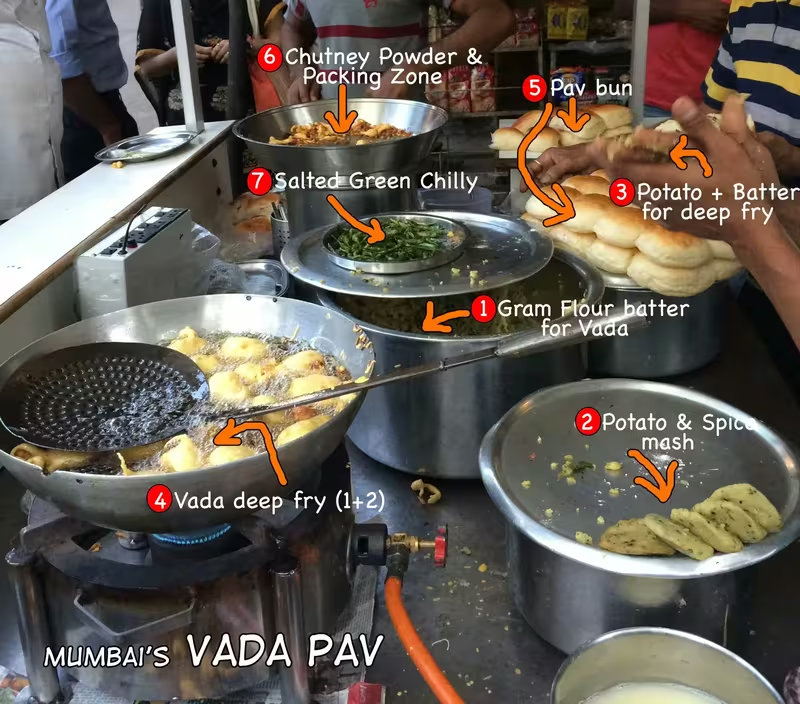
The beauty of Vada Pav lies in its simplicity, requiring just a handful of ingredients that combine to create something greater than the sum of its parts. The star ingredient is the potato (batata in Marathi), typically boiled, mashed, and seasoned with turmeric, mustard seeds, green chilies, curry leaves, and other spices. The potato filling is then shaped into round patties and coated in a besan (gram flour) batter before deep frying to create the vada.
The pav is equally crucial - a soft, slightly sweet bread roll that provides the perfect textural contrast to the crispy vada. These buns, influenced by Portuguese baking traditions, are now produced by numerous bakeries across Mumbai, with some vendors having preferred suppliers known for particular qualities of softness or taste. The pav is typically warmed or lightly toasted before serving, sometimes with a smear of butter.
Accompaniments are essential to the complete Vada Pav experience. The most traditional is dry garlic chutney (lehsun chutney), made from red chilies, garlic, and peanuts, which adds a sharp, spicy kick. Sweet tamarind chutney provides a contrasting flavor note, while green chutney made from coriander and mint offers freshness. A fried green chili (mirchi) is the traditional accompaniment, though not always consumed by those wary of excessive heat.
Traditional Preparation
Preparing authentic Vada Pav is a multi-step process that begins with making the potato filling. Potatoes are boiled until tender, peeled, and mashed. A tempering (tadka) is prepared by heating oil and adding mustard seeds, which are allowed to pop, followed by curry leaves, green chilies, ginger, garlic, and turmeric. This aromatic mixture is combined with the mashed potatoes, along with salt and sometimes a pinch of asafoetida (hing). The mixture is kneaded until uniform and shaped into round, flat patties.
The batter for coating is made from besan mixed with water to a flowing consistency, seasoned with turmeric, red chili powder, and salt. Each potato patty is dipped in this batter and carefully lowered into hot oil for deep frying. The vadas are fried until they achieve a deep golden color and crispy exterior, then drained on paper or wire racks.
The assembly is simple but must be done correctly: the pav is sliced horizontally, leaving one side attached like a hinge. The cut side may be lightly toasted on a griddle. Dry garlic chutney is spread on both interior surfaces, followed by sweet tamarind chutney if desired. The hot vada is placed inside, and the sandwich is ready to eat. The fried green chili is served on the side.
Street vendors have perfected an efficient assembly line method, often preparing multiple vadas simultaneously while managing pav warming and customer service. This efficiency is part of what makes Vada Pav such successful street food - customers typically wait no more than a minute or two for their order.
Regional Variations
While Vada Pav originated in Mumbai, it has spread throughout Maharashtra and beyond, developing local variations along the way. The Pune version often includes additional chutneys and sometimes a more generous hand with spicing. Some vendors in various cities have introduced cheese vada pav, butter vada pav (with extra butter melted into the pav), and even schezwan vada pav (using Chinese-Indian fusion sauce) to cater to evolving tastes.
In some areas outside Maharashtra, adaptations have been made to local preferences, though purists argue these depart from authentic Vada Pav. The core formula, however - potato vada in pav with chutneys - remains remarkably consistent across locations, a testament to the perfection of the original concept.
Cultural Significance
Social and Economic Context
Vada Pav occupies a unique position in Indian food culture as the great equalizer. Unlike many foods that signal class or community identity, Vada Pav is genuinely consumed across all economic strata. A business executive in a three-piece suit and a construction worker in dusty clothes might stand side by side at the same stall, united in their appreciation for this simple snack. This democratic quality makes it quintessentially Mumbaikar - reflecting the city's reputation as a place where merit and hard work matter more than background.
The economics of Vada Pav also tell an important story. For decades, it has remained one of the most affordable filling foods available in what is consistently ranked among India's most expensive cities. Even as prices have risen from paise to rupees, Vada Pav has maintained its position as an economical meal option. For many students, young professionals, and daily wage workers, it remains a reliable breakfast or lunch choice that doesn't strain their budget.
Daily Life and Routine
For Mumbaikars, Vada Pav is woven into the fabric of daily life. It's the quick breakfast grabbed at the railway station before boarding a packed local train, the mid-morning snack that tides one over until lunch, the evening treat on the way home. Street vendors develop relationships with regular customers, knowing their preferences - extra chutney, less spicy, extra green chili - without being asked.
The food has also become part of Mumbai's social rituals. Friends meeting casually will often do so over Vada Pav and cutting chai (small glasses of tea) at a popular stall. It's the fuel for late-night study sessions, the post-movie snack, and the comfort food sought when away from the city. For Mumbaikars living elsewhere, Vada Pav represents home in a way few other foods do.
Identity and Pride
Vada Pav has transcended its origins to become a symbol of Mumbai identity. Mumbaikars take pride in their city's signature snack, defending its authenticity and quality with passion. Food bloggers, journalists, and regular citizens engage in spirited debates about which stall serves the best Vada Pav - debates that have no resolution but are enjoyed for their own sake.
The dish represents several values that Mumbai holds dear: efficiency, accessibility, unpretentiousness, and quality without luxury. It embodies the city's no-nonsense attitude - good food doesn't need expensive ingredients or elaborate presentation, just honest flavor and proper execution. This philosophy extends beyond food to how many Mumbaikars approach life and work.
Culinary Techniques
The key techniques in Vada Pav preparation, while seemingly simple, require skill to master. The tempering (tadka) that flavors the potato filling must be done at the right temperature - too low and the spices won't release their flavors; too high and they'll burn. The timing of adding each ingredient matters: mustard seeds first, allowed to pop before adding curry leaves, then the other aromatics.
Creating the right batter consistency is crucial. Too thick and it creates a heavy coating that overshadows the potato; too thin and it won't adhere properly or create the desired crispy shell. The batter must also be seasoned correctly - bland coating can ruin otherwise perfect filling.
Deep frying requires attention to oil temperature and timing. The oil must be hot enough to create immediate sizzle and seal the exterior, but not so hot that the outside burns before the inside heats through. Experienced vendors can judge by sound and appearance when vadas are perfectly done.
Even assembling the final product involves technique. The pav must be sliced carefully to maintain structure while opening enough to accommodate the vada. Chutney application should be even and in the right quantity - enough for flavor but not so much that it makes the pav soggy. These details distinguish exceptional Vada Pav from mediocre versions.
Evolution Over Time
Since its 1966 invention, Vada Pav has undergone considerable evolution while maintaining its essential character. The basic recipe has remained remarkably stable, but the context and presentation have changed. What began as purely street food is now available in air-conditioned quick-service restaurants, food courts, and even upscale fusion establishments.
The rise of food delivery apps has brought Vada Pav into homes across Indian cities, changing its consumption patterns. What was once eaten standing at a stall or while walking is now also enjoyed while sitting on a couch. Some brands have attempted to package Vada Pav for retail, though with limited success - the dish is best consumed fresh and hot.
Innovation has come in the form of variations: cheese vada pav, fried vada pav (where the entire sandwich is dipped in batter and fried), pizza vada pav, and numerous other creative interpretations. While purists often dismiss these as gimmicks, they demonstrate the dish's flexibility and continued relevance to younger generations.
The COVID-19 pandemic posed challenges for street vendors, but also spurred adaptations. Many moved to online ordering, pre-packaged servings, and contactless delivery. The resilience of the Vada Pav business during this period spoke to both the vendors' entrepreneurship and customers' loyalty to their favorite food.
Famous Establishments
While Vada Pav is fundamentally street food, certain vendors and establishments have achieved legendary status. These range from decades-old street stalls that attract loyal followings to newer chains attempting to standardize and scale the product. Each famous spot has its own story - the original vendor who trained under one of the early pioneers, the stall that served a particular Bollywood star, the location that's been at the same corner for forty years.
Railway stations remain prime locations for Vada Pav consumption, with stalls near platforms doing brisk business throughout the day. Certain stations - Dadar, where it all began, along with Churchgate, Mumbai Central, and others - are known for particularly good Vada Pav. Universities and colleges typically have their own beloved vendors who become part of the institutional memory, with alumni returning years later to revisit their favorite stall.
Modern Relevance
In contemporary India, Vada Pav maintains strong relevance despite competition from global fast-food chains and new food trends. Its affordability, vegetarian nature, and established taste profile continue to appeal to health-conscious consumers and those seeking authentic regional flavors over homogenized international options.
The dish has become a point of cultural pride and even political symbolism. Some political movements in Maharashtra have embraced Vada Pav as representative of Marathi identity and local entrepreneurship, contrasting it with multinational food corporations. This has occasionally led to campaigns promoting Vada Pav consumption as an act of regional solidarity.
Food enthusiasts and chefs internationally have begun recognizing Vada Pav as an exemplar of successful street food design - simple, affordable, flavorful, and perfectly adapted to its context. It appears on lists of must-try street foods and has inspired fusion interpretations in cities far from Mumbai.
The story of Vada Pav - from 1966 railway station innovation to national cultural icon - demonstrates how food can capture something essential about a place and its people. It remains not just a snack, but a edible expression of Mumbai's character: resourceful, unpretentious, democratic, and deeply satisfying. Whether eaten at a historic street stall or a modern restaurant, Vada Pav continues to connect people to the city's working-class roots and its ongoing transformation.