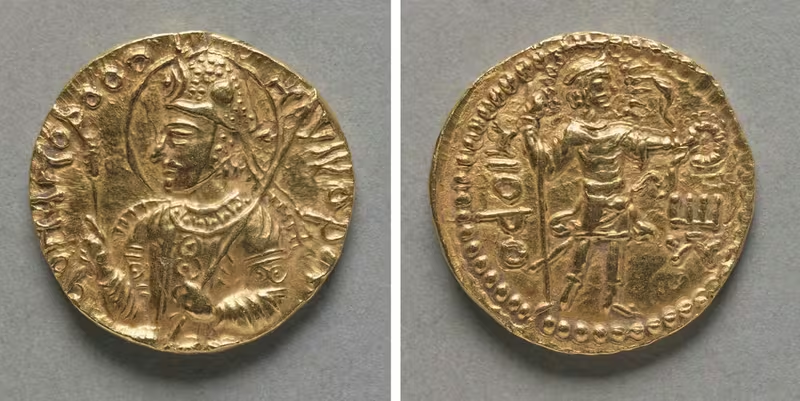
Kushan Coinage: Empire, Gods, and Royal Power in Metal
Gold coins weighing about 7.9 grams formed the principal high-value currency of the Kushan Empire, while base-metal issues appeared in a wide range of weights, from 12 grams to 1.5 grams. Issued approximately between 30 and 375 CE across North India and Central Asia, Kushan coinage presents a political and religious landscape in miniature. One side commonly shows a deity, while the other presents the ruler as a profile head, a standing figure, or a mounted king.
These coins broadly continued the Hellenistic visual language of the preceding Greco-Bactrian rulers. Yet their imagery also records strong Iranian influence and the participation of Indian religious traditions. The inscriptions are typically in Bactrian, written in a script derived from Greek. Royal titles changed over time, and the coins display tamga symbols that functioned as monograms for rulers. Because written evidence for Kushan political history is limited, the coinage provides much of what is known about the empire’s rulers, regional organization, and changing economic systems.
Discovery and Provenance
Discovery
The historical account of Kushan coinage does not identify a single excavation, discovery, or findspot for this body of material. Kushan coinage represents issues produced over several centuries rather than one isolated object. Its evidence comes from coins associated with the empire’s rulers, regional mints, legends, symbols, weights, and changing designs.
Journey Through History
Kushan coins circulated within an empire that appears to have contained several semi-independent regions. MacDowell identified three regional copper issues associated with Kajula Kadphises and Vima Taktu. Bactria produced the largest coins, weighing 12 grams, as well as pieces of 1.5 grams. Gandhara issued large coins of about 9–10 grams and small coins of approximately 2 grams. In the Indian area, coins weighed about 4 grams.
Later issues were brought into a unified central weight system. Kushan coinage was also copied beyond the empire. Imitations appeared among the Kushano-Sasanians in the west and in the kingdom of Samatata in Bengal to the east. Toward the end of Kushan rule, the first coinage of the Gupta Empire derived its weight standard, techniques, and designs from Kushan models.
Current Home
No single museum, collection, or current display location is identified for Kushan coinage as a whole. The material is best understood as a historical coin series rather than a single museum object with a documented ownership history.
Physical Description
Materials and Construction
The main Kushan coins were gold, while base-metal issues were produced in multiple weights. Little silver coinage was issued. In later periods, the gold itself was debased with silver, indicating a gradual reduction in the value of the metal.
The coins were produced through minting practices involving engraved dies. The surviving designs show the influence of Hellenistic models, while late first- and second-century CE issues also reveal continuing Roman influence in their designs and mint practices.
Dimensions and Form
The gold coinage generally weighed 7.9 grams. Vima Kadphises issued three gold denominations: two pieces weighing 15.75 grams, one weighing 7.8 grams, and a quarter-dinar piece weighing 1.95 grams. Base-metal coins varied more widely, with weights between 12 grams and 1.5 grams.
Condition
The condition of individual Kushan coins varies, but no general condition is specified for the coinage as a whole. The artistry of the dies is generally considered lower than the exceptionally high standards of the best Greco-Bactrian coins.
Artistic Details
A typical Kushan design places a deity on one side and the ruler on the other. Kings may appear as profile heads, standing figures officiating at a fire altar in a Zoroastrian style, or mounted on horseback. Tamga symbols appear on many coins as monograms associated with rulers.
The imagery is particularly notable for its broad pantheon. Greek figures include Helios, Hephaistos, Selene, Anemos, Heracles, and Sarapis. Indic figures include Buddha, Maitreya, Mahasena, Skanda Kumara, and Shakyamuni Buddha. Iranian divinities include Mithra, Nana, Atar, Vata, Oxus, Ahura Mazda, Verethragna, and others.
Historical Context
The Era
The Kushan Empire occupied a cultural zone linking North India and Central Asia. Its coinage reflects contact among Hellenistic, Iranian, Indian, and Roman traditions. The use of Bactrian language in a Greek-derived script, together with the changing royal title under Kanishka, shows how political identity developed across these cultural environments.
Purpose and Function
The coins served as currency and as instruments of royal communication. Their portraits presented the authority of Kushan rulers, while divine images connected kingship with a varied religious pantheon. Differences among regional issues also reveal the economic organization of the empire.
Commissioning and Creation
The coins were issued under Kushan rulers, including Kajula Kadphises, Vima Taktu, Vima Kadphises, Kanishka, and Huvishka. Several regional mints produced the early base-metal issues. Under later rulers, the coinage moved toward a unified central weight system.
Significance and Symbolism
Historical Importance
Kushan coinage is a major historical record because much of the limited information about Kushan political history derives from coins. Royal portraits, titles, tamgas, deity names, metal content, and weight standards together provide evidence for rulers, political authority, regional administration, and economic change.
Artistic Significance
The coins demonstrate the persistence of Hellenistic forms while incorporating Roman, Iranian, and Indian features. Their designs show how visual traditions could be adapted across a multilingual and religiously diverse empire.
Religious/Cultural Meaning
The Kushan pantheon contains more than 30 different gods represented on coins and seals. Early coins use Greek names for Greek deities. During Kanishka’s reign, the language changed to Bactrian, though the Greek-derived script remained in use. After Huvishka, only Ardoxsho, identified with Lakshmi, and Oesho, associated with Shiva or more recently interpreted as Avestan Vayu conflated with Shiva, appear on the coins.
Two copper coins of Huvishka carry a “Ganesa” legend but show an archer holding a full-length bow and an arrow. This figure is generally assumed to represent Shiva and is typically compared with depictions of Rudra.
Inscriptions and Text
Kushan inscriptions are typically in Bactrian written in a script derived from Greek. Early coins use Greek names and legends. Under Kanishka, the language of the coinage changed to Bactrian while the script remained Greek-derived. His royal title changed from the Greek “King of kings,” ΒΑΣΙΛΕΥΣ ΒΑΣΙΛΕΩΝ, to the Persian form ϷAONANOϷAO, “Shah of Shahs.”
Scholarly Study
Key Research
MacDowell’s studies of Kushan base-metal issues identified three regional copper systems connected with Bactria, Gandhara, and the Indian area. His 1960 proposal described a gradual reduction in the weight or value of the three issues beginning with Huvishka. Chattopadhyay, writing in 1967, instead proposed a rapid devaluation under Kanishka. The evidence has also been interpreted as indicating two reductions based on the coinage of these rulers.
Debates and Controversies
The identity of Oesho remains debated. It was long considered a representation of the Indian god Shiva, but more recent interpretation identifies it as the Avestan Vayu conflated with Shiva. The two Huvishka coins with a “Ganesa” legend and an archer image present another unusual problem of identification.
Legacy and Influence
Impact on Art History
Kushan coinage influenced monetary traditions across a wide area. It was copied by the Kushano-Sasanians and the kingdom of Samatata. The Gupta Empire’s first coinage also followed Kushan weight standards, techniques, and designs. Samudragupta’s standard coin type closely resembles later Kushan coins, including the sacrificial scene over an altar and the ruler’s halo.
Gupta coins later developed more Indian imagery. Differences from Kushan models included the ruler’s close-fitting cap rather than a pointed Kushan hat, the Garuda standard rather than a trident, and jewelry described as Indian.
Modern Recognition
Kushan coinage continues to be studied through catalogues and scholarship on its rulers, mints, titles, weights, and deities. Its combination of royal portraiture, multilingual inscriptions, and religious imagery makes it a central body of evidence for the Kushan period.
Viewing Today
The historical account does not identify a specific museum or exhibition for Kushan coinage. Online catalogues and studies provide access to the coin series and its inscriptions, regional issues, rulers, and religious imagery.
Conclusion
Kushan coinage brought together the monetary and artistic languages of a vast cultural crossroads. Its gold and base-metal issues preserve evidence of regional mints, changing weight systems, metal debasement, and royal authority. Their images move from Hellenistic forms to powerful Iranian and Indian expressions, while their inscriptions shift from Greek-associated titles to Bactrian language and Persian royal terminology. The coins also preserve an unusually diverse pantheon, including Greek, Iranian, Buddhist, and other Indic figures. Through later imitation by the Kushano-Sasanians, Samatata, and the Gupta Empire, Kushan monetary traditions extended beyond the dynasty itself. As both currency and historical record, these coins remain essential for understanding Kushan political, economic, and religious life.