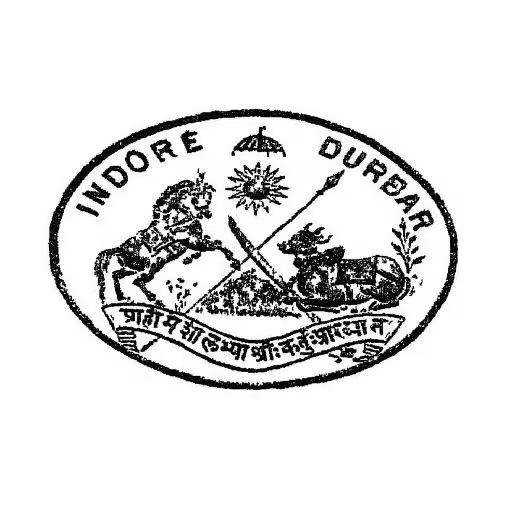
Overview
The Holkar story began in the Malwa region during the expansion of Maratha power in the 1720s. Malhar Rao Holkar, a Maratha chief from a Dhangar family, served Peshwa Baji Rao I and was entrusted with responsibility around Indore. From this base, the Holkars became the ruling house of Indore and one of the principal Maratha houses.
Their position changed as the Maratha Confederacy weakened. Initially subordinate to the Peshwas, the Holkars asserted themselves as autonomous rulers while remaining connected to the wider Maratha political world. After the Third Anglo-Maratha War, their territory was reduced and Indore became a princely state under British protection. The dynasty continued through the colonial period and ended its rule when Indore joined Madhya Bharat in 1948.
Rise to Power
Malhar Rao Holkar was born in 1694 at Murum in Satara district, in a Dhangar family. His military career developed under Peshwa Baji Rao I, the chief minister of Shahu I. During the 1720s, Malhar Rao led Maratha armies in Malwa. In 1733, the Peshwas granted him nine parganas near Indore.
Indore itself was not created by Malhar Rao. The township already existed as an independent principality established by Nandlal Mandloi of Kampel. Maratha forces won Nandlal’s support, and he allowed them to camp across the Khan River. In 1734, Malhar Rao established a camp that later became known as Malharganj. In 1747, he began building the Rajwada palace.
By the time of his death in 1766, Malhar Rao administered much of Malwa on behalf of the Maratha Empire. His position placed the Holkars among the five major houses of the Maratha political order. Their authority rested on military service, control of territory, and their relationship with the Peshwas.
Golden Age
The most celebrated phase of Holkar rule came under Ahilyabai Holkar, who governed from 1767 to 1795. She was born in Chaundi village in Maharashtra and entered the Holkar ruling family as Malhar Rao’s daughter-in-law. Following a brief succession crisis after Malhar Rao’s death, she assumed effective rule.
Ahilyabai moved the capital from Indore to Maheshwar, a town on the Narmada River south of Indore. Her reign is especially remembered for construction and religious patronage. She supported temples in Maheshwar and Indore and also commissioned or built temples at sacred sites outside her territory. These locations extended from Dwarka in Gujarat eastward to the Kashi Vishwanath Temple at Varanasi on the Ganges.
Her rule gave the Holkar state a distinctive association with public building and Hindu pilgrimage networks. The surviving historical account identifies her as a prolific builder, although it does not provide a complete catalogue of the works undertaken during her reign.
Ahilyabai was succeeded in 1795 by Tukoji Rao Holkar, an adopted son of Malhar Rao who had served as a commander throughout her rule. His reign was brief, lasting until 1797. The succession that followed was unsettled, with Kashi Rao Holkar, Khande Rao Holkar, and finally Yashwantrao Holkar occupying the throne or exercising authority during a period of political conflict.
Administration and Governance
The Holkars governed first as powerful subahdars and Maratha chiefs under the Peshwas. Their authority expanded through military command and grants of territory. As Maratha power fractured, they declared themselves rulers of Indore while retaining their place as an autonomous member of the Maratha Confederacy until 1818.
The capital shifted according to political circumstances. Indore was the original centre associated with Malhar Rao, while Ahilyabai used Maheshwar as her capital. After the state came under British protection, the capital was returned to Indore. The old palace had been destroyed by the army of Daulat Rao Scindia, and a new palace was built in its place.
During the minority of Malhar Rao Holkar III, who succeeded Yashwantrao in 1811 at the age of four, his mother Tulsabai Holkar supervised the administration. Tantia Jog later served as Diwan after Malhar Rao III entered Indore in 1818. In the nineteenth century, the office of Diwan remained important; T. Madhava Rao was appointed Diwan in 1872 by Tukoji Rao Holkar II.
The available historical account gives limited detail about taxation, local bureaucracy, and economic administration. It does, however, show a political system that moved from Maratha military governorship to autonomous monarchy and then to British-supervised princely rule.
Military Campaigns
Yashwantrao Holkar, who ruled from 1797 to 1811, opposed British expansion during the Second Anglo-Maratha War. He attempted to free the Mughal emperor Shah Alam II from the British, though the effort was unsuccessful. Shah Alam nevertheless honoured him with the title Maharajadiraj Rajrajeshwar Alija Bahadur in recognition of his bravery.
Yashwantrao also attempted to unite other rulers, but these efforts failed. He was eventually approached for peace by the British. The Treaty of Rajghat, signed in late December 1805, recognised him as a sovereign king.
After Yashwantrao’s death, the state entered a dangerous period. Tulsabai Holkar took charge for the young Malhar Rao III. Dharama Kunwar and Balaram Seth plotted to imprison them with the help of Pathans, Pindaris, and the British. Tulsabai responded by beheading both men in 1815 and appointing Tantia Jog.
The crisis deepened when Gaffur Khan Pindari secretly signed an agreement with the British on 9 November 1817. He killed Tulsabai on 19 December that year. A treaty was signed at Mandsaur on 6 January 1818. Bhimabai Holkar rejected the settlement and continued attacking the British through guerrilla methods. The Holkars ultimately lost much of their territory at the end of the Third Anglo-Maratha War.
Cultural Contributions
The Holkar legacy is closely tied to architecture and religious patronage. Malhar Rao’s Rajwada in Indore symbolised the establishment of a royal centre, while the later palace built after the destruction of the old one reflected the reconstruction of Holkar authority under princely-state conditions.
Ahilyabai’s building programme had a wider geographical reach. Her patronage extended beyond the territories ruled directly by the Holkars, linking the dynasty to important Hindu sacred places. Maheshwar and Indore benefited from her activity, while temples at Dwarka and Varanasi connected her reign with major pilgrimage traditions.
Economy and Trade
The historical record identifies the parganas around Indore and the wider region of Malwa as the territorial foundation of Holkar power, but it does not provide detailed information about trade routes, taxation, agricultural production, or state coinage in this account. A separate study of Holkar state coinage indicates that the state’s monetary history has been examined, but the specific denominations and circulation patterns are not detailed here.
Decline and Fall
The Holkars’ decline was part of the wider weakening of Maratha power. Internal rivalries, succession disputes, Pindari involvement, and British intervention combined to undermine the state. The Treaty of Mandsaur in 1818 marked the decisive reduction of Holkar independence.
Malhar Rao Holkar III entered Indore on 2 November 1818 as a minor, with Tantia Jog serving as Diwan. Indore then existed as a princely state under British protection. The dynasty continued through the nineteenth century, including the long reign of Tukoji Rao Holkar II from 1844 to 1886. During the Indian Rebellion of 1857, Tukoji Rao II remained loyal to the British East India Company.
Yashwantrao Holkar II, who ruled from 1926, remained ruler until shortly after Indian independence. On 22 April 1948, he signed a covenant with neighbouring princely rulers to form Madhya Bharat. Madhya Bharat was created on 28 May, and Indore State merged with the newly independent Indian states on 16 June 1948.
Legacy
The Holkars shaped the political history of Malwa and established Indore as a major centre of Central India. Their history illustrates the changing meaning of sovereignty in the eighteenth and nineteenth centuries: a military house serving the Peshwas became an autonomous Maratha power, then a British-protected princely state, and finally part of the Indian Union.
Ahilyabai Holkar remains the dynasty’s most enduring figure because of her administrative reputation and extensive temple patronage. Malhar Rao is remembered for creating the foundation of Holkar power, while Yashwantrao Holkar represents resistance to British expansion. Together, their careers reveal the varied political, military, and cultural roles played by the Holkar house.
Timeline
Maratha expansion in Malwa
Malhar Rao Holkar begins leading Maratha armies in Malwa under Peshwa Baji Rao I.
Grant of territory near Indore
The Peshwas grant Malhar Rao nine parganas in the vicinity of Indore.
Holkar camp at Indore
Malhar Rao establishes a camp later known as Malharganj.
Rajwada begins
Malhar Rao begins construction of the royal palace at Indore.
Ahilyabai becomes ruler
Ahilyabai Holkar begins her reign and later governs from Maheshwar.
Tukoji Rao succeeds Ahilyabai
Tukoji Rao Holkar, Malhar Rao’s adopted son and former commander, succeeds her.
Treaty of Rajghat
Yashwantrao Holkar is recognised as a sovereign king after negotiations with the British.
Treaty of Mandsaur
The Holkars lose much of their territory and Indore becomes a British-protected princely state.
Merger into Madhya Bharat
Yashwantrao Holkar II joins the formation of Madhya Bharat, and Indore State merges with the new Indian political order.