Overview
In 1529, Viswanatha Nayaka became governor of Madurai and the surrounding Tamil provinces on behalf of the Vijayanagara emperor. His appointment marked the beginning of a political order that would endure for more than two centuries. The Madurai Nayaks began as Telugu-speaking Balija warrior administrators serving a larger imperial state, but gradually developed into an independent regional power based in southern Tamil Nadu.
Their rule extended across much of the territory that makes up modern southern and western Tamil Nadu. Madurai was their principal capital, although Tiruchirappalli temporarily became the seat of government between 1616 and 1635. The dynasty’s authority was never uniformly centralized. Alongside royal officials stood a network of 72 palayams, or military-administrative districts, governed by palaiyakkarars—chiefs who possessed considerable autonomy in return for revenue and military service.
The Nayaka period is especially associated with temple restoration and expansion, monumental architecture, Telugu and Tamil literary patronage, irrigation and fortification works, and the transformation of older Vijayanagara political arrangements into a regional kingdom. The Meenakshi-Sundareswarar temple at Madurai, the Thirumalai Nayakar Mahal, and Nayaka additions at Srirangam remain among the clearest expressions of this era.
The dynasty included thirteen rulers: nine kings, two queens, and two joint kings or associated rulers, according to the historical account preserved in the tradition of the dynasty. The best-known figures are Tirumala Nayaka, whose reign represented the political and architectural high point of the kingdom, and Rani Mangammal, who governed as regent during a difficult period of Mughal expansion and regional competition.
Rise to Power
Origins in the Vijayanagara south
The Madurai Nayaks emerged from the administrative and military structure of the Vijayanagara Empire. Their ancestors were Telugu-speaking Balija warriors associated with present-day Andhra Pradesh. Some traditions also connect the family with merchant activity, including the bangle trade. A Dutch East India Company account compiled in 1677 described Viswanatha Nayaka as belonging to the Wellen Chetti merchant community, while another account connected him with the Garikepati family of the Balija caste.
The dynasty’s social background has been described in several ways. References to the Gavaras, Tamilized Balijas, and the Vira-Balanja tradition connect the family’s wider identity with communities that combined commercial activity and martial status. The terms Vira-Balija in Telugu, Vira-Banajiga in Kannada, and Vira-Valanjiyar in Tamil conveyed the idea of valiant merchants. These varied descriptions point to the fluid relationship between military service, commerce, and political authority in the southern Deccan and Tamil country.
Before the Nayakas established themselves in Madurai, the region had been a difficult province for Vijayanagara. Its distance from the imperial capital made direct control challenging, and the Tamil country had only been fully brought under Vijayanagara authority in the early sixteenth century. Local chieftains, older royal lineages, and regional powers continued to possess political influence.
The first major figure in the dynasty’s rise was Nangama Nayaka, an able general of Krishnadevaraya. The emperor sent him with a large army to restore imperial control over Pandya Nadu. Nangama succeeded militarily, but his firm administration and refusal to recognize the authority of local chieftains made him unpopular. He also began to resist the strict control imposed by the imperial court while continuing to claim power as the emperor’s deputy.
Viswanatha’s victory over Nangama
Krishnadevaraya responded by sending Nangama’s son, Viswanatha Nayaka, with an army to recover Madurai. Viswanatha defeated his father and sent him as a prisoner to the emperor. Krishnadevaraya pardoned Nangama in recognition of his earlier service, while Viswanatha received the governorship of Madurai and the other Tamil provinces in 1529.
A second account presents the episode differently. In that version, the Pandyas appealed to Krishnadevaraya for help against the Cholas. Nangama defeated the Cholas but took the Pandyan throne for himself, prompting the emperor to send Viswanatha against him. This story explains Viswanatha’s appointment as a reward for restoring the Pandyan ruler. However, the account is not supported by epigraphic evidence, so the circumstances should be treated as a tradition rather than a securely established sequence of events.
Viswanatha was not initially an independent monarch. He remained a governor responsible to Vijayanagara. He originally controlled Chola Nadu as well as Madurai, but Chola Nadu was later transferred to the Thanjavur Nayakas. In 1544, Viswanatha assisted Rama Raya’s army in subduing Travancore, which had refused to pay tribute.
His work in the Madurai region combined military control with internal stabilization. He rebuilt fortifications at Madurai, improved the security of roads, cleared jungle along the Kaveri near Tiruchirappalli, and destroyed robber hideouts in the area. By the end of his life, the kingdom included much of modern southern and western Tamil Nadu, although numerous local chiefs remained dissatisfied with his authority.
The palayam system
To manage these local powers, Viswanatha and his chief minister Ariyanatha Mudaliar developed the palayam or polygar system. The territory was divided into 72 palayams, each governed by a palaiyakkarar. These chiefs combined military, judicial, and law-enforcement responsibilities and possessed substantial autonomy from the central government.
The system was intended to incorporate local warrior elites rather than eliminate them. In return for authority over a palayam, a chief was expected to provide revenue and maintain troops. One-third of the palayam’s revenue went to the Nayaka ruler, another third supported the army, and the remaining share was retained locally. In practice, some poligars became difficult for the centre to control and occasionally raided neighbouring territories.
Two of the 72 palayams—Kurvikulam and Ilayarasanendal—were regarded as royal palayams. They were governed by Kamma Nayakas from the Pemmasani, Komatineni, and Ravella clans. The system became one of the defining institutional features of the Madurai kingdom and continued to shape political relations in southern Tamil Nadu beyond the dynasty’s fall.
Golden Age
From provincial rule to effective independence
Viswanatha’s son Krishnappa was crowned in 1564. He immediately faced opposition from nobles who resented the new palayam arrangements. A revolt led by Tumbichchi Nayaka drew support from some polygars, but Krishnappa defeated the rebels.
That same year, the Vijayanagara Empire suffered a decisive setback at the Battle of Talikota. A Madurai contingent had been sent to support Rama Raya but did not arrive in time. The defeat weakened imperial authority and allowed the southern Nayaka states to act with increasing independence. The Madurai rulers continued to acknowledge Vijayanagara in varying forms, but the balance of power had changed.
Krishnappa later intervened in Kandy when its ruler, an ally of Tumbichchi Nayaka, stopped sending tribute. He invaded the island, killed the king, sent the late ruler’s wife and children to Anuradhapura, and installed his own brother-in-law, Vijaya Gopala Naidu, as viceroy. The campaign demonstrated both the reach of Madurai authority and the importance of tributary relations to the Nayaka state.
After Krishnappa’s death in 1572, power passed to Virappa Nayaka. Some documents describe Krishnappa’s two sons as co-rulers, while other historians interpret the arrangement as an association of a royal family member with the government rather than a formal joint reign. Such uncertainty reflects the complexity of succession within the dynasty.
Virappa’s reign was relatively stable. He suppressed another revolt by poligars who claimed descent from the Pandyas and maintained generally cordial relations with Vijayanagara when the imperial centre remained strong. After his death in 1595, authority passed to his eldest son, Krishnappa Nayaka II. During his rule, Madurai occupied Travancore and recognized Venkatapati Raya as emperor of Vijayanagara. Ariyanatha Mudaliar, the important minister associated with the palayam system, also died during this period.
Succession crisis and coastal policy
Krishnappa Nayaka II died in 1601, leading to a succession crisis. His younger brother Kasturi Rangappa seized the throne but was assassinated after only a week. Muttu Krishnappa Nayaka, the son of another brother, then became ruler.
Muttu Krishnappa concentrated much of his attention on the southern coast. The coastal population had long depended on fishing and pearl diving, activities that offered an important source of revenue. Earlier Nayaka rulers had neglected the region, allowing disorder to grow and Portuguese influence to expand.
When the Portuguese claimed the coast and began collecting taxes, Muttu Krishnappa responded by appointing Sethupathis in the Ramanathapuram region. Their duties included protecting pilgrims travelling to Rameswaram and compelling the Portuguese to recognize Nayaka authority. Muttu Krishnappa is therefore associated with the foundation of the Sethupathi dynasty of Ramnad.
His son Muttu Virappa Nayaka succeeded him in 1609. Seeking greater independence from Vijayanagara, Muttu Virappa stopped paying tribute regularly. Yet the changing political situation at the imperial centre forced him to reconsider his position.
The Battle of Toppur
After Venkatapati Raya’s death in 1614, the Vijayanagara Empire entered a succession crisis. Gobburi Jagga Raya murdered the successor Sriranga II and his family, but Sriranga’s son Rama Deva Raya escaped. A civil war followed.
Madurai, Gingee, and the Portuguese supported Jagga Raya. Thanjavur’s ruler Raghunatha Nayaka and Yachama Nayaka of Kalahasti supported Rama Deva Raya. Their forces met at the Battle of Toppur in 1616. Raghunatha and Yachama’s military leadership produced a crushing defeat for Jagga Raya, who was killed.
Muttu Virappa was forced to pay a heavy tribute to the imperial centre. Later in 1616, he shifted the Madurai capital to Tiruchirappalli, partly to make a possible invasion of Thanjavur easier. That effort failed. His policy toward the Pandyan vassals, however, helped secure their loyalty. When Mysore invaded Dindigul in 1620, the Pandyans remained loyal and the invasion was repelled.
Muttu Virappa died in 1623. His brother Tirumala Nayaka then assumed power, either as the formal ruler or as the effective ruler in an arrangement whose exact legal status is not entirely clear.
Tirumala Nayaka and the height of power
Tirumala Nayaka is generally regarded as the most powerful and influential ruler of the dynasty. One of his first major decisions was to move the capital back from Tiruchirappalli to Madurai. The city offered stronger religious associations and, in his view, better protection against invasion. The transfer took ten years and was completed in 1635.
Tirumala also expanded the army to around 30,000 men. His reign was marked by repeated military challenges from Mysore, Travancore, the Sethupathis, and the weakened Vijayanagara Empire.
In 1625, Mysore invaded Madurai while Tirumala was ruling from the region. Tirumala and his generals Ramappayya and Ranganna Nayaka defeated the invasion and counterattacked, laying siege to Mysore. In 1635, Travancore stopped paying tribute. Tirumala sent an army against it and forced the resumption of tribute payments.
The same year, Tirumala dispatched Ramappayya against the Sethupathi of Ramnad, who had rejected the ruler’s decision in a succession dispute. The Portuguese supported Tirumala in this campaign. In return, Tirumala allowed them to construct a fortress and maintain a small garrison wherever they wished.
Independence from Vijayanagara
By Tirumala’s reign, the Vijayanagara Empire was declining rapidly. Madurai stopped paying tribute altogether. When Sriranga III became emperor, he treated the decision as rebellion and assembled a large army to bring Tirumala back under control.
Tirumala first allied with Thanjavur and Gingee, though Thanjavur later defected to the emperor. Madurai then formed a new alliance with the Golconda Sultanate. Golconda besieged Vellore and defeated Sriranga III. When Sriranga appealed to his Nayaka allies, they refused to support him, and the Vijayanagara Empire effectively fell as a political force.
The resulting power vacuum did not bring peace. Golconda conquered Vellore around 1646 and joined the Bijapur Sultanate in besieging Gingee. Tirumala’s army arrived too late to save the fortress. The old imperial political order had disappeared, leaving Madurai to compete directly with other regional states.
Mysore invaded again in 1655, when Tirumala was seriously ill. He entrusted the defence of the kingdom to the Sethupathi of Ramnad. Raghunatha Thevar drove the Mysorean forces back. In recognition of this service, Tirumala cancelled the tribute previously demanded from the Sethupathi.
Tirumala’s reign thus combined military expansion, strategic alliances, and administrative consolidation. It also established Madurai’s practical independence from Vijayanagara. His most visible legacy, however, lies in the monumental buildings associated with his court.
Administration and Governance
The Madurai Nayaka state was a decentralized monarchy. The king stood at the top of the political hierarchy, but he depended on ministers, military commanders, governors, and local chiefs. The most important official was the dalavai, who supervised both civil and military affairs. Ariyanatha Mudaliar, Ramappayya, and Narasappayya are identified as the three most effective dalavais of the dynasty.
The pradhani, or finance minister, ranked next in importance. The rayasam directed the bureaucracy. Provinces and smaller administrative areas possessed their own governors and officials, while the village remained the basic unit of local organization. Revenue was primarily collected through taxes on land.
The palayam system existed alongside this royal administration. Its 72 districts were governed by palaiyakkarars, commonly called poligars. They were not merely tax collectors. They held powers of law enforcement and judicial administration, maintained troops, and exercised authority over local territory.
The arrangement offered advantages to both sides. The Nayaka state gained access to a military network without maintaining every local institution directly. Warrior chiefs gained recognized authority and a share of local revenue. Yet the same decentralization created persistent dangers. Some poligars operated beyond effective central supervision, raided neighbouring areas, or supported rebellions during succession crises.
The history of the dynasty repeatedly shows this tension. The system helped Viswanatha govern a region containing strong local interests, but later rulers had to suppress revolts by nobles and poligars. By the eighteenth century, the political strength of regional chiefs made the kingdom more vulnerable to external intervention.
Military Campaigns
The Nayakas were involved in conflicts across the Tamil country, the southern coast, Kandy, Travancore, Mysore, and the declining Vijayanagara sphere.
Viswanatha’s first major military achievement was his defeat of Nangama Nayaka, which secured his appointment as governor. He also assisted Vijayanagara forces against Travancore in 1544 and worked to suppress robbers and local opposition around Madurai and Tiruchirappalli.
Krishnappa Nayaka faced revolts linked to the creation of the palayams. He later invaded Kandy after its ruler stopped paying tribute. The intervention placed Kandy under a Madurai-appointed viceroy, though relations between the two regions continued to evolve.
Muttu Virappa’s period was shaped by the Vijayanagara succession war and the Battle of Toppur in 1616. His support for Jagga Raya ended in defeat, and Madurai was forced to pay a substantial tribute. The kingdom nevertheless retained enough power to repel Mysore at Dindigul in 1620.
Tirumala Nayaka fought Mysore in 1625 and again faced Mysorean pressure in 1655. His armies also compelled Travancore to resume tribute and campaigned against the Sethupathi of Ramnad. At the same time, he managed shifting alliances with Thanjavur, Gingee, Golconda, Bijapur, and the Portuguese.
Military authority was closely tied to administration. The palaiyakkarars supplied troops and enforced order in their territories. This made them indispensable during external invasions but also gave them the capacity to resist the court. The dynasty’s military history is therefore also a history of negotiation between central kingship and regional warrior power.
Cultural Contributions
Languages and literature
Telugu and Tamil were the principal languages of the Nayaka realm. Tamil was the language of most of the common population, while Telugu-speaking cultivators also lived in the region. The ruling Nayakas had Telugu as their mother tongue but could speak Tamil.
The court patronized Telugu, Tamil, and Sanskrit literature. Many rulers placed particular emphasis on poetry, which was regarded as a divine form of expression. Under Nayaka patronage, Telugu prose also developed significantly.
The Madurai court had connections beyond Hindu literary traditions. The earliest surviving complete Muslim work in Tamil was a translation by Vaṇṇapparimaḷappulavar of the Persian Book of One Thousand Questions. It was presented at the Madurai court in 1572. This episode reflects the multilingual and culturally varied environment of the Nayaka capital.
Temple architecture
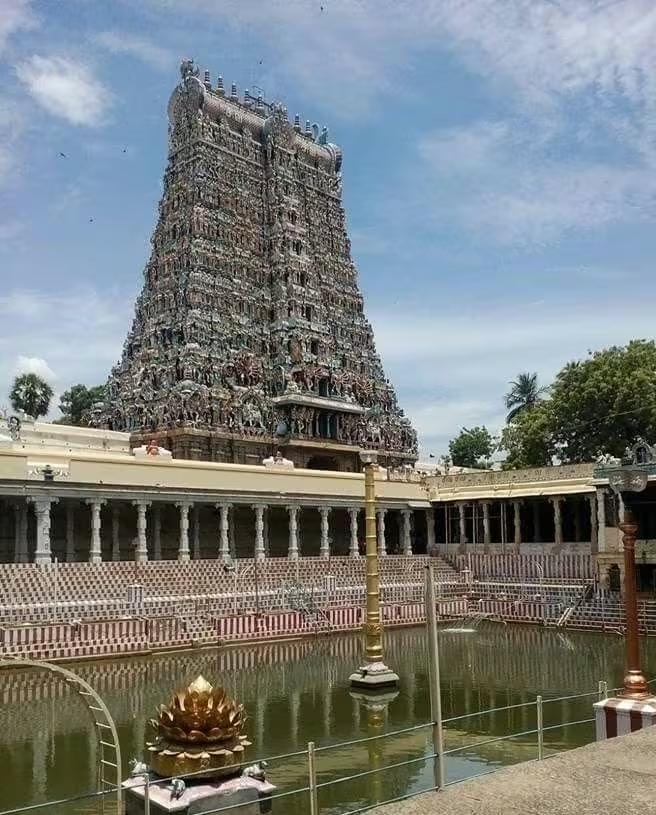
The Nayakas were prolific builders, although much of their work consisted of additions to older Vijayanagara or pre-Vijayanagara monuments rather than entirely new foundations. Their most celebrated project was the Meenakshi-Sundareswarar temple complex at Madurai.
The earlier Pandyan temple had been neglected during the period of the Madurai Sultanate and had fallen into ruin. Vijayanagara rulers had begun reconstruction, but the Nayakas made the most extensive contributions. Successive rulers, queens, and ministers donated to the complex, which grew to approximately 254 by 238 metres.
The temple is known for its four towering gopurams, some reaching about 50 metres. Nayaka architecture emphasized monumental vertical structures, elaborate carved surfaces, and mandapas—columned halls used as important architectural and ritual spaces. The pudu mandapa, directly adjoining the temple complex, is associated with the elaborate pillars and sculptural vocabulary of the period.
The style was primarily Dravidian but also represented a mixture of traditions. Nayaka builders developed forms inherited from Vijayanagara and incorporated elements associated with Bahmani architecture, including arches, cusps, and geometric designs. These features were combined with indigenous Tamil forms, such as cylindrical columns inspired by wooden architectural traditions.
The Nayakas also expanded the Azhagar Kovil and the Tiruparankundram Murugan temple near Madurai. At Srirangam, they enlarged the Ranganathaswamy temple complex by extending the original shrine into seven concentric enclosures topped by gopurams. The project remained incomplete when the dynasty fell and has continued into the modern period.
Palaces and public works
Tirumala Nayaka is especially remembered for the Thirumalai Nayakar Mahal at Madurai. George Mitchell suggested that it may have been the largest royal residence of the seventeenth century. The palace developed earlier Vijayanagara forms while creating a distinct architectural language.
Its design included square and rectangular bases, U-shaped ascending floors, courts, verandahs, double-curved eaves, gopuram-like towers, and plastered sculptures. Arches, cusps, and geometric motifs show influences associated with the Bahmanis. Cylindrical columns and other features connected the palace to Tamil architectural traditions.
Only two principal sections survive: the dance hall and the audience hall. Even in this reduced form, the building illustrates the scale and ambition of Nayaka court architecture.
The dynasty also sponsored irrigation canals and fortresses. These works supported agriculture, improved defence, and strengthened the administrative reach of the kingdom. Their broader building programme linked political authority with the maintenance and enlargement of sacred and civic spaces.
Coins
Madurai Nayaka coins provide another view of the dynasty’s political imagery. Some early coins show the king, while the bull appears frequently. Chokkanatha Nayaka issued coins depicting animals such as bears, elephants, and lions, as well as figures of Hanuman and Garuda.
The inscriptions used Tamil, Telugu, Kannada, and Nagari scripts. Unlike the coins of many earlier dynasties, Nayaka coins are relatively accessible to modern coin collectors. Their imagery and multilingual inscriptions reflect the cultural environment of a Telugu-speaking ruling family governing a predominantly Tamil region.
Economy and Trade
Agriculture formed the basis of state revenue, with land taxes collected through village and provincial administration. The palayam system divided revenue among the local chief, the army, and the Nayaka ruler. This arrangement connected cultivation directly to military organization.
The southern coast was important for fishing and pearl diving. Muttu Krishnappa Nayaka recognized the revenue potential of these activities and attempted to reassert control after Portuguese influence expanded. His appointment of Sethupathis in Ramanathapuram was intended both to protect pilgrims travelling to Rameswaram and to challenge Portuguese taxation.
Foreign trade during the period was conducted mainly with the Dutch and Portuguese. British and French influence had not yet made significant inroads into the region. Relations with European powers could be commercial, diplomatic, or military. The Portuguese supported Tirumala Nayaka in his campaign against the Sethupathi, receiving permission to establish a fortress and a small garrison in return.
Trade and military authority were therefore closely connected. Control of the coast brought revenue from maritime communities and commercial activity, while forts and appointed officials helped the Nayaka court prevent external powers from converting commercial presence into political control.
Decline and Fall
Tirumala Nayaka was succeeded by his son in 1659, but the new ruler reigned for only four months. Chokkanatha Nayaka then became king. His reign began with a revolt by the army commander and chief minister, who were supported by Thanjavur. Chokkanatha defeated the insurgents and invaded Thanjavur in retaliation.
He briefly placed his brother Muddu Alagiri on the Thanjavur throne, but Madurai soon lost control when Alagiri declared himself independent. In 1675, the Marathas under Venkoji conquered Thanjavur. Chokkanatha also fought Mysore and lost territory, although his successor Muttu Virappa III later recovered some of it.
After Muttu Virappa III died in 1689, his infant son inherited the throne. The child’s grandmother, Rani Mangammal, governed as regent. Her regency was one of the most capable periods of late Nayaka rule.
Rani Mangammal
The Mughal advance into southern India created a new strategic danger. Rani Mangammal judged that recognizing Mughal authority and paying tribute was preferable to facing a direct invasion. She supported the Mughal capture of Gingee from Rajaram, who might otherwise have attacked Madurai and Thanjavur. Gingee was then held as a Mughal vassal.
Her policy illustrates the difficult choices confronting regional rulers after the decline of Vijayanagara. Madurai had to balance military resistance, diplomatic submission, and alliances with neighbouring powers. Tribute could preserve local authority, at least temporarily, when outright resistance risked the destruction of the kingdom.
Muttu Virappa III’s son Vijayaranga Chokkanatha reached maturity in 1704. He was more interested in scholarship and learning than in governing. Effective power passed to his chief counsellor and army commander, who were accused of abusing their positions. Court authority weakened further.
The final succession crisis
After Vijayaranga Chokkanatha’s death in 1732, his widow, Queen Meenakshi, adopted the son of Bangaru Tirumalai Nayaka, a member of the royal family. The adoption did not resolve the succession question. Instead, it produced a serious conflict between Bangaru Tirumalai and Meenakshi.
In 1734, the Nawab of Arcot sent an expedition south to demand tribute and submission from the regional kingdoms. Seeking support, Meenakshi paid tribute to Chanda Sahib, the Nawab’s son-in-law, and formed an alliance with him.
Bangaru Tirumalai withdrew to the far south and organized a large force of dissatisfied poligars. His army captured Dindigul, but Meenakshi and Chanda Sahib assembled a force against him. At the Battle of Ammayanayakkanur near Dindigul, Bangaru Tirumalai was defeated and fled to Sivaganga.
After Bangaru Tirumalai was admitted into the fort at Tiruchirappalli, Chanda Sahib declared himself king and imprisoned Queen Meenakshi in her palace. This seizure of power ended the Madurai Nayaka dynasty in 1736. A later tradition holds that Meenakshi poisoned herself in 1739, but the date belongs to that tradition rather than to the political end of the dynasty, which occurred with Chanda Sahib’s takeover.
Legacy
The Madurai Nayakas transformed a distant Vijayanagara province into a durable regional kingdom. Their authority was built through military service, negotiation with local chiefs, tributary relationships, and the gradual assertion of independence as the imperial centre weakened.
Their most visible legacy is architectural. The Meenakshi-Sundareswarar temple at Madurai became a monumental complex through generations of Nayaka patronage. The Thirumalai Nayakar Mahal preserves the courtly architecture of Tirumala Nayaka’s period, while additions at Srirangam, Azhagar Kovil, and Tiruparankundram show the breadth of the dynasty’s building programme.
The palayam system also had a long institutional afterlife. By distributing authority among 72 warrior chiefs, the Nayakas created a structure that could mobilize troops and administer difficult territory. It also left behind powerful local elites whose autonomy could threaten central rule. The same system that helped establish the dynasty contributed to the political fragmentation visible during its decline.
The dynasty’s cultural legacy was multilingual. Telugu-speaking rulers governed a largely Tamil-speaking population, patronized Tamil and Sanskrit alongside Telugu, and presided over literary and architectural exchanges across southern India. The connection between Madurai and Kandy continued through marriage and military relationships. In Sri Lanka, the death of the last ethnically Sinhalese king of Kandy, Vira Narendra Sinha, in 1739 led to the accession of his Madurai-born brother-in-law, Sri Vijaya Rajasinha. This established the Nayak dynasty of Kandy, which ruled until 1815.
The Madurai Nayakas are therefore remembered not only as a regional ruling family but also as builders of institutions, temples, palaces, and cultural connections that outlasted their political authority.
Timeline
Viswanatha Nayaka becomes governor
After defeating his father Nangama Nayaka, Viswanatha is appointed governor of Madurai and the surrounding Tamil provinces under Vijayanagara.
Campaign against Travancore
Viswanatha assists Rama Raya’s army in subduing Travancore after it refuses to pay tribute.
Krishnappa Nayaka is crowned
Viswanatha’s son takes power and faces opposition from nobles dissatisfied with the new palayam system.
Aftermath of Talikota
A Madurai contingent sent to support Rama Raya does not arrive in time, while the Vijayanagara defeat increases Nayaka independence.
Virappa Nayaka succeeds
Power passes to Virappa Nayaka, whose reign is described as a period of relative stability.
Muttu Virappa Nayaka rules
Muttu Virappa seeks greater independence from Vijayanagara and later becomes involved in the imperial succession conflict.
Battle of Toppur
The defeat of Jagga Raya’s forces forces Muttu Virappa to pay a major tribute to the Vijayanagara centre.
Tirumala Nayaka takes power
Tirumala becomes ruler and begins the policies that lead Madurai toward its political and architectural high point.
Capital returns to Madurai
After a decade-long transfer, Tirumala completes the movement of the capital from Tiruchirappalli back to Madurai.
Vijayanagara power collapses
Golconda conquers Vellore and the old imperial order disintegrates, leaving Madurai effectively independent.
Mysore invasion repelled
Raghunatha Thevar of Ramnad drives back Mysorean forces while Tirumala Nayaka is seriously ill.
Rani Mangammal becomes regent
After Muttu Virappa III’s death, his infant son inherits the throne and Mangammal governs on his behalf.
Vijayaranga Chokkanatha reaches maturity
The ruler’s interest in scholarship allows powerful ministers and military officials to dominate government.
Queen Meenakshi inherits the crisis
After Vijayaranga Chokkanatha’s death, Meenakshi’s adoption and rivalry with Bangaru Tirumalai deepen the succession dispute.
End of the Madurai Nayakas
Chanda Sahib declares himself ruler at Tiruchirappalli and imprisons Queen Meenakshi.