Overview
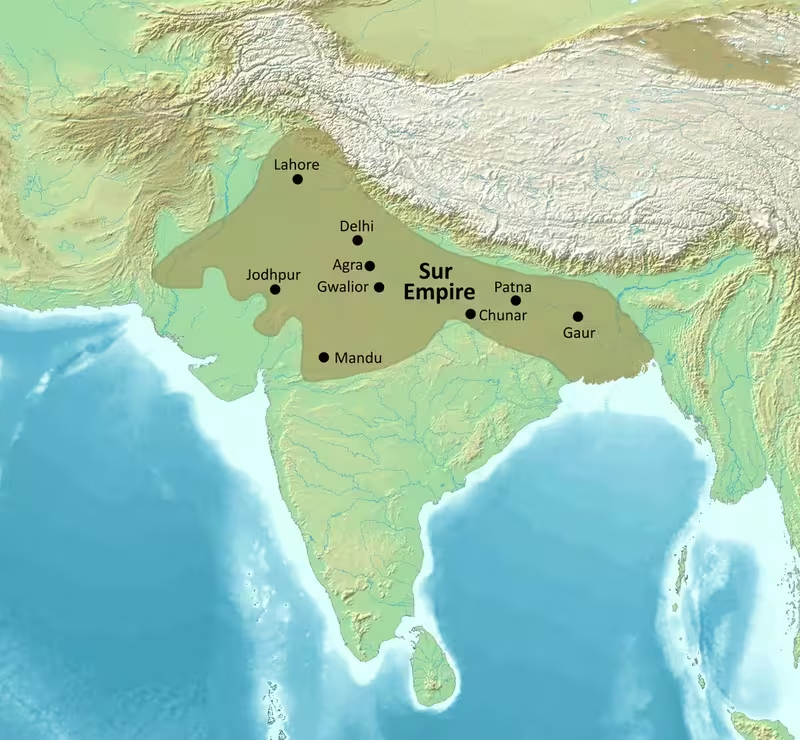
In 1540, after defeating the Mughal emperor Humayun at Kannauj, Sher Khan took the title Sher Shah and captured Delhi. His victory created the Sur Empire, an Afghan-ruled state that governed northern India for roughly sixteen to eighteen years, depending on whether its beginning is dated to 1538 or 1540. Sasaram, in present-day Bihar, served as its capital and remained closely associated with the dynasty’s founder.
The Sur Empire emerged from the political crisis of the Mughal Empire under Humayun. Sher Shah had first built his power in Bihar and Bengal, where he challenged both the Bengal Sultanate and the Mughals. By the time Humayun was forced into exile, the Sur state controlled nearly all the territories that had belonged to the Mughal Empire along the Indo-Gangetic Plain. Its western reach extended to eastern Balochistan and the lands west of the Indus, while its eastern sphere reached toward present-day Bangladesh and Rakhine.
The dynasty’s political life was brief, but its institutional influence lasted longer. Sher Shah reorganized provincial administration, introduced a standardized silver rupee, improved major roads, created postal relays, strengthened policing and justice, and built forts to secure difficult frontiers. When the Mughals returned to power, particularly under Akbar, elements associated with Sur administration influenced the organization of the restored Mughal state.
The Sur Empire was not a uniformly controlled territory. Some regions were governed by powerful military commanders, while hill peoples, frontier chiefs, Rajput rulers, and local elites resisted or negotiated with the dynasty. Its history therefore combines rapid imperial expansion with continuing struggles to make central authority effective across a large and diverse landscape.
Rise to Power
Afghan origins and the family of Sher Shah
The Sur dynasty presented itself as Afghan in origin and traced its ancestry to Muhammad Sur, described as a prince of the Ghorian house. According to the account preserved in the historical tradition of the dynasty, Muhammad Sur left his native country and married the daughter of an Afghan chief of Roh. Later, Ibrahim Khan Sur, the grandfather of Sher Shah, and Hasan Khan, Sher Shah’s father, came to Hindustan from Afghanistan.
Their earlier homeland was called Shargarí in Afghan usage and Rohrí in the Multan region. It was described as a ridge or spur of the Sulaiman Mountains, near the Gumal. Ibrahim Khan and Hasan Khan entered the service of Muhabbat Khan Sur, who held jagirs in the Punjab under Sultan Bahlul Lodi. The family settled in the pargana of Bajwara, and this movement into the political world of northern India provided the setting for Sher Shah’s later rise.
The dynasty’s Afghan identity was politically important. Sher Shah invited Afghans from across his territories, appointed them to high positions, and recruited them into the army. He also used personal ties, military patronage, and the distribution of jagirs to bind Afghan commanders to his rule. At the same time, his authority depended on more than ethnic solidarity: he sought control over cities, forts, roads, revenue districts, and the established political structures of northern India.
Conflict with Bengal and Humayun
Sher Shah’s decisive rise began through his campaigns against the Bengal Sultanate. His relentless pressure on Bengal led its ruler to request assistance from Humayun. The Mughal emperor mobilized an army in July 1537 and advanced toward Chunar, a strategic fort associated with Sher Shah’s power.
Humayun reached Chunar in November 1537 and laid siege to it. The siege lasted for more than six months. Despite attempts by Rumi Khan to bring the fort down quickly, Chunar eventually fell. Sher Shah then turned his attention to Bengal and besieged Gauda, the capital of the Bengal Sultanate. Afghan forces captured Gauda in April 1538.
The same year, Rohtasgarh also came under Sher Shah’s control. He used the fort to settle Afghan families and store the wealth taken during the campaign. The treasure obtained from Gauda was transferred there, giving Sher Shah a secure base in eastern India. After these victories, he held his first coronation.
Sher Shah then offered Humayun terms intended to end the conflict. He proposed a payment of 10,000,000 dinars and offered to surrender Bihar in exchange for control of Bengal. Humayun rejected the arrangement. Bengal’s resources made it too valuable to abandon, and Ghiyasuddin Mahmud Shah, the wounded ruler of Bengal, entered Humayun’s camp and urged him to continue the war. Ghiyasuddin died from his wounds soon afterward.
Humayun advanced toward Bengal, but the Mughal army was weakened by the climate and the difficult conditions of the march. Heavy rain caused the loss of baggage between Patna and Monghyr. Humayun eventually reached Gauda and occupied it on 8 September 1538 without opposition. The Afghans had already withdrawn, taking the treasury with them. Humayun restored order in the city but remained there for months because the weather prevented an easy return.
Sher Shah used this delay to strike at the Mughal position. He moved into Bihar and Varanasi, recovered Chunar, and laid siege to Jaunpur. Other Afghan detachments reached as far as Kannauj. These operations cut Humayun’s communications and left him isolated at Gauda. When disturbances broke out at Agra, Humayun sought a settlement with Sher Shah. The two sides concluded peace, and Humayun began his return.
The Mughal army crossed the Karmanasa River in a vulnerable condition. Sher Shah attacked at Chausa, catching the Mughals off guard. The battle resulted in a complete Mughal rout. More than 7,000 Mughal soldiers died, including prominent nobles, while Humayun barely escaped with his life.
Chausa, Kannauj, and the capture of Delhi
After Chausa, Humayun returned to Agra and dealt with disturbances caused by his brother, Hindal Mirza. He then gathered a much larger army. The Mughal force numbered about 40,000 men, while Sher Shah brought approximately 15,000.
The two armies met at Kannauj, facing one another across the Ganges. Humayun crossed the river and began skirmishing with the Afghans. During the fighting, many Mughal nobles hid their insignia so that the Afghans would not recognize them. Some fled from the battlefield. The Mughal army was defeated, and Humayun escaped toward Sindh.
This victory transformed Sher Shah’s position. On 17 May 1540, he was crowned a second time, took the title Sher Shah, and was declared emperor of northern India. He also adopted the epithet Sultan Adil, meaning “Just King.” With Humayun in flight, Sher Shah captured Delhi and established the Sur Empire as the dominant power across northern India.
Golden Age
The high point of the Sur Empire came during Sher Shah’s reign from 1540 to 1545. In this short period, the dynasty expanded across much of northern India, defeated or contained major rivals, reorganized territories, and established institutions that outlived its political control.
The empire’s territory stretched across the Indo-Gangetic Plain. It included Bihar, Bengal, Delhi, the Punjab, Multan, Malwa, parts of Rajasthan, and upper Sindh. The western frontier reached eastern Balochistan and the lands west of the Indus, while the eastern sphere extended toward modern Bangladesh and Rakhine. The precise degree of direct control varied by region, particularly in frontier and hill areas.
Eastern India continued to be an important center of Sur power even as Sher Shah consolidated authority elsewhere. Eight of the sixteen silver mint cities established by him were located between Chunar and Fathabad. This distribution indicates the importance of the eastern heartland, where Sher Shah had first built his political base and where Bihar and Bengal supplied wealth, soldiers, and strategic depth.
Sher Shah’s authority rested on a combination of military force, administrative organization, political negotiation, and infrastructure. He did not simply conquer territory and leave it unchanged. Bengal was divided into smaller administrative units, military governors were placed in important regions, forts were constructed along vulnerable frontiers, and roads and postal systems were improved to connect the empire.
Yet the golden age was also a period of continuous campaigning. Sher Shah fought in Bengal, Punjab, Malwa, Raisen, Sindh, and Marwar. His government had to respond to revolts, frontier resistance, local rulers, Mughal claims, and the difficulty of sustaining a large cavalry army across long distances. The strength of the Sur state was therefore visible both in its rapid expansion and in the constant effort required to hold its territories together.
Administration and Governance
Provincial organization
The Sur Empire was divided into large subdivisions known as iqtas. Some were governed by military commanders. Haibat Khan, for example, governed the Punjab and controlled more than 30,000 men. He could assign jagirs to his soldiers. Khwas Khan governed Rajasthan and assembled more than 20,000 men.
The heads of iqtas could be known by different titles, including Hakim, Faujdar, or Momin. They maintained their own bodies of troops, generally numbering fewer than 5,000 men. Their main responsibilities were to preserve order and enforce the authority of the central government within their territories.
Iqtas were divided into districts called sarkars. Each sarkar had two principal officers: the Shiqar and the Munsif. The Shiqar was responsible for civil administration and could command 200 to 300 soldiers to maintain law and order. The Munsif collected revenue and administered civil justice. Chief Shiqars also handled criminal cases.
Each sarkar was further divided into two or three parganas. A pargana consisted of a moderately sized town and its surrounding villages. Its officials included a Shiqar, a Munsif, and a treasurer called the Fotdar. A Karkun, capable of writing in Hindi and Persian, assisted them.
The pargana Shiqar was a military official under the authority of the sarkar Shiqar. He helped maintain stability, supported the collection of land revenue, and participated in the measurement of land. The pargana Munsif functioned under the supervision of the chief Munsif of the sarkar.
At village level, local assemblies called panchayats retained considerable autonomy. Sher Shah respected these institutions. Village elders addressed local needs and applied punishments according to the customs of their community. The village headman acted as a link between the village and higher government, serving in a diplomatic capacity when necessary.
This layered arrangement combined central supervision with local institutions. Military officers represented imperial power, revenue officials connected the state to agricultural production, and village assemblies continued to manage many local matters.
Bengal reforms
Sher Shah regarded Bengal as especially important and concentrated administrative attention there. In March 1541, Khijir Khan, his governor of Bengal, rebelled. Sher Shah personally led an army against him, defeated him, and restored Bengal to Sur authority.
After this, Bengal was divided into forty-seven smaller administrative divisions. These were placed under Shiqdars, with Kazi Fajilot serving as chief supervisor of the Muqtars. The organization strengthened the role of Afghan officials in the region and encouraged Afghan settlement.
Some Afghans who moved into Bengal later founded dynasties of their own. The Muhammad Shahi dynasty ruled Bengal from 1553 to 1563, followed by the Karrani dynasty, which ruled from 1563 to 1576. These later developments show how the movement of Afghan commanders and families during Sur rule continued to shape eastern Indian politics after the empire itself had weakened.
Currency and coinage
Sher Shah introduced a system of tri-metallic coinage that later became characteristic of Mughal currency. The most influential coin was the silver rupee. Although the word rūpya had previously been used generically for a silver coin, during Sher Shah’s reign rūpee became the name of a silver coin of standardized weight.
The Sur rupee weighed 178 grains and became a precursor of the modern rupee. Gold coins known as mohurs weighed 169 grains, while copper coins were called paisas. Together, the silver, gold, and copper issues provided a structured monetary system.
Coins dated AH 945, corresponding to 1538, have been interpreted by numismatists as evidence that Sher Khan had assumed the royal title Farid al-Din Sher Shah and struck coins in his own name before the Battle of Chausa. This suggests that his claim to sovereign authority developed before his formal coronation in 1540.
Justice and policing
Sher Shah developed a strong reputation for justice. Qadis held courts, while Sher Shah himself is said to have observed civil cases. Hindus could settle disputes through panchayat assemblies, but criminal law applied across the empire and did not exempt people because of rank.
Punishments were severe, partly because the government intended fear of the consequences to deter crime. Officials and people holding high positions could receive heavy penalties. Sher Shah also introduced a system of official responsibility: when a murder or other serious crime occurred, local officials were expected to identify and arrest the culprits. If they failed, they could themselves be punished, even by hanging.
The effectiveness of this policy became part of Sher Shah’s reputation. Merchants were said to be able to travel and sleep in deserted areas without fear of bandits. Soldiers also acted as a form of police, searching for thieves and robbers. The account of Sher Shah’s rule presents this system as one of the reasons for the relative security of roads and commercial routes.
Religious policy
Sher Shah’s religious policy remains debated. Some historians, including Dr. Qanungo, have described him as tolerant toward Hindus. Ram Sharma emphasized his devotion to Islam, including regular prayer, and interpreted some of his wars against Rajput rulers as jihad. The campaign against Puran Mall was specifically described in these terms by some interpretations.
Other assessments stress that Sher Shah did not conduct a general policy of displacing Hinduism and did not maintain propaganda against Hindus as a group. According to the view associated with Srivastava, his policy sought to preserve Islamic supremacy over the conquered territories while allowing Hindu religious life to continue. The surviving descriptions therefore present a ruler whose political and religious actions could appear different depending on the context: pragmatic and accommodating in some settings, and framed in strongly Islamic terms during particular wars.
Military Campaigns
Punjab and the Gakhars
After Humayun fled, Sher Shah pursued the Mughals into the Punjab. His advance caused panic in Lahore. Kamran Mirza was not prepared to confront him and withdrew toward Kabul. Sher Shah captured Lahore in November 1540, and Afghan armies advanced as far as the Khyber Pass.
Sher Shah did not extend his empire beyond the Indus. He was reluctant to absorb large numbers of Afghans who valued their independence and might be difficult to govern. Afghan forces did seize Multan in 1541, but they did not continue pursuing the Mughals because the latter no longer appeared to pose an immediate threat.
The Gakhars presented a more persistent challenge. They had long been difficult to subdue and had maintained friendly relations with the Mughals since the time of Babur. Sher Shah invited their chief, Sarang Khan, to acknowledge him as emperor of India. Sarang Khan rejected the request and sent a bow, an arrow, and a lion cub as symbols of defiance.
Sher Shah responded by marching into the Punjab. Sarang Khan was killed, much of the countryside was devastated, and many people were taken prisoner. Sher Shah also ordered the construction of Rohtas Fort to keep the Gakhars under pressure and protect the north-western approaches.
To secure the Punjab and prevent a possible Mughal return, Sher Shah left 50,000 men in the region while turning back toward Bengal. The struggle with the Gakhars continued beyond Sher Shah’s lifetime. When Haibat Khan Niazi later rebelled against Islam Shah, many Niazi nobles sought refuge with the Gakhars.
Gwalior and Malwa
In 1542, Sher Shah began a campaign toward Malwa. He feared that Malwa might ally with the Mughals, especially while Humayun was trying to establish a base in Gujarat. A Mughal-Malwa partnership could have threatened the Sur Empire from the south-west.
The Afghan army first moved against Gwalior under Shujaat Khan. Gwalior submitted to Afghan authority after Abul Qasim Beg, its Mughal wali, accepted Sher Shah’s supremacy. This removed the immediate danger of being flanked while the Afghan army advanced toward Malwa.
The army continued to Sarangpur. Qadir Khan, ruler of the Malwa Sultanate, found that his vassals would not support him and appealed to Sher Shah for mercy. Sher Shah treated him generously, gave him gifts, and assigned him a jagir in Bengal. Qadir Khan, however, disliked the settlement and fled to Gujarat.
An attempt to recapture him under Shujaat Khan failed. Sher Shah consolidated the newly acquired territories and returned to Agra. On the way, he received the submission of the ruler of Ranthambore. Shujaat Khan was appointed governor of Malwa.
Qadir Khan later attempted to recover his territories and fought Shujaat Khan more than once. Although Shujaat Khan’s coalition was numerically weaker, he defeated Qadir Khan decisively. Sher Shah rewarded him with more than 12,000 horses.
Raisen
Sher Shah’s campaign against Raisen began after Puran Mall recovered the territory following the death of Bahadur Shah of Gujarat. Raisen had been annexed by Bahadur Shah in 1532. After recovering control, Puran Mall was accused of acting tyrannically toward the city’s Muslim population. Survivors appealed to Sher Shah, who also saw an opportunity to bring the territory directly under his authority.
Sher Shah first offered Puran Mall Varanasi in exchange for Raisen. Puran Mall rejected the offer, and war followed. Jalal Khan led the Afghan army to Vidisha, where he joined Sher Shah. The combined force advanced to Raisen and began a siege.
The siege lasted six months. Sher Shah’s artillery eventually destroyed the city’s defenses, and Puran Mall surrendered. The treaty guaranteed free passage for Puran Mall, his family, and their belongings. Sher Shah agreed to withdraw two marches from the fort, while Adil Khan and Qutab Khan swore that Puran Mall and his family would not be harmed.
Sher Shah initially honored the terms and withdrew. On the road, however, widows of the chiefs of Chanderi and other survivors appealed to him. They accused Puran Mall of killing their husbands, enslaving their daughters, taking their lands, and forcing some women into performances as dancing girls. They warned that they would accuse Sher Shah before God if he failed to provide justice.
The account describes Sher Shah as being moved to tears by their suffering. His army also pressed him to act. He ordered Isa Khan Hajjab to lead a forced march against Puran Mall’s retreating group. The Rajput forces resisted but were ultimately annihilated. This episode remains important in assessments of Sher Shah’s rule because it combines a written guarantee of safe passage with a subsequent decision to abandon that agreement under political, religious, and emotional pressure.
Upper Sindh and the Lahore-Multan route
Multan, conquered in 1541, was later overrun by Baloch tribes. Sher Shah prepared a new campaign in 1543, partly to recover the territory and partly to improve the road between Lahore and Multan.
During this period, a raider named Fateh Khan Jat attacked routes between Lahore and Delhi. Complaints accumulated, and Sher Shah ordered Haibat Khan to stop the raids. Haibat Khan trapped Fateh Khan in a mud fort near Fatehpur. Fateh Khan eventually surrendered when escape seemed impossible.
The fort’s garrison, commanded by Hinda Baluch, made a sortie and escaped. Hinda Baluch was captured during the operation, and Balochi leaders were executed. After the campaign, Haibat Khan extended Sur control across upper Sindh as far as Sehwan.
Marwar and the Battle of Sammel
In 1543, Sher Shah marched against Maldeo Rathore, the Rajput ruler of Marwar. Sher Shah commanded about 80,000 cavalry, while Maldeo brought an army of approximately 50,000. Instead of advancing directly on Jodhpur, Sher Shah halted at Sammel in the pargana of Jaitaran, about ninety kilometres east of Jodhpur.
The armies skirmished for a month. Sher Shah’s position became difficult because feeding such a large force was increasingly challenging. He then used a deception. Forged letters were placed near Maldeo’s camp so that they would be discovered. The letters falsely suggested that some of Maldeo’s commanders had promised to support Sher Shah.
Maldeo suspected his commanders and withdrew toward Jodhpur with his own men, leaving Jaita and Kumpa to face the Afghan army. The two Rajput generals fought with only a few thousand men against approximately 80,000 Afghans supported by artillery.
The resulting Battle of Sammel, also called the Battle of Giri Sumel, ended in a Sur victory. Sher Shah’s army suffered thousands of casualties, and several of his generals were killed. Afterward, Khawas Khan Marwat took Jodhpur and occupied much of Marwar, from Ajmer to Mount Abu.
Maldeo retreated to Siwana. After Sher Shah’s death, he recovered Jodhpur by July 1545 and regained the rest of his territories by 1546, defeating the chain of Sur garrisons established during the conquest.
Death at Kalinjar
After the Marwar campaign, Sher Shah besieged Kalinjar Fort in 1544. During the siege, he was mortally wounded when one of his cannons burst and caused a gunpowder explosion. He was taken to his tent and survived for two days.
Sher Shah received news that the fort had finally fallen and reportedly thanked God. He died from his wounds on 22 May 1545. His age is given as either 73 or 59, reflecting uncertainty in the historical record.
He was buried in a monumental tomb at Sasaram. The mausoleum stands in the middle of an artificial lake and rises to a height of 122 feet. Sher Shah had commissioned the tomb himself, and construction was completed on 16 August 1545, three months after his death.
Cultural Contributions
Architecture and monuments
Sur architecture expressed the authority of an Afghan dynasty ruling a large northern Indian empire. Its buildings combined military strength, Islamic religious forms, monumental scale, and local architectural traditions.
Rohtas Fort, built in the Punjab, was one of the dynasty’s most important military works. Sher Shah ordered its construction to control the Gakhars and secure the north-western frontier. The fort remains associated with the Sur effort to impose imperial power in a region where hill communities and frontier chiefs had repeatedly resisted central authority.
Sher Shah also built or sponsored many structures within Rohtasgarh Fort in Bihar. This fort had already served an important role in his rise: he used it to house Afghan families and store wealth taken during his campaigns in Bengal.
In Delhi, the Qila-i-Kuhna Mosque stands within the Purana Qila complex. Sher Shah also built the Sher Mandal, an octagonal structure in the same complex. The building later served as Humayun’s library, linking the architectural history of the two rival dynasties.
The Sher Shah Suri Masjid in Patna is another monument associated with his reign. In 1545, he founded a new city called Bhera in present-day Pakistan and built a grand mosque there in his own name.
The most celebrated Sur monument is Sher Shah’s mausoleum at Sasaram. Set in an artificial lake, the tomb’s height and isolated setting give it a distinct monumental character. It has been described as one of the most beautiful monuments in India. The British archaeologist Cunningham even preferred it to the Taj Mahal.
Roads, shade, and travel infrastructure
Sher Shah greatly rebuilt and modernized the Grand Trunk Road, a major artery running from present-day Bangladesh to Afghanistan. The road connected the eastern and western parts of the empire and supported the movement of soldiers, officials, merchants, and messages.
Caravanserais and mosques were constructed along the route. Trees were planted on both sides to provide shade, and wells were dug, especially along the western section. These measures addressed practical needs of long-distance travel across the subcontinent.
The road was not only an economic project. It was also a tool of imperial integration. Troops could move more efficiently, officials could communicate with provincial centers, and merchants could travel under the protection of the state. Its significance continued beyond the short lifetime of the Sur Empire.
Postal communications
Sher Shah established a postal system in which mail was carried by relays of horse riders. The system helped link the capital, provincial centers, military governors, and frontier regions.
In a large empire built through rapid conquest, communication was essential. Information about rebellions, military movements, revenue, and local conditions had to travel quickly. The postal relays therefore complemented the road network and strengthened the central government’s ability to respond to distant events.
Economy and Trade
Currency and monetary order
The standardized silver rupee was central to Sur economic policy. By defining a silver coin at a standard weight of 178 grains, Sher Shah created a reliable medium for payments, taxation, military salaries, and trade. Gold mohurs and copper paisas completed the tri-metallic system.
The rupee’s later importance is reflected in its continued connection with the national currencies of several South Asian and Indian Ocean countries. The Sur coin was not identical to every modern rupee, but it became an important predecessor of the modern monetary unit.
The placement of mints also reveals the geography of Sur economic power. Sher Shah established sixteen silver mint cities, eight of them between Chunar and Fathabad. This concentration in the east reflects the continuing importance of Bihar and Bengal to the dynasty.
Customs and internal trade
Sher Shah sought to stimulate commerce by abolishing taxes collected at provincial borders. Under his policy, only two levies remained: one on goods brought into the country and another when goods were sold. Customs duties at internal provincial boundaries were removed.
The policy reduced barriers to movement within the empire. Merchants no longer faced the same accumulation of border taxes as goods passed from one province to another. Combined with improved roads, wells, caravanserais, policing, and postal communication, this created conditions more favorable to long-distance trade.
The government’s emphasis on security was equally important. The soldiers who guarded roads and pursued thieves supported commercial movement. The reputation that merchants could travel without constant fear of robbery became part of Sher Shah’s image as a ruler who connected justice with economic prosperity.
Military supply and the rural state
The Sur state depended on a large military establishment. In 1540, Sher Shah’s army was described as including more than 150,000 cavalrymen, 25,000 infantrymen, and over 5,000 war elephants. Maintaining such forces required revenue collection, land measurement, administrative oversight, and reliable supply networks.
Military governors controlled their own bodies of troops and could distribute jagirs to soldiers. Banjaras accompanied the army to provide provisions. The army was divided into units led by commanders, and strict discipline was enforced.
The system of dagh assigned men particular roles and allowed spies to detect misconduct. Cavalry formed the core of the army, while infantry used muskets. Sher Shah’s organization of military manpower linked the state’s political power to its systems of revenue and administration.
Decline and Fall
Islam Shah’s succession
Sher Shah was succeeded by his second son Jalal Khan, who took the title Islam Shah. His accession immediately faced opposition from the amirs who had served his father.
Kutb Khan, commander of the Kumaon Hills, fled to the Punjab after attempting to place Islam Shah’s brother on the throne. He sought the support of Khawas Khan and Haibat Khan. The Niazis under Haibat Khan and Khawas Khan then rebelled, forcing Islam Shah to lead an army against them.
Islam Shah defeated the rebels at Ambala. The Niazis were routed, but the conflict did not end. After losing another battle at Dhankot, Haibat Khan sought protection among the Gakhars in 1548. Islam Shah spent the next two years campaigning against the Gakhars but did not defeat them or capture Haibat Khan.
In 1550, the Niazis attempted to enter Kashmir. Mirza Haidar Dughlat opposed them and defeated them at Sambla. The heads of Haibat Khan and his family were sent to Islam Shah.
Islam Shah also worked to strengthen the northern frontier. He built a chain of fortresses north of Sialkot to guard against a possible Mughal invasion and to control the Gakhars and other hill communities. He considered destroying Lahore so that it could not fall into enemy hands, but this plan was not carried out.
Fragmentation and Mughal return
The Sur Empire’s political system depended heavily on strong central leadership. Sher Shah had combined personal military authority with administrative reforms, but his death removed the figure who had held rival commanders and regional interests together.
Under Islam Shah, rebellions among Afghan nobles and frontier groups consumed the state’s resources. Continued resistance by the Gakhars and the ambitions of military commanders weakened unity. After Islam Shah’s reign, the Sur succession became increasingly unstable, and civil war opened the way for the Mughals to return.
Humayun eventually recovered the Mughal throne. The final stage of Sur resistance was led by Sikandar Shah Suri, who took refuge at Mankot. Mughal forces under Bairam Khan besieged the fort for six months. Sikandar surrendered on 25 July 1557 after stiff resistance using artillery and matchlocks.
He was pardoned and entered the service of Akbar, but soon fell out of favor. The surrender at Mankot marked the effective end of the Sur dynasty as an independent imperial power. The chronology of the dynasty is sometimes given as ending in 1556, but the siege and surrender of Sikandar Shah at Mankot took place in 1557.
Legacy
The Sur Empire’s direct rule was brief, but its institutional impact was substantial. Sher Shah’s standardized rupee, improved roads, postal relays, caravanserais, wells, administrative divisions, and systems of justice provided models for later governments.
Its influence was especially important after the Mughals returned. The Mughal state did not simply restore the political order that had existed before Sher Shah. It inherited a landscape in which the Sur administration had demonstrated the value of centralized revenue collection, organized military provinces, secure communication routes, and a standardized currency. The Mughal administrative reforms associated especially with Akbar were significantly influenced by practices connected with the Sur period.
The dynasty also changed the political geography of northern India. Afghan commanders and families settled in Bengal, Punjab, Bihar, and other regions. Some later established independent or semi-independent dynasties. The Karrani dynasty of Bengal, for example, emerged from the Afghan political environment strengthened during Sur rule.
Sher Shah’s reputation has remained complex. He is remembered as a formidable conqueror who defeated Humayun and built a wide empire in a few years. He is also remembered as an administrator whose roads, currency, postal system, policing, and revenue organization shaped later statecraft. At the same time, his campaigns involved severe violence, including the destruction of settlements, executions, mass casualties, and the annihilation of Puran Mall’s retreating forces after the siege of Raisen. His religious policy is debated, and his treatment of Hindu rulers varied according to political and military circumstances.
The architecture of the dynasty preserves this complexity in material form. Forts such as Rohtas represent frontier control and military coercion. Mosques and urban structures express Islamic kingship. The tomb at Sasaram presents Sher Shah as a monumental ruler whose political life ended abruptly but whose memory was preserved in stone.
The Sur Empire therefore occupies a distinctive place between the early Mughal conquest and the restored Mughal state. It was neither merely an interruption nor a failed replacement. For a short period, an Afghan dynasty controlled much of northern India and experimented with forms of administration that later rulers found useful. Its political collapse did not erase its institutional achievements.
Timeline
Humayun lays siege to Chunar
The Mughal emperor advances against Sher Shah’s stronghold at Chunar; the siege lasts more than six months.
Gauda falls to Sher Shah
Afghan forces capture Gauda in Bengal, while Rohtasgarh also comes under Sher Shah’s control.
Humayun occupies Gauda
Humayun takes the abandoned city on 8 September but becomes stranded there by weather and disrupted communications.
Battle of Chausa
Sher Shah defeats Humayun, routing the Mughal army and forcing the emperor to flee.
Battle of Kannauj
Sher Shah defeats Humayun again on 17 May and is crowned emperor of northern India.
Capture of Delhi
With Humayun in flight, Sher Shah takes Delhi and establishes the Sur Empire.
Bengal reorganized
After defeating the revolt of Khijir Khan, Sher Shah divides Bengal into forty-seven administrative divisions.
Multan conquered
Afghan forces seize Multan, strengthening Sur control over the north-western routes.
Gwalior and Malwa campaign
Sher Shah’s forces subdue Gwalior and advance into Malwa.
Raisen besieged
Sher Shah’s artillery forces the surrender of Raisen after a six-month siege.
Campaign in upper Sindh
Haibat Khan suppresses raiding and extends Sur authority toward Sehwan.
Battle of Sammel
Sher Shah defeats Maldeo Rathore’s forces and occupies much of Marwar.
Siege of Kalinjar begins
Sher Shah besieges Kalinjar Fort after the Marwar campaign.
Death of Sher Shah
Sher Shah dies on 22 May from injuries caused by a cannon explosion during the Kalinjar siege.
Islam Shah succeeds
Jalal Khan succeeds his father as Islam Shah and faces immediate rebellion from Afghan nobles.
Niazi defeat at Sambla
Mirza Haidar Dughlat defeats the Niazis attempting to enter Kashmir.
End of Islam Shah’s reign
The Sur state enters a period of civil conflict and political fragmentation.
Sikandar Shah surrenders at Mankot
After a six-month siege, Sikandar Shah Suri surrenders to Mughal forces led by Bairam Khan.