Overview
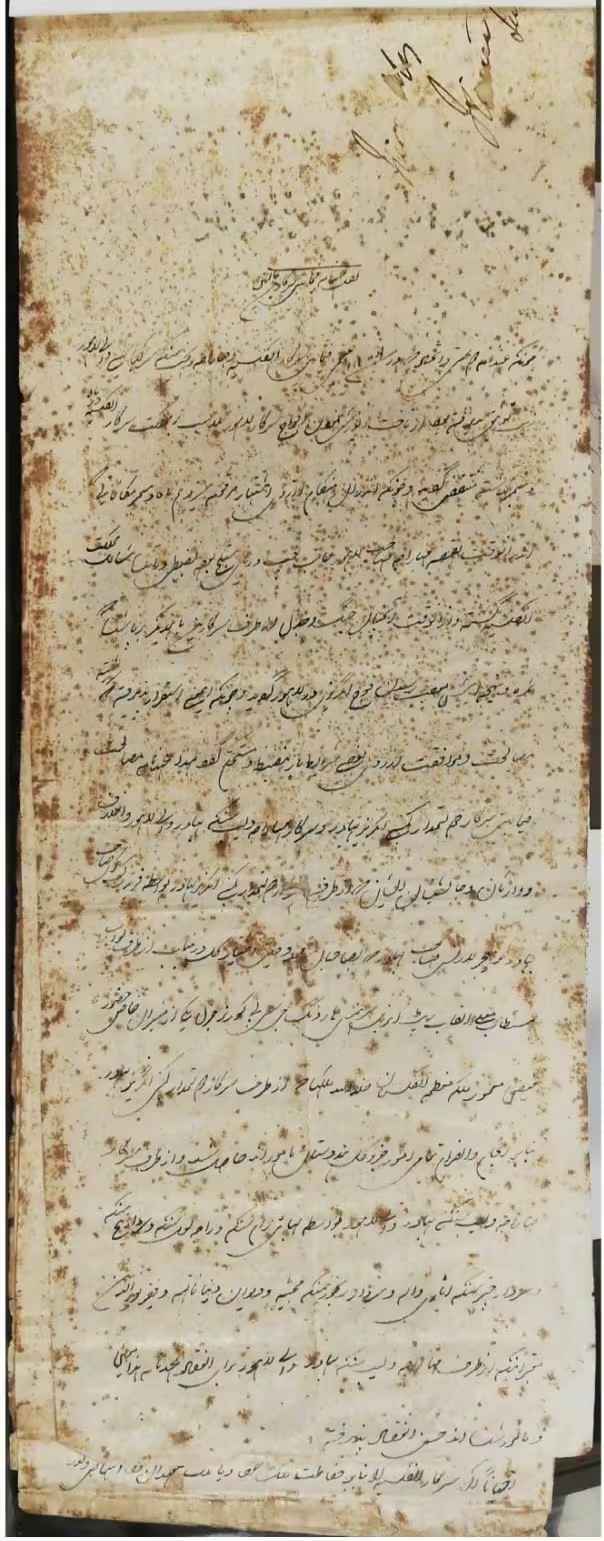
Signed at Lahore on 9 March 1846, the Treaty of Lahore brought the First Anglo-Sikh War to an end. It was concluded for the British by Governor-General Sir Henry Hardinge and two East India Company officers. On the Sikh side, the signatories included the seven-year-old Maharaja Duleep Singh and seven members of Hazara.
The treaty was more than a military settlement. It transferred territory, restricted the Lahore army, confiscated thirty-six field guns, and established British control over important river routes. Its financial provisions also led directly to the separate sale of Kashmir to Gulab Singh and, later in 1846, to a political arrangement that placed the Lahore Government under a British Resident.
Background
Maharaja Ranjit Singh of the Sukerchakia family had made Lahore the capital of the Sikh Empire, which he built across Punjab between 1799 and his death in 1839. His death removed the authority that had held the state together. Factions and assassinations weakened the government and damaged the unity of the empire.
This instability concerned the British because the Sikh state had served as a buffer against what they perceived as a possible invasion from the north. Relations deteriorated as provocative actions by both sides increased tension. On 13 December 1845, Hardinge issued a proclamation declaring war on the Sikhs.
The early fighting did not produce an immediate British triumph. British forces came close to defeat at Ferozeshah, but eventually prevailed. After the Sikh defeat at Sobraon, British troops marched into Lahore without opposition on 20 February 1846.
Prelude
Peace terms were negotiated and drafted by Frederick Currie, assisted on military matters by Brevet-Major Henry Lawrence. Both acted under authority given by Hardinge. Currie’s diplomatic work impressed Hardinge so greatly that British authorities later rewarded him with a baronetcy in January 1847.
The negotiations took place after the military collapse of Sikh resistance and the occupation of the capital. The resulting treaty combined territorial surrender with financial compensation and restrictions on the future strength of the Lahore army.
The Event
The Treaty of Lahore required the Lahore Government to surrender territory south of the Sutlej and the forts and territory in the Jalandhar Doab, between the Sutlej and Beas. The British also gained control of the Sutlej and Beas and part of the Indus. This transfer was accompanied by a provision that it should not obstruct passenger boats owned by the Lahore Government.
The treaty placed limits on the size of the Lahore army. Thirty-six field guns were confiscated, reducing the military capacity of the state that had recently contested British power in Punjab.
A further provision allowed the East India Company to sell separately the hilly regions between the Beas and the Indus, including Kashmir. This arrangement created the basis for a distinct transaction with Gulab Singh, the Raja of Jammu.
Key Phases
The first phase was the formal peace settlement of 9 March. The second came on 11 March, when the same parties signed eight supplementary articles. These permitted a British force to remain in Lahore until no later than the end of 1846, ostensibly to protect Maharaja Duleep Singh and Lahore’s inhabitants while the Sikh army was reorganized.
Under the supplementary agreement, the Lahore army was to leave the city. The Lahore Government would provide suitable quarters for British troops and pay their additional expenses. The agreement also recognized the bona fide rights of jagirdars in Lahore territories and promised British assistance in recovering arrears of revenue owed to the Lahore Government.
Turning Points
The decisive turning point had occurred before the treaty: the Sikh defeat at Sobraon and the subsequent British entry into Lahore. The treaty then converted battlefield victory into territorial, financial, and administrative leverage.
Participants
The British
Hardinge represented the British government. Currie handled the diplomatic drafting, while Henry Lawrence assisted with military matters. Together, they negotiated terms that weakened the Lahore state while preserving a temporary appearance of its continued existence.
The Lahore Government
Duleep Singh, still seven years old, was the Sikh Maharaja and a signatory. The Sikh side accepted territorial losses, military restrictions, and indemnity arrangements after the defeat of the Lahore army.
Aftermath
The British demanded 15 million rupees as reparations for the cost of the war. Since the Lahore Government could not pay the full amount immediately, it ceded territories including Hazara and Kashmir as the equivalent of 10 million rupees. The Maharaja was also required to pay 6 million rupees immediately.
On 16 March 1846, the East India Company concluded the Treaty of Amritsar with Gulab Singh, selling Kashmir to him for 7.5 million rupees. Gulab Singh thereby became the founder and first Maharaja of the princely state of Jammu and Kashmir.
When the end of 1846 approached, the Lahore Durbar asked the British to remain until Duleep Singh reached sixteen. The request produced the Treaty of Bhairowal, signed on 26 December 1846. It appointed a British Resident at Lahore with full authority to direct and control every department of the state. Maharani Jindan Kaur, Duleep Singh’s mother and Regent, received an annual pension of 150,000 rupees and was replaced by a Council of Regency operating under British guidance.
Historical Significance
The Treaty of Lahore ended the First Anglo-Sikh War, but it did not restore the Lahore state to its earlier independence. Its territorial cessions and military restrictions reduced Sikh power, while the financial settlement broke up the political geography of the former empire. The supplementary agreement and Treaty of Bhairowal then transformed temporary British military presence into direct administrative influence.
Legacy
The treaty is remembered alongside the Treaties of Amritsar and Bhairowal as part of the sequence through which British authority expanded across Punjab after the First Anglo-Sikh War. Its consequences included the creation of the princely state of Jammu and Kashmir under Gulab Singh and the subordination of the Lahore Government to British supervision.
Historiography
The surviving account presents the treaty as both a peace agreement and a mechanism of political reorganization. Its provisions can be read narrowly as wartime compensation and security measures, but their combined effect was broader: they transferred territory, weakened the army, enabled the sale of Kashmir, and prepared the way for British control of Lahore’s administration.