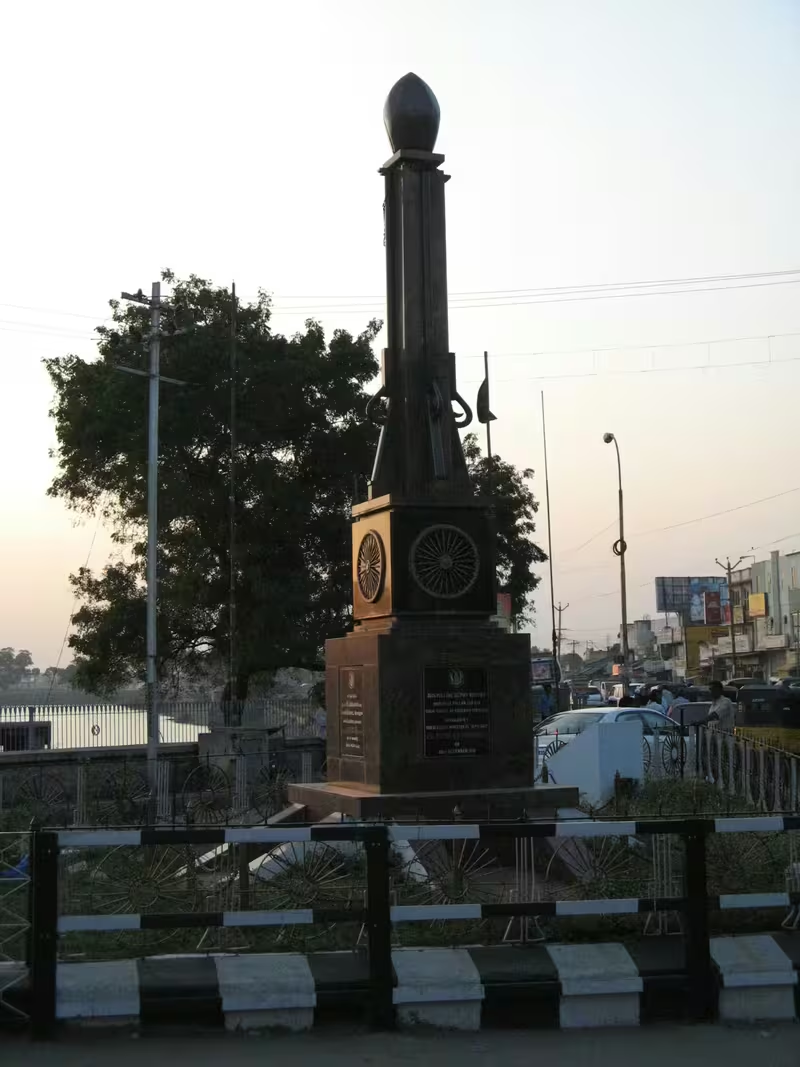
Overview
At around two hours after midnight on 10 July 1806, Indian sepoys inside Vellore Fort turned against their officers and the East India Company. By dawn, they had seized the fort, killed or wounded approximately 200 British troops, and raised the flag of the Mysore Sultanate. The uprising lasted only one day, but it became the first large-scale and violent mutiny by Indian sepoys against the Company.
The immediate grievance was a set of military dress regulations introduced in November 1805. These rules interfered with practices that Hindu and Muslim soldiers regarded as religiously and culturally important. Hindu sepoys were forbidden to wear marks on their foreheads while on duty. Muslim sepoys were required to shave their beards and trim their moustaches. A new round hat, fitted with a leather cockade and intended to replace the existing turban-like headdress, added to the offence.
The revolt was crushed by a force sent from Arcot under Captain Robert Rollo Gillespie. Cavalry and artillery broke into the fort, and the remaining mutineers were overwhelmed. Approximately 350 rebels were killed during the fighting, while many others were wounded or captured. The Company subsequently cancelled the disputed regulations, disbanded the three Madras battalions involved, and recalled senior officers.
Background
The Vellore Mutiny developed within the Madras Army, whose Indian soldiers served under the East India Company. Military authorities sought to improve what they described as the “soldierly appearance” of the sepoys. Yet the reforms treated religious customs and personal appearance as matters of uniform discipline rather than as sensitive issues requiring consultation.
An earlier military board had warned that changes to sepoy uniforms should receive “every consideration which a subject of that delicate and important nature required.” Despite this warning, the new regulations were enforced. The round hat was particularly provocative. Its form was associated not only with Europeans but also, in the perceptions of the time, with Indian converts to Christianity. The leather element attached to it deepened the concerns surrounding the headdress.
The regulations were not merely unpopular in theory. In May 1806, some sepoys who protested were sent to Fort Saint George at Madras. Two—one Hindu and one Muslim—received 90 lashes each and were dismissed from the army. Nineteen others were sentenced to 50 lashes apiece, though they later received a pardon from the East India Company. These punishments convinced many soldiers that opposition to the dress code could bring severe consequences.
A second source of tension lay within Vellore Fort itself. The sons of the defeated ruler Tipu Sultan had been confined there since 1799. Tipu’s wives and sons, along with numerous retainers, lived as Company pensioners in a palace inside the fort complex. Their presence gave the uprising a political dimension beyond the immediate dispute over uniforms.
Prelude
One of Tipu Sultan’s daughters was scheduled to marry on 9 July 1806. The wedding provided a reason for people connected with the former Mysore court to gather at the fort. According to the surviving account of the events, plotters used the ceremony as a pretext for assembling. The exact objectives of the civilian conspirators remain unclear. By taking and holding Vellore Fort, however, they may have hoped to encourage a wider rising across the territory of the former Mysore Sultanate.
The sons of Tipu Sultan were present within the complex, and retainers of Tipu’s second son, Fateh Hyder, later joined the mutineers. Yet the princes themselves were reluctant to assume leadership once the uprising began. This hesitation left the rebellion without a clearly established political command.
The military situation at Vellore helped the plotters. The garrison included four companies of the British 69th Regiment of Foot and three battalions of Madras infantry: the 1st/1st, 2nd/1st, and 2nd/23rd Madras Native Infantry. Sepoys who had families at Vellore normally lived in huts outside the fort walls. A field-day scheduled for 10 July changed this arrangement. Most of the soldiers were required to sleep inside the fort so they could assemble quickly before dawn.
The Event
The Night Attack
At approximately two hours after midnight, the sepoys launched their attack. They killed fourteen of their own officers and 115 men of the 69th Regiment, most of them while they slept in their barracks. Colonel St. John Fancourt, the fort’s commander, was among those killed.
By dawn, the mutineers controlled Vellore Fort. They raised the flag of the Mysore Sultanate over the stronghold, signalling the connection between the military revolt and the former ruling house. Retainers from Fateh Hyder’s household emerged from the palace portion of the complex and joined the uprising.
The surviving Europeans—about 60 men of the 69th Regiment—held part of the ramparts. They were commanded by non-commissioned officers and assisted by two surgeons. Their position was precarious: they had run out of ammunition and remained inside a fort controlled by the mutineers.
The Alarm and Relief Force
Major Coopes, a British officer who had been outside the fort walls, managed to alert the garrison at Arcot. A relief force was assembled from the 19th Light Dragoons, galloper guns, and a squadron of the 3rd Regiment of Madras Native Cavalry. It was placed under Captain Robert Rollo Gillespie.
The force covered the 16 miles between Arcot and Vellore in about two hours. Gillespie reportedly left Arcot within a quarter of an hour of the alarm. He rode ahead of the main body with a single troop of around 20 men, displaying the urgency of the response.
Breaking into the Fort
When Gillespie reached Vellore, he found the surviving soldiers of the 69th still defending a portion of the ramparts. The entrance was held by the mutineers, so he could not simply ride through the gate. Instead, he climbed the wall with the help of a rope and a sergeant’s sash lowered to him.
Once inside, Gillespie led the 69th in a bayonet charge along the ramparts. The assault created enough time for the rest of the relief force to arrive. When the 19th Light Dragoons reached the fort, their galloper guns blew open the gates. Gillespie then led another charge by the 69th to clear space inside the entrance.
The cavalry followed. The Light Dragoons and the Madras Cavalry charged and used their sabres against sepoys who resisted. The attack ended the mutineers’ control of the fort. About 100 sepoys who had taken refuge inside the palace were brought out and, on Gillespie’s orders, placed against a wall and shot.
Turning Points
The first decisive moment was the mutineers’ successful seizure of the fort during the night. Their surprise attack killed many British soldiers before they could organise a defence. Raising the Mysore flag also gave the revolt a potential political meaning.
The second turning point was Major Coopes’s warning to Arcot. Without that message, the surviving British troops inside Vellore might have been overwhelmed. The speed of Gillespie’s march then became critical. The relief force arrived while the defenders still held part of the ramparts, allowing the British to regain the initiative.
The final turning point was the use of galloper guns to open the gates. Once the cavalry could enter, the mutineers’ position collapsed. The rebellion was suppressed within a single day, and the possibility of a wider disturbance was ended immediately.
Participants
Indian Sepoys and the Mysore Connection
The principal rebel force consisted of sepoys from the Madras infantry units stationed at Vellore. Their anger arose from the new dress regulations and from the punishments imposed on those who resisted them. Both Hindu and Muslim soldiers regarded the changes as an attack on important religious and cultural practices.
Civilian conspirators associated with Tipu Sultan’s household also played a role. The wedding gathering created an opportunity for them to assemble, while retainers of Fateh Hyder joined the mutiny. The precise plan of these civilians is uncertain. They may have hoped to spread the rising through the former Mysore territories, but Tipu’s sons did not take command after the outbreak.
East India Company Forces
The British garrison included the 69th Regiment of Foot. Colonel St. John Fancourt commanded the fort until his death during the initial attack. The surviving defenders held part of the ramparts until Gillespie arrived.
The relief force brought together British cavalry, Madras cavalry, and artillery. Gillespie’s rapid response and aggressive assault determined the outcome. The senior officers associated with the dress regulations included John Cradock, Commander-in-Chief of the Madras Army, and William Bentinck, Governor of Madras. Both were recalled after the mutiny.
Aftermath
The human cost was severe. Nearly 350 mutineers were killed during the fighting, and approximately the same number were wounded. About 200 British troops were killed or wounded in the initial attack and its suppression. Many surviving sepoys fled into the countryside. Local police captured some of them; others were released or returned to Vellore for court-martial.
The formal punishments were varied and severe. Six mutineers were blown away from guns, five were executed by firing squad, eight were hanged, and five were transported. Around 100 sepoys had already been killed in summary executions during the recapture of the fort.
The three Madras battalions involved in the uprising were disbanded. The orders concerning the new turbans were cancelled, as were the wider measures interfering with the social and religious customs of the sepoys. Senior officers responsible for the dress regulations were recalled to England. The Company even refused to pay Cradock’s passage.
Tipu Sultan’s family was moved from Vellore to Calcutta. The Company’s Court of Directors criticised the failure to investigate the “real sentiments and dispositions” of the sepoys before enforcing such severe measures. The response indicated that the Company recognised the mutiny as a failure of policy as well as a military emergency.
Historical Significance
The Vellore Mutiny demonstrated how quickly military discipline could break down when regulations were perceived as attacks on religious identity. The immediate dispute concerned clothing, grooming, and marks worn on the body, but the deeper issue was whether the Company respected the customs of the Indian soldiers on whom its armies depended.
The episode also foreshadowed the Indian Rebellion of 1857. In both uprisings, sepoys believed that Company policies threatened their religious and cultural practices. In Vellore, the rebels raised the Mysore flag and were connected to Tipu Sultan’s sons. In 1857, sepoys proclaimed the restoration of Mughal authority by reinstating Bahadur Shah as emperor. The later rebellion was much larger and involved the Bengal Army, while the Madras Army was not affected in the same way.
The comparison should not erase the differences between the two events. Vellore lasted one day and was confined to a single fort, while the events of 1857 developed into a major rebellion across extensive areas. Nevertheless, Vellore revealed an early pattern: military orders that appeared administrative to Company officials could become politically explosive when they touched religious practice and social identity.
Legacy
The mutiny survives in military memory, local history, and literature. Sir Henry Newbolt’s poem “Gillespie” presents the relief of Vellore through the dramatic figure of the British commander. George Shipway’s 1976 novel Strangers in the Land revisits the uprising from the perspectives of both British and Indian participants.
The only surviving eyewitness account of the actual outbreak is associated with Amelia Farrer, Lady Fancourt, the wife of the fort commander. Written two weeks after the massacre, her manuscript describes how she and her children survived while her husband was killed. Her testimony provides a personal view of an event otherwise dominated by military reports, punishments, and official decisions.
Historiography
Interpretations of the Vellore Mutiny generally place the dress regulations at its centre while also recognising the political role of Tipu Sultan’s household. The regulations clearly provoked resentment: they affected Hindu forehead marks, Muslim facial hair, and the wearing of a controversial leather-cockaded hat. The punishments imposed on protesting sepoys further intensified the crisis.
At the same time, the aims of the civilian conspirators cannot be established with certainty. Their gathering during the royal wedding and the raising of the Mysore flag suggest an attempt to connect the military revolt with the restoration of the former Mysore order. Yet Tipu’s sons did not take charge, leaving the extent of their involvement unresolved.
The event is therefore remembered both as a military mutiny caused by insensitive discipline and as a politically charged attempt to revive opposition to Company rule. Its suppression did not erase the warning it carried: the Company’s Indian armies could not be separated from the religious and political worlds in which their soldiers lived.
Timeline
Dress Regulations Introduced
New rules restrict religious marks, alter Muslim grooming practices, and introduce the controversial round hat.
Sepoys Punished
Protesting soldiers receive lashes and dismissals or sentences that are later pardoned.
Vellore Mutiny Begins
In the early hours of 10 July, sepoys attack their officers and British troops inside Vellore Fort.
Fort Seized
The mutineers take control of the fort and raise the flag of the Mysore Sultanate.
Relief from Arcot Arrives
Captain Robert Rollo Gillespie leads cavalry and artillery to Vellore, covering 16 miles in about two hours.
Mutiny Suppressed
Galloper guns breach the gates and cavalry retake the fort within the same day.
Regulations Cancelled
The new turbans and related dress orders are withdrawn; battalions are disbanded and senior officers recalled.