Overview
Beside the old course of the Brahmaputra, Sonargaon grew into a river port, textile centre and political capital of eastern Bengal. Its location connected the interior of the delta with the Bay of Bengal, while its surrounding countryside supported rice cultivation, cotton production, weaving and other crafts. Over several centuries, rulers used the town as a capital, provincial headquarters, mint centre and military base.
The place known today as Sonargaon corresponds broadly to Sonargaon Upazila in Narayanganj District of Bangladesh’s Dhaka Division. Its history reaches from the ancient kingdoms of Vanga and Samatata to the medieval Bengal Sultanate, the Baro-Bhuyan resistance and Mughal Bengal. Under British rule, the Panam neighbourhood became a wealthy textile business district filled with townhouses, offices, temples and mosques.
Sonargaon is especially remembered for the quality of its cotton textiles. Its cloth, including the fine fabric known as Khasa, was produced by a large population of weavers and artisans. The town was also an intellectual centre. Persian scholars, Sufi teachers, jurists, administrators and poets settled there, and its institutions of learning acquired a reputation across the Indian subcontinent.
Today, the historic area contains archaeological remains, mosques, tombs, bridges, shrines, temples and the surviving townhouses of Panam Nagar. The Bangladesh Folk Arts and Crafts Foundation, established in Sonargaon in 1975, has made the place an important centre for the preservation and presentation of Bangladeshi traditional culture.
Etymology and Names
The name Sonargaon is connected with the ancient term Suvarnagrama, often interpreted as “Golden Hamlet.” The name appears in forms associated with the region’s long history. Greco-Roman accounts mention an emporium called Sounagoura, which archaeologists have considered a possible reference to the Wari-Bateshwar ruins north of Sonargaon.
The connection between Sounagoura and Wari-Bateshwar remains an archaeological identification rather than an unquestioned fact. Wari-Bateshwar has been considered the trading settlement described by ancient writers, but Sonargaon’s later importance developed in a related riverine landscape around the old Brahmaputra.
Sonargaon is also one of the possible locations associated with the fabled land of Suvarnabhumi, a name appearing in traditions across the Indian subcontinent and Southeast Asia. This association is uncertain, and the identification cannot be treated as a settled geographical conclusion. What is clearer is the continuity of the “golden” name in the forms Suvarnagrama and Sonargaon.
Geography and Location
Sonargaon lies in the riverine landscape of central Bangladesh, near the old course of the Brahmaputra. The surrounding deltaic environment shaped nearly every aspect of its history. Rivers provided transport, connected the town to the Bay of Bengal and created routes for military movement, trade and pilgrimage.
The old Brahmaputra corridor offered access toward the interior of Bengal. Through the waterways of the delta, Sonargaon could communicate with regions such as Chittagong, Tripura, Arakan and the wider Bay of Bengal. This position gave the town strategic value to rulers attempting to control eastern Bengal.
Its geography also influenced warfare. Armies operating in the region had to negotiate rivers, marshes and changing waterways. Naval forces could move rapidly during the monsoon, while land campaigns were more effective during the dry season. The fourteenth-century rivalry between Sonargaon, Lakhnauti and Satgaon demonstrated this distinction: Sonargaon performed strongly in naval campaigns during the monsoon, while Lakhnauti held an advantage in land campaigns in the dry season.
The same landscape supported agriculture and textile production. Rice was exported from the area, while cotton cultivation and weaving supported a dense population of artisans. The river port allowed these products to move outward toward other parts of Bengal and overseas markets.
Ancient History
The wider region around Sonargaon was associated with the ancient kingdoms of Vanga and Samatata. Later, the Sena dynasty used the area as a base after losing control of western Bengal to Bakhtiyar Khalji. In the middle of the thirteenth century, King Dasharathadeva of the Deva dynasty is said to have shifted his capital from Bikrampur to Suvarnagrama.
The ancient history of the area is also connected with Wari-Bateshwar, located to the north. Greco-Roman writers described an emporium called Sounagoura, and archaeologists have considered the Wari-Bateshwar ruins a possible identification of that trading colony. This suggests that the region participated in long-distance commerce before the rise of the medieval sultanates, although the exact relationship between the ancient emporium and later Sonargaon remains a matter of interpretation.
The historical landscape was therefore not created suddenly by Muslim rule. Political centres, river routes and commercial networks already existed in eastern Bengal. Later rulers built upon these foundations, turning Sonargaon into a fortified, administratively organised and internationally connected town.
Historical Timeline
Early Kingdoms and the Deva Dynasty
In antiquity, the region formed part of the political world of Vanga and Samatata. The Sena dynasty later used it as a base after the loss of western Bengal. By the middle of the thirteenth century, the Deva ruler Dasharathadeva had shifted his capital from Bikrampur to Suvarnagrama.
This movement of the capital indicates that the area had acquired political importance before the Delhi Sultanate’s direct involvement. Its rivers and connections with eastern Bengal made it suitable for administration and communication.
Delhi Sultanate
Muslim settlers arrived in Sonargaon around 1281. In the early fourteenth century, Shamsuddin Firoz Shah, the Delhi governor in Gauda, conquered central Bengal and brought Sonargaon into the Delhi Sultanate’s sphere.
Firoz Shah established a mint at Sonargaon, from which a large number of coins were issued. The existence of a mint shows that the town was not merely a settlement or local market. It had become an administrative and financial centre with the institutional infrastructure required for regional rule.
Delhi’s governors in Bengal frequently attempted to establish independence. Sonargaon was a favoured capital for rebel governors because of its strategic position in the eastern delta. After Firoz Shah’s death in 1322, his son Ghiyasuddin Bahadur Shah became ruler. The Delhi Sultan Ghiyasuddin Tughlaq declared war on him in 1324 and captured him in battle. That same year, Sultan Muhammad bin Tughlaq released Bahadur Shah and appointed him governor of Sonargaon.
The period also established Sonargaon as a centre of Islamic learning and Persian literary culture. Persian and Persianate Turkic immigrants settled in the town, strengthening its links with the wider intellectual networks of the Islamic world.
Learning under the Sufis and Scholars
Maulana Sharfuddin Abu Tawwama of Bukhara arrived in Sonargaon around 1270. He established a Sufi khanqah and madrasa that taught both religious and secular subjects. These institutions became renowned across the Indian subcontinent.
The madrasa’s influence extended beyond Bengal. Sharfuddin Yahya Maneri, later a celebrated Sufi scholar of Bihar, was among its alumni. Abu Tawwama’s mystical work, Maqamat, also gained a strong reputation.
Sonargaon’s scholarly production included Nam-i-Haq, a work on Islamic jurisprudence written in elegant Persian verse during the administration of Roknuddin Kaikaus, who ruled from 1291 to 1301. The work contains ten volumes and 180 poems. Although authorship was once attributed to Abu Tawwama, the introduction identifies one of his disciples as the actual writer, working from his teacher’s instruction.
Another important legal compilation, the Fatwa-i-Tatarkhani, was prepared at the initiative of Tatar Khan, the Tughluq governor of Sonargaon. These works reveal the town’s place within the legal, religious and literary culture of the period.
The Sonargaon Sultanate
In 1338, Bahram Khan died, and his armour-bearer Fakhruddin Mubarak Shah declared himself the independent Sultan of Sonargaon. The new sultanate controlled central, northeastern and southeastern parts of Bengal for a short period.
Fakhruddin sponsored roads, raised embankments and commissioned mosques and tombs. His government also expanded eastward. Sonargaon’s army conquered Chittagong in 1340, extending the sultanate’s influence toward the southeastern coast.
The independent state competed with Lakhnauti and Satgaon for supremacy in Bengal. Its naval strength was particularly important. During the monsoon, river and maritime forces could move through the delta, giving Sonargaon an advantage over rivals whose strength was more closely tied to land campaigns.
The Moroccan traveller Ibn Battuta visited the Sonargaon Sultanate in the fourteenth century. He reached the region through the port of Chittagong, travelled to Sylhet to meet Shah Jalal and then proceeded to Sonargaon. He described Fakhruddin as a distinguished ruler who welcomed strangers, especially fakirs and Sufis.
Ibn Battuta’s account also illustrates the town’s international connections. At Sonargaon’s river port, he boarded a Chinese junk that carried him toward Java. The episode places the town within the maritime world linking Bengal with Southeast Asia.
Fakhruddin died in 1349 and was succeeded by his son, Ikhtiyaruddin Ghazi Shah. The independent sultanate did not last long. In 1352, Shamsuddin Ilyas Shah of Satgaon defeated Sonargaon and established the Bengal Sultanate.
The Bengal Sultanate
The unification of Bengal’s three major city-states created an independent sultanate separate from Delhi. Sonargaon became one of the principal townships of the eastern Indian subcontinent and a major centre in eastern Bengal.
Sultan Ghiyasuddin Azam Shah established a royal court in Sonargaon. The town flourished as a centre for writers, jurists and lawyers. The large body of Persian prose and poetry produced there has been described as a golden age of Persian literature in Bengal. Ghiyasuddin Azam Shah even invited the Persian poet Hafez to the Bengali court at Sonargaon.
The scholarly institutions founded by Abu Tawwama continued under later Sufi teachers, including Saiyid Ibrahim Danishmand, Saiyid Arif Billah Muhammad Kamel and Saiyid Muhammad Yusuf. Sonargaon thus combined courtly culture with religious education and legal scholarship.
Chinese maritime activity reached Sonargaon during the fifteenth century. An expedition connected with the treasure voyages of Admiral Zheng He visited the town. Ma Huan, one of the expedition’s participants, described Sonargaon in 1451 as a fortified and walled city containing a royal court, bazaars, busy streets, water reservoirs and a port.
Under the Hussain Shahi dynasty, Sonargaon served as a base for campaigns against Assam, Tripura and Arakan. Its river port was essential to naval operations, including the Bengal Sultanate’s campaigns against the Kamata Kingdom and the Kingdom of Mrauk U between 1512 and 1516.
The town also continued to host a mint. Turkic, Arab, Habesha and Persian settlers moved into the region and became part of the community identified as Sonargaiyas. The town became the eastern terminus of the Grand Trunk Road during the sixteenth century, after Sher Shah Suri developed the major route linking Bengal with Central Asia.
European travellers, including Ludovico di Varthema, Duarte Barbosa and Tomé Pires, described Bengal’s prosperity and commercial activity. Their accounts support Sonargaon’s reputation as a major marketplace. Many of its weavers and artisans were Hindus, illustrating the socially diverse character of the textile economy.
The Baro-Bhuyan Resistance
When the Karrani dynasty lost western Bengal to Mughal forces, Isa Khan emerged as the leading figure in eastern Bengal. Under Sultan Taj Khan Karrani, Isa Khan had served as prime minister and received an estate covering the Sonargaon area.
Isa Khan gradually expanded his authority and became the dominant ruler of the Bhati region, receiving the title Mansad-e-Ala. He led a confederation of zamindars known as the Baro-Bhuyans, or Twelve Bhuiyans. The confederation included Bengali Muslim and Hindu zamindars, many of whom had Turkic or Rajput ancestry.
Sonargaon became a principal base of resistance to Mughal expansion. Isa Khan used Jangalbari Fort and relied heavily on naval forces suited to the delta’s waterways. In the Ain-i-Akbari, Abul Fazl praised the “fine Bengali war boats” of Isa Khan. In the Akbarnama, he described Isa as a careful and capable leader who brought the Twelve Zamindars under his authority.
The conflict produced several important victories. In 1578, the Twelve Bhuiyans defeated the Mughal viceroy Khan Jahan I under the leadership of Majlis Pratap and Majlis Dilawar, after Isa Khan had been forced to retreat during an engagement on the Meghna River.
In 1584, following an invasion by Shahbaz Khan Kamboh, Isa Khan and Masum Khan Kabuli launched a successful land and naval counterattack at Egarosindur on the Brahmaputra. The Mughal invasion was repulsed.
In 1597, Isa Khan’s navy defeated the Mughal fleet on the Padma River. The Mughal forces were commanded by the viceroy Man Singh I, whose son died in the battle. Isa Khan’s fleet surrounded the Mughal navy on four sides.
The English traveller Ralph Fitch visited the region in 1580 and described its waterways as a major obstacle to Mughal cavalry. He also praised Sonargaon’s cotton cloth, calling it the finest in India. His account records the town’s commercial importance as well as the strength of Isa Khan’s political position.
Isa Khan died in September 1599. His son Musa Khan then took control of Bhati. During Musa Khan’s rule, the court poet Nathuresh compiled the dictionary Shabda-Ratnakari. Musa Khan was defeated by the Mughal general Islam Khan on 10 July 1610. After this defeat, Sonargaon became a district of Bengal Subah, while the political centre of Mughal Bengal developed at Dhaka.
Political Significance
Sonargaon’s political history was shaped by the tension between regional autonomy and imperial control. Delhi’s governors used it as a capital when they rebelled. Fakhruddin Mubarak Shah made it the centre of an independent sultanate. The Bengal Sultans maintained a royal court and mint there. Isa Khan later transformed the region into a centre of resistance against the Mughals.
Its importance came from more than its population or wealth. Sonargaon combined a port, a river network, fertile hinterland and access to military routes. Control of the town meant access to eastern Bengal’s communications and commercial resources.
Under Mughal rule, Sonargaon lost its position as an independent centre of power but remained strategically relevant. The Mughals built riverside fortifications near it to help defend Dhaka against Arakanese and Portuguese pirates. Hajiganj Fort and Sonakanda Fort formed part of this defensive landscape.
Religious and Cultural Importance
Sonargaon was an important centre of Islamic education from the late thirteenth century. Abu Tawwama’s khanqah and madrasa taught religious and secular subjects, and later Sufi scholars sustained the town’s intellectual reputation.
The town’s cultural life was not limited to religious institutions. Royal courts supported Persian prose and poetry, legal scholars wrote works on jurisprudence and immigrant communities added new languages and traditions to the urban population.
The wider region also contains Hindu temples, shrines and ashrams. Baradi is associated with Esha Khan’s palace, the Sonali Mosque and the ashram of Loknath Brahmachari. Other important religious destinations include Kadam Rasul Dargah and Panch Pirer Mazar.
Kadam Rasul Dargah is believed to house a footprint associated with the Islamic Prophet Muhammad. Panch Pirer Mazar, in Bhagalpur village, attracts visitors for prayer and pilgrimage. These sites illustrate how Sonargaon’s religious landscape developed across different historical periods and communities.
Economic Role
The economic life of Sonargaon rested on textiles, agriculture and river commerce. The town’s hinterland was a major centre of muslin production, with many weavers and artisans living in the surrounding settlements.
One celebrated fabric was Khasa, a fine cotton cloth known for its quality. Ralph Fitch’s description of 1580 records the scale of cotton production and the importance of rice exports. He noted that large quantities of cotton cloth and rice moved from the region to India, Ceylon, Pegu and Malacca.
Sonargaon’s port connected the town to the Bay of Bengal through the mouth of the Bengali delta. Maritime vessels travelled between Sonargaon and regions in southeastern and western Asia. The movement of Chinese shipping and Ibn Battuta’s departure for Java demonstrate the port’s international reach.
The textile economy continued into the colonial period. Panam Nagar became a wealthy business centre focused especially on cotton fabrics. Its merchants included Bengali Hindus, Marwaris and Bengali Muslims.
Monuments and Architecture
Panam Nagar
Panam Nagar is the most recognisable historic neighbourhood associated with modern Sonargaon. It developed during British colonial rule and contains approximately 52 old brick mansions. The buildings combine local traditions with European and Indo-Saracenic influences.
The neighbourhood included townhouses, offices, temples and mosques. Its architecture reflects the prosperity of merchants involved in the textile trade. The surviving buildings provide evidence of a commercial community that grew after Sonargaon’s earlier political prominence had declined.
Bara Sardar Bari
Bara Sardar Bari was built in 1901 by the zamindar Ishan Chandra Saha. The palace is associated with Mughal-influenced architecture and now forms part of the Sonargaon Folk Art and Craft Museum.
Goaldi Mosque
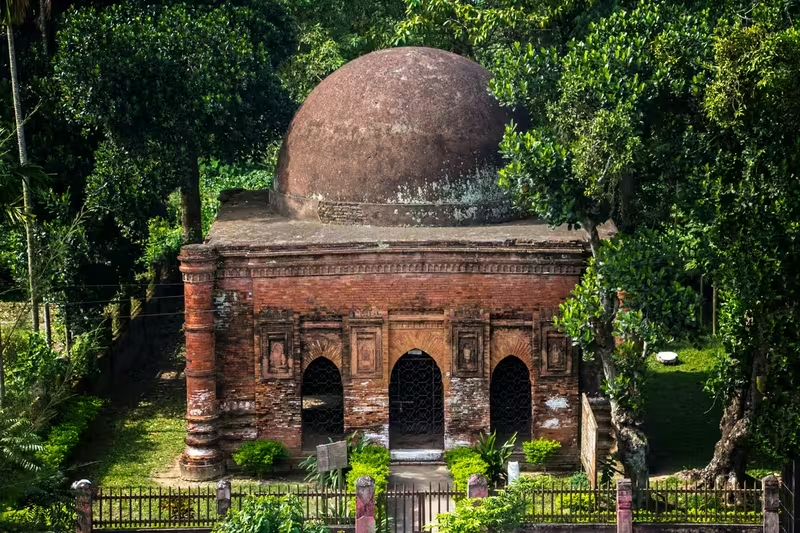
Goaldi Mosque is a fifteenth-century mosque known for its carvings and historical importance. It is among the principal architectural remains that connect present-day visitors with Sonargaon’s Sultanate-era past.
Forts and Bridges
The Mughals constructed Hajiganj Fort and Sonakanda Fort as part of the defences protecting Dhaka and the surrounding river routes. Their location near the waterways reflects the military importance of the delta.
Several historic bridges also remain in use, including Panam Bridge, Dalalpur Bridge and Panamnagar Bridge. These structures represent the continuing importance of transport across Sonargaon’s waterways and channels.
Museum and Memorials
The Bangladesh Folk Arts and Crafts Foundation preserves textiles, pottery, woodwork and metal crafts. The institution was established by the Bangladeshi painter Zainul Abedin on 12 March 1975.
The Joynul Abedin Smriti Jadughar is dedicated to the artist and displays paintings, sketches, writings and personal belongings. Together, the museum and memorial connect Sonargaon’s historic craft traditions with modern efforts to preserve Bangladeshi artistic heritage.
Famous Personalities
Several rulers and intellectuals are closely associated with Sonargaon:
- Fakhruddin Mubarak Shah made Sonargaon the capital of an independent sultanate, expanded its territory and sponsored roads, embankments, mosques and tombs.
- Ikhtiyaruddin Ghazi Shah, Fakhruddin’s son, succeeded him as ruler of Sonargaon.
- Ghiyasuddin Azam Shah established a royal court in Sonargaon during the Bengal Sultanate and supported literary culture.
- Abu Tawwama founded the influential khanqah and madrasa that made Sonargaon a major centre of learning.
- Ibn Battuta visited the town and recorded its ruler, port and connection to Chinese shipping.
- Isa Khan led the Baro-Bhuyan resistance and used the region as a base against Mughal expansion.
- Musa Khan succeeded Isa Khan and continued the resistance until his defeat in 1610.
- Zainul Abedin established the Bangladesh Folk Arts and Crafts Foundation in Sonargaon in 1975.
Decline and Revival
Sonargaon’s political autonomy ended with Musa Khan’s defeat by Islam Khan in 1610. The town became a district of Mughal Bengal, and Dhaka developed as the new Mughal metropolis. Sonargaon retained strategic and commercial importance, but it was no longer the principal political centre of eastern Bengal.
During British rule, commercial activity shifted toward Panam Nagar. The neighbourhood became a prosperous textile business centre, but the rise of the nearby Port of Narayanganj, established in 1862, eventually eclipsed Sonargaon’s importance.
The town’s modern revival has focused on heritage, culture and tourism. The Folk Arts and Crafts Foundation has preserved traditional material culture, while Panam Nagar and the surrounding archaeological and religious sites draw visitors.
Preservation remains difficult. Flooding and vandalism threaten the historic structures, and Sonargaon was included in the World Monuments Fund’s 2008 Watch List of the 100 Most Endangered Sites. The history of Sonargaon therefore involves not only its past splendour but also the continuing challenge of protecting a riverine heritage landscape.
Modern City
Sonargaon is now a municipality and a subdistrict of Narayanganj District. At the 2011 census, Sonargaon Municipality contained 7,289 households and had a population of 32,796. Of this population, 21.20 percent was under ten years of age. The recorded literacy rate was 62.57 percent, with a sex ratio of 951 females per 1,000 males.
Visitors encounter several overlapping layers of history: the remains of a Sultanate-era capital, the waterways and fortifications of Mughal Bengal, the merchant houses of colonial Panam and the living religious institutions of villages such as Baradi and Bhagalpur.
The Folk Art and Craft Museum provides a useful introduction to the region’s material culture. Panam Nagar offers an architectural record of the colonial textile economy, while mosques, tombs, bridges, forts and shrines reveal the area’s longer political and religious history.
Sonargaon’s importance today lies in this combination. It is not a single monument but a historical landscape shaped by rivers, rulers, merchants, weavers, scholars, soldiers and religious communities.
Timeline
Abu Tawwama arrives
Maulana Sharfuddin Abu Tawwama of Bukhara establishes a Sufi khanqah and madrasa at Sonargaon.
Muslim settlers arrive
Muslim settlers are recorded at Sonargaon around this time.
Bahadur Shah and Delhi
After capturing Ghiyasuddin Bahadur Shah, Muhammad bin Tughlaq appoints him governor of Sonargaon.
Independent sultanate
Fakhruddin Mubarak Shah declares himself independent Sultan of Sonargaon.
Conquest of Chittagong
The army of Sonargaon conquers Chittagong.
Bengal Sultanate
Shamsuddin Ilyas Shah defeats Sonargaon and establishes the Bengal Sultanate.
Chinese expedition
Ma Huan describes Sonargaon as a fortified city with a court, bazaars, reservoirs and a port.
Ralph Fitch’s account
The English traveller praises Sonargaon’s fine cotton cloth and describes its riverine setting.
Naval victory
Isa Khan’s navy defeats the Mughal fleet on the Padma River.
Death of Isa Khan
Isa Khan dies in September; his son Musa Khan takes control of Bhati.
Mughal conquest
Musa Khan is defeated by Islam Khan, and Sonargaon becomes a district of Bengal Subah.
Narayanganj port
The nearby Port of Narayanganj is established, eventually eclipsing Sonargaon’s commercial importance.
Bara Sardar Bari
Zamindar Ishan Chandra Saha builds Bara Sardar Bari.
Folk Arts and Crafts Foundation
Zainul Abedin establishes the Bangladesh Folk Arts and Crafts Foundation in Sonargaon.
Endangered heritage listing
Sonargaon is placed on the World Monuments Fund Watch List of the 100 Most Endangered Sites.