Overview
In May 326 BCE, the Macedonian army of Alexander the Great confronted the Paurava king Porus on the banks of the Hydaspes River, now known as the Jhelum, in the Punjab of present-day Pakistan. The river was deep, fast, and swollen by the seasonal rains. Porus had placed his army on the opposite bank to prevent Alexander from entering his kingdom, while Alexander established his camp to the north and searched for a way across.
The resulting battle was a Macedonian victory, but it was unlike many of Alexander's earlier successes. The crossing was difficult, the Indian army included heavily armoured war elephants, and Macedonian losses were unusually high. Alexander's soldiers eventually defeated Porus through a combination of deception, disciplined infantry, and coordinated cavalry attacks. Porus was captured, yet Alexander chose to restore him as ruler rather than remove him from power.
The battle brought large areas of the Punjab into the Macedonian Empire and created an important point of contact between Greek political and cultural traditions and the Indian subcontinent. Alexander continued east after the victory, but his army later refused to advance beyond the Hyphasis, now the Beas. The Hydaspes therefore marked both the height of his military progress in India and the last major victory of his eastern campaign.
Background
Alexander's Indian campaign followed his victories over the remaining forces of the Achaemenid Empire. After defeating Bessus and Spitamenes in 328 BCE, he turned towards India in 327 BCE, seeking to extend his empire farther east. He fortified Bactria with 10,000 men and began the invasion through the Khyber Pass.
The main Macedonian column entered through the Khyber route. Alexander himself led a smaller force along a northern route and captured the fortress of Aornos, identified with modern Pir-Sar. The position held special meaning for the Greeks because tradition claimed that Herakles had failed to occupy it during his own campaign in India. The Hindu Kush clans offered Alexander's army its toughest opposition up to that point. Although the Macedonians were outnumbered, Alexander prevailed; estimates of the numerical disadvantage range from three-to-one to five-to-one.
In early spring of the following year, Alexander formed an alliance with Taxiles, whose local name was Ambhi, the king of Taxila. Taxiles joined Alexander against his neighbour, Porus, the ruler of the territory around the Hydaspes. Unlike Taxiles, Porus refused Alexander's demand that he surrender. He prepared to resist the invasion and selected the river as the main barrier against the Macedonian advance.
Porus had strong reasons to defend the river crossing. The Hydaspes was wide, fast, and difficult to ford, and an army attempting to cross directly would be exposed while divided between the banks. Alexander, however, could not leave such a powerful opponent behind him. A hostile kingdom on his flank would threaten his communications and make further movement eastward dangerous. Porus therefore had to be defeated or neutralized before Alexander could continue.
Porus's later performance won respect even among Greek writers. The historian Peter Green judged that he outperformed Alexander's earlier opponents Memnon of Rhodes and Spitamenes. Although the Paurava army lost, its king remained the most formidable recorded opponent Alexander faced during the Indian campaign.
Prelude
Alexander fixed his camp on the northern bank of the Hydaspes. Porus drew up his army on the southern bank, ready to challenge any attempt to cross. He positioned himself where he could observe the river and respond to Macedonian movements. Alexander began a prolonged campaign of deception rather than attempting an immediate assault.
Each night, Macedonian mounted troops moved up and down the bank. Their movements suggested that a crossing might be attempted at several points. Porus shadowed these manoeuvres, keeping his army in motion to meet a possible attack. Alexander repeatedly visited potential crossing places, but on each occasion he moved inland afterwards, preserving the impression that the demonstrations were only threats.
The Macedonians also used other forms of deception. A look-alike was reportedly placed in a mock royal tent near the main camp, helping to make it appear that Alexander remained there. Meanwhile, the commander Craterus stayed behind with most of the army. He was ordered to cross and attack only if Porus faced Alexander with all his troops. If Porus moved only part of his army against Alexander, Craterus was to hold his position and prevent the Indian king from discovering the full plan.
Other commanders, including Meleager, Attalus, and Gorgias, were instructed to cross at different locations during the operation. Their movements helped maintain pressure along the river and complicated Porus's attempts to identify the main point of attack.
Eventually Alexander selected a crossing approximately 27 kilometres upstream from his camp. At this place, an uninhabited island covered with trees divided the river. The island concealed the Macedonians from observation and gave them an intermediate position from which to complete the crossing. Alexander took a strong contingent with him. Arrian reports 6,000 infantry and 5,000 cavalry, though the force may have been larger.
The crossing was conducted quietly. The Macedonians used skin floats filled with hay and small vessels made from larger boats cut into sections. Thirty-oared galleys were reportedly divided into three parts for transport. Craterus continued his feints near the main camp, sustaining the impression that Alexander might attempt to cross there.
The operation took place under cover of darkness. A storm broke during the night, and its noise concealed the movement of the soldiers and boats. Porus had watched the river closely for so long that he eventually concluded Alexander's repeated demonstrations were a bluff. This relaxation of vigilance allowed the main Macedonian force to reach the island and then the far bank.
The crossing was not entirely smooth. Alexander mistakenly landed on the island rather than immediately reaching the opposite shore. The troops nevertheless completed the passage and began advancing towards Porus's camp. Alexander moved with the cavalry and foot archers, while the Macedonian phalanx followed behind.
Porus learned that the main Macedonian force had crossed and sent a small force under his son, also named Porus, to oppose it. The younger Porus brought cavalry and chariots, hoping to prevent Alexander from consolidating his position. The attempt was weakened by the conditions near the river. Mud immobilized the chariots, while a storm had made the ground difficult for movement.
Alexander's horse archers opened the encounter with a shower of arrows. His heavy cavalry then charged the smaller Indian force before it could form effectively. The younger Porus was killed, and his troops were routed. When news reached the elder Porus, he realized that Alexander had crossed with a substantial force. He left a small detachment behind to interfere with any attempt by Craterus to cross and marched with the best part of his army to meet Alexander.
The Event
Porus arranged his army with cavalry on both wings and chariots in front of them. The centre consisted of infantry supported by war elephants, placed at intervals of roughly fifty feet. The elephants were intended to deter the Macedonian cavalry and disrupt the phalanx. They wore heavy armour and carried castle-like howdahs bearing archers and javelin men.
Porus himself did not use the usual royal chariot. He rode the tallest of his war elephants. The animal lacked a howdah because Porus wore chain-mail armour and did not require the additional protection of a tower. His position made him visible to his army and placed him directly within the battle.
The Indian soldiers carried axes, lances, and maces. Accounts describe their clothing as brightly coloured, with steel helmets, scarves, and baldrics. The Macedonian infantry had the advantage in close combat. Their long sarissas gave them greater reach, while the Indian infantry were less heavily armoured. The muddy ground, however, also reduced the effectiveness of heavy armour-piercing bows, giving some advantage to the more lightly equipped Indian troops.
Alexander recognized that Porus's centre was strongly defended by infantry and elephants. He therefore began by targeting the flanks. The Macedonian phalanx held back while the cavalry attempted to defeat the Indian horsemen and expose the sides of the main formation.
Key Phases
1. Attack on the Indian cavalry
Alexander first sent Dahae horse archers to harass the Indian cavalry on the right wing. At the same time, he personally led the armoured Companion cavalry against the Indian cavalry on the left. The Indian horsemen were outnumbered and came under severe pressure.
Porus sent cavalry from the right to support the hard-pressed left. Coenus, commanding Macedonian squadrons, followed this movement and attacked the reinforcing troops from the rear. The Indian cavalry now faced attacks from two directions. Their attempt to form a double phalanx made their movements more complicated and caused confusion within their ranks.
The Macedonian cavalry exploited the disorder. The Indian horsemen were defeated and withdrew towards the elephants, leaving Porus's centre more exposed.
2. The war elephants advance
The Indian war elephants then moved against the Macedonian cavalry. Their armoured bodies, tusks, and elevated fighting platforms made them dangerous opponents. The beasts impaled soldiers, threw men into the air, crushed them, and disrupted the dense formations of the phalanx.
The Macedonian infantry resisted rather than allowing the elephants to break the army. Light troops threw javelins at the animals' eyes and at their mahouts, or elephant handlers. Heavy infantry tried to hamstring the elephants with two-sided axes and kopis swords. Their purpose was not simply to kill the animals but to disable them and prevent them from maintaining an organized advance.
The elephants caused serious Macedonian losses, but they eventually became difficult for the Indian army to control. Many mahouts were killed by Macedonian missiles before they could destroy their own mounts with poisoned rods. The wounded and frightened animals turned back. Their retreat produced further destruction, as some of the elephants trampled Indian infantry and cavalry.
3. The Macedonian counterattack
While the elephants were being repulsed, the Indian cavalry attempted another attack. Alexander's cavalry squadrons regrouped and drove them back. The Macedonian infantry then locked shields and advanced against the confused Indian mass.
At this stage the Macedonians combined pressure from the front with a cavalry attack from the rear. The phalanx fixed the Indian army in place, while the cavalry struck behind it in a classic “hammer and anvil” manoeuvre. The Indian army finally broke and began to flee.
Craterus and the troops remaining at the base camp were able to cross the Hydaspes during the battle. Their arrival allowed the Macedonians to pursue the retreating Indian forces. The timing mattered: Craterus's force joined the pursuit when the Indian army was already disorganized.
Turning Points
The first decisive turning point was Alexander's successful river crossing. Porus had used the Hydaspes as a natural defensive barrier, but Alexander's feints and night operation prevented him from concentrating against the main crossing in time.
The defeat of the younger Porus was the second turning point. It eliminated the first attempt to contain Alexander's force and alerted the elder Porus that the principal Macedonian army had reached his bank.
The Macedonian cavalry attacks on both Indian wings then changed the shape of the battle. By defeating the cavalry before the elephants could fully decide the engagement, Alexander prevented Porus from using his mounted troops to protect the flanks of the elephant-supported centre.
Finally, the elephants' retreat damaged their own formation. They had inflicted heavy casualties, but once their mahouts were killed and the animals panicked, they became a source of disorder within the Paurava army. The Macedonian phalanx and cavalry then completed the defeat.
Participants
The Macedonian Empire
Alexander commanded the operation personally. His plan depended on patience, secrecy, and the ability to coordinate several separate forces. He kept Craterus at the original camp, used other commanders to maintain feints, and led the main crossing force upstream.
The crossing contingent included infantry, cavalry, and foot archers. Alexander's cavalry played the most visible role in the opening phases of the battle. The Companion cavalry attacked the Indian left, while Dahae horse archers harassed the opposite wing. Coenus's squadrons followed the Indian reinforcements and struck them from behind.
The Macedonian phalanx faced the elephants directly. Although heavily outnumbered by the Indian infantry—one estimate places the ratio at one Macedonian to five Indian infantrymen—it possessed longer weapons and greater discipline in close combat. Its ability to remain organized under elephant attack was central to the final victory.
Craterus commanded the troops left at the base camp. His instructions required him to avoid an unnecessary attack if Porus faced Alexander with only part of the Indian army. Once Porus committed the main force, Craterus crossed and participated in the pursuit.
The Paurava Kingdom
Porus commanded the Paurava forces and chose to resist Alexander rather than accept his demand for surrender. His army combined infantry, cavalry, chariots, and war elephants. The arrangement placed the cavalry on the wings, chariots in front, and elephants among the infantry in the centre.
Porus's use of elephants reflected the particular military conditions of the region. The animals could frighten cavalry, disrupt close formations, and inflict casualties even against disciplined infantry. Their howdahs carried missile troops, while Porus's own mount provided him with a commanding position.
The Paurava army fought effectively despite the eventual defeat. The Indian cavalry was weakened by the need to respond to attacks on both sides, and the chariots were hindered by the muddy riverbank. The elephants succeeded in causing heavy Macedonian losses but could not remain under control after many mahouts were killed.
Porus's son, the younger Porus, led the first force sent against Alexander after the crossing. His cavalry and chariots were defeated, and he was killed. Porus's relative and ally Spitakes, along with two of Porus's sons and many chieftains, also died during the battle.
Aftermath
Porus was captured after the defeat. Alexander is said to have watched his courage with increasing admiration and to have recognized that the king intended to fight rather than be taken alive. Alexander first sent Taxiles to summon him. Porus reacted angrily when he saw his former enemy and threw a spear at him, forcing Taxiles to flee.
Several other messengers were rejected. Eventually Meroes, a personal friend of Porus, persuaded him to hear Alexander's message. Exhausted and thirsty, Porus dismounted from his elephant and requested water. After being refreshed, he allowed himself to be taken to Alexander.
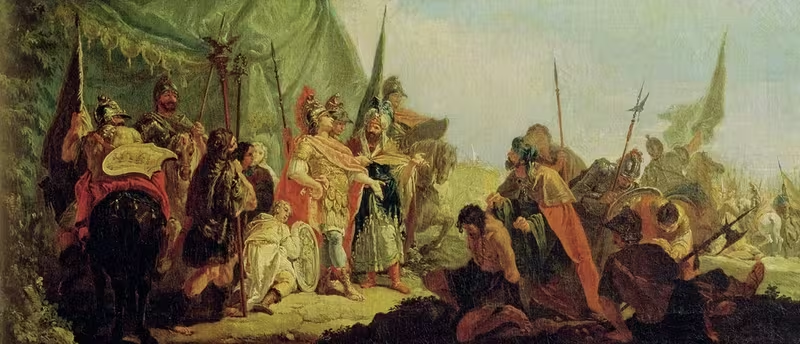
The meeting between the two kings became the most remembered episode of the battle's aftermath. When Alexander asked how Porus wished to be treated, Porus replied that he should be treated as one king would treat another. Alexander was impressed and allowed him to retain his lands. Porus was effectively reinstated as ruler and made a satrap within the enlarged Macedonian sphere.
The Macedonian victory brought large areas of the Punjab into Alexander's empire. Alexander founded two cities, Nikaia and Boukephala. Nikaia, named from the Greek word for victory, commemorated the battle. Boukephala honoured Bucephalus, Alexander's famous horse, which died during or after the engagement.
The battle was costly for the victorious army. Arrian reports 80 Macedonian infantry killed, along with 10 horse archers, 20 Companions, and 200 other cavalrymen. Diodorus gives a larger figure of about 1,000 Macedonian dead, which the military historian J. F. C. Fuller considered more realistic. The difference illustrates the uncertainty of ancient casualty figures.
Indian losses are also disputed. Arrian gives 23,000, while Diodorus reports 12,000 killed and more than 9,000 captured. Around 80 elephants were captured alive. Alexander also obtained another 70 elephants when reinforcements summoned by Porus arrived too late for the battle and surrendered the animals as tribute.
Historical Significance
The Hydaspes extended Macedonian power farther into the Indian subcontinent than any previous victory in Alexander's campaign. It removed Porus as an independent military obstacle and allowed Alexander to continue eastward. The arrangement with Porus also shows that conquest did not always mean direct replacement of local rulers. Alexander could preserve a defeated king's authority when that served the stability of his empire.
The battle also created a lasting zone of political and cultural contact. Greek political and cultural influences became more visible in the Indian subcontinent, while Greek accounts of the encounter recorded Indian military practices, especially the use of war elephants. These contacts continued to affect Greeks and Indians for centuries.
The campaign did not, however, produce unlimited Macedonian expansion. After the Hydaspes, Alexander continued towards the boundaries of the Nanda Empire. His army had been campaigning for nearly eight years. Weapons and armour were wearing out, and the soldiers feared that another enormous Indian army could bring disaster.
At the Hyphasis, now the Beas, the troops refused to advance farther east. Historians generally describe this not as a formal mutiny but as growing military unrest that finally compelled Alexander to yield. The river marked the farthest point of his advance in India. Before leaving, he placed Porus in charge of the easternmost territory under his authority.
Alexander then ordered the army to move south along the Indus rather than immediately turning back west. The Hydaspes thus stood at the centre of both his greatest Indian victory and the chain of events that led to the limit of his advance.
Legacy
The battle's most immediate legacy was the survival of Porus's rule under Macedonian authority. His treatment by Alexander became a model of political reconciliation in the surviving narratives: a defeated king retained power because his courage and ability made him useful as a regional ruler.
The battle also became an example of river-crossing strategy. Alexander conducted the operation while Porus watched the opposite bank, combining repeated feints, a mock royal presence, night movement, the cover of a storm, and an upstream crossing. The manoeuvre has been described as one of his major achievements in combat.
In later Indian military thought, the battle was treated as a lesson in preparation. During the later Maurya period, the strategist Kautilya highlighted the need for military training before battle. Chandragupta, the first Mauryan emperor, maintained a standing army, while the chariot corps occupied only a marginal role in Mauryan military organization.
Historiography
The surviving accounts do not agree on every detail of the battle. Arrian provides figures for the Macedonian and Indian casualties and describes the movement of Alexander's army, while Diodorus gives different casualty totals. Arrian's Macedonian figure is much lower than Diodorus's account, and J. F. C. Fuller judged the larger estimate more credible because the elephants achieved partial success and the engagement was unusually costly for a victorious Macedonian army.
The exact strength of the forces is also uncertain. Arrian reports that Alexander's crossing force consisted of 6,000 infantry and 5,000 cavalry, but the force may have been larger. The larger campaign account refers to approximately 40,000 infantry and 5,000 cavalry crossing the river in time to engage the enemy. These differing figures should be treated as estimates rather than exact counts.
The descriptions of the battle emphasize Alexander's tactical skill, especially his decision to cross the monsoon-swollen river despite Porus's surveillance. Yet the outcome was not effortless. The Indian elephants caused major losses, disrupted the Macedonian infantry, and forced Alexander's army to adapt its tactics during the engagement.
Greek historians also agree that Porus fought bravely. His defeat resulted from the Macedonian use of coordinated cavalry and infantry, the disadvantages suffered by his chariots on muddy ground, and the eventual loss of control over the elephants. The battle was therefore both a Macedonian tactical victory and a demonstration of the serious military challenge posed by Porus's army.
Timeline
Alexander enters India
After defeating the remaining Achaemenid forces, Alexander begins his Indian campaign through the Khyber Pass.
Capture of Aornos
Alexander takes the fortress identified with modern Pir-Sar after resistance from Hindu Kush clans.
Alliance with Taxiles
Taxiles, the king of Taxila, joins Alexander against his neighbour Porus.
Macedonian feints begin
Alexander establishes a camp north of the Hydaspes and repeatedly suggests crossings at different points.
Night crossing
Alexander crosses upstream near a wooded island with a strong contingent while Craterus remains at the main camp.
Defeat of the younger Porus
The first Paurava force sent against Alexander is routed; the younger Porus is killed.
Battle of the Hydaspes
Macedonian cavalry defeats the Indian wings, the phalanx withstands the elephants, and the Paurava army is routed.
Porus restored
Alexander meets the captured Porus and allows him to retain his kingdom as a subordinate ruler.
Advance to the Hyphasis
Alexander continues east, but his exhausted army refuses to advance beyond the Beas.