Overview
The First Anglo-Maratha War (1775–1782) marked a significant early confrontation between the expansionist British East India Company and the powerful Maratha Empire in western and central India. Lasting over seven years, this conflict arose from British intervention in Maratha internal politics, specifically their support for the deposed Peshwa Raghunathrao's claim to power. The war was characterized by intermittent campaigning across the territories between Surat and Poona (modern-day Pune), with neither side achieving the decisive victory they sought.
What makes this war particularly notable in the annals of British colonial expansion is its inconclusive outcome. Despite the East India Company's growing military capabilities, they found themselves unable to overcome the Marathas' highly effective mobile warfare tactics. The conflict eventually concluded with the Treaty of Salbai in 1782, which essentially restored the status quo ante bellum—both sides returned captured territories, and the British withdrew their support for Raghunathrao.
This war represented a temporary check on British ambitions in western India and demonstrated that the Maratha Empire remained a formidable power capable of resisting European military forces. The peace that followed would last two decades before the British and Marathas clashed again in the Second Anglo-Maratha War, beginning a series of conflicts that would ultimately lead to British supremacy over the subcontinent.
Background
The Maratha Empire in the 18th Century
By the mid-18th century, the Maratha Empire had emerged as one of the dominant powers in India following the decline of the Mughal Empire. The Marathas controlled vast territories across western, central, and northern India, governed by a confederacy system under the nominal leadership of the Peshwa (prime minister) based in Poona. The Peshwas had gradually become the de facto rulers of the Maratha state, reducing the Chhatrapati (the descendants of Shivaji) to ceremonial figureheads.
However, this period also saw increasing internal tensions within the Maratha confederacy. Various powerful families—including the Scindias, Holkars, Gaekwads, and Bhonsles—controlled different regions and sometimes pursued conflicting interests. This internal political complexity would create opportunities for external powers, particularly the British, to intervene in Maratha affairs.
British East India Company's Growing Ambitions
The British East India Company had significantly expanded its influence in India following Robert Clive's victory at the Battle of Plassey in 1757. By the 1770s, the Company controlled Bengal and had established a strong presence in Madras and Bombay. Western India, with its wealthy ports and trading centers, represented the next frontier for British commercial and territorial expansion.
The Company's strategy often involved exploiting succession disputes and internal conflicts among Indian rulers, offering military support to rival claimants in exchange for territorial concessions and political influence. This approach would prove central to their involvement in Maratha affairs.
The Succession Crisis
The immediate catalyst for British involvement came from a succession crisis following the death of Peshwa Madhavrao I in 1772. Raghunathrao (also known as Raghoba), the uncle of the deceased Peshwa, had ambitions to claim the position for himself. However, the Maratha nobles instead appointed Madhavrao's younger brother, Narayanrao, as the new Peshwa, with a council of ministers (including Nana Fadnavis) effectively wielding power.
Political intrigue and conspiracy followed, culminating in Narayanrao's assassination in 1773—an event in which Raghunathrao was allegedly implicated. Following this, Narayanrao's posthumous son, Madhavrao II (born after his father's death), was declared Peshwa with a regency council. Raghunathrao, finding himself excluded from power and fearing for his safety, fled to British-controlled territories seeking their military assistance to claim what he believed was his rightful position.
Prelude
The Treaty of Surat (1775)
On March 6, 1775, Raghunathrao concluded the Treaty of Surat with the British authorities in Bombay. Under this agreement, the British East India Company committed to supporting Raghunathrao's claim to become Peshwa. In return, Raghunathrao promised to cede the territories of Salsette and Bassein to the British, along with revenue rights to other districts.
The Treaty of Surat represented a significant British intervention in Maratha internal politics. From the Company's perspective, it offered an opportunity to establish a puppet ruler in Poona who would be dependent on British support, thereby extending their influence over the wealthy Maratha territories. For Raghunathrao, desperate and isolated, the British alliance seemed his only path to power.
Maratha Response
The Maratha ruling council in Poona, led by the capable minister Nana Fadnavis, viewed the Treaty of Surat as an unacceptable foreign intervention in their internal affairs. They refused to recognize any agreement made by Raghunathrao, whom they considered a usurper and conspirator. The council prepared to resist British military intervention, drawing upon the Maratha confederacy's considerable military resources.
The stage was set for conflict between two powerful entities: the increasingly assertive British East India Company with its disciplined European-style armies, and the Maratha Empire with its legendary cavalry and guerrilla warfare traditions.
The War
Opening Hostilities (1775-1776)
Following the Treaty of Surat, British forces from Bombay began military operations to support Raghunathrao's claim. The initial phase of the war saw British troops advancing from their coastal bases toward the Maratha heartland. However, they quickly encountered the challenges that would characterize much of the conflict.
The Marathas avoided large-scale pitched battles where British artillery and disciplined infantry formations would have advantages. Instead, they employed their traditional tactics of rapid cavalry raids, cutting supply lines, and harassing British columns on the march. This highly mobile warfare proved extremely effective in the varied terrain of the Deccan plateau and the Western Ghats.
The Convention of Wadgaon (1779)
One of the most significant episodes of the war occurred in January 1779 when a British force found itself surrounded and in dire straits near Wadgaon (also spelled Vadgaon). Facing starvation and military defeat, the British commander was forced to sign the humiliating Convention of Wadgaon, agreeing to surrender all territories acquired since 1773 and to provide a supply of weapons to the Marathas.
However, the British authorities in Calcutta, under Governor-General Warren Hastings, refused to ratify this convention. They viewed it as an unacceptable capitulation and instead reinforced their commitment to the war effort. This decision prolonged the conflict but also demonstrated the lengths to which the Company was willing to go to maintain its prestige and expand its influence.
General Goddard's Campaigns (1778-1780)
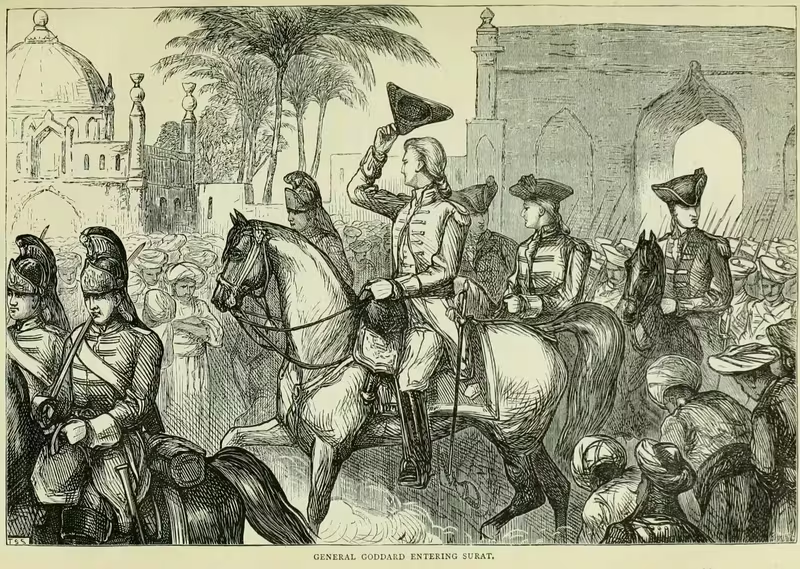
To reinforce the struggling Bombay presidency forces, Colonel (later General) Thomas Goddard led a remarkable military expedition from Bengal across central India to reach the western theater. In 1778, his force made the arduous journey from Kalpi to Surat, covering hundreds of miles through territories that were often hostile or controlled by Maratha allies.
Goddard's arrival energized British military operations. In 1779, he successfully captured Surat, an important commercial center on the Gujarat coast. His painting entering the city became an iconic representation of British military achievement during the war. However, even with these reinforcements and tactical successes, the British still could not force a decisive conclusion to the conflict.
Indecisive Campaigning (1780-1782)
The remaining years of the war saw continued military operations but no breakthrough for either side. British forces achieved some local successes, capturing forts and winning skirmishes. However, they consistently failed to bring the main Maratha armies to a decisive battle or to capture Poona, the heart of Maratha power.
The Marathas, for their part, could not expel the British from their newly-acquired territories or force them to completely abandon their support for Raghunathrao. The war settled into a costly stalemate that drained resources from both sides without offering a clear path to victory.
Key Participants
British East India Company Leadership
The British war effort suffered from divided command and sometimes conflicting strategies between the Bombay, Bengal, and Madras presidencies. Warren Hastings, the Governor-General in Calcutta, ultimately directed overall British policy. Various military commanders including General Goddard, Colonel Egerton, and others led British forces in the field, attempting to coordinate conventional European military tactics with the demands of fighting in unfamiliar terrain against an elusive enemy.
Maratha Leadership
The Maratha resistance was coordinated by the council of ministers in Poona, with Nana Fadnavis playing a particularly crucial role as the chief minister and strategist. Various Maratha chiefs and commanders led different forces, employing the confederation's traditional military strengths. The Maratha leadership demonstrated political unity in resisting what they viewed as foreign interference, even as they dealt with the internal complications of managing a regency for the infant Peshwa Madhavrao II.
Raghunathrao
The deposed Peshwa remained with British forces throughout the war, serving as the nominal justification for British intervention. However, as the war dragged on inconclusively, he became increasingly a liability rather than an asset to British policy. His presence prevented any easy diplomatic resolution, as the Maratha government would not negotiate while the British continued to support his claim.
Aftermath
The Treaty of Salbai (1782)
After seven years of inconclusive warfare, both sides recognized the futility of continued fighting. Negotiations led to the Treaty of Salbai, signed on May 17, 1782. This agreement effectively restored the status quo ante bellum:
- Both sides agreed to return all territories captured during the war
- The British East India Company withdrew its support for Raghunathrao's claim to be Peshwa
- Raghunathrao himself was granted a pension and estates but had to abandon his political ambitions
- The treaty established a temporary peace between the Company and the Maratha Empire
Immediate Consequences
The treaty represented a significant diplomatic achievement for the Marathas. They had successfully resisted British military power and forced the Company to abandon its intervention in Maratha internal politics. The infant Madhavrao II's position as Peshwa (under the regency council) was secured, and Maratha sovereignty over their territories was maintained.
For the British, the treaty was a pragmatic acknowledgment of military reality. The Company had demonstrated that while it could win tactical engagements and capture individual locations, it lacked the capability to decisively defeat the Maratha confederacy or impose its will on western India. The inconclusive outcome was unusual in the broader pattern of British colonial expansion and served as a sobering lesson about the limits of Company military power.
Historical Significance
A Temporary Check on British Expansion
The First Anglo-Maratha War stands out as one of the few conflicts where the British East India Company failed to achieve its objectives. Unlike their wars against other Indian powers during this period—such as the four Anglo-Mysore Wars or the conquest of Bengal—the British could claim no territorial gains or political advantages from this seven-year struggle.
This outcome delayed British expansion into western India by two decades. During this period, the Marathas remained one of the few major Indian powers capable of matching British military and political capabilities. The breathing space allowed the Maratha confederacy to continue as an independent entity, though internal divisions would eventually weaken their position.
Military Lessons
The war demonstrated both the strengths and limitations of different military systems. British forces showed their capabilities in conventional warfare, with well-drilled infantry, effective artillery, and competent logistics over long distances (as demonstrated by Goddard's march from Bengal). However, they proved unable to counter effectively the Maratha's mobile cavalry tactics and their familiarity with local terrain.
The Marathas demonstrated that traditional Indian military methods, particularly light cavalry and guerrilla tactics, remained viable against European armies when employed strategically. However, the war also showed that these tactics, while effective defensively, were not sufficient to achieve decisive offensive victories or to expel well-entrenched British forces from fortified positions.
Political Implications
The treaty established a precedent for British-Maratha relations that would influence future interactions. It demonstrated that negotiated settlements were possible and that the British could be forced to modify their ambitions when facing determined resistance. However, it also left unresolved tensions and competing interests that would eventually lead to renewed conflict.
The war's inconclusive nature also had implications for British policy more broadly. It influenced debates within the Company about the wisdom of territorial expansion versus commercial focus, and about the risks of intervening in Indian political disputes. These debates would continue through subsequent decades of British involvement in Indian affairs.
Legacy
Path to Future Conflicts
The peace established by the Treaty of Salbai proved temporary. Twenty years later, in 1802, a new succession crisis among the Marathas would provide the British with another opportunity to intervene. The Second Anglo-Maratha War (1803-1805) would see more decisive British military success, partly because the Maratha confederacy had become more divided internally.
The Second and Third Anglo-Maratha Wars would ultimately result in the dismantling of Maratha power and the extension of British control over virtually all of India. In this context, the First Anglo-Maratha War can be seen as merely postponing an inevitable outcome driven by the Company's expanding military capabilities and political ambitions.
Historical Memory
The war is remembered differently by various communities. In Maratha historiography, it represents successful resistance to foreign intervention and a defense of sovereignty. Monuments such as the Scindia Memorial at Vadgaon commemorate Maratha military achievements during this period.
In British colonial history, the war is often treated as a minor episode—an inconclusive conflict overshadowed by more dramatic British victories elsewhere in India. However, for historians of British imperialism, it represents an important reminder that colonial expansion was neither inevitable nor universally successful, and that Indian powers were capable of effective resistance.
Historiographical Debates
Historians continue to debate various aspects of the war. Some emphasize the role of Maratha political divisions and argue that a more unified Maratha response might have achieved even better results. Others focus on British strategic mistakes and the challenges of coordinating military policy across the three presidencies.
The war also features in broader discussions about the nature of 18th-century Indian warfare and the process of British colonial expansion. It provides evidence for those who argue that traditional Indian military systems remained viable longer than once assumed, and that British victories were often more contingent and hard-fought than triumphalist colonial narratives suggested.
Conclusion
The First Anglo-Maratha War occupies a unique place in the history of British India as a conflict that neither side won decisively. For seven years, the armies maneuvered across western and central India, fighting numerous engagements but achieving no breakthrough. The Treaty of Salbai that concluded the war simply restored matters to where they had begun, with both sides exhausted by the effort.
Yet this inconclusive war had lasting significance. It demonstrated that the Maratha Empire, despite internal political complications, remained a formidable power capable of resisting British ambitions. It delayed British expansion into western India for a generation and provided one of the few examples of the East India Company being forced to accept a stalemate.
The peace would not last forever. The underlying tensions—British expansionist ambitions and Maratha determination to maintain independence—remained unresolved. Within two decades, these powers would clash again, beginning a new series of conflicts that would ultimately reshape the political map of India. But for those twenty years between 1782 and 1802, the Treaty of Salbai held, a testament to the military stalemate achieved in the First Anglo-Maratha War.