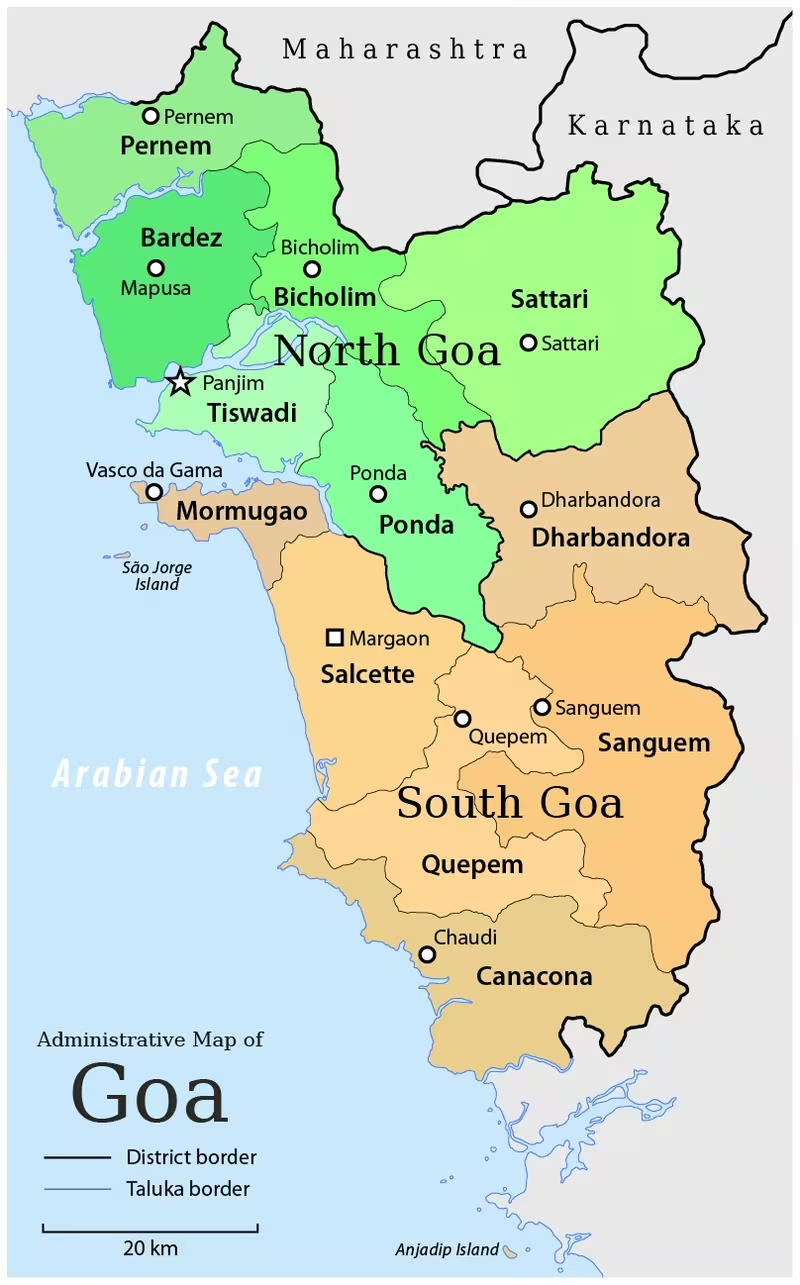
Overview
At 09:45 on 17 December 1961, Indian troops attacked and occupied the town of Maulinguém in northern Goa. Two days later, at 20:30 on 19 December, Governor-General Manuel António Vassalo e Silva signed the Portuguese instrument of surrender. Between those moments, Indian land, naval and air forces overran Goa, Daman and Diu in a coordinated operation code-named Operation Vijay, or “Victory” in Sanskrit.
In India, the action is generally remembered as the Liberation of Goa. In Portugal, it was described as the Invasion of Goa. The contrasting names reflect the central disagreement surrounding the event. India regarded Goa, Daman and Diu as historically Indian territories still held by a European colonial power. Portugal regarded them as parts of Portuguese national territory and therefore described the Indian operation as aggression against Portugal and its citizens.
The conflict ended 451 years of Portuguese rule over the territories. Twenty-two Indian personnel and thirty Portuguese personnel were killed in the fighting. The short campaign also produced an international dispute over the use of force, colonialism, self-determination and the principles of the United Nations Charter.
After the surrender, Goa, Daman and Diu were placed under Indian military administration. Military rule ended on 8 June 1962, when the lieutenant governor established an informal Consultative Council. Portugal did not recognise the incorporation for more than a decade. Diplomatic relations improved only after the fall of Portugal’s Estado Novo regime, and Portuguese recognition of Indian sovereignty followed in 1974.
Background
Portuguese territories after Indian independence
When British rule ended in August 1947, Portugal continued to control several territories on the Indian subcontinent. These were Goa, Daman and Diu, together with the landlocked enclaves of Dadra and Nagar Haveli. Collectively, they were known as the Portuguese State of India.
Goa, Daman and Diu covered approximately 1,540 square miles, or about 4,000 square kilometres. Their population was given as 637,591. The religious distribution was approximately 61 percent Hindu, 37 percent Christian—mostly Catholic—and 2 percent Muslim. Agriculture remained the foundation of the economy, although mining, especially iron ore and some manganese mining, expanded during the 1940s and 1950s.
The Goan diaspora was estimated at about 175,000 people. Roughly 100,000 lived within the Indian Union, particularly in Bombay. This population connected Goan political concerns to debates within independent India and provided an important network for nationalist activity.
Portugal’s political system was the Estado Novo, an authoritarian regime led by António de Oliveira Salazar. The regime was strongly committed to colonialism. It did not describe Goa and the other territories as colonies awaiting independence. Instead, it treated them as extensions of Portugal itself. This position placed Lisbon increasingly at odds with the international movement toward decolonisation and self-determination.
Early nationalist activity
Modern resistance to Portuguese rule was pioneered by Tristão de Bragança Cunha, a French-educated Goan engineer. In 1928, Cunha founded the Goa Congress Committee in Portuguese India. He published Four Hundred Years of Foreign Rule and a pamphlet titled Denationalisation of Goa. These works sought to draw attention to the political subordination of Goa and encourage a wider Goan national consciousness.
The Goa Congress Committee received messages of solidarity from prominent leaders of the Indian independence movement, including Rajendra Prasad, Jawaharlal Nehru and Subhas Chandra Bose. On 12 October 1938, Cunha and other members met Bose. Following Bose’s advice, they opened a branch office of the Goa Congress Committee at 21 Dalal Street in Bombay. The Goa Congress became affiliated with the Indian National Congress, and Cunha was selected as its first president.
Resistance took both non-violent and armed forms. In June 1946, the Indian Socialist leader Ram Manohar Lohia visited Goa to meet his friend Juliao Menezes, a Goan nationalist leader who had founded the Gomantak Praja Mandal in Bombay and edited the weekly newspaper Gomantak. Cunha and other political activists were also present.
Lohia advocated Gandhian methods of non-violent protest. On 18 June 1946, he, Cunha, Purushottam Kakodkar, Laxmikant Bhembre and others organised a protest in Panaji—then generally written as Panjim—against the suspension of civil liberties. The Portuguese authorities had banned public gatherings. They disrupted the protest and arrested its organisers.
The date became known as Goa Revolution Day. Demonstrations continued intermittently between June and November 1946. These protests made civil liberties and Portuguese rule central issues in the emerging Goan nationalist movement.
Alongside non-violent campaigns, armed groups such as the Azad Gomantak Dal and the United Front of Goans conducted attacks against Portuguese authority. Their targets included economic installations, roads, railway and water transport, and telegraph and telephone lines. The purpose was to disrupt economic activity and create conditions for a broader uprising.
The Indian government supported the Azad Gomantak Dal with financial, logistical and military assistance. The armed groups operated from bases in Indian territory, often under the protection of Indian police forces. Portuguese officers later described the attacks as a serious guerrilla challenge. Captain Carlos Azaredo stated in 2001 that approximately eighty policemen died in Goa during 1961 before the Indian intervention. He also said that many members of the Azad Gomantak Dal had previously served in the British Army during the Second World War.
Prelude
Failed negotiations
On 27 February 1950, the Indian government asked Portugal to open negotiations about the future of its Indian territories. Portugal rejected the premise of the request. Its government argued that Goa, Daman and Diu were not colonies but parts of metropolitan Portugal. Their transfer, Lisbon maintained, was therefore not a matter for negotiation.
The Portuguese government also argued that India could not claim rights over territories acquired before the Republic of India existed. India regarded this position as an attempt to preserve colonial rule by redefining the status of the territories.
Portugal did not respond to subsequent Indian aide-mémoires. On 11 June 1953, India withdrew its diplomatic mission from Lisbon.
India then applied increasing pressure. In 1954, it imposed visa restrictions on travel between Goa and India. These restrictions paralysed transport between Goa and the other Portuguese enclaves, including Daman, Diu, Dadra and Nagar Haveli. India also imposed sanctions intended to encourage the incorporation of Goa into India. The sanctions continued until 1961. The Indian Union of Dockers added to the pressure by boycotting shipping to Portuguese India.
Dadra and Nagar Haveli
Dadra and Nagar Haveli were two Portuguese landlocked enclaves in the Daman district. They were surrounded by Indian territory and separated from Daman by approximately twenty kilometres of Indian land. The Portuguese maintained police forces there but no substantial military garrison.
India had already begun isolating the enclaves in 1952. Restrictions on the movement of people and goods created severe economic difficulties. Since normal land communication with Daman was blocked, Salazar’s government established an airline to connect the enclaves with Portuguese Indian ports.
In July 1954, pro-Indian forces began attacks on Dadra and Nagar Haveli. Participants included members of the United Front of Goans, the National Movement Liberation Organisation, the Communist Party of India, the Rashtriya Swayamsevak Sangh and the Azad Gomantak Dal. Indian police forces supported the operation.
On the night of 22 July, United Front of Goans forces attacked the small police station at Dadra. Police Sergeant Aniceto do Rosário and Constable António Fernandes were killed while resisting the assault. On 28 July, RSS forces captured the police station at Naroli.
The Portuguese authorities asked India for permission to move reinforcements across Indian territory. India refused. Isolated and unable to receive assistance, the Portuguese administrator and police forces in Nagar Haveli surrendered to Indian police on 11 August 1954.
Portugal later appealed to the International Court of Justice. In a decision dated 12 April 1960, the Court recognised Portuguese sovereign rights over Dadra and Nagar Haveli but also recognised India’s right to deny Portugal passage for armed personnel across Indian territory. In practical terms, Portugal could not legally send forces through India to recover the enclaves.
The loss of Dadra and Nagar Haveli demonstrated the weakness of Portuguese control and deepened the dispute over Goa, Daman and Diu.
The 1955 satyagraha
On 15 August 1955, between 3,000 and 5,000 unarmed Indian activists attempted to enter Goa at six locations. Portuguese police violently repulsed them. Between twenty-one and thirty people were killed.
News of the deaths intensified Indian public opposition to continued Portuguese rule. On 1 September 1955, India closed its consulate in Goa.
Portuguese officials proposed a referendum on Goa’s future in 1956. Marcello Mathias, Portugal’s ambassador to France, and Salazar discussed the idea. The proposal was rejected by Portugal’s ministers for defence and foreign affairs. General Humberto Delgado, a presidential candidate in 1957, repeated the demand for a referendum, but no vote was held.
International mediation and rising tensions
Salazar recognised that India might eventually use force. He first asked Britain to mediate, then appealed to Brazil, and finally sought intervention by the United Nations Security Council. The United States urged India to resolve the dispute peacefully. Ambassador John Kenneth Galbraith repeatedly encouraged mediation and consensus.
India did not renounce the possibility of military action. Krishna Menon, the defence minister and head of India’s delegation at the United Nations, stated that India had not “abjured the use of force” in Goa.
Tensions rose sharply on 24 November 1961. The passenger vessel Sabarmati, travelling between Kochi and the Portuguese-held island of Anjidiv, was fired upon by Portuguese ground troops. One passenger was killed and the chief engineer was injured. The Portuguese feared that the vessel might carry a military landing party intending to attack Anjidiv.
The incident strengthened public support in India for intervention. On 10 December, nine days before the operation, Nehru told the press that the continuation of Portuguese rule in Goa was impossible. The United States warned that if India used force and the issue reached the Security Council, Washington would not support the Indian position.
Military preparations
Indian forces
After Krishna Menon ordered military action, Lieutenant-General Chaudhari of the Indian Army’s Southern Command assembled the forces needed to capture the Portuguese territories.
The principal formations were:
- The 17th Infantry Division under Major General K. P. Candeth.
- The 50th Parachute Brigade under Brigadier Sagat Singh.
- The 1st battalion of the Maratha Light Infantry for Daman.
- The 20th battalion of the Rajput Regiment and the 5th battalion of the Madras Regiment for Diu.
The Indian Air Force placed its operations under Air Vice Marshal Erlic Pinto, commander-in-chief of Western Air Command. The air plan called for the destruction of Dabolim’s runway without damaging the terminal and other airport facilities, the destruction of the wireless station at Bambolim, and the denial of the airfields at Daman and Diu if permission was granted. Air units were also expected to support the advancing ground forces.
The Indian Navy positioned warships near Goa. The planned forces included surface action, carrier, minesweeping and support groups. The light aircraft carrier INS Vikrant was deployed approximately seventy-five miles from Goa. Its presence helped deter foreign intervention and prepared for a possible amphibious operation.
Portuguese forces
Portuguese military preparations had begun after the 1954 blockade and attacks. Portugal sent three light infantry battalions to Goa—one from Portugal, one from Angola and one from Mozambique—along with support units. This increased Portuguese forces from a very small peacetime presence to a much larger garrison.
Different estimates place the total Portuguese military presence in Portuguese India at different levels. One account gives approximately 8,000 personnel in 1955, including land, naval, police and fiscal forces. By 1961, after some troops were redeployed to Portuguese Africa, the effective military strength had fallen to approximately 3,995. Many of the locally recruited Indo-Portuguese soldiers had limited military training and were used mainly for security duties.
The armed forces were organised as the Armed Forces of the State of India, under a unified command. The governor-general also held the position of commander-in-chief. General Manuel António Vassalo e Silva held both offices in 1961.
Portuguese defensive planning centred on two schemes. The Plano Sentinela, or Sentinel Plan, divided Goa into four sectors: North, Centre, South and Mormugão. The Plano de Barragens, or Barrage Plan, called for the demolition of bridges and the mining of roads and beaches to slow the Indian advance.
The plans were weakened by inadequate communications and insufficient mines. Captain Carlos Azaredo later described the defence scheme as unrealistic and incomplete. It assumed that Portuguese forces could exchange territory for time, but the necessary portable communications equipment was lacking.
Portugal’s naval presence was also limited. The main Portuguese warship in Goa was the sloop NRP Afonso de Albuquerque, armed with four 120-millimetre guns and four rapid-firing automatic guns. Three small patrol boats carried 20-millimetre guns. Portugal attempted to send additional naval vessels to Goa, but Egypt denied them access to the Suez Canal.
The Portuguese Air Force had no operational presence in India. Portuguese air defence consisted of a small number of obsolete anti-aircraft guns. Some weapons had reportedly been transported into Goa disguised as football teams.
Civilian evacuation
The military buildup caused panic among European civilians in Goa. On 9 December, the vessel India arrived at Mormugão while travelling from Timor to Lisbon. Although Lisbon had instructed the governor-general not to allow civilians to leave, Vassalo e Silva permitted approximately 700 Portuguese civilians of European origin to board. The ship had capacity for only 380 passengers and was filled beyond that level.
Civilian evacuation continued by air. The evacuation reflected the Portuguese authorities’ awareness that a military confrontation was approaching, even while Lisbon publicly insisted that the garrison should resist.
The Event
Operation Vijay begins
Hostilities began on 17 December 1961. Indian operations involved simultaneous advances in Goa, Daman and Diu, supported by naval gunfire and air attacks.
Goa: northern and north-eastern sectors
The 17th Infantry Division and attached formations were ordered to advance towards Panaji and Mormugão. The principal thrust towards Panaji came through the north under the 50th Parachute Brigade. Another advance came from the east, while a deceptive movement was made from the south along the Majali–Canacona–Margao axis.
At 09:45 on 17 December, Indian troops attacked and occupied Maulinguém in north-eastern Goa. Two Portuguese soldiers were killed. The Portuguese 2nd Reconnaissance Squadron requested permission to engage the Indian troops, but permission was refused.
During the afternoon, Portuguese headquarters took direct control of orders, bypassing local command posts. This created confusion. At 02:00 on 18 December, the 2nd Reconnaissance Squadron moved towards Doromagogo to assist withdrawing police forces. Indian troops attacked the unit during its return.
At 04:00, Indian artillery began shelling Portuguese positions south of Maulinguém. The bombardment was based partly on false intelligence that Portuguese heavy tanks were present in the area. Bicholim came under fire at 04:30. Portuguese forces destroyed bridges at Bicholim, Chapora in Colvale and Assonora in an attempt to delay the Indian advance.
On the morning of 18 December, the 50th Parachute Brigade moved into Goa in three columns:
- The 2nd Para Maratha advanced towards Ponda through Usgão.
- The 1st Para Punjab moved towards Panaji through Banastari.
- The western and main thrust consisted of the 2nd Sikh Light Infantry with armoured support, crossing the border at 06:30 and advancing towards Tivim.
Portuguese troops left their barracks at Ponda at 05:30 and marched towards Usgão. They encountered the advancing 2nd Para Maratha, which included M4 Sherman tanks of the Indian 7th Cavalry.
By 09:00, the Portuguese reported that Indian troops had covered half the distance to Ponda. At approximately the same time, Portuguese forces of the 1st Reconnaissance Squadron began withdrawing south towards Mapuca under pressure from the 2nd Sikh Light Infantry.
The Portuguese retreat continued through Indian positions. Armoured cars fired ahead to cover the withdrawal of personnel carriers. The unit eventually moved south by ferry towards Panaji. At 13:30, after the 2nd Reconnaissance Squadron had withdrawn, Portuguese troops destroyed the bridge at Banastarim, severing the road connection to Panaji.
By 17:45, the Portuguese units had crossed the Mandovi River by ferry. They reached Panaji only minutes before Indian armoured forces arrived. Indian tanks reached Betim, on the opposite bank of the Mandovi, without meeting resistance. The 2nd Sikh Light Infantry arrived at Betim at 21:00 after crossing minefields and demolished bridges. It remained there overnight because orders to cross the river had not yet arrived.
At 20:00, a Goan named Gregório Magno Antão crossed the Mandovi and delivered a ceasefire proposal from Major Acácio Tenreiro. The Portuguese proposal sought a parley and an immediate halt to firing in order to prevent the destruction of Panaji and the loss of civilian life.
That night, Major Shivdev Singh Sidhu of the Indian 7th Cavalry decided to attack Fort Aguada after receiving information that political prisoners were being held there. Portuguese defenders had not received surrender orders and opened fire. Major Sidhu and Captain Vinod Sehgal were killed.
On the morning of 19 December, Indian forces received orders to cross the Mandovi. Two rifle companies of the 2nd Sikh Light Infantry entered Panaji at 07:30 and secured the town without resistance. On Brigadier Sagat Singh’s orders, the troops removed their steel helmets and wore the maroon berets associated with the Parachute Regiment.
Fort Aguada was captured later that day. Indian armoured forces from Betim supported the 7th Cavalry, and political prisoners held in the fort were released.
Goa: eastern advance
The 63rd Indian Infantry Brigade advanced from the east in two columns. The 2nd Bihar moved on the right, while the 3rd Sikh moved on the left. The columns linked up at Mollem and then continued separately towards Ponda.
By nightfall, the 2nd Bihar had reached Candeapur and the 3rd Sikh had reached Darbondara. Portuguese forces had destroyed bridges across the rivers, but the Indian advance continued.
The 4th Sikh Infantry reached Candeapar in the early hours of 19 December. Rather than stop at the destroyed Borim Bridge, its troops crossed the Zuari River in military tankers and then waded through chest-high water across a smaller stream. They reached the dock at Embarcadouro de Tembim in Raia, from where a road led towards Margao.
The battalion rested briefly in a cattle shed and in a neighbouring house before reaching Margao by 12:00. It then advanced towards Mormugão. At Verna, it encountered a Portuguese force of approximately 500 men. After fierce fighting, the Portuguese unit surrendered at 15:30.
The 4th Sikh continued towards Mormugão and Dabolim Airport, where the main Portuguese force was concentrated. A company of the 4th Rajput made a diversionary attack south of Margao. It crossed minefields and roadblocks and passed over demolished bridges before helping secure the town.
Indian air operations over Goa
The first major Indian air raid over Goa took place on 18 December. Twelve English Electric Canberra aircraft under Wing Commander N. B. Menon attacked Dabolim Airport. Approximately 63,000 pounds of explosives were dropped within minutes. The runway was destroyed, while the terminal and other airport facilities were deliberately left untouched under the Indian Air Force’s instructions.
Eight more Canberras, led by Wing Commander Surinder Singh, attacked the runway later that day. Two civilian aircraft were stranded on the apron: a TAP Lockheed Constellation and a Douglas DC-4 belonging to Portuguese India Airlines.
Portuguese workers hastily repaired part of the runway. During the night, the TAP aircraft took off with only 700 metres of usable runway. Debris damaged its fuselage, producing twenty-five holes and a flat tyre. The aircraft escaped under cover of darkness and reached Karachi. The DC-4 also escaped.
Six Hawker Hunters later attacked the wireless station at Bambolim with rockets and cannon fire. Indian de Havilland Vampires patrolled in support of ground forces, although they did not receive requests for direct action. Two Vampires accidentally fired rockets at positions held by the 2nd Sikh Light Infantry, injuring two Indian soldiers. Indian ground troops also mistakenly fired on an Indian Air Force T-6 Texan, causing limited damage.
The capture of Anjidiv
Anjidiv was a small island of approximately 1.5 square kilometres off the coast of Karnataka. Although geographically separate from Goa, it belonged to the Portuguese district of Goa. A sixteenth-century fort on the island was defended by a platoon of Goan soldiers.
The Indian Navy assigned the cruiser INS Mysore and frigate INS Trishul to the operation. Under covering fire from the ships, Indian marines commanded by Lieutenant Arun Auditto landed at 14:25 on 18 December.
Portuguese defenders repulsed the initial attack. Seven Indian marines were killed and nineteen wounded, including two officers. Indian naval shelling eventually overwhelmed the defenders. The island was secured at approximately 14:00 on 19 December.
Most of the Portuguese defenders were captured. Two corporals and one private initially evaded capture. One corporal surrendered on 19 December. Another was captured the following day after throwing grenades that injured Indian marines. Private Manuel Caetano, who had swum to the Indian mainland, was captured on 22 December and became the last Portuguese soldier captured in India.
Naval battle at Mormugão
The Portuguese sloop NRP Afonso de Albuquerque was anchored near Mormugão Harbour. Its tasks included engaging Indian naval units, supporting coastal defences and maintaining radio contact with Lisbon after Indian air attacks destroyed land-based communications.
At 09:00 on 18 December, three Indian frigates led by INS Betwa took position outside the harbour. Indian aircraft bombed Mormugão at 11:00. At noon, INS Betwa and INS Beas entered the harbour and opened fire with their 4.5-inch guns. They also transmitted surrender demands in Morse code.
The Afonso de Albuquerque raised anchor and returned fire with its 120-millimetre guns. It was heavily outnumbered and was disadvantaged by the confined harbour. Its guns could fire only two rounds per minute, while the Indian frigates could fire much more rapidly.
At approximately 12:15, an Indian shell struck the control tower and injured the Portuguese weapons officer. Ten minutes later, an anti-personnel shrapnel bomb exploded over the vessel. The Portuguese radio officer was killed and the commander, Captain António da Cunha Aragão, was severely wounded. First Officer Pinto da Cruz assumed command.
The ship’s propulsion system was damaged. At 12:35, it turned 180 degrees and ran aground near Bambolim. A white flag was raised but became wrapped around the mast and was not noticed by the Indian vessels. Indian fire continued.
By 12:50, the ship had fired nearly 400 rounds and had hit two Indian vessels, but it had suffered extensive damage. The order was given to abandon ship. Portuguese crewmen went ashore, set fire to the vessel and took the wounded commander to Panaji hospital.
The Indian side lost five sailors killed and thirteen wounded. The remaining Portuguese crew formally surrendered with the other Portuguese forces on 19 December. Indian naval commanders later visited Captain Aragão in hospital as a gesture of goodwill.
The ship was renamed Saravastri by the Indian Navy. It remained grounded near Dona Paula until 1962, when it was towed to Bombay and sold for scrap. Parts of it were later displayed at the Naval Museum in Mumbai.
The Portuguese patrol boat NRP Sirius was also present. Its commander, Lieutenant Marques Silva, decided to scuttle it after observing the Afonso de Albuquerque run aground and losing communication with naval headquarters. The crew damaged the propellers and drove the boat onto rocks. The eight sailors escaped aboard a Greek freighter and reached Pakistan.
Military actions in Daman
Ground attack
Daman covered approximately 72 square kilometres and bordered the Indian states of Gujarat and Maharashtra. The Daman Ganga River divided the capital into Nani Daman and Moti Daman. Important Portuguese positions included Daman Fort and the airport control tower.
The Portuguese garrison consisted of approximately 360 army personnel, 200 police officers and around thirty customs officials. The army units included two companies of light infantry, an artillery battery and an engineer detachment. The Portuguese had also laid small minefields and constructed defensive shelters.
The Indian operation was conducted by the 1st Maratha Light Infantry under Lieutenant-Colonel S. J. S. Bhonsle. The assault began before dawn on 18 December and aimed to capture Daman in stages: the airport, the open countryside, Nani Daman and finally Moti Daman and its fort.
The first Indian advance targeted the airport. Surprise was lost when the Indian A Company attempted to seize the control tower and suffered three casualties. The Portuguese lost one soldier and six were captured.
The Indian D Company captured Point 365 before the following morning. At dawn, Indian Air Force Mystère fighters attacked Portuguese mortar positions and guns inside Moti Daman Fort.
Portuguese artillery and Indian ground forces fought around the eastern border. By late morning, Portuguese forces at Varacunda had exhausted their ammunition and withdrawn. The Portuguese artillery battery on the Daman Ganga was ordered to fire on the advancing Indians, but its commander dismantled the guns and surrendered instead.
By noon, the Indian A and C companies attacked the airfield. The A Company suffered another fatality and seven wounded. By 17:00, Indian forces had occupied most of the territory, while Portuguese troops retained the airport and Nani Daman.
Indian aircraft conducted six attacks in the Daman sector. These strikes contributed to the demoralisation of the Portuguese defenders. The Portuguese attempted to open negotiations during the evening, but a delegation sent towards the Indian lines was fired upon and withdrew. Another attempt to surrender the following morning was also fired upon.
The Indians attacked the airfield on 19 December. The Portuguese surrendered at 11:00 without further fighting. Major António José da Costa Pinto, the Portuguese commander, was wounded but was taken by stretcher to the airfield because Indian forces would accept surrender only from him.
Approximately 600 Portuguese soldiers and police, including twenty-four officers, were captured. Four Indian soldiers were killed and fourteen wounded. Portuguese losses in Daman were reported as ten dead and two wounded.
Air and naval actions
Indian Mystère aircraft conducted fourteen sorties against Portuguese artillery positions around Daman. The attacks were intended to suppress the guns and support the advancing infantry.
The Portuguese patrol boat NRP Antares, commanded by Second Lieutenant Abreu Brito, remained near Daman during the invasion. It witnessed the air strikes and ground advance but lost communications with the shore on 19 December. Concluding that Portuguese territory had been occupied, Brito sailed for Karachi. The boat travelled approximately 530 miles and reached the Pakistani port on 20 December.
Military actions in Diu
Ground attack
Diu was an island measuring approximately 13.8 by 4.6 kilometres, with an area of about 40 square kilometres. Swamps and narrow channels separated it from the mainland. No bridge crossed the channels in 1961.
The Portuguese garrison, commanded by Major Fernando de Almeida e Vasconcelos, consisted of approximately 400 soldiers and police officers. Indian forces attacked from the north-west and north-east. The 20th Rajput Battalion moved along Kob Forte towards the airfield, while the 4th Madras Battalion and Rajput units advanced through Gogal and Amdepur.
The Indian formations rejected a request from Wing Commander M. P. O. Blake to delay the attack until first light, when close air support would be available. Portuguese artillery and mortars repulsed the initial attacks.
At 01:30 on 18 December, the 4th Madras attacked a police post at Gogol. Thirteen Portuguese police officers resisted the assault. A second attack at 02:00 also failed, this time under Portuguese artillery and mortar fire.
At approximately 03:00, two companies of the 20th Rajput attempted to cross a muddy swamp towards Passo Covo. They used rafts made from bamboo cots tied to oil barrels. Portuguese defenders opened fire with machine guns and automatic weapons. The crossing was repulsed.
Major Mal Singh and five men reached the far bank and attacked a light machine-gun position at Fort-De-Cova. The weapon operators were killed. Portuguese medium machine-gun fire wounded Mal Singh and two others, but Company Havildar Major Mohan Singh and two additional soldiers evacuated them across the creek.
As dawn approached, Portuguese fire intensified. Indian water-crossing equipment was damaged and the battalion withdrew towards Kob village. A further attack at 05:00 was also repulsed.
At 06:30, Portuguese troops recovered abandoned rafts, ammunition and a wounded Indian soldier. They treated the wounded man before returning him to Indian forces.
Indian air attacks began at 07:00. Portuguese troops withdrew from Passo Covo towards Malala. The Portuguese unit at Gogol also retreated, allowing Rajput troops to occupy the town under artillery cover.
At 10:15, the Indian cruiser INS Delhi began bombarding Portuguese positions from offshore. At 12:45, Indian aircraft attacked a mortar position near Diu Fort. The attack caused a fire near an ammunition dump, and Portuguese authorities ordered the evacuation of the fort.
By 14:15, the evacuation was complete. Portuguese commanders met at 18:00 and concluded that continued defence was impossible. They had lost contact with headquarters in Goa and Lisbon, while Indian ground, naval and air forces continued to advance.
The Portuguese formally surrendered at noon on 19 December. Four hundred and three prisoners were taken, including the governor, eighteen officers and forty-three sergeants. Seven Portuguese soldiers were killed.
The 4th Madras C Company later landed on Pani Khota, an island off Diu. Thirteen Portuguese soldiers surrendered there on 19 December.
Air and naval actions
Indian air operations over Diu began at dawn on 18 December. The first attacks targeted the fortifications facing the mainland. Indian aircraft maintained continuous support for advancing troops.
A pair of Toofani aircraft attacked and destroyed the Diu airfield’s air-control facilities. Another sortie destroyed portions of the runway with 1,000-pound bombs. A further attack by Wing Commander Blake was aborted when he saw people apparently waving white flags.
Indian aircraft later destroyed a Portuguese ammunition dump and attacked the patrol boat NRP Vega. The boat had attempted to escape from Diu but was disabled.
The Indian cruiser INS Delhi fired on Diu Fort with six-inch guns. Portuguese shore batteries attempted to respond, but Indian air superiority and naval fire quickly reduced the effectiveness of the defence.
At 04:00 on 18 December, the Vega encountered the Delhi about twelve miles from Diu. The Indian cruiser’s fire forced the patrol boat to withdraw. At 07:00, after receiving orders to fight until its ammunition was exhausted, the Vega sailed out again.
The boat opened fire on two Indian aircraft with its 20-millimetre gun. The aircraft attacked in return, killing the Portuguese captain and gunner. The rest of the crew abandoned the boat, swam ashore and were captured.
Turning points
Several moments shaped the outcome of Operation Vijay.
The failure of Portuguese isolation tactics
Portuguese planners hoped that demolished bridges, mined roads and separated defensive sectors would slow the Indian advance. In practice, Indian forces crossed rivers in tankers, waded through water and used multiple routes. The destruction of bridges delayed the advance but did not prevent it.
The capture of Panaji
The movement of the 50th Parachute Brigade through northern Goa placed Indian troops across the Mandovi River from Panaji on 18 December. When the order to cross arrived on 19 December, the city was secured without resistance. The fall of the capital undermined Portuguese coordination.
The destruction of communications
Indian air strikes against Dabolim and Bambolim damaged the Portuguese ability to communicate and move supplies. In Diu, the loss of contact with headquarters in Goa and Lisbon contributed directly to the decision to surrender.
The naval defeat at Mormugão
The Afonso de Albuquerque was the principal Portuguese warship in Goa. Its defeat removed a significant part of the coastal defence and demonstrated the overwhelming superiority of the Indian naval force.
The Portuguese surrender
Lisbon ordered Vassalo e Silva to fight to the last man and not expect a truce or Portuguese prisoners. Vassalo e Silva disobeyed the order. He judged that the difference in forces and resources made continued resistance a needless sacrifice of Portuguese, Goan and civilian lives. His decision ended the conflict on 19 December.
Participants
India
Jawaharlal Nehru
Prime Minister Jawaharlal Nehru initially hoped that the Goan popular movement, combined with international pressure, would persuade Portugal to leave. Military action was not his first preference. However, negotiations failed, and Portuguese policy remained inflexible.
Nine days before the operation, Nehru told the press that the continuation of Portuguese rule in Goa was impossible. After the victory, he defended the decision by saying that Portugal had ultimately left India no choice.
Krishna Menon
Defence Minister Krishna Menon played an important role in advocating military action. He had warned internationally that India had not abandoned the use of force. After negotiations and pressure had failed, he ordered the military preparations for Operation Vijay.
Major General K. P. Candeth
Candeth commanded the 17th Infantry Division. After the Portuguese surrender, he became Goa’s military governor. Military administration continued until June 1962.
Brigadier Sagat Singh
Sagat Singh commanded the 50th Parachute Brigade. His forces led the rapid advance through northern Goa and were among the first Indian troops to enter Panaji. Portuguese authorities later offered a reward for his capture.
Indian Army, Navy and Air Force
The operation was a joint campaign. Army units advanced through Goa, Daman and Diu. The Navy blockaded ports, bombarded Portuguese positions and captured Anjidiv. The Air Force destroyed runways and communications facilities and provided direct support to ground operations.
Indian personnel who served within the disputed territories for forty-eight hours, or who flew at least one operational sortie, received the General Service Medal 1947 with the Goa 1961 bar.
Portugal
António de Oliveira Salazar
Salazar’s Estado Novo government rejected decolonisation in Portuguese India. He argued that Goa, Daman and Diu were parts of Portugal rather than colonies. He ordered Vassalo e Silva to resist to the end and hoped that prolonged Portuguese resistance would produce international intervention.
Manuel António Vassalo e Silva
Vassalo e Silva served as governor-general and military commander of Portuguese India. He was aware that the Portuguese garrison could not defeat the much larger Indian forces in a conventional war.
Despite Lisbon’s orders, he authorised evacuation, sought to reduce civilian casualties and finally surrendered on 19 December. Portugal later punished him for disobeying orders. He was expelled from the military and went into exile. After the fall of the Estado Novo in 1974, his military status was restored. He later returned to Goa and received a warm reception.
Portuguese soldiers and police
Portuguese forces included personnel from Portugal, Angola, Mozambique and the local Indo-Portuguese population. The military was supported by police, fiscal guards and rural guards. Many local personnel had limited military training and were used primarily for internal security.
Surrender and immediate aftermath
The formal surrender took place at 20:30 on 19 December 1961. Vassalo e Silva signed the instrument of surrender, ending Portuguese rule over Goa, Daman and Diu.
A total of 4,668 personnel were taken prisoner by the Indian Army. The prisoners included military and civilian personnel, Portuguese, Africans and Goans. The reported deaths were twenty-two Indian and thirty Portuguese.
The Indian government declared Goa, Daman and Diu a federally administered union territory under the President of India. Major General K. P. Candeth became military governor.
The transition was not immediately civilian. Portuguese military and administrative structures had collapsed, and the Indian authorities first governed through military administration. On 8 June 1962, the lieutenant governor replaced military rule with civilian government by nominating an informal Consultative Council of twenty-nine members.
Prisoners of war
Portuguese soldiers were initially interned at military camps in Navelim, Aguada, Ponda and Alparqueiros. Conditions were harsh, including sleeping on cement floors and performing hard manual labour. By January 1962, most prisoners had been transferred to a new camp at Ponda, where conditions improved.
Some prisoners attempted to escape. In one incident on 19 March 1962, prisoners tried to leave the Ponda camp in a rubbish lorry. The attempt failed. Captain Carlos Azeredo was later beaten by Indian soldiers after an altercation with a camp commander. The Indian Army punished the officer responsible for violating the Geneva Convention.
Goans visited the prisoners and brought cigarettes, biscuits, tea, medicines and money. Indian authorities initially restricted these visits and later permitted access mainly through Red Cross representatives.
Repatriation was delayed by disagreement between India and Portugal. Portugal wanted Portuguese aircraft to transport the prisoners. India rejected this and insisted on neutral aircraft. The dispute continued for months, partly because Salazar detained approximately 1,200 Indians in Mozambique as a bargaining measure.
By May 1962, most prisoners had been flown to Karachi in French chartered aircraft and then transported to Lisbon by the ships Vera Cruz, Pátria and Moçambique.
Portuguese officers faced punishment after returning home. Lisbon regarded the surrender as insubordination. In March 1963, the former governor-general, military commander, chief of staff, a naval captain, six majors, a sublieutenant and a sergeant were dismissed from military service. Other officers received suspensions.
International reactions
The operation provoked sharply divided reactions.
Support for India
Several African governments supported India because they viewed the conflict as part of the wider struggle against European colonialism. Ghanaian radio described the operation as the liberation of Goa and linked it to the future liberation of Angola and other Portuguese territories in Africa. Adelino Gwambe, a leader of the Mozambique National Democratic Union, also expressed support.
The United Arab Republic backed India’s efforts to recover what it described as occupied territory. Morocco, Tunisia and other Arab states issued similar statements.
Ceylon supported India. Prime Minister Sirimavo Bandaranaike ordered that Portuguese troops and equipment not be allowed to use Ceylonese ports or airports. Ceylon, Liberia and the United Arab Republic introduced a pro-Indian resolution at the United Nations.
Indonesia also described the action as a struggle against colonialism. Its foreign ministry argued that India, a peace-loving country, had been compelled to use force because colonialism could not be compromised with.
The Soviet Union strongly supported India. Leonid Brezhnev, who was visiting India at the time, urged Indians to ignore Western criticism. Nikita Khrushchev sent Nehru a message describing widespread Soviet support for the operation. The Soviet Union also vetoed a Security Council resolution condemning India.
Criticism from the United States
The United States condemned the Indian operation at the United Nations. Adlai Stevenson called for the immediate and unconditional withdrawal of Indian forces. The American position was that India had used force to settle a political dispute after repeatedly presenting itself as an advocate of non-violence and peaceful settlement.
The United States Senate Foreign Relations Committee attempted to reduce American foreign aid to India by 25 percent, although President John F. Kennedy opposed the move.
American media coverage was often strongly critical. Some commentators portrayed the operation as politically motivated and associated it particularly with Krishna Menon. The criticism also reflected American concern that the precedent might encourage other states to use force in territorial disputes.
Britain and the Netherlands
Britain acknowledged that many Indians wanted Goa, Daman and Diu incorporated into India and that Portugal should have relinquished its territories. Nevertheless, the British government said it deeply deplored India’s use of military force.
The British representative at the United Nations said Britain had been shocked and dismayed by the outbreak of hostilities. The Dutch government similarly regretted that India had resorted to force, particularly because India had often defended the principles of the United Nations Charter.
Dutch officials also feared that the operation might encourage Indonesia to attack West New Guinea.
Brazil and Pakistan
Brazil strongly supported Portugal. Its government regarded the relationship between Brazil and Portugal as based on history, blood and sentiment. Former Brazilian President Juscelino Kubitschek said that Brazilians could not accept what he called an act of violence against Goa.
Pakistan condemned the operation as “naked militarism”. It argued that the future of Goa should have been decided through a United Nations-sponsored plebiscite. Pakistani statements also connected Goa with Kashmir, arguing that India should apply the same principle of self-determination there.
China
The People’s Republic of China officially supported the anti-colonial struggle of Asian, African and Latin American peoples. However, a Chinese-language communist newspaper in Hong Kong criticised Nehru for using Goa to restore his political prestige and suggested that domestic pressures and the coming Indian election had influenced the timing.
The Catholic Church
The Catholic Church did not issue an immediate public denunciation of the annexation. However, the Portuguese-born Archbishop of Goa and Daman remained connected to Portugal. The Holy See delayed appointing a native head of the Goan Church until 1963, when Francisco Xavier da Piedade Rebelo became Bishop and Vicar Apostolic of Goa.
Raul Nicolau Gonçalves succeeded him in 1972 and became the first native-born Patriarch of Goa in 1978.
The United Nations debate
Portugal requested a United Nations Security Council debate on 18 December 1961. The request was approved with the support of the United States, Britain, France, Turkey, Chile, Ecuador and Nationalist China. The Soviet Union and Ceylon opposed the request, while the United Arab Republic and Liberia abstained.
Portugal’s representative argued that Lisbon had consistently acted peacefully and that Portuguese forces were fighting a delaying action despite being heavily outnumbered. India’s representative, C. S. Jha, responded that ending the last vestiges of colonialism in India was an article of faith for the Indian people.
The United States condemned the invasion and called for an Indian withdrawal. The Soviet Union argued that Goa was an internal Indian matter and that Portugal had itself ignored United Nations resolutions supporting independence for colonial peoples.
Liberia, Ceylon and the United Arab Republic proposed a resolution that would have recognised the Portuguese enclaves as a threat to international peace and supported India’s position. The resolution received support only from the Soviet Union.
A second resolution, sponsored by France, Turkey, Britain and the United States, called for an immediate end to hostilities and the withdrawal of Indian forces to their pre-17 December positions. It also urged India and Portugal to seek a peaceful settlement. The resolution received seven votes in favour and four against, but the Soviet veto prevented its adoption.
The debate exposed the conflict between two international principles: opposition to the use of force and opposition to colonial rule.
Historical significance
Completion of territorial integration
The annexation removed the principal remaining European colonial territories from the Indian subcontinent. India had become independent in 1947, but Portuguese rule meant that political decolonisation was not complete. Operation Vijay ended that unfinished process in Goa, Daman and Diu.
The earlier occupation of Dadra and Nagar Haveli, followed by the 1961 military operation, brought the main Portuguese possessions in India under Indian control.
A challenge to India’s non-violence image
The use of military force challenged India’s international image as a state committed to non-violence and peaceful settlement. Western governments and commentators argued that India had contradicted its own public principles.
Indian leaders answered that colonial occupation presented a different question. In their view, Goa was not foreign territory but part of India that had been separated from the country by Portuguese rule. The action was therefore described domestically as liberation rather than conquest.
This disagreement remained central to later interpretations of the event.
The colonial and legal question
The legality of the annexation has been debated. India had recognised Portuguese sovereignty over Goa after independence, but later argued that colonial acquisitions made by force could not be treated as permanently legitimate under twentieth-century international law.
One interpretation holds that the annexation violated the United Nations Charter because it involved the use of force against territory under Portuguese sovereignty. Another argues that Goa was an integral part of India and that Portugal’s colonial claim could not override the right of self-determination or the principle of decolonisation.
The International Court of Justice had earlier recognised Portuguese sovereign rights over Dadra and Nagar Haveli while also recognising India’s right to deny passage to Portuguese armed personnel. That decision did not resolve the separate question of Goa’s status.
Later legal analysis noted a distinction between the international law of the sixteenth century, when Portugal acquired Goa, and the legal norms of the twentieth century. A treaty cannot necessarily erase the original legal controversy, although the 1974 treaty established Portugal’s recognition of Indian sovereignty and confirmed the political reality created in 1961.
India–Portugal relations
Portugal severed diplomatic relations with India after the annexation and refused to recognise the incorporation of Goa, Daman and Diu. The Portuguese government continued to encourage resistance through radio broadcasts and explored plans for clandestine opposition.
A programme known as the Plano Gralha reportedly envisaged attacks intended to disrupt shipping and port operations at Mormugão and Bombay. In June 1964, Casimiro Monteiro, a Portuguese PIDE agent of Goan descent, and Ismail Dias carried out bombings in Goa.
Relations changed after the Portuguese military coup of 1974 ended the Estado Novo. Portugal then abandoned its previous colonial policy. On 31 December 1974, India and Portugal signed a treaty recognising Indian sovereignty over Goa, Daman, Diu, Dadra and Nagar Haveli.
Legacy
Indian memory
In India, 19 December is associated with the liberation of Goa. The operation is remembered as the final removal of Portuguese colonial rule and as an example of the integration of territories left outside the Union after 1947.
The name Operation Vijay is used for the military campaign. The phrase “Liberation of Goa” remains the most common Indian description, emphasising the claim that the territories were historically Indian and that their incorporation represented decolonisation.
Portuguese memory
In Portugal, the event was remembered as an invasion and a national defeat. Salazar’s government treated the surrender as a violation of Portuguese sovereignty. In Lisbon, Christmas celebrations were muted, cinemas and theatres closed, and large crowds took part in a silent procession associated with the relics of St Francis Xavier.
Vassalo e Silva’s decision to surrender was treated as cowardice and insubordination by the Estado Novo. After the regime fell, however, his reputation changed. His refusal to carry out a scorched-earth policy and his decision to avoid unnecessary deaths were viewed more sympathetically.
Administrative transformation
The end of Portuguese rule did not immediately produce full political normalisation. Military administration was followed by a civilian arrangement in June 1962. The change also affected religious, legal and cultural institutions that had developed under Portuguese rule.
The transfer of authority created a long-term debate about how Goa’s distinct historical experience should relate to Indian political integration. The conflict ended Portuguese sovereignty, but it did not erase the social and cultural traces of centuries of Portuguese rule.
A contested decolonisation
The annexation remains a useful example of the tensions within post-war decolonisation. India’s action was welcomed by states and movements that regarded Portuguese rule as an anachronistic form of colonialism. It was condemned by governments that feared the precedent set by military annexation.
The event therefore occupies two positions at once. It was a successful anti-colonial movement in the eyes of India and much of the post-colonial world. It was also a contested use of force that raised questions about sovereignty, treaty obligations and the United Nations Charter.
Historiography
Historical interpretations of the annexation generally differ according to how they weigh colonialism against sovereignty and the use of force.
The Indian interpretation places the event within the broader history of national integration. From this perspective, Portugal’s refusal to negotiate and its insistence that Goa was metropolitan Portuguese territory prevented a peaceful settlement. Military action became necessary after decades of diplomatic appeals, civil protest and international pressure. The operation is therefore described as liberation.
A Portuguese interpretation emphasises continuity of sovereignty. Portugal regarded Goa as national territory and its inhabitants as Portuguese citizens. From this perspective, the Indian operation was an invasion and the surrender was imposed by overwhelming force.
A third interpretation focuses on international law. It accepts that Portuguese colonialism was increasingly incompatible with the principle of self-determination but questions whether that principle authorised India to use force. Quincy Wright argued that the episode demonstrated a major difference between Eastern and Western interpretations of United Nations law.
Some commentators have also examined the domestic political context. American reporting suggested that the operation helped Nehru and Menon answer Indian criticism that the government had tolerated Portuguese colonialism while failing to respond effectively to other security challenges. The timing before the February 1962 election was therefore treated by some observers as politically relevant. The Indian government, however, presented the decision as the culmination of a long diplomatic and anti-colonial dispute.
The legacy of the conflict is consequently not reducible to a single narrative. The military victory was decisive, but the legal and moral debate over the use of force continued after the Portuguese surrender.