Overview
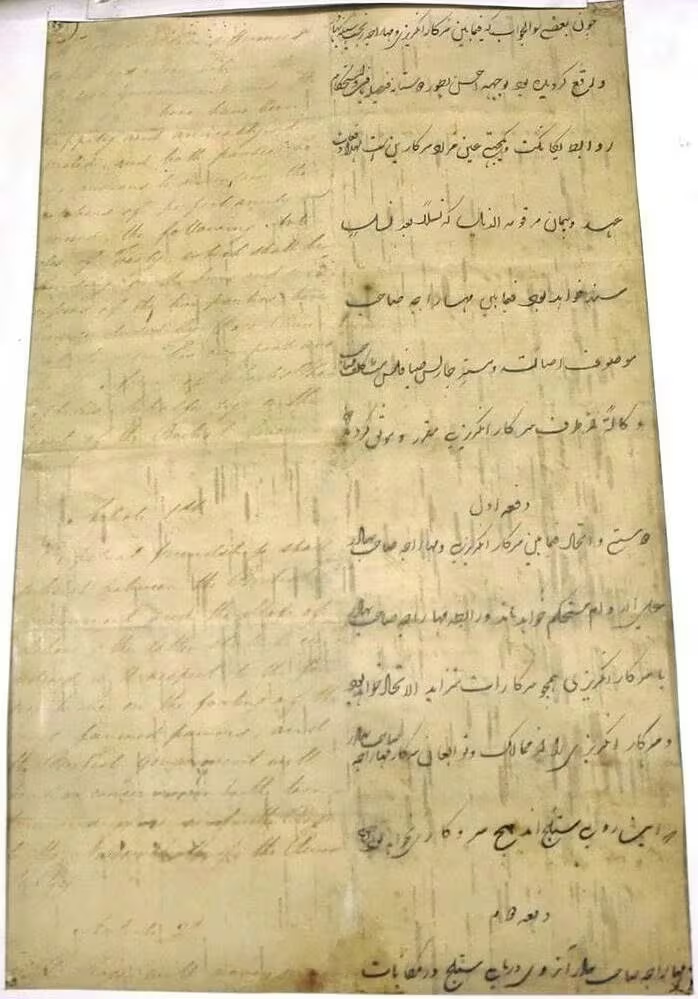
On 25 April 1809, Maharaja Ranjit Singh and the British East India Company reached an agreement at Amritsar that reshaped the political map of the Punjab. Its central effect was to establish the Sutlej River as the practical boundary between Ranjit Singh's Lahore state and the territories placed under British protection. The agreement was finalized through a proclamation on 3 May, while the treaty text records its conclusion at Amritsar on 26 April.
The settlement was both a restriction and an opportunity. Ranjit Singh abandoned hopes of bringing all Sikh communities between the Sutlej and Yamuna under his direct rule, and he was prevented from further expansion south of the Sutlej. In return, the treaty recognized British non-interference in his territories north of the river. This allowed him to focus on rival Sikh misls, Afghanistan, and the western Punjab, contributing to the later expansion of the Sikh Empire.
Background
Ranjit Singh, born in 1780, had emerged as the leading Sikh ruler in northern India. He established Lahore as his capital in 1799 and proclaimed himself Maharaja of the Punjab in 1801. By 1808, his authority extended across a broad area bounded by the Jhelum and Sutlej rivers.
His ambitions also reached into the cis-Sutlej region, the territory between the Sutlej and Yamuna rivers. The Malwa Sikhs living there feared that Ranjit Singh would absorb their states. They therefore appealed to the British East India Company for protection. At first, the Company declined to intervene. Its wider strategic concerns made Ranjit Singh potentially useful: reports circulated that Napoleon and Russia might threaten India, and the Sikh kingdom lay between the northwestern approaches and British-controlled territories.
The political situation had been influenced by the Treaty of Tilsit, signed in 1807 between Napoleon and Russia. British officials feared that cooperation between the two powers might lead to an attack on India. Ranjit Singh's state could serve as a buffer against such a danger, so the Company sought his support rather than immediately confronting him.
Prelude
Ranjit Singh agreed to meet Charles Theophilus Metcalfe, the Company's diplomat, to discuss the possible French-Russian threat. Negotiations continued for months, but the two sides had different aims. The British wanted to prevent the Lahore state from dominating the cis-Sutlej chiefs. Ranjit Singh wanted recognition of his territorial gains and hoped to establish the Yamuna as the southern limit of his power.
To demonstrate his authority in the Malwa region, Ranjit Singh invaded cis-Sutlej territory during the negotiations. The British answered by moving troops toward the Sutlej. On 9 February 1809, David Ochterlony stated that any further Sikh incursions south of the river would meet British aggression.
The confrontation became more serious when British troops reached the Sutlej and declared it to be the boundary. Ranjit Singh challenged this position by sending his own forces across the river, bringing the two armies face to face. Several pressures then influenced his decision. He feared that continued aggression would push the cis-Sutlej chiefs into a firmer alliance with the British, while his own military position was relatively weaker.
The British position also changed. Napoleon's forces attacked Spain, making a French assault on India appear much less likely. The Company no longer needed Ranjit Singh as urgently as an ally against a European invasion. Instead of continuing an openly aggressive policy, it offered terms under which he could retain some earlier conquests in Malwa while accepting the Sutlej as the frontier.
The Event
The treaty was agreed between Ranjit Singh, identified in the document as the Raja of Lahore, and Charles Metcalfe on behalf of the British Government. It promised perpetual friendship between the British Government and the Lahore state. The Lahore state was to be treated as a most-favoured power, and the British Government declared that it would not interfere in Ranjit Singh's territories north of the Sutlej.
This recognition of non-interference was central to the agreement. It did not make Ranjit Singh subordinate to the Company in his northern territories. Instead, it created a boundary beyond which the British pledged not to concern themselves with his lands and subjects, provided that the treaty's rules of friendship were maintained.
The treaty also placed firm restrictions on Ranjit Singh's activity on the left bank of the Sutlej. He could not maintain more troops there than were necessary for internal administration, and he was not to encroach on the possessions or rights of neighbouring chiefs. The cis-Sutlej chiefs of Malwa and Sirhind were placed under British protection and removed from Ranjit Singh's authority and influence.
Key Phases
The settlement developed through four connected stages:
- Diplomatic contact: Ranjit Singh met Metcalfe to discuss the European threat and the future relationship between Lahore and the Company.
- Military pressure: Ranjit Singh's movement into Malwa was followed by a British advance to the Sutlej.
- Revision of British policy: The changing situation in Europe reduced the Company's need for a close alliance with Ranjit Singh.
- Formal settlement: The treaty was signed at Amritsar, followed by ratification and a proclamation extending British protection to the cis-Sutlej chiefs.
Turning Points
The decisive turning point was the British decision to make the Sutlej, rather than the Yamuna, the frontier. Ranjit Singh had sought recognition of a much wider southern sphere, but the Company used its military position to protect the cis-Sutlej chiefs. His choice to accept the revised terms avoided an immediate war with a stronger opponent.
Participants
The Lahore State
Ranjit Singh represented the expanding Sikh power centred on Lahore. His government had consolidated much of the Punjab and sought to bring the Malwa Sikhs into a wider Sikh kingdom. The treaty forced him to give up further southern expansion, but it also secured an important political advantage: British non-interference north of the Sutlej.
Ranjit Singh subsequently turned his attention away from the cis-Sutlej region. The treaty left him free to confront rival Sikh misls and pursue campaigns toward Afghanistan. His state later expanded to Peshawar, Multan, and Kashmir, helped by armies modernized with the assistance of French generals.
The British East India Company
The Company acted through Metcalfe and Ochterlony. Its immediate objectives were to protect the cis-Sutlej chiefs, establish a defensible frontier, and prevent Ranjit Singh from extending his influence toward the Yamuna. The treaty also reduced the danger of a direct conflict while preserving British influence over the chiefs of Malwa and Sirhind.
The protected chiefs retained their existing rights and authority in their own possessions. They were exempted from tribute to the British Government, but protection carried obligations. If a British army needed to pass through their territories, the chiefs had to provide troops, grain, and other supplies. If an enemy threatened their lands, they were expected to join the British army and obey military discipline.
Aftermath
The ratified treaty was sent to Ranjit Singh by Lieutenant-Colonel Ochterlony on 12 June 1809. On the same day, Ochterlony announced publicly that the cis-Sutlej chiefs were under British protection.
For Ranjit Singh, the territorial costs were concrete. He was permitted to retain cis-Sutlej territories acquired before his third expedition into the region, but he vacated his control over Faridkot and Ambala. He also lost the ability to form alliances with the cis-Sutlej chiefs. The British frontier consequently moved from the Yamuna to the Sutlej.
The settlement successfully halted the southward expansion of the Sikh state. Ranjit Singh soon redirected his immediate attention toward the Gurkha occupation in the Punjab Hills and conflicts within Afghanistan. The treaty did not end Sikh expansion; it redirected it.
Historical Significance
The Treaty of Amritsar created a durable political division within the Punjab. South of the Sutlej, the British gained a protected sphere and influence over local chiefs. North of it, Ranjit Singh retained broad freedom to organize and expand his kingdom.
This division was important because it allowed the Sikh state to develop without an immediate British campaign against Lahore. Ranjit Singh could concentrate resources on unifying rival Sikh territories and challenging Afghan power. The resulting expansion toward Peshawar, Multan, and Kashmir helped form the Sikh Empire, which survived until British subjugation in 1849.
The treaty also illustrates how diplomacy and military pressure worked together in early nineteenth-century India. Neither side simply dictated terms. Ranjit Singh tested the limits of British authority, while the Company adjusted its policy as the European threat changed. The final agreement reflected both the Company's strategic advantage and Ranjit Singh's decision that avoiding war was preferable to defending an uncertain southern frontier.
Legacy
The treaty is remembered primarily as the agreement that fixed the Sutlej frontier between the Lahore state and British power. Its importance lies not only in the territory Ranjit Singh could no longer claim, but also in the expansion it enabled elsewhere. By closing the route toward the Yamuna, it encouraged the Lahore state to look toward the northwest.
The settlement therefore occupies a pivotal place in the history of the Sikh Empire. It marked the limit of one phase of Ranjit Singh's ambitions and the beginning of a clearer division between Sikh and British political spheres in northern India.
Historiography
The treaty can be interpreted in two connected ways. From the British perspective, it protected the cis-Sutlej chiefs, established a frontier favourable to the Company, and prevented a powerful Sikh state from expanding farther toward British-held territory. From the perspective of the Lahore state, it imposed a significant southern limitation but secured recognition of its independence north of the Sutlej.
The surrounding negotiations also show that the agreement was shaped by changing international circumstances. British interest in an alliance with Ranjit Singh was strongest when a French-Russian invasion seemed possible. Once Napoleon's forces became involved in Spain, the Company adopted a less conciliatory strategic position. The final treaty was consequently not simply the result of local rivalry; it was also connected to wider anxieties about European intervention in India.