Mizo Language: A Tonal Voice of Mizoram
In 1874, Thomas Herbert Lwein created a written script for Lushai, marking an early documented stage in the development of Mizo writing. Today, Mizo—also known as Duhlián ṭawng, Duhlian, or Lushai—is spoken mainly in Mizoram, where it serves as the official language and lingua franca. It is the mother tongue of the Mizo people and is also used by members of the Mizo diaspora. Its linguistic base is chiefly the Lusei dialect, but Mizo has also drawn vocabulary from surrounding Mizo clans, including Hmar and Pawi.
Mizo belongs to the Sino-Tibetan language family and is generally classified among the Central Kuki-Chin languages. Its sound system is notable for its tones: pitch and pitch contour can distinguish meanings, and the vowels a, aw, e, i, and u can each carry eight tones and intonations. The language has developed a written literary culture alongside older oral traditions, and its modern publishing activity includes newspapers, magazines, and other forms of print.
Origins and Classification
Linguistic Family
Mizo is a member of the Sino-Tibetan language family. Most linguists classify it as a Central Kuki-Chin language. In Mizo, the Kuki-Chin languages are known as Zohnahthlâk ṭawngho or Mizo ṭawngho.
Within the Central Kuki-Chin group, VanBik places Mizo in the North Central group alongside neighbouring languages such as Laiholh and Maraic. Other classifications differ. Schafer placed it in the Kukish section of Burmese, while Paul K. Benedict classified it under Central-Kuki within the Kuki-Chin-Naga branch.
Origins
Mizo is mainly based on the Lusei dialect. It has also derived many words from surrounding Mizo clans, including Hmar and Pawi. The available historical description does not provide a single founding date or a precise place of origin separate from the region in which Mizo is spoken today.
Name Etymology
The language is known as Mizo and also as Duhlián ṭawng. The names Duhlian and Lushai are associated with colonial usage. “Lushai” was a colonial term connected with the Duhlian people, who were the first among the Mizo people to be encountered by the British during their colonial expansion.
Historical Development
Early Written Lushai (1874)
A written script for Lushai was created in 1874 by Thomas Herbert Lwein. This represents an early recorded effort to write the language or its historical variety.
Missionary Orthography
The current form of the Mizo alphabet was devised by the Christian missionaries J. H. Lorrain and F. W. Savidge. They based it on the Hunterian system of transliteration. The alphabet was subsequently adapted to represent features of Mizo pronunciation, especially vowel length and tone.
Modern Period
Mizo has undergone considerable change during the twentieth century. Its literature includes both written and oral traditions. Contemporary written use is visible in newspapers and magazines: the Mizoram Press Information Bureau listed approximately twenty Mizo daily newspapers in Aizawl in March 2013.
Scripts and Writing Systems
Roman Alphabet-Based Mizo Script
The Mizo alphabet is based on the Roman alphabet and contains 25 letters. It is written from left to right. The alphabet's modern form emerged through the work of Christian missionaries and the Hunterian transliteration system.
A circumflex was later added to vowels to indicate long vowels: Â, Ê, Î, Ô, Û. These marks distinguish long vowels but do not fully express the range of Mizo tones and intonations.
Tone Marking
More recently, publications including the newspaper Vanglaini and the magazine Kristian Ṭhalai began using additional acute, grave, and diaeresis marks. Examples include Á, À, Ä, É, È, Ë, Í, Ì, Ï, Ó, Ò, Ö, Ú, Ù, Ü. This system indicates long intonations and tones, although it does not distinguish all the different intonations available to short tones.
Tone orthography remains unsettled, particularly in the representation of the four short tones. The number of required diacritics can also complicate keyboard design. Some publications may therefore represent short tones with digrams, using apostrophe-like or glottal elements to reduce the number of diacritics required.
Geographic Distribution
Historical Spread
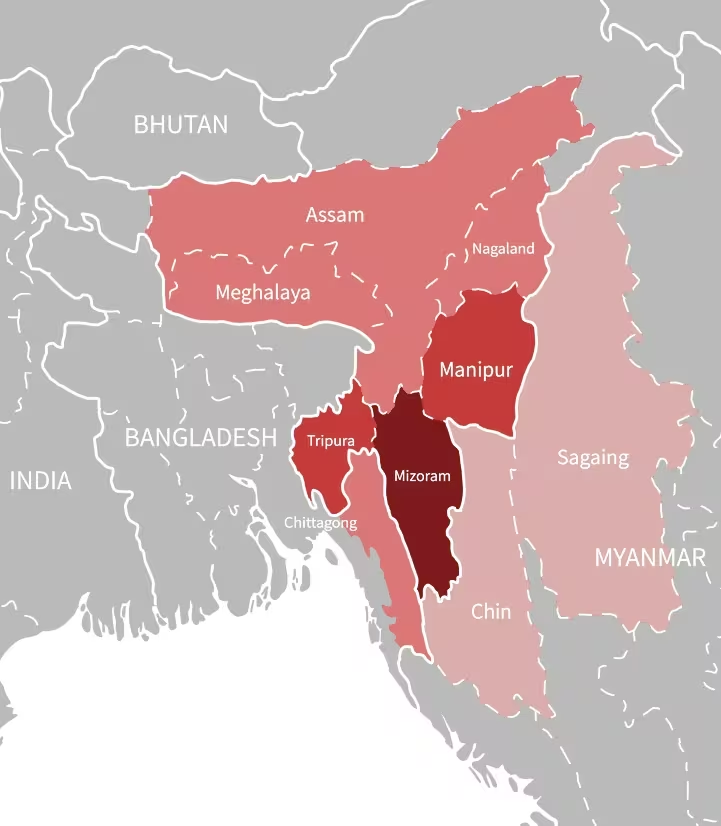
Mizo is spoken mainly in Mizoram in northeastern India. It is also used in Meghalaya, Manipur, Tripura, and Assam. Outside India, it is spoken in Myanmar's Sagaing Region and Chin State, as well as in the Chittagong Hill Tracts of Bangladesh.
Modern Distribution
Mizoram is the principal centre of Mizo use. Within the state, Mizo functions as both the official language and a lingua franca. The language is also maintained among some members of the Mizo diaspora.
Literary Heritage
Oral and Written Literature
Mizo has a thriving literature with both oral and written traditions. Literary activity underwent considerable change during the twentieth century. The language's literary culture is supported by continuing publication in newspapers and magazines.
Sample Text
A Mizo rendering of Article 1 of the Universal Declaration of Human Rights begins:
Mi zawng zawng hi zalèna piang kan ni a, zahawmna leh dikna chanvoah intluk tláng vek kan ni.
The English translation given for the passage is:
“All human beings are born free and equal in dignity and rights.”
The complete Mizo sample continues with a statement about reason, conscience, and acting toward one another in a spirit of brotherhood.
Grammar and Phonology
Key Features
Mizo verbs express tense through aspect and the addition of particles. Listed particles include ang, associated with the simple future; tawh, used for the simple past and past perfect; mék, used in progressive tenses; dáwn, associated with the simple future; and dáwn mék, associated with the near future.
Gerunds and past participles are formed through a change in word ending known as tihdanglamna. The resulting forms are called “stem II” in English-language linguistic literature.
Mizo nouns decline into cases. Plural forms are created by adding suffixes such as -te, -ho, -teho, or -hote. Pronouns occur in free and clitic forms and are also declined into cases. In declarative sentences, negation is formed by adding lo, meaning “not,” at the end of the sentence.
Sound System
Mizo is a tonal language: differences in pitch and pitch contour can change the meanings of words. The eight tones and intonations can be demonstrated with the sequence p-a-n-g:
- long high tone: páng
- long low tone: pàng
- peaking tone: pâng
- dipping tone: päng
- short rising tone: pǎng
- short falling tone: pȧng
- short mid tone: pang
- short low tone: pạng
Mizo also has the triphthongs iai, iau, uai, and uau. Glottal and glottalised consonants occur only in final position.
Influence and Legacy
Linguistic Influences
Mizo is chiefly based on Lusei but has incorporated many words from neighbouring Mizo clans, including Hmar and Pawi. Its classification alongside Laiholh and Maraic reflects its regional relationship within the Central Kuki-Chin group.
Cultural Impact
Mizo serves as a shared means of communication across Mizoram and has a substantial literary and publishing presence. Its combination of oral tradition, written literature, tonal complexity, and a Roman-based orthography gives it a distinctive position among the languages of northeastern India.
Modern Status
Official Recognition
Mizo is the official language of Mizoram and is widely used as the state's lingua franca. It remains the mother tongue of the Mizo people and is spoken in neighbouring Indian states, parts of Myanmar and Bangladesh, and the Mizo diaspora.
Preservation and Resources
Mizo language documentation is represented by the Mizo Language Resource collection in the Computational Resource for South Asian Languages archive. A dictionary of the Lushai language by J. Herbert Lorrain was published by the Asiatic Society in 1940. These resources accompany continuing newspaper, magazine, oral, and literary use.
Learning and Study
Academic Study
Mizo has been studied within Sino-Tibetan and Kuki-Chin linguistics. Works listed in connection with its study include Paul K. Benedict's Sino-Tibetan: A Conspectus, Kenneth VanBik's work on Proto-Kuki-Chin, and Lalnunthangi Chhangte's A Preliminary Grammar of the Mizo Language.
Resources
Learners and researchers can consult the 1940 Dictionary of the Lushai Language, grammatical studies, the Sino-Tibetan Etymological Dictionary and Thesaurus database, and the Mizo Language Resource collection in the CoRSAL archive.
Conclusion
Mizo is a living Sino-Tibetan language centred in Mizoram and extending across parts of northeastern India, Myanmar, Bangladesh, and the Mizo diaspora. Its identity is shaped by a Lusei-based vocabulary enriched by neighbouring Mizo varieties, while its grammatical system includes case-marked nouns, distinct free and clitic pronouns, plural suffixes, aspectual verb marking, and sentence-final negation. Its eight tones and intonations make pitch a central part of meaning. Written Mizo developed through a Roman-based alphabet, beginning with a 1874 script for Lushai and later expanding its system of vowel and tone marking. Together, its official role, oral traditions, literary activity, and continuing documentation demonstrate the language's enduring cultural importance.