Prakrit: The Languages of Ancient India's Common People
Prakrit represents not a single language but a group of Middle Indo-Aryan vernacular languages that flourished across ancient India from approximately the 6th century BCE to the 8th century CE. The term "Prakrit" itself derives from the Sanskrit word prākṛta, meaning "natural" or "original," distinguishing these spoken vernaculars from the refined, standardized Sanskrit. While Sanskrit served as the language of elite scholarly and religious discourse, Prakrit languages captured the authentic voice of common people, merchants, women, and Buddhist and Jain communities. These languages bridged the gap between the ancient Vedic Sanskrit and the modern Indo-Aryan languages spoken today across North India, serving as crucial vehicles for literature, religious texts, royal inscriptions, and dramatic works. The story of Prakrit is fundamentally the story of linguistic democracy in ancient India.
Origins and Classification
Linguistic Family
Prakrit languages belong to the Middle Indo-Aryan branch of the Indo-Aryan language family, itself part of the larger Indo-European language group. They represent an intermediate stage in the evolution from Old Indo-Aryan (Vedic and Classical Sanskrit) to the New Indo-Aryan languages (modern languages like Hindi, Bengali, Marathi, and Gujarati). Linguistically, Prakrits are characterized by the simplification of Sanskrit's complex phonology and grammar, reflecting natural linguistic evolution through everyday speech.
The Middle Indo-Aryan period spans roughly from 600 BCE to 1000 CE, with Prakrit languages dominating the earlier centuries. These languages shared certain phonological features that distinguished them from Sanskrit, including the loss of certain consonant clusters, simplification of case endings, and changes in vowel quality. However, significant regional variation existed among different Prakrit languages, reflecting the vast geographic spread across the Indian subcontinent.
Origins
The origins of Prakrit languages trace back to the vernacular dialects spoken alongside Vedic Sanskrit in ancient North India. As Sanskrit became increasingly standardized and associated with Brahmanical ritual and learning, the spoken vernaculars continued to evolve naturally. By the 6th century BCE, these vernaculars had diverged sufficiently from Sanskrit to be recognized as distinct languages.
The earliest evidence of Prakrit appears in the form of Buddhist and Jain religious texts, which deliberately chose vernacular languages to make their teachings accessible to common people. This democratic impulse toward linguistic accessibility would become a defining characteristic of Prakrit's historical role. The Buddha himself is believed to have preached in a Prakrit dialect, rejecting the exclusive use of Sanskrit for religious discourse.
Name Etymology
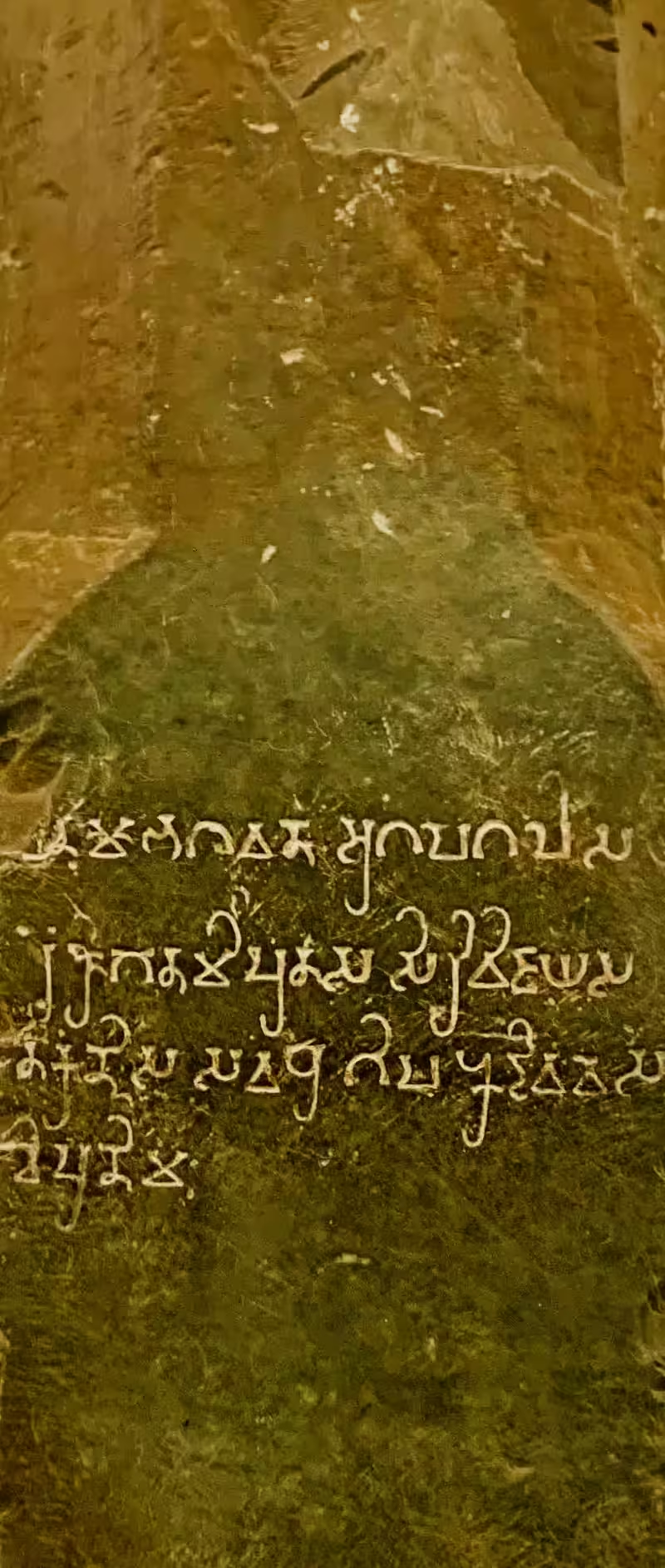
The word "Prakrit" comes from the Sanskrit prākṛta (प्राकृत), derived from prakṛti meaning "nature," "original," or "unrefined." This etymology reflects the Sanskrit grammarians' perspective that these were "natural" or "unrefined" languages in contrast to saṃskṛta (Sanskrit), meaning "refined," "perfected," or "put together." The term appears in the Mandsaur stone inscription of Yashodharman-Vishnuvardhana from 532 CE, where the word praakritee is clearly inscribed, providing concrete epigraphic evidence of the term's historical usage.
However, this Sanskrit-centric etymology should not obscure the fact that Prakrit languages had their own sophisticated literary traditions and grammatical systems. The term reflects a hierarchical view of language that privileged Sanskrit, but Prakrit languages developed their own standards, grammars, and aesthetic conventions that were valued in their own right.
Historical Development
Early Prakrit (600 BCE - 200 BCE)
The earliest phase of Prakrit development corresponds with the rise of Buddhism and Jainism in the 6th century BCE. These heterodox religious movements consciously adopted vernacular languages for their teachings, rejecting the Brahmanical monopoly on Sanskrit. The Buddha's teachings were transmitted orally in Prakrit dialects, and the earliest Buddhist texts preserve linguistic features from this period.
During this era, Prakrit existed primarily as spoken vernaculars with limited written documentation. The languages showed considerable regional variation, reflecting the diverse linguistic landscape of ancient India. These early Prakrits simplified many of Sanskrit's complex grammatical features, making them more accessible while retaining intelligibility with Sanskrit for educated speakers.
Middle Prakrit (200 BCE - 400 CE)
This period witnessed the flourishing of Prakrit as a literary and administrative language. Emperor Ashoka's decision to use Prakrit for his famous edicts around 250 BCE marked a watershed moment. Ashoka chose Prakrit over Sanskrit specifically to communicate his messages of dhamma (righteousness) to the widest possible audience. His inscriptions, found throughout the Mauryan Empire, employed various regional Prakrit dialects written in the Brahmi script.
The Mauryan period established Prakrit as a legitimate language of governance and public communication. Subsequently, numerous dynasties continued using Prakrit for inscriptions, demonstrating its prestige and practical utility. During this phase, several standardized literary Prakrit forms emerged, including Maharashtri Prakrit (used for lyric poetry), Shauraseni Prakrit (used in drama), and Magadhi Prakrit (associated with Buddhist texts).
This was also the golden age of Prakrit literature. The Gaha Sattasai (Seven Hundred Verses), an anthology of love poetry attributed to the Satavahana king Hāla (circa 1st century CE), represents one of the finest achievements of Prakrit literature. Written in Maharashtri Prakrit, this collection exemplifies the language's capacity for expressing sophisticated literary themes and emotions.
Late Prakrit (400 CE - 800 CE)
During the late Prakrit period, these languages began transitioning toward the Apabhramsha stage, representing a further evolution toward modern Indo-Aryan languages. Sanskrit experienced a literary renaissance during the Gupta period and beyond, gradually reasserting dominance in elite literary production. However, Prakrit remained important in certain literary genres, particularly lyric poetry and dramatic dialogue.
In classical Sanskrit drama, a sophisticated linguistic convention emerged where different characters spoke different languages based on their social status and gender. Kings and learned men spoke Sanskrit, while women, children, and common people spoke various forms of Prakrit. This theatrical convention, codified in texts like the Natya Shastra, preserved Prakrit's association with authentic emotion and everyday life even as Sanskrit dominated elite discourse.
By the 6th century CE, inscriptional evidence shows Prakrit evolving into increasingly localized forms. The Mandsaur inscription of 532 CE explicitly mentions "Praakritee," demonstrating continued recognition of these languages as distinct from Sanskrit even as they evolved toward their modern descendants.
Transition to Modern Languages
By the 8th-10th centuries CE, Prakrit languages had evolved into Apabhramsha dialects, which in turn gave rise to the early forms of modern Indo-Aryan languages. Hindi, Marathi, Gujarati, Bengali, Punjabi, Sindhi, and Odia all trace their lineage through various Prakrit languages. This linguistic continuity makes Prakrit essential for understanding the historical development of modern South Asian languages.
Scripts and Writing Systems
Brahmi Script
The primary writing system used for Prakrit during the ancient period was the Brahmi script, one of the earliest writing systems developed in India. Brahmi appears in inscriptions from around the 3rd century BCE, most famously in Ashoka's edicts. The script was written from left to right and contained separate symbols for vowels and consonants, allowing for precise representation of Prakrit phonology.
Brahmi script adapted well to Prakrit languages, capturing their simplified phonological system more naturally than it captured Sanskrit's complex consonant clusters. Archaeological evidence from sites like Nagarjunakonda in Andhra Pradesh preserves Prakrit inscriptions in Brahmi from the 1st-3rd centuries CE, demonstrating the script's widespread use across different regions. These inscriptions often record donations to Buddhist monasteries, land grants, and commemorative statements, providing invaluable historical information alongside linguistic data.
The Brahmi script eventually evolved into numerous regional scripts, including Devanagari, Bengali, Tamil, Telugu, and others. This diversification paralleled the evolution of Prakrit languages into distinct regional languages, with each region developing writing systems suited to local phonological features.
Devanagari and Later Scripts
As Prakrit languages evolved and Sanskrit experienced its classical resurgence, the Devanagari script (which developed from Brahmi through intermediate forms) became increasingly used for writing both Sanskrit and Prakrit texts from around the 6th century CE onward. Manuscripts of Prakrit literary texts, including Jain religious works and poetry collections, were often copied in Devanagari during the medieval period.
The 15th-century manuscript of the Suryaprajnapati Sutra exemplifies this later tradition, showing Prakrit text written in a developed form of Devanagari. Similarly, 17th-century manuscripts of the Upadesamala demonstrate the continued copying and preservation of Prakrit texts using Devanagari script long after Prakrit had ceased to be a living spoken language.
Script Evolution
The evolution of scripts used for Prakrit reflects broader changes in Indian writing systems. From the relatively simple Brahmi of Ashokan inscriptions to the more elaborate Devanagari of medieval manuscripts, the physical form of writing changed dramatically. However, Prakrit texts continued to be copied and studied, with later scholars adding commentary and preserving these works for posterity.
Geographic Distribution
Historical Spread
Prakrit languages were spoken across a vast geographic area encompassing most of the Indian subcontinent. Different regional varieties emerged, each with distinctive phonological and grammatical features. The major Prakrit languages included:
Maharashtri Prakrit: Considered the most prestigious literary Prakrit, spoken in western and central India (modern Maharashtra region). It became the standard language for lyric poetry and was used extensively in literature.
Shauraseni Prakrit: Associated with the Mathura region (modern Uttar Pradesh), this form was commonly used in Sanskrit drama for dialogue spoken by female characters and commoners.
Magadhi Prakrit: Connected with the ancient kingdom of Magadha (modern Bihar), this dialect was associated with Buddhist literature and was considered the language of the Buddha's teachings.
Ardhamagadhi: A hybrid form used primarily in Jain canonical literature, combining features of Magadhi with other dialects.
Centers of Learning
While Prakrit was fundamentally a vernacular language without the institutionalized teaching tradition of Sanskrit, certain centers became associated with Prakrit learning and literature. Buddhist monasteries at sites like Nalanda and Taxila preserved Prakrit texts and transmitted Buddhist teachings in these languages. Jain monasteries similarly maintained extensive libraries of Prakrit religious texts.
The Satavahana court, particularly during the reign of King Hāla, became a renowned center of Prakrit literary culture in the early centuries CE. The Deccan region under Satavahana patronage saw the flourishing of Maharashtri Prakrit literature, producing sophisticated poetic works that rivaled Sanskrit literature in aesthetic refinement.
Modern Distribution
Prakrit languages are extinct as spoken vernaculars, having evolved into modern Indo-Aryan languages over the course of the medieval period. However, their legacy persists in multiple forms. Linguistically, every major North Indian language preserves Prakrit features and vocabulary. Culturally, Prakrit texts continue to be studied by scholars, and Jain communities maintain particular reverence for their Prakrit religious texts.
The word "Jambulo" (जम्वुलो), a Prakrit term still recognized in some Indian contexts, demonstrates how certain Prakrit vocabulary persists in regional linguistic consciousness. Such linguistic survivals connect modern speakers to their ancient linguistic heritage.
Literary Heritage
Classical Literature
Prakrit developed a sophisticated literary tradition that rivaled Sanskrit in certain genres. The Gaha Sattasai (also known as Sattasai or Gathasaptashati) stands as the crown jewel of Prakrit literature. This anthology of approximately 700 verses, attributed to King Hāla of the Satavahana dynasty (circa 1st-2nd century CE), contains exquisite lyric poetry dealing with themes of love, nature, separation, and seasonal beauty. Written in Maharashtri Prakrit, these verses demonstrate remarkable literary sophistication, employing complex metaphors and subtle emotional nuances.
The anthology's influence extended far beyond its original context. Later Sanskrit poets frequently drew inspiration from the Gaha Sattasai, and the work was extensively commented upon by medieval scholars. The poetry captures moments of everyday life with remarkable immediacy, presenting perspectives of rural women, farmers, and villagers rarely represented in elite Sanskrit literature.
Religious Texts
Prakrit languages served as crucial vehicles for Buddhist and Jain religious literature. The early Buddhist canon, though later translated into Pali (itself a Middle Indo-Aryan language closely related to Prakrit), originated in Prakrit dialects. Buddhist inscriptions throughout India employed local Prakrit variants to communicate religious ideas to lay communities.
For Jainism, Prakrit became the primary language of canonical literature. The Jain Agamas, the fundamental religious texts of Jainism, were composed in Ardhamagadhi Prakrit and related dialects. These texts, which recount the teachings of Mahavira and other Tirthankaras, have been preserved through an unbroken manuscript tradition spanning over two millennia. Works like the Sadhupratikramanasutra represent the extensive Jain literary tradition in Prakrit, covering theology, ethics, cosmology, and monastic discipline.
The Suryaprajnapati Sutra, preserved in 15th-century manuscripts, exemplifies how Jain communities continued copying and preserving Prakrit texts long after the language ceased being spoken. This textual tradition maintained Prakrit as a living literary and religious language within Jain communities well into the medieval period.
Poetry and Drama
Beyond the Gaha Sattasai, Prakrit poetry developed sophisticated conventions and styles. Lyric poetry in Maharashtri Prakrit explored themes of love (śṛṅgāra), separation (viraha), and the changing seasons, often from feminine perspectives. This literature valued suggestion (dhvani) and emotional resonance over explicit statement, developing aesthetic theories parallel to those in Sanskrit poetics.
In drama, Prakrit played an essential role in the Sanskrit theatrical tradition. The Natya Shastra, the classical treatise on dramaturgy, codified conventions whereby different characters spoke different languages. Female characters invariably spoke Prakrit, as did servants, merchants, and common people. This convention allowed playwrights to create linguistic diversity and social realism on stage while reserving Sanskrit for royal and learned characters.
This theatrical Prakrit showcased multiple dialects: heroines typically spoke Shauraseni, while servants might speak Magadhi, and courtesans spoke Avanti or other regional varieties. This linguistic complexity added texture to dramatic performances and preserved Prakrit languages within classical Sanskrit drama long after they ceased being widely spoken.
Scientific and Philosophical Works
While Sanskrit dominated technical and philosophical literature, some grammatical and linguistic treatises on Prakrit were composed. The most important is the Prakrit Prakasha by Vararuchi (date uncertain, possibly 3rd-8th century CE), which codified Prakrit grammar. This text, along with later works like Hemacandra's Prakrit Grammar (12th century), standardized literary Prakrit forms and established rules for deriving Prakrit forms from Sanskrit roots.
These grammatical works demonstrate that Prakrit had sophisticated metalinguistic traditions, even if less extensive than those of Sanskrit. They preserved knowledge of correct Prakrit usage for later generations and enabled the continued composition and understanding of Prakrit texts.
Grammar and Phonology
Key Features
Prakrit languages simplified many complex features of Sanskrit grammar while retaining intelligibility. Key grammatical characteristics included:
Nominal System: Prakrit reduced Sanskrit's eight cases to fewer cases, often six or seven, with some case functions absorbed by postpositions. The three genders (masculine, feminine, neuter) were retained, though with simplified declension patterns.
Verbal System: The elaborate system of Sanskrit verb conjugation was simplified. Many Sanskrit tense-mood-aspect categories merged or disappeared, with Prakrit relying more on periphrastic constructions and analytic forms rather than synthetic conjugation.
Syntax: Prakrit syntax generally followed Sanskrit patterns with SOV (Subject-Object-Verb) word order, but with greater flexibility. Compound formation remained productive, though typically simpler than in Sanskrit.
Morphology: Prakrit employed more analytic structures compared to Sanskrit's synthetic morphology, a pattern that continued in the evolution toward modern Indo-Aryan languages.
Sound System
Prakrit phonology systematically simplified Sanskrit's consonant and vowel systems:
Consonant Changes:
- Consonant clusters were simplified or eliminated (Sanskrit skanda became Prakrit kanda)
- Aspirated consonants often lost aspiration
- Voiced aspirates underwent distinctive changes
- Intervocalic single consonants often underwent lenition or deletion
Vowel Changes:
- Certain Sanskrit vowels merged (e.g., ṛ typically became i or u)
- Long and short vowels underwent complex patterns of merger and differentiation
- Diphthongs simplified
These phonological changes represented natural linguistic evolution through everyday speech, contrasting with Sanskrit's conservative standardization. The resulting phonological systems varied somewhat across different Prakrit languages, reflecting regional pronunciation patterns.
Influence and Legacy
Languages Influenced
Prakrit languages serve as the crucial evolutionary link between Sanskrit and modern Indo-Aryan languages. The following major languages evolved from various Prakrit forms:
Hindi: Descended from Shauraseni Prakrit through Apabhramsha stages, preserving extensive Prakrit vocabulary and grammatical features.
Marathi: Evolved from Maharashtri Prakrit, maintaining particularly close connections to classical Prakrit literary forms.
Gujarati: Developed from a western Prakrit variety, showing distinctive phonological developments.
Bengali: Descended from Magadhi Prakrit and Apabhramsha, preserving certain archaic features.
Punjabi, Sindhi, Odia: Each evolved from regional Prakrit varieties, developing distinctive features while maintaining the core Middle Indo-Aryan heritage.
This linguistic continuity makes Prakrit essential for understanding the historical development of modern South Asian languages. Historical linguists use Prakrit evidence to reconstruct the evolution from Sanskrit to modern languages, tracking phonological changes, grammatical simplifications, and lexical developments.
Loanwords
The relationship between Sanskrit and Prakrit involved extensive mutual influence. While Prakrit languages evolved from Sanskrit, they also borrowed extensively from Sanskrit throughout their history, creating complex patterns of "tatsama" (borrowed directly from Sanskrit) and "tadbhava" (evolved naturally from Sanskrit) vocabulary.
From Sanskrit to Prakrit:
- dharma → dhamma (righteousness, religion)
- karma → kamma (action, fate)
- nirvāṇa → nibbāna (liberation)
- skandha → khandha (aggregate)
These Prakrit forms entered Pali and other languages, with many eventually passing into modern Indian languages. Words like "dhamma" became so established in Buddhist contexts that they remained preferred over Sanskrit forms even in later literary traditions.
Prakrit to Modern Languages: Modern Indian languages preserve countless Prakrit-derived words, often showing characteristic Prakrit sound changes. The historical linguistics of Indo-Aryan languages fundamentally depends on tracing Prakrit intermediate stages.
Cultural Impact
Beyond direct linguistic influence, Prakrit languages shaped Indian cultural consciousness in profound ways. They democratized access to literature and religious teachings, challenging Brahmanical monopolies on learning and sacred language. This democratizing impulse influenced later vernacular movements throughout Indian history.
The association of Prakrit with feminine voices in drama and literature created a unique literary convention where certain perspectives and emotions were considered more authentically expressed in Prakrit than Sanskrit. This gendering of language, while reflecting social hierarchies, also preserved space for non-elite voices in classical literature.
Prakrit's role in preserving Jain and Buddhist teachings ensured these religious traditions developed in vernacular languages accessible to ordinary practitioners, establishing precedents for later bhakti (devotional) movements that similarly privileged vernacular expression over Sanskrit.
Royal and Religious Patronage
Ashoka the Great (268-232 BCE)
Emperor Ashoka's patronage of Prakrit represented perhaps the most consequential political endorsement of vernacular languages in ancient Indian history. Following his conversion to Buddhism and subsequent remorse over the Kalinga War, Ashoka embarked on an ambitious program of moral instruction throughout his empire. Crucially, he chose to communicate in Prakrit rather than Sanskrit.
Ashoka's rock and pillar edicts, distributed throughout the Mauryan Empire from modern Afghanistan to Karnataka, employed various regional Prakrit dialects adapted to local populations. This decision reflected both practical and ideological considerations: Prakrit was the language people actually spoke, making his messages of dhamma accessible to the widest audience. The edicts discuss moral principles, animal welfare, religious tolerance, and proper governance, presenting Prakrit as a suitable vehicle for elevated ethical and political discourse.
The precedent Ashoka established influenced subsequent dynasties. The Satavahanas, who ruled the Deccan from the 1st century BCE to the 3rd century CE, continued using Prakrit for inscriptions and patronized Prakrit literature. King Hāla's composition of the Gaha Sattasai represented royal engagement with Prakrit as a sophisticated literary medium.
Religious Institutions
Buddhist monasteries throughout ancient India served as crucial centers for preserving and transmitting Prakrit texts. While Buddhist literature eventually standardized around Pali in the Theravada tradition, and Sanskrit in the Mahayana tradition, early Buddhist teachings were originally transmitted in various Prakrit dialects. Monasteries at Nalanda, Taxila, and other centers maintained libraries containing Prakrit manuscripts alongside Sanskrit and other texts.
Jain institutions developed even stronger commitments to Prakrit preservation. Jain scriptures were composed in Ardhamagadhi and related Prakrits, and Jain communities maintained unbroken manuscript traditions for over two millennia. Jain scholars produced grammatical treatises on Prakrit, commentaries on Prakrit texts, and continued composing new works in Prakrit even during periods when the language had ceased being spoken in daily life.
This religious patronage ensured Prakrit texts were continuously copied, studied, and transmitted. The 15th-century Suryaprajnapati Sutra manuscript and 17th-century Upadesamala manuscripts demonstrate this continuity, showing Jain scribes preserving ancient Prakrit texts a millennium after the language's decline as a living vernacular.
Modern Status
Current Speakers
Prakrit languages are extinct as living spoken vernaculars. The last stages of Prakrit evolution occurred around the 8th-10th centuries CE, when these languages transitioned into Apabhramsha and early forms of modern Indo-Aryan languages. No communities speak Prakrit as a native language today.
However, Prakrit retains specialized uses within Jain religious communities, where canonical texts continue to be recited, studied, and occasionally composed. Jain monks and scholars study Prakrit as part of religious education, maintaining reading knowledge of the language for scriptural purposes. This situation resembles Latin in Christian contexts or Classical Arabic in Islamic contexts—the language functions liturgically and textually rather than conversationally.
Official Recognition
Prakrit has no official status in any modern nation-state. However, its importance is recognized in academic and cultural institutions. Indian universities with strong programs in ancient Indian studies, linguistics, or Jainology typically include Prakrit in their curriculum. The language is taught as part of classical Indian philology programs, often alongside Sanskrit and Pali.
Cultural organizations and Jain institutions occasionally promote Prakrit studies and organize scholarly conferences devoted to Prakrit literature and linguistics. These efforts aim to preserve knowledge of Prakrit and make its literary heritage accessible to modern scholars and general readers.
Preservation Efforts
Several initiatives work to preserve and study Prakrit:
Academic Research: Scholars worldwide study Prakrit languages, producing critical editions of texts, grammatical analyses, and historical linguistic studies. Major Prakrit texts have been edited and published with translations, making them accessible to modern readers.
Manuscript Preservation: Institutions in India and abroad maintain collections of Prakrit manuscripts, particularly Jain religious texts. Digital humanities projects increasingly digitize these manuscripts, creating online databases accessible to researchers globally.
Translation Projects: Efforts to translate major Prakrit works into modern languages make this literature available beyond specialist scholars. The Gaha Sattasai, for instance, has been translated into English, Hindi, Marathi, and other languages, introducing new audiences to Prakrit poetry.
Jain Educational Institutions: Jain communities maintain educational institutions where Prakrit is taught as part of religious education, ensuring continued knowledge transmission within traditional contexts.
Learning and Study
Academic Study
Modern study of Prakrit typically occurs within university programs focused on ancient Indian studies, historical linguistics, or comparative philology. Students generally begin with Sanskrit before proceeding to Prakrit, as knowledge of Sanskrit facilitates understanding Prakrit's relationship to its parent language.
Academic programs study Prakrit from multiple perspectives:
Historical Linguistics: Analyzing phonological, morphological, and syntactic changes from Sanskrit through Prakrit to modern languages, reconstructing patterns of linguistic evolution.
Literary Studies: Examining Prakrit poetry and drama for aesthetic, thematic, and cultural content, situating these works within broader Indian literary traditions.
Religious Studies: Reading Jain and Buddhist texts in original Prakrit, understanding doctrinal developments and sectarian variations.
Epigraphy: Studying Prakrit inscriptions to extract historical information about ancient dynasties, religious institutions, and social practices.
Resources
Resources for Prakrit study include:
Grammars: Classical Prakrit grammars like Vararuchi's Prakrit Prakasha and Hemacandra's Prakrit Grammar, along with modern descriptive grammars providing systematic accounts of Prakrit phonology, morphology, and syntax.
Dictionaries: Comprehensive Prakrit dictionaries cataloging vocabulary with Sanskrit equivalents and etymological information.
Text Editions: Critical editions of major Prakrit works, often with commentary in Sanskrit or modern languages, making primary sources accessible to students.
Online Resources: Digital databases of Prakrit inscriptions, digitized manuscripts, and online dictionaries increasingly make Prakrit materials available to global audiences.
Secondary Literature: Scholarly studies analyzing specific aspects of Prakrit languages, literature, and history, published in academic journals and monographs.
The scholar Korada Mahadeva Sastri, among others, contributed significantly to Prakrit studies, producing editions and analyses that advanced understanding of these languages. Modern Prakrit scholarship continues this tradition, combining philological rigor with linguistic theory and historical contextualization.
Conclusion
Prakrit languages occupy a unique position in Indian linguistic and cultural history. As the vernacular Middle Indo-Aryan languages that bridged the gap between Sanskrit and modern Indian languages, they represent a crucial evolutionary stage in South Asian linguistic development. Yet their significance extends far beyond historical linguistics. Prakrit served as the voice of ordinary people in ancient India, challenging elite monopolies on learning and sacred language. Through Prakrit, Buddhist and Jain teachers communicated their messages to mass audiences, Ashoka addressed his subjects about moral governance, and poets captured the emotional lives of women and common people excluded from Sanskrit literary discourse.
The legacy of Prakrit persists in every modern North Indian language, in the continued reverence Jain communities maintain toward their Prakrit scriptures, and in the exquisite poetry of works like the Gaha Sattasai that still move readers across linguistic and temporal boundaries. Though extinct as living vernaculars, Prakrit languages remain vital components of India's cultural heritage, reminding us that linguistic democracy and vernacular expression have deep roots in South Asian civilization. Understanding Prakrit enriches our comprehension of how languages evolve, how literature develops across social strata, and how ancient voices continue speaking to us across millennia through the texts they left behind.
Source: Wikipedia - Prakrit


