Tamil Language: A Living Classical Tradition Spanning Millennia
Tamil stands as one of the world's great classical languages, with a continuous literary tradition extending over two millennia. As a Dravidian language native to South India and Sri Lanka, Tamil has developed a rich corpus of literature, sophisticated grammatical systems, and distinctive cultural expressions that have profoundly influenced the linguistic and cultural landscape of South and Southeast Asia. With approximately 75 million speakers worldwide, Tamil remains vibrant as an official language in Tamil Nadu, Puducherry, Sri Lanka, and Singapore. Its ancient roots, evident in inscriptions dating to the 3rd century BCE, combined with its ongoing evolution as a modern language, make Tamil a unique example of linguistic continuity and cultural preservation. The language's recognition as a classical language by the Government of India in 2004 acknowledges its independent literary tradition, substantial ancient literature, and original cultural heritage distinct from Sanskrit influences.
Origins and Classification
Linguistic Family
Tamil belongs to the Dravidian language family, representing the southern branch of this ancient linguistic group indigenous to the Indian subcontinent. As the most prominent member of the South Dravidian subgroup, Tamil shares ancestral roots with Malayalam, Kannada, and Telugu, though it has maintained greater distinctiveness from Indo-Aryan influences than its neighboring languages. The Dravidian language family is believed to have been spoken across much of India before the arrival of Indo-Aryan languages, and Tamil preserves many archaic features that provide insights into the proto-Dravidian language. Linguistic scholars consider Tamil crucial for reconstructing the early history of Dravidian languages due to its extensive ancient literature and relative conservatism in maintaining older linguistic features.
Origins
The origins of Tamil trace back to Proto-Dravidian, spoken approximately 4,500 years ago. The earliest form of Tamil that can be definitively identified appears in inscriptions using the Tamil-Brahmi script dating to approximately the 3rd century BCE, though the language's oral tradition is certainly older. These early inscriptions, found in natural caves and on pottery in Tamil Nadu, represent some of the earliest written records in India outside of the Indus Valley civilization. The Sangam period (approximately 300 BCE to 300 CE) witnessed the flourishing of classical Tamil literature, producing works that provide invaluable information about the language's early forms, social structures, and cultural practices of ancient Tamil society.
Name Etymology
The word "Tamil" (தமிழ்) is believed to be derived from the self-designation of Tamil people. Various theories exist regarding its ultimate etymology, with some scholars suggesting connections to words meaning "sweet" or "proper." Historical linguistic analysis indicates that the term "Tamil" has been used to refer to both the language and the people who speak it for at least two millennia. Early Sanskrit texts refer to the language as "Dramiḍa" or "Dramila," from which the term "Dravidian" is derived. The self-referential nature of the name emphasizes the strong identity connection between the Tamil people and their language, a relationship that continues to define Tamil cultural consciousness today.
Historical Development
Old Tamil Period (300 BCE - 700 CE)
Old Tamil represents the earliest documented phase of the language, characterized by the magnificent Sangam literature—a corpus of classical poetry and prose composed by numerous poets over several centuries. The Sangam period produced exceptional literary works organized into anthologies such as the Ettuttokai (Eight Anthologies) and Pattuppattu (Ten Songs), covering themes from love and war to ethics and governance. The grammatical text Tolkappiyam, attributed to the sage Tolkappiyar, stands as the oldest surviving Tamil grammar and one of the oldest grammatical treatises in any language. This period's Tamil shows relatively few Sanskrit influences, preserving a pure Dravidian vocabulary and grammatical structure. The language of this era displays sophisticated poetic conventions, including the famous akam (interior/love) and puram (exterior/war) classifications that governed thematic content and stylistic features.
Middle Tamil Period (700 CE - 1600 CE)
Middle Tamil witnessed significant developments in religious and philosophical literature, particularly the devotional poetry of the Bhakti movement. This period saw the composition of the Tevaram hymns by the Nayanars (Shaivite saints) and the Divya Prabandham by the Alvars (Vaishnavite saints), which transformed Tamil into a major liturgical language. The epic Silappathikaram (The Tale of the Anklet) and its companion work Manimekalai represent the height of Tamil epic poetry. The medieval period also produced the Tamil version of the Ramayana by Kambar (Ramavataram), which adapted the Sanskrit epic into Tamil cultural and literary conventions. During this phase, Tamil increasingly incorporated Sanskrit loanwords, particularly in religious, philosophical, and administrative contexts, though it maintained its grammatical independence. The development of commentarial literature and prose works expanded Tamil's expressive range significantly.
Modern Tamil Period (1600 CE - Present)
Modern Tamil has evolved while maintaining strong connections to its classical heritage, creating a distinctive diglossia between literary Tamil (centamiḻ) and colloquial Tamil (koṭuntamiḻ). The colonial period introduced European linguistic influences and spurred the development of modern prose, journalism, and new literary genres. The 19th and 20th centuries witnessed language reform movements, standardization efforts, and debates about the appropriate balance between Sanskrit borrowings and pure Tamil vocabulary (taṉittamiḻ). The modern period has seen Tamil adapt to contemporary needs through technological terminology, scientific discourse, and global communication while preserving classical literary forms. Contemporary Tamil maintains one of the world's most conservative orthographies, with modern script closely resembling forms from several centuries ago, facilitating continuity with classical texts.
Scripts and Writing Systems
Tamil-Brahmi Script
Tamil-Brahmi represents the earliest writing system used for Tamil, appearing in inscriptions from approximately the 3rd century BCE. This script evolved from the Brahmi script used throughout ancient India but developed distinctive features to accommodate Tamil phonology. Tamil-Brahmi inscriptions have been discovered in cave shelters, pottery, and hero stones across Tamil Nadu and parts of Kerala and Sri Lanka. The script wrote both Tamil and Prakrit, with the earliest examples showing a language closely related to the Tamil of Sangam literature. Notable early Tamil-Brahmi inscriptions include those found at Mangulam, Pugalur, and Adichanallur. The script's discovery and decipherment have been crucial for understanding early Tamil history and the development of Tamil writing systems. Tamil-Brahmi gradually evolved and transformed, eventually giving rise to the distinctive Tamil script.
Tamil Script
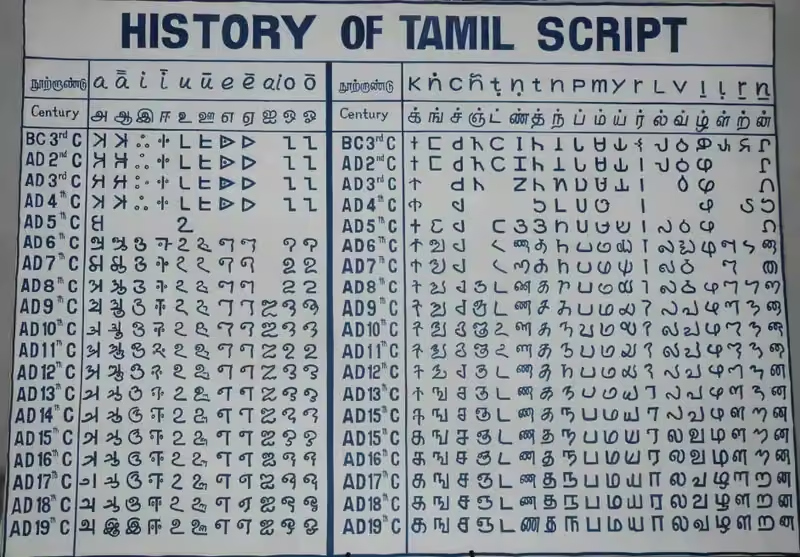
The modern Tamil script (தமிழ் அரிச்சுவடி) evolved from the Tamil-Brahmi and Vatteluttu scripts between the 6th and 9th centuries CE, developing its characteristic rounded forms. Unlike many Indian scripts that represent the complete range of Sanskrit phonemes, Tamil script is specifically designed for Tamil phonology, consisting of 12 vowels, 18 consonants, and one special character (ஃ). The script employs a syllabic structure where consonants carry an inherent 'a' vowel that can be modified with diacritical marks to represent other vowels. Tamil script is notable for its aesthetic cursive nature and its conservative orthography that has remained relatively stable for centuries, making classical texts accessible to modern readers. The script's elegance has been celebrated in Tamil culture, and calligraphy has been an important art form. Modern technological adaptations have successfully incorporated Tamil script into digital communication, with Tamil becoming one of the first Indian languages to develop comprehensive Unicode support.
Script Evolution
The evolution of Tamil script reflects both linguistic changes and cultural influences over two millennia. From the angular forms of Tamil-Brahmi through the intermediate Vatteluttu script to the rounded modern Tamil script, the writing system has continuously adapted while maintaining distinctive Tamil characteristics. Unlike most other Indian scripts that derive from Brahmi and retain similar phonetic inventories, Tamil script deliberately simplified to match Tamil phonology, eliminating sounds not present in Tamil. This process of simplification and adaptation reflects Tamil linguistic purism and cultural identity. The script's development shows remarkable continuity, with medieval manuscripts readable to modern Tamil speakers with minimal training. Contemporary debates about script reform, particularly regarding the representation of sounds borrowed from other languages, continue to engage Tamil scholars and language planners.
Geographic Distribution
Historical Spread
Tamil has been primarily spoken in the southern tip of the Indian subcontinent since ancient times, with its heartland in present-day Tamil Nadu. Historical evidence suggests Tamil presence in Sri Lanka from at least the 3rd century BCE, with Tamil kingdoms and settlements established on the island's northern and eastern coasts. Ancient Tamil merchant communities established themselves throughout Southeast Asia, particularly in present-day Indonesia, Malaysia, Thailand, and Myanmar, where Tamil inscriptions and loanwords attest to their presence. The Chola dynasty's maritime expansion in the 11th and 12th centuries spread Tamil influence across the Bay of Bengal region. Historical sources mention Tamil-speaking communities in regions as distant as Cambodia and Vietnam, where Tamil merchants played significant roles in trade networks.
Centers of Learning
Tamil learning and literary production have historically centered in several key locations. Madurai, traditionally associated with the legendary Tamil Sangams (literary academies), has been a major center of Tamil scholarship for over two millennia. Thanjavur emerged as a crucial center during the Chola period, with its royal patronage supporting extensive literary production and manuscript preservation. The city of Kanchipuram in the Pallava territories became important for both Sanskrit and Tamil learning, producing bilingual scholars. Jaffna in northern Sri Lanka developed as a significant center of Tamil literary activity, particularly during the medieval period. Temple complexes throughout Tamil Nadu served as repositories of Tamil manuscripts and centers of traditional learning, with attached schools teaching Tamil grammar, literature, and commentaries.
Modern Distribution
Today, Tamil is spoken by approximately 75 million people worldwide, with the majority residing in Tamil Nadu (approximately 60 million) and Sri Lanka (approximately 5 million). Significant Tamil-speaking populations exist in Puducherry, Kerala, Karnataka, and Andhra Pradesh in India. The Indian diaspora has established substantial Tamil-speaking communities in Malaysia (approximately 2 million), Singapore (approximately 200,000), Mauritius, South Africa, Fiji, and Réunion, where Tamil maintains official or recognized status. Recent migrations have created Tamil communities in Western countries including the United States, Canada, United Kingdom, Australia, and various European nations. Tamil's geographic distribution reflects both ancient settlement patterns and modern migration, with the language adapting to diverse contexts while maintaining its core identity. The global Tamil diaspora has increasingly used technology to maintain linguistic and cultural connections with their homeland.
Literary Heritage
Classical Literature
Tamil classical literature, particularly from the Sangam period, represents one of the world's oldest living literary traditions. The Sangam corpus includes the Ettuttokai (Eight Anthologies) containing 2,381 poems, and the Pattuppattu (Ten Songs), long poems describing various aspects of Tamil society. These works follow sophisticated poetic conventions codified in early grammatical and rhetorical treatises. The poetry displays remarkable sophistication in its treatment of human emotions, natural descriptions, and social observations. The Tirukkural by Thiruvalluvar, consisting of 1,330 couplets on virtue, wealth, and love, has achieved universal acclaim and has been translated into numerous languages. The twin epics Silappathikaram and Manimekalai represent the transition to narrative poetry, incorporating diverse philosophical and religious themes while maintaining classical Tamil poetic excellence.
Religious Texts
Tamil religious literature constitutes a vast corpus spanning various traditions. The Tevaram, composed by the Nayanar saints Appar, Sambandar, and Sundarar, consists of devotional hymns to Shiva that revolutionized Tamil religious expression. The Divya Prabandham, composed by the twelve Alvars, represents Vaishnavite devotional poetry and holds canonical status in Sri Vaishnavism, being regarded as the "Tamil Veda." Karaikkal Ammaiyar's works represent early female religious authorship in Tamil. The Periya Puranam chronicles the lives of Nayanar saints, while the Tirumurai collection preserves Shaivite sacred literature. These devotional works democratized religious expression by composing in Tamil rather than Sanskrit, making profound spiritual concepts accessible to ordinary people. Jain and Buddhist Tamil literature, though less preserved, includes important philosophical and narrative works. The synthesis of devotional fervor with sophisticated Tamil poetic forms created enduring religious literature.
Poetry and Drama
Beyond religious poetry, Tamil developed rich traditions of secular poetry and drama. Kambar's Ramavataram (12th century) adapted the Ramayana into Tamil, transforming it through Tamil cultural perspectives and poetic conventions. Avvaiyar's didactic poems have educated Tamil children for centuries with their moral wisdom. Medieval Tamil produced courtly poetry praising royal patrons while maintaining high literary standards. The development of Tamil drama, though less prominent than poetry, includes folk theatrical forms like Therukoothu and literary drama drawing from Sanskrit models. Modern Tamil poetry, beginning with Subramania Bharati in the early 20th century, revolutionized Tamil verse by introducing free verse and new themes while drawing inspiration from classical traditions. Contemporary Tamil poetry continues to evolve, addressing modern concerns while engaging with the rich classical heritage.
Scientific and Philosophical Works
Tamil intellectual tradition extends beyond literature to scientific and philosophical domains. Tolkappiyam, beyond being a grammatical text, contains extensive discussions on poetics, society, and human nature. Medieval Tamil developed extensive commentarial literature on grammar, prosody, and literary criticism. Tamil astronomical and mathematical works, though less extensive than Sanskrit traditions, include important texts on calendar calculation and astrology. Medical literature in Tamil, particularly texts on Siddha medicine, preserves indigenous healing traditions. Philosophical works include Tamil adaptations of various Indian philosophical schools and original Tamil philosophical speculation, particularly in Shaivite Siddhanta texts. The tradition of Tamil grammatical and linguistic analysis, continuing from Tolkappiyam through medieval commentaries to modern linguistics, demonstrates sustained intellectual engagement with language structure and use.
Grammar and Phonology
Key Features
Tamil grammar displays distinctive features that reflect its Dravidian heritage. The language employs an agglutinative structure, where grammatical relationships are expressed through suffixes added to word roots. Tamil distinguishes between rational (uyarttiṇai) and irrational (aḵṟiṇai) noun classes, affecting verb agreement. The language has no gender distinction in the first and second persons but distinguishes masculine, feminine, and neuter in the third person. Tamil verb system expresses tense, mood, voice, and aspect through various suffixes, with distinct forms for positive and negative. The language features extensive use of postpositions rather than prepositions. Tamil syntax typically follows subject-object-verb word order, though flexibility exists for poetic and emphatic purposes. The language maintains formal distinctions between literary and colloquial forms, with literary Tamil preserving archaic features and colloquial Tamil showing regional variation and innovation.
Sound System
Tamil phonology is characterized by a relatively small consonant inventory compared to Sanskrit and other Indian languages. The language distinguishes six stop consonants with places of articulation at different points in the mouth, plus nasal consonants, liquids, and semivowels. Tamil lacks voiced and aspirated stops found in Indo-Aryan languages, though these may appear in loanwords. The language features distinctive retroflex consonants articulated with the tongue curled back. Tamil distinguishes between two rhotic sounds (ர and ற), two lateral sounds (ல and ள), and two nasal sounds (ந and ன) based on place of articulation. The vowel system includes five basic vowels, each with short and long variants, plus two diphthongs. Tamil phonotactics restricts consonant clusters, often inserting vowels in loanwords to avoid prohibited sequences. The sound system's conservative nature has preserved many Proto-Dravidian features lost in related languages.
Influence and Legacy
Languages Influenced
Tamil has significantly influenced neighboring South Indian languages through sustained contact and cultural exchange. Malayalam emerged as a distinct language from Tamil around the 9th-10th centuries CE, initially as a regional variant of Tamil before developing independent identity, and retains substantial Tamil vocabulary. Kannada and Telugu, though belonging to different Dravidian branches, have borrowed extensively from Tamil, particularly in literary and cultural terminology. Sinhala, an Indo-Aryan language of Sri Lanka, contains numerous Tamil loanwords reflecting centuries of contact and Tamil settlement. Southeast Asian languages including Malay, Indonesian, Thai, and Khmer contain Tamil loanwords, primarily in commercial and maritime terminology, reflecting ancient Tamil merchant activities. Tamil influence extended to language planning concepts, with Tamil literary traditions influencing the development of literature in other South Indian languages.
Loanwords
While Tamil has maintained relative lexical independence, it has engaged in extensive borrowing from Sanskrit, particularly in religious, philosophical, and administrative domains. The extent of Sanskrit borrowing has been contentious, with Tamil purist movements advocating for pure Tamil (taṉittamiḻ) alternatives. Early Tamil borrowed minimally from Sanskrit, but increased cultural interaction during the medieval period led to substantial incorporation of Sanskrit vocabulary, especially in formal registers. Tamil has also borrowed from Prakrit, Persian, Arabic, Portuguese, and English during different historical periods. Conversely, Tamil has contributed words to various languages: Sanskrit borrowed Tamil words for certain flora, fauna, and cultural items; English contains Tamil loanwords including "catamaran," "curry," and "pariah"; other Indian languages have borrowed Tamil terms, particularly for South Indian cultural concepts. The pattern of borrowing reflects Tamil's cultural interactions while maintaining grammatical independence from donor languages.
Cultural Impact
Tamil language and literature have profoundly shaped South Indian cultural identity and continue to influence global Tamil diaspora communities. The language serves as a primary marker of Tamil identity, with language protection movements playing significant roles in Tamil politics and cultural life. Tamil literary traditions influenced the development of devotional movements throughout India, with the Bhakti poetry model spreading to other linguistic regions. The Tamil grammatical tradition influenced linguistic thinking in South India, providing models for analyzing other languages. Tamil philosophical concepts, particularly in Shaivite Siddhanta, have contributed to Indian philosophical discourse. The language's classical status and continuous tradition provide Tamil speakers with strong historical consciousness and cultural pride. Modern Tamil cultural production in cinema, music, and literature continues to draw inspiration from classical traditions while engaging with contemporary issues.
Royal and Religious Patronage
Chola Dynasty
The Chola dynasty (approximately 850-1279 CE) provided extensive patronage to Tamil language and literature, marking a golden age of Tamil culture. Chola rulers commissioned temple inscriptions in classical Tamil, documenting religious endowments, administrative arrangements, and historical events. The great Chola temples at Thanjavur, Gangaikonda Cholapuram, and Darasuram contain extensive Tamil inscriptions that are masterpieces of both linguistic and epigraphic art. Royal courts supported Tamil poets and scholars, leading to the production of major literary works. The Chola period saw the composition of extensive commentaries on classical Tamil literature, preserving and interpreting ancient texts. Chola maritime expansion spread Tamil culture and language across Southeast Asia. The dynasty's integration of Tamil cultural identity with imperial power created lasting associations between Tamil language and political authority.
Pallava Dynasty
The Pallava dynasty (approximately 275-897 CE) played a crucial role in developing Tamil script and supporting both Tamil and Sanskrit literature. Pallava inscriptions mark important stages in the evolution from Tamil-Brahmi to the modern Tamil script. The Pallavas supported a bilingual culture where both Sanskrit and Tamil flourished, with many inscriptions containing parallel texts in both languages. Their capital Kanchipuram became a major center of learning for both linguistic traditions. Pallava patronage supported the development of Tamil temple architecture with inscriptions documenting religious and administrative matters. The dynasty's cultural synthesis influenced later South Indian kingdoms, establishing models for royal patronage of Tamil language and literature.
Religious Institutions
Tamil temples have served as crucial institutions for preserving and transmitting Tamil language and culture. Temple complexes maintained libraries (called "saraswathi bhandaram") containing Tamil manuscripts covering religious, literary, and scientific subjects. Temples employed scholars to recite Tamil devotional poetry, teach Tamil grammar and literature, and compose new works. The integration of Tamil hymns into temple liturgy, particularly the Tevaram and Divya Prabandham, ensured continuous oral transmission and preservation. Temple inscriptions documented complex administrative and economic arrangements in Tamil, creating vast archives of linguistic and historical material. Religious institutions provided education in Tamil, ensuring literacy and cultural continuity across generations. The sacred status accorded to Tamil devotional poetry elevated the language's prestige and motivated its careful preservation.
Modern Status
Current Speakers
Tamil is spoken by approximately 75 million people worldwide, making it one of the world's most widely spoken classical languages. In India, Tamil serves as the primary language of Tamil Nadu (approximately 60 million speakers) and Puducherry, with significant speaker populations in Karnataka, Kerala, and Andhra Pradesh. Sri Lanka has approximately 5 million Tamil speakers, primarily in the Northern and Eastern provinces. Malaysia hosts approximately 2 million Tamil speakers, descended from Indian migrants during the colonial period. Singapore has approximately 200,000 Tamil speakers, with Tamil holding official language status. Substantial Tamil communities exist in Mauritius, South Africa, Fiji, Réunion, and the Middle East. Recent diaspora migration has created Tamil-speaking communities in North America, Europe, and Australia, with active efforts to maintain language transmission to younger generations.
Official Recognition
Tamil enjoys official status in multiple jurisdictions, reflecting its widespread use and cultural importance. In India, Tamil is one of the 22 scheduled languages under the Constitution's Eighth Schedule and serves as the official language of Tamil Nadu and Puducherry. The Government of India accorded Tamil classical language status in 2004, recognizing its ancient literature and independent tradition. In Sri Lanka, Tamil is an official language alongside Sinhala, though implementation of language rights has been contentious. Singapore recognizes Tamil as one of four official languages, used in government communications and education. Tamil has official status in Malaysia and South Africa within specific contexts. UNESCO has recognized Tamil's significance by designating January 14 as International Tamil Language Day, commemorating the language's cultural contributions.
Preservation Efforts
Tamil benefits from active preservation and promotion efforts by governmental and non-governmental organizations. The Tamil Nadu government supports Tamil through education policy, research institutions, and development of technical terminology. The Classical Tamil Project and other initiatives work to digitize ancient manuscripts and make classical literature accessible. The Central Institute of Classical Tamil, established by the Government of India, promotes research, teaching, and publication of classical Tamil literature. Diaspora communities maintain Tamil through language schools, cultural organizations, and online resources. Technology companies have developed comprehensive Tamil language support for digital platforms, including text input, fonts, and localization. Academic institutions worldwide offer Tamil language and literature programs, ensuring continued scholarly engagement. Broadcasting and publishing in Tamil remain vibrant, with Tamil cinema (Kollywood) being one of India's major film industries, promoting Tamil language and culture globally.
Learning and Study
Academic Study
Tamil is studied in academic institutions worldwide, both as a living language and as a classical literary tradition. Universities in Tamil Nadu and other Indian states offer comprehensive programs in Tamil language, literature, and linguistics from undergraduate through doctoral levels. International institutions including universities in the United States, United Kingdom, Germany, France, Australia, and other countries have established Tamil studies programs, some dating back over a century. The study of classical Tamil literature requires knowledge of specialized grammatical terminology and literary conventions codified in ancient texts. Modern Tamil linguistics examines the language's structure, sociolinguistics, dialectology, and computational applications. Comparative Dravidian linguistics uses Tamil as a primary source for reconstructing Proto-Dravidian and understanding language family relationships. Manuscript studies involve reading and interpreting ancient palm-leaf manuscripts in various Tamil scripts.
Resources
Learning resources for Tamil have expanded significantly in the digital age. Traditional resources include Tamil grammar books, dictionaries (such as the comprehensive Tamil Lexicon), and literary anthologies. Modern learners have access to textbooks designed for various proficiency levels, from basic primers to advanced literary analysis. Digital resources include online dictionaries, learning apps, and websites offering Tamil lessons. Tamil Wikipedia contains extensive content in Tamil, serving both as a learning resource and a platform for Tamil language use. YouTube and other video platforms host Tamil language lessons, literary discussions, and cultural content. Tamil film and music provide engaging exposure to colloquial Tamil. For classical Tamil study, critical editions of Sangam literature and medieval texts, along with commentaries and scholarly translations, facilitate access to the literary tradition. University-level courses are increasingly available online, making Tamil studies accessible globally.
Conclusion
Tamil stands as a living testament to linguistic continuity and cultural resilience, maintaining an unbroken literary tradition spanning over two millennia while adapting to modern communication needs. Its journey from ancient Sangam poetry through medieval devotional literature to contemporary global use demonstrates remarkable vitality and adaptability. As one of the few classical languages remaining vibrant in everyday use, Tamil provides unique insights into language change, literary development, and cultural identity maintenance. The language's official recognition across multiple countries, its thriving diaspora communities, and its successful integration into digital technology ensure its continued relevance in the 21st century. Tamil's preservation of ancient grammatical traditions alongside modern linguistic innovation exemplifies how classical languages can remain living forces rather than mere historical artifacts. For students of Indian history, linguistics, and South Asian culture, Tamil offers invaluable perspectives on the region's intellectual heritage, literary sophistication, and cultural complexity. The language's enduring significance extends beyond its millions of speakers to encompass its role as a cultural repository, a marker of identity, and a bridge connecting ancient wisdom with contemporary expression. As Tamil enters its third millennium of documented existence, it continues to evolve while maintaining the essential characteristics that have defined it as one of humanity's great linguistic achievements.


