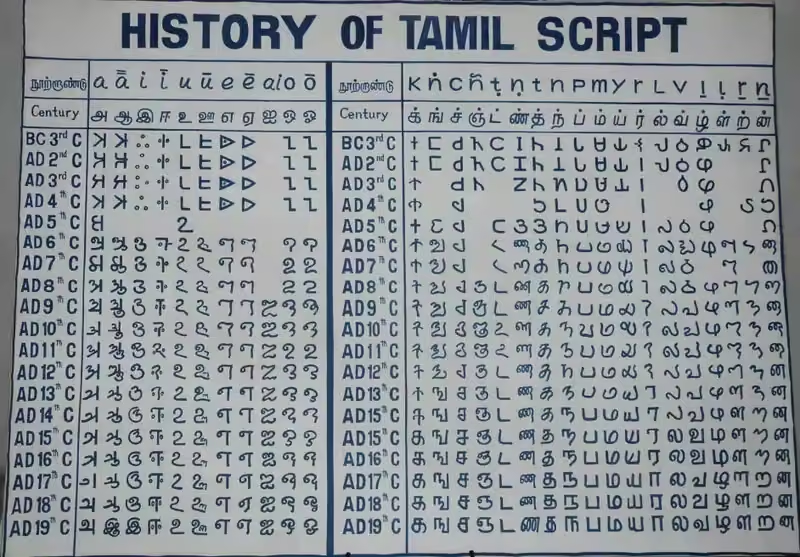
Tamil Script: The Ancient Writing System of South India
Tamil script is one of the oldest continuously used writing systems in the world, serving as the vehicle for expressing the Tamil language for over two millennia. As an abugida (alphasyllabary) writing system, Tamil script represents each consonant-vowel combination as a unit, distinguishing it from pure alphabets. The script has evolved through various stages from Tamil-Brahmi inscriptions of the 3rd century BCE to its modern standardized form used today by over 75 million people worldwide. Its remarkable longevity, distinct character forms, and rich epigraphic tradition make Tamil script a crucial element in understanding South Indian history, culture, and linguistic evolution. The script's development parallels the rise and fall of great dynasties, particularly the Pallavas and Cholas, who left behind thousands of inscriptions that serve as invaluable historical records.
Origins and Classification
Linguistic Family
Tamil script belongs to the Brahmic family of scripts, which are ultimately derived from the ancient Brahmi script that emerged in India around the 3rd century BCE. However, Tamil script occupies a unique position within this family. While most Indian scripts derive from Northern Brahmi variants, Tamil script evolved from Southern Brahmi, specifically the Tamil-Brahmi variant that developed distinctive characteristics suited to representing the phonology of the Tamil language, a Dravidian language with significantly different sound patterns from Indo-Aryan languages.
What makes Tamil script particularly distinctive within the Brahmic family is its minimalist approach. Unlike most other Indian scripts that retained or expanded the number of consonants to accommodate Sanskrit sounds, Tamil script streamlined itself to represent only the sounds actually present in spoken Tamil. This resulted in a script with fewer letters than its relatives, lacking the aspirated consonants (like kh, gh, ch, jh) found in most other Indian scripts.
Origins
The origins of Tamil script trace back to the adaptation of Brahmi script to write the Tamil language around the 3rd century BCE. The earliest evidence comes from Tamil-Brahmi inscriptions found in natural caves and on pottery sherds across Tamil Nadu and parts of Kerala and Sri Lanka. These early inscriptions show a script already adapted to Tamil phonology, with modifications to the standard Brahmi alphabet.
The most famous early Tamil-Brahmi inscriptions include those found at Mangulam, Pugalur, and Azhagankulam, dating to approximately 250-200 BCE. These cave inscriptions typically record donations by individuals to Buddhist and Jain monks, providing insights into both the script's early form and the religious landscape of ancient Tamil Nadu.
The script evolved from this early Tamil-Brahmi through several intermediate stages. Between the 4th and 10th centuries CE, another script called Vatteluttu (meaning "rounded script") was used alongside Tamil-Brahmi, particularly in southern Tamil Nadu and Kerala. Vatteluttu featured more rounded letter forms compared to the angular Tamil-Brahmi. Eventually, elements from both traditions merged and evolved into what we recognize as the modern Tamil script by around the 10th-11th centuries CE.
Name Etymology
The word "Tamil" itself is of uncertain etymology, though it appears in early inscriptions and literature. The script is simply called "Tamil script" or "Tamil letters" (தமிழ் எழுத்து - Tamizh Ezhuthu) in Tamil. In historical contexts, scholars sometimes refer to different phases by specific names: Tamil-Brahmi for the earliest phase (3rd century BCE to 4th century CE), Vatteluttu for the rounded script variant (4th-10th centuries CE), and modern Tamil script for the standardized form that emerged around the 10th century CE.
The Pallavas, who ruled from the 3rd to 9th centuries CE, played a crucial role in developing what is sometimes called the "Chola-Pallava script," an intermediate form that bridges Tamil-Brahmi and modern Tamil script. This naming acknowledges the contributions of both the Pallava and later Chola dynasties in standardizing and promoting the script.
Historical Development
Tamil-Brahmi Period (3rd Century BCE - 4th Century CE)
The earliest phase of Tamil writing is marked by Tamil-Brahmi inscriptions, representing the adaptation of Brahmi script to the Tamil language. This period is characterized by cave inscriptions, primarily recording donations to religious institutions. The Tamil-Brahmi script already showed significant modifications from standard Brahmi to accommodate Tamil phonology.
Key features of Tamil-Brahmi included the presence of special characters for Tamil-specific sounds and the absence of characters for sounds not found in Tamil, such as aspirated consonants. The script was written from left to right, following the Brahmi convention. The letter forms were relatively angular and simple, suited to being carved into stone.
Archaeological evidence from this period comes from over 150 sites across Tamil Nadu, with significant concentrations in areas like Madurai district, Tirunelveli district, and parts of the Kongu region. These inscriptions not only demonstrate the early use of the script but also provide valuable historical information about trade, religion (particularly the presence of Jainism and Buddhism), and social organization in ancient Tamil Nadu.
Vatteluttu and Transitional Period (4th - 10th Century CE)
Between the 4th and 10th centuries CE, Tamil epigraphy shows the use of multiple script forms. Alongside the continuing evolution of Tamil-Brahmi, the Vatteluttu script emerged, particularly in southern regions. Vatteluttu means "rounded script" and is characterized by more circular letter forms compared to the angular Tamil-Brahmi.
During this period, the Pallava dynasty (3rd-9th centuries CE) played a crucial role in script development. Pallava inscriptions show a transitional script that incorporated elements from both Tamil-Brahmi and developing regional variants. The Pallavas also promoted the Grantha script for writing Sanskrit, which influenced Tamil script development, particularly in adding special characters for representing Sanskrit loanwords.
This era saw Tamil script used extensively in temple inscriptions, particularly during the later Pallava period and the rise of the Chola dynasty. The script became more standardized, with clearer distinctions between letter forms. The use of vowel markers (puḷḷi and kuṟil-nedil marks) became more systematic.
Classical Tamil Script Period (10th - 18th Century CE)
The Chola dynasty (9th-13th centuries CE) marked the classical period of Tamil script development. Under Chola patronage, Tamil literature flourished, and the script achieved a high degree of standardization. Thousands of Chola-period inscriptions, found in temples across Tamil Nadu and extending to Sri Lanka and Southeast Asia, showcase the script in its classical form.
The script during this period developed its characteristic rounded forms, moving away from the angularity of Tamil-Brahmi. The basic character set was established, consisting of 12 vowels, 18 consonants, and one special character (āytam), along with various combinations forming compound characters. The Chola inscriptions at Thanjavur, including those at the Brihadisvara Temple, represent masterpieces of Tamil epigraphy from this era.
After the Chola period, subsequent dynasties including the Pandyas, Vijayanagara governors, and Nayak rulers continued using and refining Tamil script. Manuscript traditions developed, with palm-leaf manuscripts becoming the primary medium for preserving Tamil literature. The script's forms became more elaborate in manuscripts compared to inscriptional forms.
Modern Period (18th Century CE - Present)
The modern period brought significant changes to Tamil script with the arrival of printing technology. The first Tamil book was printed in 1578 by Portuguese Jesuit missionary Henrique Henriques in Quilon (modern Kollam, Kerala). This work, "Thambiran Vanakkam" (Prayers to God), marked the beginning of Tamil printing. Early printed books used movable type that attempted to replicate manuscript forms.
The 19th and 20th centuries saw efforts to standardize and simplify Tamil script for printing and education. Reform movements sought to reduce the number of compound characters, though traditional forms remained in use. The development of typewriters and later computers prompted further standardization.
In 1991, Tamil script was encoded in Unicode, ensuring its representation in digital technology. The Unicode Tamil block includes basic characters and common combinations, though some traditional compound characters require special encoding. Today, Tamil script is used extensively in print, digital media, and education across Tamil Nadu, Sri Lanka, Singapore, and Tamil diaspora communities worldwide.
Scripts and Writing Systems
Tamil-Brahmi Script
Tamil-Brahmi represents the earliest writing system used for Tamil, dating from approximately the 3rd century BCE to the 4th century CE. This script was an adaptation of the Brahmi script specifically modified for writing Tamil. Tamil-Brahmi inscriptions are found extensively throughout Tamil Nadu, with notable concentrations in natural caves and rock shelters.
The key features of Tamil-Brahmi include modifications to standard Brahmi characters to represent Tamil phonology. The script lacked aspirated consonants (kh, gh, ch, jh, etc.) since these sounds do not exist in Tamil. It introduced specific characters for Tamil retroflex sounds and maintained the inherent vowel 'a' following consonants, characteristic of Brahmic scripts.
Tamil-Brahmi inscriptions are typically brief, recording donations or dedications. The longest and most significant inscriptions include those at Mangulam, which contain several lines of text. These inscriptions provide crucial evidence for early Tamil society, religion (particularly Jainism and Buddhism), trade networks, and linguistic evolution. The script gradually evolved over centuries, with later Tamil-Brahmi showing increasing standardization and the development of cursive elements.
Vatteluttu Script
Vatteluttu, meaning "rounded script," emerged around the 4th century CE and was used alongside Tamil-Brahmi, particularly in southern Tamil Nadu and Kerala. As its name suggests, Vatteluttu is characterized by rounded letter forms, contrasting with the more angular Tamil-Brahmi.
The origins of Vatteluttu are debated among scholars. Some suggest it developed independently as a cursive form of writing, while others see it as an evolution of Tamil-Brahmi. Vatteluttu was used extensively in the Pandyan kingdom and later in early medieval Kerala, where it eventually evolved into the Malayalam script.
Vatteluttu inscriptions are found on temple walls, copper plates, and stone monuments. The script was particularly popular for recording grants and donations. Notable examples include inscriptions from the Pandyan period (6th-9th centuries CE) and early Chola period. By the 10th-11th centuries, Vatteluttu gradually merged with evolving Tamil script forms, though it continued in Kerala, contributing to Malayalam script development.
Grantha Script Influence
While not strictly Tamil script, the Grantha script significantly influenced Tamil writing, particularly for representing Sanskrit words and sounds not native to Tamil. Grantha was developed in the Pallava kingdom around the 5th-6th centuries CE specifically for writing Sanskrit in South India.
Tamil literature and inscriptions frequently include Sanskrit words, particularly in religious, philosophical, and technical contexts. To accommodate Sanskrit sounds absent in Tamil (such as voiced aspirated consonants and sibilants), Tamil script incorporated Grantha characters. This resulted in a hybrid writing system where Tamil characters are used for Tamil words and Grantha characters for Sanskrit words or sounds.
This practice continues in modern Tamil script, where several additional characters beyond the basic Tamil alphabet are used for Sanskrit loanwords. These include characters for sounds like ja, śa, ṣa, sa, and ha in their Sanskrit forms. Traditional Tamil texts often switch between pure Tamil script and Tamil-Grantha combinations depending on the content.
Modern Tamil Script
Modern Tamil script, standardized by the 10th-11th centuries and refined through subsequent centuries, represents the culmination of Tamil writing system evolution. The script consists of 12 vowels (including the short and long forms), 18 consonants, and one special character (āytam), forming a relatively compact alphabet compared to other Indian scripts.
The fundamental principle of Tamil script is the abugida or alphasyllabary system, where each consonant carries an inherent vowel 'a'. Different vowel sounds are indicated by adding diacritical marks to the consonant. When a consonant appears without any vowel (a "pure consonant"), a dot called puḷḷi is placed above it.
Modern Tamil script features distinctively rounded letter forms. Unlike many other Indian scripts, Tamil script has minimal conjunct consonants (combined forms of consecutive consonants). Instead, consecutive consonants are typically written separately with the puḷḷi mark on the first consonant to indicate the absence of a vowel between them.
The script is written from left to right, like all Brahmic scripts. It has no distinction between upper and lower case letters. Punctuation marks in modern Tamil include a period-like mark for sentence endings and various marks borrowed from Western systems in contemporary usage.
Script Reform Movements
The 19th and 20th centuries witnessed several reform movements aimed at simplifying Tamil script. Reformers argued that the large number of compound characters (formed by combining consonants and vowels) made learning Tamil writing difficult. Various proposals suggested reducing these combinations and adopting a more phonetic, alphabet-like system.
In 1978, the Tamil Nadu government implemented a reform that reduced the number of compound characters taught in schools from several hundred to about 247, later further reduced to 216. This reform was controversial, with traditionalists arguing it disconnected modern learners from classical Tamil literature written in traditional script.
The debate between traditional and reformed script continues, particularly in the digital age. Unicode encoding has made it possible to represent both traditional and simplified forms, though keyboard layouts and input methods vary. Educational institutions generally teach the reformed script, while traditional forms remain in classical texts and religious literature.
Geographic Distribution
Historical Spread
Tamil script's geographic distribution reflects the historical spread of Tamil culture, language, and political power. The earliest Tamil-Brahmi inscriptions concentrate in Tamil Nadu, particularly in regions that correspond to ancient kingdoms like the Pandyas (southern Tamil Nadu), Cholas (Thanjavur region), and Cheras (western Tamil Nadu and parts of Kerala).
By the early centuries CE, Tamil script spread to Sri Lanka with Tamil-speaking communities and Buddhist/Jain establishments. Early Tamil inscriptions in Sri Lanka date to around the 2nd-3rd centuries BCE, showing Tamil-Brahmi script similar to that found in Tamil Nadu. Sri Lanka developed its own Tamil script traditions while maintaining connections with mainland developments.
The medieval period, particularly under Chola dynasty expansion (9th-13th centuries CE), saw Tamil script extend to Southeast Asia. Chola inscriptions in Tamil script are found in locations as far as Thailand, Cambodia, and Sumatra, marking centers of Tamil merchant communities and Chola political influence. These inscriptions document donations to temples, trade agreements, and political proclamations.
Within India, Tamil script influenced neighboring regions. In Kerala, which shared close cultural ties with Tamil Nadu, Tamil script (along with Vatteluttu) was used before the development of the distinct Malayalam script. Even after Malayalam script emerged, it retained significant similarities to Tamil script in structure and many letter forms.
Centers of Learning
Tamil script flourished in centers of learning that also served as hubs of Tamil literature and culture. Ancient Tamil Nadu had several important centers where Tamil learning was patronized and script development occurred.
Madurai, the capital of the Pandyan dynasty, was legendary for its Tamil Sangam (academy), though the historical Sangam period is debated among scholars. Regardless of the Sangam's exact historicity, Madurai remained a major center of Tamil learning throughout history. Temples in Madurai, particularly the Meenakshi Temple, house thousands of inscriptions in Tamil script.
Thanjavur, under the Cholas, became another major center. The Chola kings were great patrons of Tamil literature and arts. The Thanjavur royal library contained thousands of palm-leaf manuscripts in Tamil script. The Brihadisvara Temple complex at Thanjavur features extensive Tamil inscriptions documenting grants, administrative details, and temple management.
Temple complexes throughout Tamil Nadu served as centers of learning where Tamil script was taught and used. Major temples like those at Chidambaram, Srirangam, and Rameswaram maintained manuscript libraries and supported scholars. Monasteries (maṭhas) affiliated with both Hindu and Jain traditions also served as centers for Tamil learning.
In Sri Lanka, Jaffna emerged as a major center of Tamil learning. The Jaffna kingdom (13th-17th centuries CE) patronized Tamil literature and maintained strong cultural connections with Tamil Nadu. Monasteries and temples in Jaffna preserved Tamil manuscripts and promoted Tamil education.
Modern Distribution
Today, Tamil script is used primarily in India (Tamil Nadu and Puducherry), Sri Lanka, Singapore, and by Tamil diaspora communities worldwide. In India, Tamil is an official language of Tamil Nadu and Puducherry, with Tamil script used in all official documents, education, media, and daily communication.
Tamil Nadu has a population of over 70 million, almost all of whom are literate in Tamil script. The state government strongly promotes Tamil language and script, with policies ensuring Tamil-medium education and Tamil signage. Puducherry, formerly a French colony, maintains Tamil as an official language alongside French and English.
Sri Lanka has a significant Tamil-speaking population (about 4-5 million), concentrated in the Northern and Eastern provinces. Tamil is an official language of Sri Lanka, and Tamil script is used in education, administration, and media in Tamil-majority areas. Sri Lankan Tamil has developed some orthographic conventions distinct from Indian Tamil, though the script remains mutually intelligible.
Singapore recognizes Tamil as one of its four official languages, though Tamil speakers constitute only about 5% of the population. Tamil script is used in Singaporean Tamil schools, media, and official documentation. The Singapore Tamil community maintains strong cultural connections with Tamil Nadu.
Substantial Tamil-speaking populations exist in Malaysia, Mauritius, South Africa, United Kingdom, Canada, and the United States, among other countries. These diaspora communities maintain Tamil script through community schools, religious institutions, cultural organizations, and increasingly through digital media and online platforms.
Literary Heritage
Classical Literature
Tamil possesses one of the world's oldest literary traditions, with classical works dating back over two millennia. The earliest Tamil literature, collectively known as Sangam literature, dates approximately from 300 BCE to 300 CE. These works were composed orally and later written down in Tamil script. Sangam literature includes eight anthologies (Eṭṭuttokai) and ten longer poems (Pattuppāṭṭu), covering themes from love and war to ethics and philosophy.
The Tolkappiyam, attributed to the grammarian Tolkappiyar, is the earliest surviving Tamil grammatical work, possibly dating to the 3rd century BCE. This text not only codifies Tamil grammar but also provides insights into the social and cultural context of ancient Tamil society. Written in a sophisticated verse form, Tolkappiyam demonstrates the antiquity and complexity of Tamil literary tradition.
The Tirukkural, composed by Thiruvalluvar around the 3rd-4th centuries CE, is perhaps the most celebrated Tamil literary work. This masterpiece consists of 1,330 couplets covering virtue (aram), wealth (porul), and love (inbam). The Tirukkural has been translated into numerous languages and continues to be widely read and quoted. Its manuscripts in Tamil script represent important artifacts of Tamil paleography.
The five great epics of Tamil literature—Silappatikaram, Manimekalai, Civaka Cintamani, Valayapathi, and Kundalakesi—were composed between the 2nd and 10th centuries CE. Of these, Silappatikaram (The Tale of an Anklet) by Ilango Adigal and Manimekalai by Seethalai Saathanar are the most complete surviving epics. These works showcase the mature form of classical Tamil literature and were preserved through manuscript traditions in Tamil script.
Religious Texts
Tamil script has been used extensively for religious literature across multiple traditions. The most significant corpus is the Shaiva Siddhanta texts, particularly the Tevaram hymns composed by the Nayanars (Shaiva saints) between the 6th and 9th centuries CE. The Tevaram consists of hymns by Sambandar, Appar, and Sundarar, totaling over 4,000 verses. These devotional hymns were crucial in the Tamil Bhakti movement.
The Tiruvacagam, composed by the saint Manikkavacakar (9th century CE), represents another pinnacle of Tamil devotional literature. Written in highly poetic Tamil, these hymns express intense devotional fervor and philosophical depth. Palm-leaf manuscripts of Tiruvacagam in classical Tamil script are preserved in temple libraries and museums.
The Vaishnava tradition produced the Divya Prabandham, a collection of 4,000 hymns composed by the Alvars (Vaishnava saints) between the 6th and 9th centuries CE. These Tamil hymns are considered equivalent to the Sanskrit Vedas by Tamil Vaishnavas and are recited daily in many South Indian Vishnu temples. The script used in Divya Prabandham manuscripts shows the classical Tamil script with Grantha characters for Sanskrit quotations.
The Jain tradition also produced significant Tamil literature. The Civaka Cintamani (10th century CE) by Tirutakkatevar is considered one of the five great Tamil epics and a masterpiece of Jain Tamil literature. Various other Jain religious texts, ethical works, and narrative literature were composed in Tamil and preserved in Tamil script.
Christian missionary activity from the 16th century onward produced religious literature in Tamil. The first printed Tamil book, "Thambiran Vanakkam" (1578) by Henrique Henriques, was a Christian devotional work. Subsequent centuries saw Tamil translations of the Bible and various Christian theological and devotional works, all using Tamil script.
Poetry and Drama
Tamil poetry has ancient roots, with sophisticated metrical systems and aesthetic theories. Classical Tamil poetry is divided into akam (interior/love) and puram (exterior/heroic) themes. The Sangam anthologies contain thousands of poems by hundreds of poets, showcasing the diversity and sophistication of early Tamil poetic tradition.
Medieval Tamil poetry flourished under royal and religious patronage. The Kamban Ramayanam, composed by Kamban (12th century CE), is a Tamil rendering of the Sanskrit Ramayana that is considered superior to the original by many Tamil scholars. This work demonstrates the heights of Tamil poetic composition and was preserved through elaborate manuscript traditions.
Tamil dramatic literature includes various forms. The kūttu tradition, a form of dance-drama, has ancient roots. While early dramatic texts may not have survived, references to drama appear in classical literature. Medieval period saw the development of various theatrical forms, with scripts and performance texts preserved in Tamil script.
The colonial and modern periods witnessed new poetic forms influenced by Western literature while maintaining Tamil literary traditions. Poets like Subramania Bharati (1882-1921) revolutionized Tamil poetry, writing nationalist, reformist, and philosophical poems in Tamil script. Modern Tamil poetry continues to evolve while maintaining connections to classical traditions.
Scientific and Philosophical Works
Tamil has a rich tradition of scientific and technical literature. Medical texts in the Siddha system, one of India's traditional medical systems, were written in Tamil. The Siddha medical corpus includes texts on anatomy, physiology, pharmacology, and therapeutics, with many ancient manuscripts preserved in Tamil script.
Astronomical and mathematical texts were also composed in Tamil, though this literature is less extensive than Sanskrit scientific works. Some texts show integration of Tamil and Sanskrit scientific traditions, using Tamil script with Grantha characters for technical Sanskrit terminology.
Philosophical literature includes both religious philosophy (particularly Shaiva Siddhanta) and secular ethics. The Tirukkural itself is a philosophical work of ethics. Medieval commentaries on classical literature, religious philosophy, and logic were written in Tamil, creating a rich philosophical tradition in Tamil script.
The tradition of writing commentaries (urai or vyakhyanam) on classical texts created an extensive corpus of scholarly literature. These commentaries, dating from medieval to modern periods, explain difficult passages, provide historical context, and interpret philosophical meanings. Manuscript traditions preserved multiple commentaries on major works, all in Tamil script.
Grammar and Phonology
Key Features
Tamil script's structure reflects Tamil language phonology and grammar. As an abugida, each consonant character carries an inherent vowel 'a'. Different vowels are indicated through diacritical marks attached to consonants. This system efficiently represents Tamil's syllabic structure.
A distinctive feature of Tamil script is the puḷḷi (dot), placed above a consonant to indicate the absence of any vowel, creating a "pure consonant." This is necessary when consonants appear consecutively or at the end of syllables. The puḷḷi system distinguishes Tamil script from some other Indian scripts that use conjunct consonants for such combinations.
Tamil script has relatively few basic characters compared to other Indian scripts. The core alphabet consists of 12 vowel characters (including five pairs of short and long vowels, plus two diphthongs) and 18 consonant characters. This minimalism reflects Tamil phonology, which lacks many sounds found in Sanskrit and other Indo-Aryan languages.
The script lacks separate characters for aspirated consonants (kh, gh, ch, etc.), voiced stops distinct from voiceless stops, and several sibilants found in Sanskrit. This reflects Tamil's phonological system, which does not phonemically distinguish these categories. When writing Sanskrit loanwords, Tamil script either uses Grantha letters or approximates Sanskrit sounds with Tamil characters.
Tamil grammar distinguishes between five types of sounds: vowels (uyir), consonants (mey), consonant-vowel combinations (uyirmey), the special character āytam, and pure consonants (marked with puḷḷi). This classification is fundamental to Tamil phonology and is reflected in how Tamil script is organized and taught.
Sound System
Tamil phonology is characterized by several distinctive features that are reflected in Tamil script. The language distinguishes between short and long vowels, with five pairs: a/ā, i/ī, u/ū, e/ē, o/ō, plus two diphthongs ai and au. The script represents each of these with distinct characters.
Tamil consonants include stops at five places of articulation: velar (k), palatal (c), retroflex (ṭ), dental (t), and labial (p). Each of these can appear in three forms: hard (unvoiced), soft (voiced), and nasal. However, voicing is not phonemically contrastive in Tamil; the same character represents both voiced and unvoiced allophones, which are determined by position in the word.
A characteristic feature of Tamil is the three types of 'r' sounds: the alveolar approximant ர் (r), the retroflex approximant ழ் (ṛ), and the alveolar trill ற் (ṟ). Each has a distinct character in Tamil script. The sound represented by ழ் is particularly distinctive to Tamil and does not occur in Sanskrit or most other Indian languages.
Tamil phonology includes rules of sandhi (sound changes at morpheme boundaries) and euphonic combinations. While these phonological processes are governed by strict grammatical rules described in texts like Tolkappiyam, Tamil script generally represents the surface phonological form rather than underlying morphology. However, some traditional writings preserve etymological spellings that reflect underlying forms.
The āytam (ஃ), a special character in Tamil script, represents a rare sound (a glottal fricative) that appears mainly in word-final position in certain contexts. Its usage has become extremely limited in modern Tamil, appearing primarily in certain fixed expressions and classical texts.
Influence and Legacy
Languages Influenced
Tamil script has directly influenced several other writing systems in South Asia. The most direct descendant is Malayalam script, used for the Malayalam language of Kerala. Malayalam script evolved from medieval Tamil script (specifically from Tamil-Vatteluttu combinations) around the 10th-11th centuries CE. The two scripts share many letter forms and structural principles, though Malayalam script has additional characters for sounds present in Malayalam but not in Tamil.
The Sinhala script of Sri Lanka shows some influence from early Tamil writing systems, though its primary ancestry is from other Brahmic scripts. Historical contact between Tamil and Sinhala communities led to some script influence, particularly in representing retroflex consonants.
The Grantha script, while primarily used for Sanskrit in South India, was influenced by Tamil script development. Grantha and Tamil scripts coexisted and influenced each other during the Pallava period. Grantha eventually became specialized for Sanskrit while Tamil script remained for Tamil, but the interaction between the two enriched both.
Southeast Asian scripts, particularly in regions with historical Tamil merchant and cultural presence, show some Tamil script influence. However, these influences are generally subtle, mixed with influences from other Indian scripts and local innovations. Tamil inscriptions in Southeast Asia demonstrate the presence of Tamil script in the region, even if direct script influence was limited.
Loanwords
Tamil has both contributed loanwords to and received loanwords from other languages, with these exchanges reflected in script usage. Sanskrit has been the major source of loanwords in Tamil, particularly for religious, philosophical, and technical terminology. When writing Sanskrit words in Tamil script, hybrid Tamil-Grantha script is often used, employing Grantha letters for Sanskrit sounds not present in Tamil.
Tamil has contributed words to various languages through cultural and commercial contact. Some Tamil loanwords entered Sanskrit (particularly words for tropical items, naval terms, and South Indian cultural concepts). Many Indian languages, particularly South Indian languages like Telugu, Kannada, and Malayalam, contain Tamil loanwords.
European languages acquired Tamil words through colonial contact. Words like "catamaran" (from Tamil கட்டுமரம் kaṭṭumaram), "curry" (from Tamil கறி kari), "cheroot" (from Tamil சுருட்டு curuṭṭu), and others entered English and other European languages. When these words first appeared in European texts, they were transliterated from Tamil script using various systems.
Tamil merchants and settlers carried Tamil words to Southeast Asian languages. Maritime trade vocabularies in Malay and other Southeast Asian languages include some Tamil-origin terms. Historical Tamil inscriptions in Southeast Asia show Tamil script used for Tamil words in multilingual contexts.
In the modern period, Tamil has borrowed extensively from English, particularly for technical, administrative, and modern cultural vocabulary. These English loanwords are typically written in Tamil script using approximate phonetic representations, as Tamil script lacks characters for some English sounds (like f, z, and sh). Debates continue about whether to naturalize English words fully or to maintain closer phonetic representations.
Cultural Impact
Tamil script's cultural impact extends far beyond its linguistic function. The script is intimately connected to Tamil identity and serves as a powerful cultural symbol. The antiquity and continuity of Tamil script are sources of pride in Tamil culture, representing an unbroken literary and cultural tradition spanning over two millennia.
In Tamil Nadu, Tamil script is prominently displayed in public spaces, temple architecture, government buildings, and commercial establishments. Laws mandate Tamil script in signage and official documentation. This visible presence of Tamil script in the landscape reinforces its role as a cultural marker.
Tamil script has been central to linguistic nationalism and Dravidian movements in Tamil Nadu. From the 19th century onward, Tamil language and script became symbols of distinct Tamil/Dravidian identity, particularly in resistance to Hindi imposition and Sanskrit influence. The script itself became politically significant, with debates about script reform, linguistic purity, and cultural preservation often entering political discourse.
Educational policies regarding Tamil script have been contentious. Debates about whether to teach traditional or reformed script, whether to include Grantha letters, and how to balance Tamil with English education reflect broader cultural tensions. Tamil Nadu's education system continues to prioritize Tamil literacy alongside English.
Tamil script has adapted to modern technology while maintaining tradition. Tamil computing, digital typography, and Unicode representation have made Tamil script accessible in digital media. Tamil-language websites, social media, and digital publishing flourish. However, technological challenges remain, particularly in representing the full range of traditional compound characters and in developing natural-language processing tools for Tamil.
Royal and Religious Patronage
Pallava Dynasty
The Pallava dynasty (3rd-9th centuries CE) played a crucial role in Tamil script development. Based in Kanchipuram, the Pallavas were major patrons of both Tamil and Sanskrit literature. During their rule, the transitional script that bridges Tamil-Brahmi and modern Tamil script emerged, sometimes called the Pallava-Grantha script for inscriptions combining Tamil and Sanskrit.
Pallava inscriptions demonstrate sophisticated use of script for administrative, religious, and commemorative purposes. The famous Shore Temple at Mamallapuram contains inscriptions in the developing Tamil script. Pallava copper-plate charters record land grants and administrative orders in both Tamil and Sanskrit, using appropriate scripts or hybrid Tamil-Grantha script.
The Pallavas' patronage of education established centers of learning where Tamil script was taught and refined. Their capital Kanchipuram was renowned for scholarship in both Tamil and Sanskrit. The dynasty's bilingual cultural policy led to developments in how Tamil script could accommodate Sanskrit terminology while maintaining Tamil linguistic identity.
Chola Dynasty
The Chola dynasty (9th-13th centuries CE), particularly during its imperial phase, represents the zenith of Tamil script development and use. Chola rulers were prolific patrons of Tamil literature and used Tamil script extensively in administration and temple records. The thousands of Chola inscriptions found across South India and beyond constitute one of the richest epigraphic records in the world.
Chola inscriptions, particularly those at Thanjavur's Brihadisvara Temple (built by Raja Raja Chola I), demonstrate Tamil script at its classical best. These inscriptions document elaborate temple administration, land grants, taxation, and social organization. The precise, beautiful script carved on temple walls represents high artistry in Tamil epigraphy.
Under Chola patronage, Tamil literature flourished. The royal court supported poets and scholars. Major works like Kamban's Ramayanam were composed during or shortly after the Chola period. The Cholas maintained libraries and scriptoriums where palm-leaf manuscripts in Tamil script were copied and preserved.
The Chola empire's extent brought Tamil script to Sri Lanka and Southeast Asia. Chola inscriptions in Tamil script are found in locations from the Maldives to Sumatra, documenting Tamil cultural and political influence. These inscriptions often record donations to temples and show Tamil script used in cosmopolitan, multilingual contexts.
Religious Institutions
Hindu temples across Tamil Nadu have been crucial in preserving Tamil script and literature. Major temples maintained manuscript libraries (pothu nool nilaiyam) containing religious texts, classical literature, and administrative records in Tamil script. Temples employed scribes who copied manuscripts, maintaining textual traditions across generations.
The Tamil Shaiva Siddhanta tradition used Tamil extensively in philosophical and devotional literature. The maths (monasteries) associated with Shaiva Siddhanta, such as the Tiruvavaduthurai Adheenam, maintained scriptoriums and promoted Tamil learning. Annual festivals featuring recitation of Tamil religious texts helped preserve oral traditions alongside written texts in Tamil script.
Jain monasteries in Tamil Nadu also patronized Tamil literature and script. Jain ascetics and scholars composed Tamil texts, and Jain institutions preserved manuscripts. The Tamil Jain literary tradition, while smaller than the Hindu tradition, made significant contributions to Tamil literature, with manuscripts in classical Tamil script.
Buddhist institutions in ancient Tamil Nadu used Tamil script alongside Pali. While Buddhism declined in Tamil Nadu by the medieval period, early Buddhist establishments contributed to Tamil-Brahmi epigraphy. Buddhist texts in Tamil, though largely lost, are referenced in classical literature, indicating Buddhist participation in Tamil literary culture.
Christian missionaries from the 16th century onward used Tamil script for religious purposes. The Portuguese Jesuits, particularly Henrique Henriques, learned Tamil and used Tamil script for Christian texts. Later, Protestant missionaries established printing presses and produced Tamil Bibles and religious literature. Their work contributed to standardizing Tamil script for print.
Modern Status
Current Speakers
Tamil is spoken by approximately 75-80 million people worldwide, making it one of the most widely spoken languages globally. All Tamil speakers literate in their language use Tamil script. In India, Tamil is the official language of Tamil Nadu (population approximately 72 million) and Puducherry (population approximately 1.4 million). The literacy rate in Tamil Nadu exceeds 80%, meaning the vast majority of the state's population is literate in Tamil script.
Sri Lanka has the second-largest population of Tamil speakers, approximately 4-5 million, concentrated in the Northern and Eastern provinces. Sri Lankan Tamils use the same Tamil script as Indian Tamils, with some minor orthographic conventions differing between the two communities. Tamil-medium education in Sri Lanka ensures continued Tamil script literacy, though the civil conflict (1983-2009) disrupted education in Tamil-majority areas.
Singapore recognizes Tamil as one of its four official languages, with approximately 350,000 Tamil speakers (about 5% of Singapore's population). Tamil script is taught in Tamil-language schools and used in official contexts. The Singapore Tamil community maintains strong cultural connections with Tamil Nadu through media, education, and cultural exchanges.
Malaysia has a significant Tamil-speaking population (approximately 1.8 million) descended from plantation workers and merchants. Tamil script is used in Tamil schools, temples, and media. The Malaysian Tamil community faces challenges in maintaining Tamil literacy due to educational policies favoring Malay and English, but community organizations promote Tamil education.
Other countries with significant Tamil-speaking populations include Mauritius, South Africa, United Kingdom, Canada, United States, Australia, France, and Germany. Diaspora Tamil communities maintain Tamil script literacy through community schools, cultural organizations, and increasingly through digital media. However, second and third-generation diaspora Tamils often have limited Tamil script literacy despite speaking Tamil.
Official Recognition
Tamil has official status in several jurisdictions. In India, Tamil is a scheduled language under the Indian Constitution, one of 22 officially recognized languages. It is the official language of Tamil Nadu and Puducherry, used in state administration, legislature, judiciary, and education.
In 2004, the Government of India recognized Tamil as a classical language, acknowledging its antiquity and independent literary tradition. This status recognizes Tamil's ancient origins, its original literary tradition not borrowed from another language, and the existence of classical works at least 1500-2000 years old. This recognition was the first such designation for any Indian language and led to special governmental support for Tamil scholarship.
Sri Lanka's constitution recognizes Tamil as an official language alongside Sinhala. Tamil script is used in official documents, education, and public signage in Tamil-majority areas. The 13th Amendment to the Sri Lankan Constitution (1987) granted official status to Tamil, though implementation has been inconsistent due to political tensions.
Singapore recognizes Tamil as one of four official languages. Tamil script appears on currency, official documents, and public signage alongside English, Chinese, and Malay. However, the practical dominance of English and Mandarin means Tamil has lower functional status despite official recognition.
Malaysia does not recognize Tamil officially at the national level, though Tamil-medium schools receive some government support. Tamil script has limited presence in Malaysian official contexts. The Tamil language and script's status in Malaysia remains a concern for the Tamil community.
Internationally, Tamil is recognized in UNESCO's collection of classical and ancient languages. Tamil literature is included in various UNESCO heritage designations. International academic institutions offer Tamil studies programs, ensuring continued scholarly study of Tamil language and script.
Preservation Efforts
Tamil script and language preservation efforts operate at multiple levels. The Government of Tamil Nadu runs various programs promoting Tamil language and script. The Tamil Development Department (Tamil Valarchi Thurai) coordinates Tamil language policy, script standardization, and cultural programs. The department supports Tamil literature, funds translations, and promotes Tamil in education.
The Central Institute of Classical Tamil (CICT) in Chennai, established in 2005 following Tamil's classical language designation, works on preserving Tamil literary heritage. CICT digitizes ancient manuscripts in Tamil script, catalogs Tamil inscriptions, produces scholarly editions of classical texts, and promotes Tamil studies. The institute maintains a major digital library of Tamil texts in various script forms.
Tamil Nadu's Government Museum, the Saraswathi Mahal Library in Thanjavur, and various temple libraries preserve thousands of palm-leaf and paper manuscripts in Tamil script. Ongoing projects digitize these manuscripts, making them accessible to researchers and the public. These digitization efforts ensure preservation while allowing wider access to historical texts.
Universities in Tamil Nadu and internationally offer Tamil language and literature programs. Academic research on Tamil linguistics, literature, epigraphy, and paleography continues. Scholars work on critical editions of classical texts, studying inscriptions, and documenting language change. This academic work ensures continued understanding of Tamil script in its historical and contemporary forms.
Technology development for Tamil includes Unicode standardization, font development, keyboard layouts, and natural language processing tools. Organizations like the Tamil Virtual Academy promote Tamil language and script online. Tamil Wikipedia, which contains over 150,000 articles, uses Tamil script extensively and serves as a resource for Tamil-language information.
Cultural organizations in Tamil Nadu and globally promote Tamil script literacy. Tamil sangams (cultural associations) in diaspora communities run weekend schools teaching Tamil language and script to children. These volunteer-run organizations are crucial for maintaining Tamil literacy among diaspora youth.
However, challenges remain. The dominance of English in education and professional life, even in Tamil Nadu, threatens intergenerational Tamil literacy transmission. Among diaspora communities, Tamil script literacy typically declines after the first generation. Digital media, while offering new platforms for Tamil, also competes with English-language content.
Learning and Study
Academic Study
Tamil language and literature form established fields of academic study in India and internationally. Major universities in Tamil Nadu—University of Madras, Annamalai University, Tamil University (Thanjavur), Madurai Kamaraj University, and others—offer undergraduate, graduate, and doctoral programs in Tamil. These programs include training in reading classical Tamil script, paleography, epigraphy, and manuscript studies.
Internationally, Tamil studies programs exist at universities in the United States (University of Chicago, University of California Berkeley, University of Wisconsin-Madison), United Kingdom (Oxford University, Cambridge University, School of Oriental and African Studies London), Germany (University of Cologne, University of Hamburg), and other countries. These programs train scholars in Tamil language, literature, and script, contributing to international Tamil scholarship.
Academic research on Tamil script includes paleographic studies examining script evolution, epigraphic research documenting and analyzing inscriptions, linguistic studies on Tamil historical phonology and orthography, and manuscript studies cataloging and editing texts. This research produces critical editions, scholarly translations, and analytical studies enhancing understanding of Tamil script and literature.
Tamil epigraphy is a specialized field studying thousands of inscriptions in Tamil script across South India and beyond. Organizations like the Epigraphy Branch of the Archaeological Survey of India document inscriptions, while academic departments train epigraphers. Tamil inscriptions provide crucial historical data on political history, social organization, religious institutions, and economic systems across centuries.
Digital humanities approaches increasingly apply to Tamil studies. Projects digitize manuscripts and inscriptions, create searchable databases, develop corpus linguistics tools, and use computational methods to analyze Tamil texts. These digital resources make Tamil script texts more accessible to researchers and learners worldwide.
Resources
Learning resources for Tamil script have proliferated, especially with digital technology. Traditional resources include textbooks, grammar books, and primers teaching Tamil alphabet and script. Classical works like Tolkappiyam remain foundational for understanding Tamil grammar and linguistics.
Modern learning resources include multimedia tools. Tamil typing tutors, online courses, mobile apps, and YouTube channels teach Tamil script. These resources cater to various learner types, from heritage learners seeking to improve literacy to complete beginners learning Tamil as a foreign language.
Digital fonts for Tamil script have improved significantly. Unicode-compliant Tamil fonts enable proper display of Tamil script across platforms. Font development projects ensure Tamil script renders correctly in print and digital media, supporting Tamil content creation.
Input methods for typing Tamil script include transliteration-based keyboards (where Latin characters map to Tamil), phonetic keyboards, and Tamil keyboard layouts. Software like Google Input Tools, mobile keyboards, and operating system support for Tamil enable Tamil script typing on various devices.
Online dictionaries and translation tools assist Tamil learners. The Tamil Lexicon, a comprehensive dictionary project, is available online. Translation tools, while imperfect, provide basic assistance. Tamil corpora and linguistic databases help learners and researchers access Tamil language data.
Libraries and archives holding Tamil manuscripts increasingly provide digital access. The French Institute of Pondicherry, Saraswathi Mahal Library, University of Madras Library, and others have digitized portions of their Tamil manuscript collections. These digital libraries preserve fragile manuscripts while making them accessible globally.
For heritage learners in diaspora communities, community schools and cultural organizations remain primary resources. Weekend Tamil schools teach children of Tamil expatriates Tamil language and script. These volunteer-run institutions face challenges in maintaining engagement and developing curricula but remain vital for diaspora Tamil literacy.
Conclusion
Tamil script stands as one of humanity's oldest continuously used writing systems, embodying over two millennia of linguistic, literary, and cultural evolution. From its origins in Tamil-Brahmi inscriptions of the 3rd century BCE through its classical development under the Pallavas and Cholas to its modern digital forms, Tamil script has adapted while maintaining recognizable continuity. This remarkable longevity testifies to the vitality of Tamil culture and the script's effectiveness in representing the Tamil language.
The script's evolution—from angular Tamil-Brahmi to rounded Vatteluttu to modern Tamil script—reflects broader historical changes while preserving essential characteristics. Tamil script's relative simplicity, with its limited basic alphabet and systematic structure, has facilitated literacy across centuries. Yet this simplicity masks sophistication; the script efficiently represents Tamil's phonology while accommodating Sanskrit loanwords through hybrid Tamil-Grantha usage.
Tamil script has been the vehicle for a literary tradition of exceptional richness, from Sangam poetry and classical epics to religious devotional literature and modern writing. Thousands of inscriptions in Tamil script constitute invaluable historical records documenting South Indian political, social, religious, and economic history. Manuscript traditions preserved Tamil literature across generations, with temple and monastery libraries serving as repositories of knowledge.
In the modern era, Tamil script faces both opportunities and challenges. Official recognition, government support, and technological development support Tamil script's continued use and evolution. Digital technology has made Tamil script accessible in new ways, enabling global communication and information sharing. Yet the dominance of English, globalization pressures, and diaspora language shift threaten intergenerational transmission of Tamil script literacy.
Tamil script's future depends on continued institutional support, educational policies promoting Tamil literacy, technological development enabling Tamil digital presence, and most fundamentally, the Tamil community's commitment to their linguistic heritage. As Tamil adapts to contemporary global contexts while maintaining connections to its ancient roots, Tamil script remains a powerful symbol of cultural continuity, literary achievement, and linguistic identity. Its two-thousand-year journey continues, linking Tamil speakers worldwide to their historical roots while serving as a living script for contemporary communication.


