Overview
Bishnupur, in present-day Bankura district of West Bengal, developed as the capital of the Malla kings of Mallabhum. For almost a thousand years, the town stood at the centre of a regional kingdom whose political influence later weakened as Mughal power declined under its last rulers. The Malla court nevertheless left behind an enduring cultural landscape: terracotta temples, Radha-Krishna shrines, music, painting, weaving and metalwork.
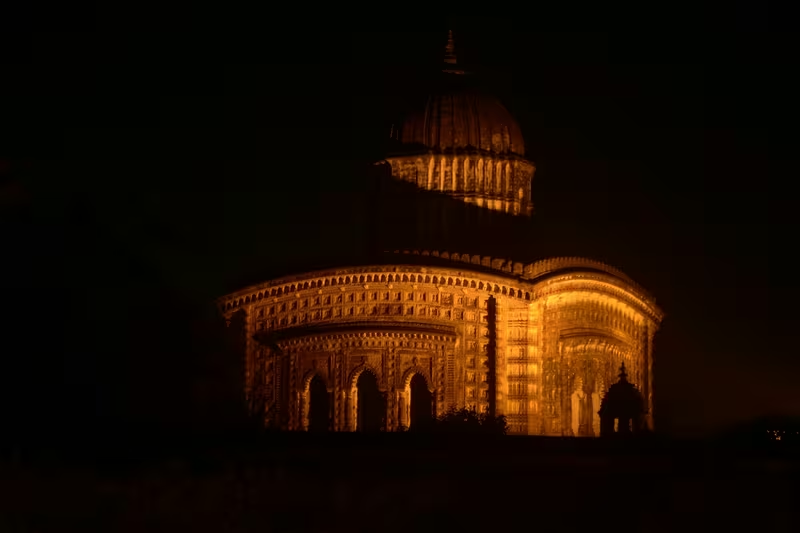
The town is especially known for temples built during the seventeenth and eighteenth centuries. Constructed from local laterite and brick, many were covered with terracotta tiles bearing scenes from the Mahabharata. This combination of regional materials and narrative decoration gave Bishnupur a distinctive architectural identity. In 1997, the Temples of Bishnupur were placed on UNESCO’s Tentative List.
Bishnupur’s importance extends beyond architecture. Royal patronage under rulers including Veer Hambir, Raja Raghunath Singha Dev and Bir Singha Dev supported a flourishing cultural environment. The town became associated with the Bishnupur Gharana of Hindustani classical music, the Bishnupur school of painting and the production of Baluchari sarees.
Etymology and Names
Bishnupur is also spelled Vishnupur. The historical region associated with the town is known as Mallabhum, a name connected with the Malla rulers. The Malla kings were Vaishnavites, and their religious affiliation shaped the temple architecture and devotional culture for which Bishnupur became renowned.
The name Bishnupur reflects the importance of Vishnu and Vaishnava worship in the town. The surviving temple tradition, particularly the many Radha-Krishna shrines, shows how religious patronage influenced the public and artistic character of the Malla capital.
Geography and Location
Bishnupur lies at approximately 23°05′ north latitude and 87°19′ east longitude, at an average elevation of 59 metres. It is situated in a fertile, low-lying alluvial landscape. The wider area is predominantly rural: 90.06 percent of the population is recorded as living in rural areas, while 8.94 percent lives in urban areas.
This setting placed Bishnupur within the broader cultural and administrative core of Mallabhum. Its location supported the growth of a settled courtly centre, while the availability of local laterite and brick directly influenced its architecture. Rather than relying on stone monuments, the Malla builders developed a local tradition in which brick structures were enriched with terracotta surfaces.
Ancient History
The early history of Bishnupur is not fully continuous in the surviving account. During the Gupta period, local Hindu kings are described as ruling the area while paying tribute to Samudra Gupta. After this period, the territory passed through a long phase in which it alternated between being a minor independent principality and a vassal state.
The region later became identified with the Malla rulers and their kingdom of Mallabhum. Bishnupur’s political importance grew from its position as the Malla capital. A tradition connected with the Rajbari Durga Puja places the beginning of the royal worship of Mrinmoyee Maa in 994 CE, though the surviving account does not provide a complete political history for every century between the Gupta period and the mature Malla kingdom.
Historical Timeline
Gupta-period Background
During the Gupta period, local Hindu rulers governed the area and paid tribute to Samudra Gupta. Bishnupur’s later history, however, is more closely associated with the rise and consolidation of the Malla kingdom.
Malla Capital
For almost a thousand years, Bishnupur served as the capital of the Malla kings of Mallabhum. The town’s political and cultural identity was shaped by this long association. The Malla rulers were Vaishnavites, and their devotion encouraged the construction of temples dedicated to Radha and Krishna.
The reign of Veer Hambir and those of his successors Raja Raghunath Singha Dev and Bir Singha Dev are particularly associated with royal patronage. Most of the terracotta temples for which Bishnupur is known were built during this period of Malla cultural prominence.
Later Political Change
The power of the Malla rulers waned during the period when the Mughal Empire weakened under its last monarchs. This political change reduced the authority of the dynasty, but the cultural traditions established under royal patronage continued. Temple architecture, music, painting, textiles and craft production allowed Bishnupur’s legacy to survive beyond the decline of its court.
Modern Heritage Recognition
The Temples of Bishnupur were placed on UNESCO’s Tentative List in 1997. In the modern period, festivals and fairs have helped present the town’s heritage through public performances, craft markets and demonstrations of regional traditions.
Political Significance
Bishnupur was primarily important as the seat of the Malla kings. Its role as a capital lasted far longer than the period represented by its most famous surviving temples. The town was the political centre of Mallabhum, a region that included areas of present-day Bankura.
Royal patronage connected administration with culture. Temple building served religious purposes, but it also displayed the resources and identity of the ruling house. The concentration of temples, shrines and court-supported artistic practices shows how Bishnupur functioned as more than a residential capital: it was a ceremonial and cultural centre of Malla power.
In the present administrative system, Bishnupur is the headquarters of Bishnupur community development block. Its police-station jurisdiction covers the municipality and the block, an area of 365.73 square kilometres with a recorded population of 138,786.
Religious and Cultural Importance
Vaishnavism is central to Bishnupur’s historical identity. The Malla rulers’ devotion to Vishnu and the worship of Radha and Krishna shaped the town’s religious landscape. The Mrinmoyee temple of the kings is regarded as a valuable historic place, and the Rajbari Durga Puja is traditionally dated to 994 CE. It is described as the oldest Durga Puja in the wider Bengal region, including present-day Bangladesh, Odisha and Tripura.
Bishnupur’s cultural importance also rests on its music. The Bishnupur Gharana is described as having been established in 1370 and flourishing under Malla patronage. It reached its peak in the sixteenth and seventeenth centuries, while another account associates its emergence with the late eighteenth century. Its musical foundation is the Dhrupad style. Pakhwaj, sitar and esraj are among its principal instruments, and Bengali Ragpradhan is one of its classical forms. Local music academies continue to preserve the tradition.
The town also developed a Bishnupur school of painting. Together with temple decoration, music and weaving, this artistic tradition reflects the wide cultural reach of the Malla court.
Economic Role
Bishnupur’s economy is closely tied to craft production. Terracotta is the most recognisable local material. Artisans make pottery, artefacts, jewellery, wall hangings and small decorative objects. Handmade jars and disks are traditional products, while terracotta horses, elephants, Ganesha figures and Nataraj images are particularly well known.
The potters’ subjects often draw on the history of kings, soldiers and warfare. The small terracotta Dal Madal Kaman, named after a cannon, is another example of how local craft connects material culture with the region’s historical memory. The Bankura or Panchmura horse, used both for religious purposes and as a decorative object, is known for its symmetrical form and rounded curves.
Bishnupur is also famous for Baluchari sarees. Woven on Jacquard punch-card looms, these richly dyed silk sarees carry intricate designs on the pallu and border. Their motifs commonly represent episodes from the Ramayana and Mahabharata, as well as folk tales. Contemporary makers have adapted some designs to suit modern tastes while retaining the mythological character of the textile.
Other crafts include brass and bell-metal work, Dashavatar Tash playing cards and lanterns made from recycled materials. Dashavatar Tash cards are traditionally round, hand-painted and backed with layers of glued fabric. They depict the ten avatars of Vishnu and are made by members of the Foujdar family of Bishnupur. A distinctive alloy formerly known as bharan was also used locally, but that material is no longer in use.
Monuments and Architecture
Bishnupur’s temples were made primarily from local laterite and brick and finished with terracotta tiles. Their surfaces depict scenes from the Mahabharata, turning the buildings into visual narratives as well as places of worship. Temples are found in Bishnupur and in other villages across Bankura district.
The town’s historic Radha-Krishna temples date broadly from 1600 to 1800 CE. Their architecture represents the height of Malla patronage and the close relationship between Vaishnava devotion and royal building activity. The Rasmancha, associated with the town’s temple complex, has also become a setting for public cultural events, including the Bishnupur Utsab.
The Mrinmoyee temple preserves the memory of royal worship and remains an important part of Bishnupur’s historic identity. Together, the temples, terracotta panels and associated religious traditions form the heritage landscape that led to the town’s inclusion on UNESCO’s Tentative List.
Famous Personalities
Several figures associated with Bishnupur represent its literary, archaeological and artistic traditions. Charan Kobi Baidyanath was a poet and social activist from the Bankura district, and the annual Charan Kabi Baidyanath Mela commemorates this connection.
Maniklal Sinha, who lived from 1916 to 1994, was an archaeologist and writer. He founded the Acharya Jogesh Chandra Pura Kirti Bhavan museum and the Bishnupur branch of the Bangiya Sahitya Parishad.
Artist Amitava Pal has worked to revive the old style of Baluchari saree and has received recognition from the Reliance Foundation. His work represents the continuing effort to preserve and renew Bishnupur’s textile heritage.
Decline and Revival
The decline of Malla political power did not erase Bishnupur’s cultural traditions. The temples survived as records of the dynasty’s religious and artistic patronage, while music, weaving, painting and handicrafts continued in local communities.
Modern revival has taken several forms. The Bishnupur Mela has been held annually since 1988, bringing together handicrafts and performances from the region. It takes place from 23 to 27 December and has hosted classical musicians, singers and dancers. In 2018, part of the fair was temporarily moved to the temple complex so that the terracotta temples could form a backdrop to the main stage; it later returned to its earlier location.
The Bishnupur Utsab, a festival of classical music and dance held in recognition of the Bishnupur Gharana, was restarted in 2018 at the Rasmancha after having stopped after 2012. A fashion show held in 2018 also promoted Baluchari sarees on an international platform.
Modern City
Bishnupur is a municipality and an educational and healthcare centre for its surrounding region. In the 2001 census, the municipality recorded a population of 61,943. Its literacy rate was 69 percent, with male literacy at 77 percent and female literacy at 61 percent.
The town has schools, Ramananda College under Bankura University and Ramsharan College of Music. It also includes teacher-training institutions, industrial training facilities, engineering and polytechnic colleges. Healthcare facilities include a 250-bed district hospital, a superspeciality hospital with an intensive-care department at Rasikganja, private hospitals and nursing homes.
Festivals remain an important part of civic and cultural life. Alongside the December fair, the town observes a snake festival in August, Ultorath, Durga Puja and Kali Puja. The combination of living worship, historic architecture, music and craft production makes Bishnupur a heritage town whose traditions remain part of everyday life.
Timeline
Gupta-period rule
Local Hindu kings are described as paying tribute to Samudra Gupta.
Mrinmoyee tradition
The Rajbari Durga Puja is traditionally dated to this year.
Bishnupur Gharana
The school of music is described as having been established in Bishnupur.
Temple-building era
The period of major Radha-Krishna temple construction begins.
End of the principal temple period
The broad period associated with Bishnupur’s historic temple building comes to a close.
Bishnupur Mela
The annual handicraft and cultural fair begins.
UNESCO Tentative List
The Temples of Bishnupur are placed on UNESCO’s Tentative List.
Cultural revival
The Bishnupur Utsab resumes and a Baluchari fashion show promotes the textile tradition.