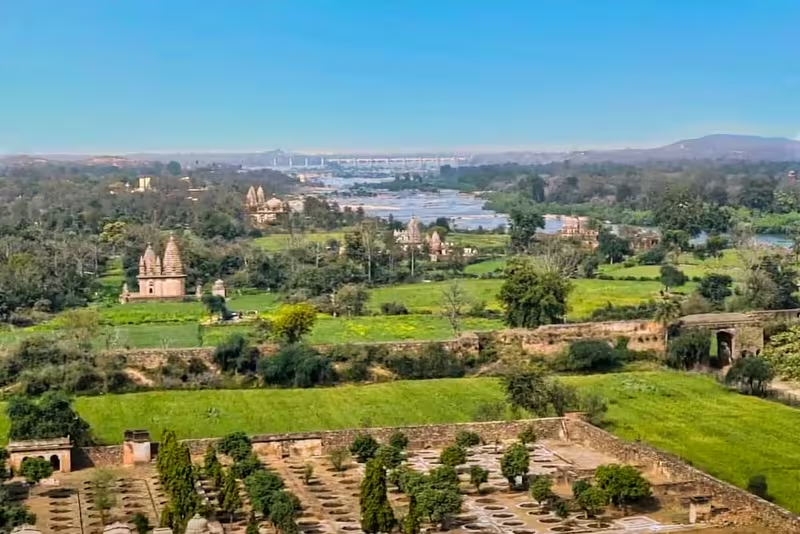
Overview
Orchha is a historic town located in the Niwari district of Madhya Pradesh, positioned along the banks of the Betwa River in the heart of the Bundelkhand region. Established by the Bundela Rajput ruler Rudra Pratap Singh sometime after 1501, Orchha served as the capital of a significant princely state that encompassed parts of central and northern India. The town represents one of the finest examples of medieval Rajput town planning and architecture, with its magnificent palaces, temples, and cenotaphs remarkably well-preserved.
Located strategically 18 km from Jhansi in Uttar Pradesh, 89 km from Tikamgarh, and 126 km from Gwalior, Orchha occupied an important position in the political and cultural landscape of Bundelkhand. At an elevation of 552 meters, the town's setting along the rocky banks of the Betwa River provided both natural defenses and scenic beauty. The Bundela rulers transformed this riverside location into a spectacular architectural ensemble that continues to attract visitors and scholars interested in medieval Indian history and culture.
Though the political capital moved to Tikamgarh in 1783, Orchha retained its religious and cultural significance, particularly as a major center of Ram worship. Today, with a population of approximately 10,500, Orchha stands as a living museum of Bundela heritage and an important heritage tourism destination, carefully preserved and managed by the Archaeological Survey of India and Madhya Pradesh Tourism.
Etymology and Names
The name "Orchha" derives from the Hindi word meaning "hidden place," which aptly describes the town's somewhat secluded location along the Betwa River valley. Alternative spellings found in historical records include "Urchha," reflecting variations in transliteration from Devanagari script. The name has remained consistent throughout the town's history, unlike many Indian cities that underwent name changes under different rulers.
The Bundela Rajputs who founded and ruled Orchha maintained the original name throughout their reign, and it continued unchanged during the period of British paramountcy over the princely state. This consistency in nomenclature reflects the continuous cultural identity maintained by the Bundela dynasty and the town's population over more than four centuries.
Geography and Location
Orchha occupies a strategic position in the Bundelkhand region of Madhya Pradesh, a geographical area characterized by rocky plateau terrain, seasonal rivers, and dense forests. The town sits at an elevation of 552 meters (1,811 feet) on the banks of the Betwa River, one of the major tributaries of the Yamuna. The Betwa's presence was crucial to Orchha's establishment, providing water resources, transportation routes, and natural defenses.
The surrounding Bundelkhand landscape features granite rock formations, scattered forests, and agricultural lands that supported the town's population. The subtropical climate of the region, with hot summers and moderate winters, influenced the architectural designs of Orchha's buildings, which incorporate features for natural cooling and ventilation. The rocky terrain, while challenging for agriculture, provided excellent building materials and created dramatic settings for the town's architectural monuments.
Orchha's location placed it at the crossroads of important medieval trade and military routes connecting central India with the northern plains. Its proximity to other significant centers like Jhansi, Gwalior, and Datia made it an important node in the political network of the Bundelkhand region. The Betwa River served as both a boundary and a connection, linking Orchha to the broader riverine trade networks of medieval India.
Foundation and Early History
The foundation of Orchha occurred sometime after 1501 when Rudra Pratap Singh, a Bundela Rajput chief, selected this site along the Betwa River to establish his capital. The Bundelas claimed descent from the Gaharwar Rajputs and had been consolidating their power in the Bundelkhand region during the late medieval period. The choice of location demonstrated strategic thinking, as the Betwa River provided natural defense while the elevated rocky terrain offered commanding views of the surrounding landscape.
Rudra Pratap Singh's establishment of Orchha marked the formalization of Bundela political power in the region. Prior to this, the Bundela chiefs had been relatively minor players in the complex political landscape of central India, dominated by various Delhi Sultanate successors and regional powers. The founding of a fixed capital signaled the Bundela transformation from mobile warrior chiefs to settled rulers with administrative ambitions.
The early development of Orchha focused on constructing defensive fortifications and royal residences. The town's layout followed traditional Hindu principles of urban planning while adapting to the specific topography of the riverside location. The early rulers began the construction of palaces and temples that would be expanded by successive generations, establishing the architectural traditions that would define Orchha's character.
The Bundela Capital Period
Orchha served as the capital of the Bundela state from its founding until 1783, nearly three centuries during which the town witnessed significant political, cultural, and architectural development. The Bundela rulers skillfully navigated the complex political landscape of medieval India, maintaining their independence while forming strategic alliances with more powerful neighbors, particularly the Mughal Empire.
The 16th and 17th centuries marked the zenith of Orchha's political importance. Rulers like Madhukar Shah (1554-1592), Vir Singh Deo (1605-1627), and Jujhar Singh (1627-1635) expanded Bundela territories and constructed the magnificent palaces and temples that define Orchha's architectural heritage. Madhukar Shah was a great patron of arts and literature, transforming Orchha into a cultural center. His devotion to Lord Krishna led to the development of Orchha as an important religious center.
Vir Singh Deo's reign represented a high point in Orchha's fortunes. A close ally of Mughal Emperor Jahangir, Vir Singh Deo was instrumental in the Mughal conquest of several Rajput states. His military and political success brought wealth to Orchha, enabling massive construction projects including the famous Jahangir Mahal, built to commemorate the emperor's visit to Orchha. This palace exemplifies the cordial Bundela-Mughal relationship and represents a fusion of Rajput and Mughal architectural elements.
The relationship with the Mughal Empire was complex and not always harmonious. Jujhar Singh's rebellion against Shah Jahan led to his defeat and death in 1635, temporarily disrupting Bundela power. However, the dynasty recovered, and Orchha continued as an important center under subsequent rulers. The town's fortifications, palaces, and temples expanded throughout this period, creating the architectural ensemble visible today.
Religious Significance and Ram Worship
Orchha holds unique significance in Hindu religious traditions, particularly regarding the worship of Lord Ram. The town's Ram Raja Temple is the only place in India where Ram is worshipped as a king (Raja) rather than as a deity, with full royal protocols including daily guard of honor by police. This exceptional tradition dates back to the 16th century and a legend involving Queen Ganeshi Bai, wife of Madhukar Shah.
According to tradition, Queen Ganeshi Bai was a devoted follower of Ram while her husband worshipped Krishna. The queen traveled to Ayodhya and through intense devotion persuaded an idol of Ram to accompany her to Orchha. The idol was temporarily installed in the queen's palace (now the Ram Raja Temple) while the Chaturbhuj Temple was being constructed to house it. However, following a stipulation that Ram's idol could not be moved once installed, the deity remained in the palace, which was converted into a temple.
This legend explains why Orchha's Ram Raja Temple occupies a palace building rather than a traditional temple structure, and why the massive Chaturbhuj Temple, originally built to house Ram's idol, now serves a different religious purpose. The Ram Raja Temple attracts thousands of pilgrims, particularly during Ram Navami, and the daily ceremonies conducted with royal honors make Orchha a unique pilgrimage destination.
Beyond the Ram Raja Temple, Orchha features numerous other temples representing various phases of Hindu architectural evolution. The Chaturbhuj Temple, Lakshminarayan Temple, and numerous smaller shrines demonstrate the deep religious devotion of Orchha's rulers and citizens. The Lakshminarayan Temple is particularly notable for its exceptional interior frescoes depicting both religious narratives and secular scenes from Bundela court life.
Architectural Heritage
Orchha's architectural heritage represents one of the finest surviving examples of Bundela Rajput architecture, combining Hindu temple traditions with Mughal palatial influences. The town's monuments can be broadly categorized into palaces (mahals), temples, and cenotaphs (chhatris), each category featuring distinctive architectural characteristics.
The palace complex, situated on an island formed by the Betwa River, comprises three main structures. The Raj Mahal (Royal Palace), built by Rudra Pratap Singh and expanded by later rulers, features apartments arranged around courtyards with remarkable interior murals depicting religious and courtly scenes. The Jahangir Mahal, built by Vir Singh Deo around 1605-1606, represents the finest example of Bundela architecture, with its symmetrical plan, ornate stone screens (jalis), and fusion of Hindu and Islamic architectural elements. The Rai Praveen Mahal, a smaller two-story structure, was built for the court poetess Rai Praveen and demonstrates the refined aesthetic sensibilities of Orchha's rulers.
The Chaturbhuj Temple, constructed during the late 16th century, presents a unique architectural form combining temple and fort characteristics. Its massive structure rises to considerable height, with soaring shikhara (spire) and cross-shaped plan. The temple's interior features vast halls and numerous chambers, designed to accommodate large congregations. The architectural style represents a transition between traditional Hindu temple forms and the fortified religious structures common in the politically turbulent medieval period.
The Lakshminarayan Temple, built by Vir Singh Deo between 1622-1627, features exceptional wall paintings covering its interior surfaces. These frescoes depict scenes from Hindu epics, particularly the Ramayana and Mahabharata, alongside contemporary courtly life, battles, and royal processions. The paintings represent an important source for understanding Bundela court culture and artistic traditions.
Along the Betwa River, a series of cenotaphs (chhatris) commemorate Orchha's rulers. These memorial structures feature characteristic Bundela architectural elements including domed canopies supported by pillared halls. The chhatris create a dramatic skyline along the riverbank and demonstrate the importance of ancestor veneration in Bundela culture.
Political Transition and Later History
In 1783, the Bundela capital shifted from Orchha to Tikamgarh, marking the end of Orchha's role as the primary seat of political power. This transition occurred during a period of political instability in central India, with the decline of Mughal authority and the rise of Maratha power. Despite losing its status as capital, Orchha retained significant religious and cultural importance.
During the 19th century, the Orchha princely state came under British paramountcy as part of the Bundelkhand Agency. The British recognized the Orchha maharajas as legitimate rulers while exercising ultimate political control. This period saw relative stability in the region, though Orchha's political significance continued to decline in favor of Tikamgarh and nearby Jhansi, which became important British administrative centers.
The 1857 rebellion saw limited involvement from Orchha state, which maintained its loyalty to the British. This contrasted with nearby Jhansi, where Rani Lakshmibai led a famous resistance. Orchha's stance during this period reflected the pragmatic political calculations of its rulers and helped preserve the state's autonomy under British paramountcy.
Following Indian independence in 1947, the princely states were integrated into the Indian Union. Orchha state merged with other Bundelkhand states to form part of Madhya Pradesh (later split with Uttar Pradesh). The town's political significance ended definitively, but its architectural and cultural heritage gained recognition as national treasures.
Cultural Life and Arts
Medieval Orchha flourished as a center of culture and arts under Bundela patronage. The rulers supported poets, musicians, painters, and scholars, creating a vibrant courtly culture. The tradition of palace frescoes found in Orchha's monuments demonstrates sophisticated painting traditions, with artists depicting both religious narratives and contemporary life with remarkable detail and artistic skill.
Rai Praveen, the legendary court poetess and courtesan during the reign of Indramani Singh (1672-1676), exemplifies Orchha's cultural sophistication. Her poems in Braj Bhasha and her skill in music and dance were celebrated throughout northern India. The Mughal Emperor Akbar reportedly summoned her to his court, but she diplomatically declined while composing verses praising the emperor. The Rai Praveen Mahal, built in her honor, reflects the respect accorded to artistic excellence in Orchha.
The Bundela courts maintained traditions of classical music, with support for both Hindustani classical traditions and devotional music. Temple rituals incorporated elaborate musical performances, and courtly ceremonies featured professional musicians. The religious festivals, particularly those associated with Ram worship, developed distinctive local traditions combining religious devotion with cultural celebration.
Local craft traditions included stone carving, as evidenced by the elaborate decorations on temples and palaces, metalwork, textile production, and traditional painting. These crafts supported the construction and maintenance of Orchha's monuments while providing livelihoods for specialist artisan communities.
Economic Base
Orchha's economy during its period as capital combined agriculture, trade, taxation, and craft production. The Betwa River valley provided fertile agricultural lands supporting cultivation of grains, pulses, and oilseeds. The town itself served as a market center for the surrounding agricultural region, with regular markets and commercial activities.
As the capital of a princely state, Orchha benefited from tax revenues collected from territories under Bundela control. These revenues supported the royal household, military forces, administrative apparatus, and the extensive construction projects that created Orchha's architectural heritage. The town attracted merchants, craftsmen, and service providers, creating a diverse urban economy.
Craft production, particularly in building trades, flourished due to continuous construction activities. Stone masons, sculptors, fresco painters, and other specialized craftsmen found employment in building and maintaining Orchha's palaces and temples. These specialist communities often organized into hereditary occupational groups, passing skills from generation to generation.
The town's location on regional trade routes facilitated commerce, though Orchha never achieved the importance of major trade centers. Local products, particularly agricultural goods and handicrafts, circulated through regional market networks connecting Bundelkhand with broader economic systems of medieval India.
Modern Orchha
Contemporary Orchha, with a population of approximately 10,500 (as of recent census data), functions primarily as a heritage tourism destination while maintaining its religious significance. The town falls under the jurisdiction of Niwari district, Madhya Pradesh, with administrative infrastructure including local government offices, police services (telephone code 07680), and public amenities.
The Archaeological Survey of India maintains responsibility for major monuments, while Madhya Pradesh Tourism develops tourism infrastructure. The town features hotels, guesthouses, and tourist facilities catering to domestic and international visitors. Despite tourism development, Orchha retains much of its traditional character, with local communities maintaining cultural practices and religious traditions.
Connectivity has improved significantly in recent decades. The town lies 18 km from Jhansi, a major railway junction on the Delhi-Mumbai and Delhi-Chennai routes, making Orchha accessible to visitors from across India. Road connections link Orchha to other Bundelkhand towns including Gwalior (126 km) and Tikamgarh (89 km). The vehicle registration code MP-36 indicates Orchha's administrative integration within Madhya Pradesh.
The Ram Raja Temple continues to function as an active place of worship, conducting daily ceremonies with traditional royal protocols. Major festivals, particularly Ram Navami, attract large numbers of pilgrims. The temple complex and surrounding areas maintain traditional religious practices while accommodating modern pilgrims and tourists.
Conservation challenges include maintaining ancient structures against environmental weathering, managing tourism impacts, and preserving traditional urban fabric while meeting modern infrastructure needs. The official website (ramrajatemple.mp.gov.in) provides information for pilgrims and manages aspects of temple administration.
Heritage Conservation
Orchha's architectural heritage faces ongoing conservation challenges requiring systematic management and resources. The monuments, constructed primarily of local stone with lime plaster and featuring elaborate murals, require specialized conservation techniques. The Archaeological Survey of India conducts regular maintenance and occasional major restoration projects, though financial and technical constraints limit comprehensive conservation.
The Betwa River's seasonal flooding poses particular risks to monuments along the riverbank, including the cenotaphs. Climate change and changing rainfall patterns may exacerbate these risks, requiring enhanced protective measures. The palace complex, situated on an island, faces particular vulnerability to water-related damage.
Interior murals in structures like the Lakshminarayan Temple and Raj Mahal require delicate conservation work. These paintings, executed in traditional techniques using natural pigments, deteriorate from humidity, temperature fluctuations, and biological growth. Specialized art conservation experts periodically work on these paintings, though comprehensive documentation and conservation remain ongoing needs.
Tourism, while providing economic benefits and raising awareness of Orchha's heritage, creates management challenges. Visitor footfall must be balanced against conservation needs, requiring controlled access to sensitive areas and visitor education about proper behavior in heritage sites. The development of tourism infrastructure must be carefully managed to avoid compromising the historic character of the town.
Timeline
- c. 1501: Rudra Pratap Singh establishes Orchha as capital of Bundela state
- 1554-1592: Reign of Madhukar Shah; development of Orchha as cultural center
- Late 16th century: Legend of Queen Ganeshi Bai bringing Ram's idol to Orchha; establishment of unique Ram Raja tradition
- 1605-1627: Reign of Vir Singh Deo; construction of Jahangir Mahal and Lakshminarayan Temple
- 1605-1606: Emperor Jahangir visits Orchha; construction of Jahangir Mahal to commemorate the visit
- 1627-1635: Reign of Jujhar Singh; eventual rebellion against Shah Jahan leading to his defeat
- 1783: Bundela capital shifts from Orchha to Tikamgarh
- 19th century: Orchha state under British paramountcy as part of Bundelkhand Agency
- 1947: Indian independence; princely states integrated into Indian Union
- 1950: Formal merger of princely states into Indian administrative structure
- Late 20th century: Recognition as national heritage site; development of heritage tourism
- 21st century: Continued conservation efforts; growing importance as heritage tourism destination