Overview
In 1321, Ghiyath al-Din Tughluq began building a new fortified city on the southern side of Delhi. The project combined an urban settlement, a citadel, royal residences, and heavy defensive works. Known as Tughluqabad, it was conceived as both a capital and a barrier against Mongol marauders.
The city was formidable in scale. Its irregular plan was enclosed by sloping rubble-filled walls between 10 and 15 metres high, reinforced by circular bastions and topped with battlements. Yet the settlement was abandoned by 1327, only a few years after its construction began. Today, Tughluqabad survives as a vast ruined complex whose walls, underground passages, palace remains, tanks, and connected royal mausoleum reveal the ambition of the first Tughlaq ruler.
The fort also gives its name to the modern Tughluqabad residential-commercial area and the Tughluqabad Institutional Area. Its setting forms part of a larger landscape associated with the Northern Aravalli leopard wildlife corridor and the forested hills of the Delhi Ridge.
Etymology and Names
The place is generally known as Tughluqabad or Tughlaqabad, after the Tughlaq dynasty founded by Ghiyath al-Din Tughluq. The fort is also commonly called Tughluqabad Fort or Tughlaqabad Fort. The name remains attached not only to the ruins but also to nearby modern residential, commercial, and institutional areas.
The surviving historical account does not preserve a separate earlier name for the site. Its identity is closely tied to the city founded by Ghiyath al-Din after he assumed power in 1321.
Geography and Location
Tughluqabad lies in southern Delhi, in a landscape of rocky and hilly ground associated with the Delhi Ridge. The location offered a defensible setting for a fortified settlement. The city’s fortifications followed an irregular plan, broadly described as a half-hexagon, with a base of about 2.4 kilometres and a complete circuit of approximately 6.4 kilometres.
The wider environment contains historical and natural sites. Surajkund, an ancient reservoir dating to the tenth century, lies in the surrounding region, while the remains of Adilabad stand southeast of Tughluqabad. The area is also linked with Asola Bhatti Wildlife Sanctuary, Mangar Bani, seasonal waterfalls near Pali-Dhuaj-Kot, and lakes formed in abandoned open-pit mines.
Ghiyath al-Din also ordered the construction of the Qutub-Badarpur Road. This connected the new city to the Grand Trunk Road and is now known as Mehrauli-Badarpur Road. In the twentieth century, this road pierced part of the causeway leading to the ruler’s mausoleum.
Ancient History
Tughluqabad’s documented history begins in the medieval period with its foundation in 1321. The historical account available for the fort does not establish an earlier settlement on the site. Its importance arose from the decision of Ghiyath al-Din Tughluq to create a new fortified centre after founding the Tughlaq dynasty.
The ruins should therefore be understood primarily as the remains of a fourteenth-century planned city rather than as a monument built up over many known earlier periods.
Historical Timeline
Foundation under Ghiyath al-Din Tughluq
Before becoming ruler, Ghazi Malik served as a feudatory of the Khalji rulers of Delhi. According to the traditional account, he once suggested to his Khalji master that a fort should be built on a hillock in southern Delhi. The king reportedly responded jokingly that Ghazi Malik should build it himself if he ever became king.
In 1321, Ghazi Malik defeated the Khaljis, assumed the title Ghiyath al-Din Tughluq, and established the Tughlaq dynasty. He soon ordered the construction of Tughluqabad. The new city was intended to be beautiful but also difficult to capture, with its heavy fortifications designed to guard against Mongol attacks.
The Conflict with Nizamuddin Auliya
The construction of Tughluqabad is strongly associated with the celebrated Sufi saint Nizamuddin Auliya. While the sultan required labourers for the fort, some were also working at night on a stepwell, or baoli, at the saint’s residence. Ghiyath al-Din attempted to stop this work by banning the sale of kerosene, preventing workers from lighting lamps after dark.
The story says that Nizamuddin Auliya responded with the words, “Ya rahe ujjar, ya base Gujjar”—“Either it remains a ruin or may the nomadic and peasant Gujjars live there.” When the sultan later learned during a campaign in Bengal that workers were still labouring on the baoli, he reportedly vowed to punish the saint after returning to Delhi. Nizamuddin’s reply, “Hunuz Dilli dur ast,” meaning “Delhi is still far off,” became attached to the fort’s later fate.
These accounts belong to the powerful tradition of oral and written legend surrounding Tughluqabad. They explain the city’s early abandonment through a saint’s curse, while the historical record also preserves a political and dynastic explanation for the ruler’s death and the changing priorities of his successor.
The Death of Ghiyath al-Din Tughluq
Ghiyath al-Din successfully completed a military campaign in Bengal and began his return to Delhi. At Kara in present-day Uttar Pradesh, his son Muhammad bin Tughluq met him. According to the account, a shamiana, or temporary pavilion, was constructed to celebrate the victory. It collapsed on the sultan, crushing him to death in 1324.
The story is often connected to Nizamuddin Auliya’s statement that Delhi was still far away. Ghiyath al-Din’s death left the new city without its founder, and Muhammad bin Tughluq succeeded him.
Abandonment
Tughluqabad was abandoned by 1327. The brief interval between its foundation and abandonment has contributed to its image as a city that never fulfilled its original purpose. The ruins preserve the scale of the plan, but large areas are now difficult to access because of dense thorny vegetation, neglect, and modern settlement.
Political and Military Significance
Tughluqabad was designed as a fortified seat of power. Its walls, bastions, gates, citadel, palace areas, and underground passages were integrated into a single urban and defensive plan. The city was divided into three principal sections: a wider residential area arranged along a rectangular grid, a citadel dominated by the tower known as Bijai-Mandal, and an adjacent palace zone containing royal residences.
The fortification’s sloping walls were filled with rubble and strengthened by circular bastions as high as two storeys. Seven rainwater tanks supported the settlement. Of the city’s supposed 52 gates, only 13 remain standing, giving an impression of how much of the original defensive system has disappeared.
Monuments and Architecture
The most striking feature of Tughluqabad is its massive stone construction. The fort walls are built primarily of granite and rise in sloping planes, a characteristic associated with Tughlaq architecture. Battlemented parapets crowned the walls, while towers and bastions strengthened the perimeter.
The citadel included Bijai-Mandal, several halls, and a long underground passage. Another underground passage extended below the tower in the palace area. These surviving elements suggest a complex designed not simply as a perimeter fort but as a complete royal city.
South of the main fort stood a large artificial reservoir within the fortified outpost surrounding Ghiyath al-Din Tughluq’s tomb. A raised causeway, approximately 180 metres long and supported by 27 arches, once crossed the lake between the fort and mausoleum. Though part of it was later cut by the Mehrauli-Badarpur Road, the surviving structure remains an important element of the site.
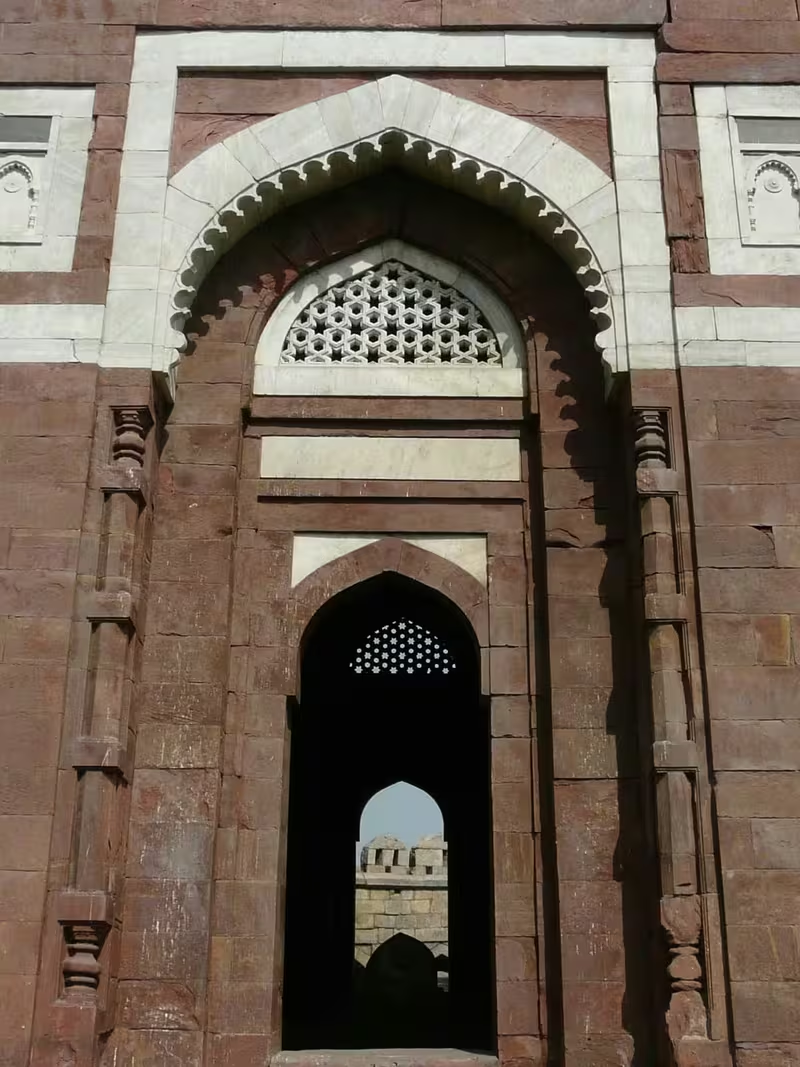
The mausoleum is a square, single-domed tomb measuring about 8 by 8 metres. Its walls slope inward and are crowned by parapets. Unlike the rough granite fortifications, the tomb is faced with smooth red sandstone, marble inlay, inscribed panels, and decorated arch borders. Its dome rests on an octagonal drum covered with white marble and slate.
Three graves lie inside: the central grave is identified as Ghiyath al-Din Tughluq’s, while the other two are believed to belong to his wife and his son Muhammad bin Tughluq. A second octagonal tomb in the enclosure is associated with Zafar Khan. His grave was already present before the outpost was built and was incorporated into the mausoleum complex.
Southeast of Tughluqabad are the remains of Adilabad, built several years later by Muhammad bin Tughluq. Its construction shares the principal characteristics of the older fort.
Famous Personalities
Ghiyath al-Din Tughluq was the founder of the city and the first ruler of the Tughlaq dynasty. His son Muhammad bin Tughluq succeeded him and is associated with the construction of Adilabad. Nizamuddin Auliya, the influential Sufi saint, became central to the legends surrounding the fort’s construction and abandonment.
Decline and Modern Condition
The abandonment of Tughluqabad transformed the planned city into a monumental ruin. Dense thorny vegetation now covers much of the former urban area, and neglect has made large sections inaccessible. An expanding modern settlement occupies parts of the old city, particularly near its lakes.
Even in this altered condition, the surviving walls and structures preserve the scale of Ghiyath al-Din’s original plan. The fort’s ruined state is not simply the result of age: it is also connected to the unusually short period between its foundation in 1321 and abandonment by 1327.
Modern Landscape
Tughluqabad is part of a wider historical and ecological landscape in southern Delhi. Nearby sites include the mausoleum of Ghiyath al-Din Tughluq, Adilabad, Surajkund, and the remnants of reservoirs and mining lakes. The surrounding environment is associated with the Northern Aravalli leopard wildlife corridor, which extends from Sariska Tiger Reserve towards Delhi.
The fort’s modern identity therefore combines medieval architectural remains, urban expansion, forested ridge terrain, and conservation concerns. Its walls continue to mark the ambitions of a ruler who sought to establish a beautiful and impregnable city, even though the city itself survived only briefly as a political centre.
Timeline
Foundation of Tughluqabad
Ghiyath al-Din Tughluq began constructing a new fortified city in southern Delhi.
Conflict with Nizamuddin Auliya
The fort’s construction became associated with a dispute over labourers building a stepwell for the Sufi saint.
Death of Ghiyath al-Din Tughluq
The sultan was reportedly crushed when a celebratory pavilion collapsed during his return from Bengal.
Muhammad bin Tughluq succeeds
Muhammad bin Tughluq became ruler after the death of his father.
Abandonment
Tughluqabad was abandoned shortly after its completion.