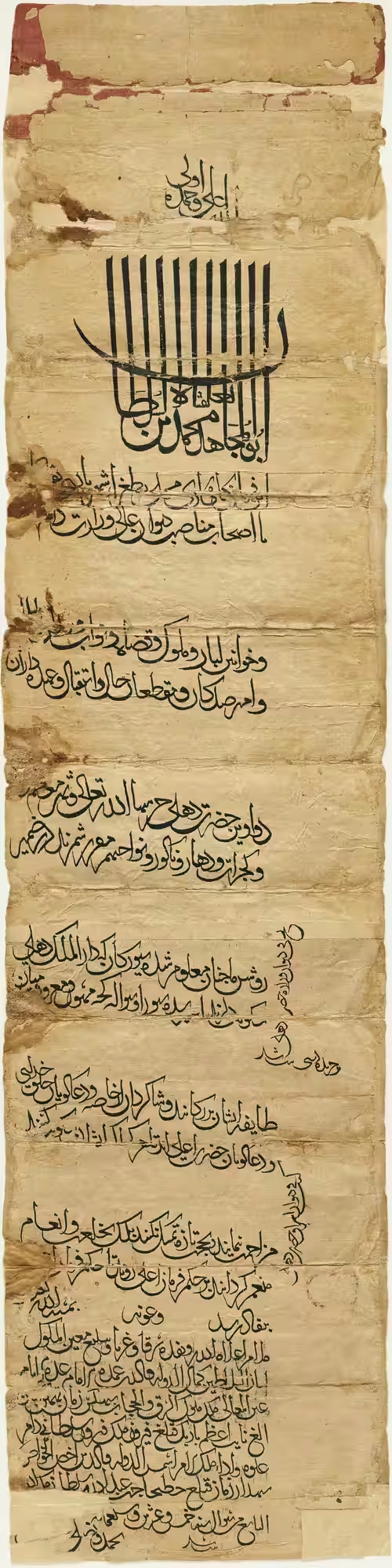
Muhammad bin Tughluq - The Wisest Fool of Delhi
In the grand, tumultuous theatre of Indian history, few characters command as much fascination and debate as Muhammad bin Tughluq. He was a paradox personified: a brilliant scholar who could debate with the most learned men in philosophy, logic, and mathematics, yet a ruler whose policies were so disastrous they earned him the infamous title, “the wisest fool.” His reign over the Delhi Sultanate, from 1325 to 1351, was a dizzying mix of breathtaking ambition and catastrophic failure, a period when the empire reached its greatest territorial extent only to begin its inexorable fragmentation. His story is not just of a king and his kingdom, but a timeless lesson in the chasm that can exist between a magnificent idea and its flawed execution.
Early Life & The Ascent to Power
Born Fakhr Malik Jauna Khan around 1290, he was the eldest son of Ghiyas-ud-din Tughluq, a formidable Turkic general who rose through the ranks to seize the throne of Delhi and establish the Tughlaq dynasty in 1320. Unlike many princes of his era, whose education was confined to the arts of war and statecraft, Jauna Khan was immersed in a world of profound intellectual pursuit. His father ensured he received the finest education possible, and the young prince displayed a voracious appetite for knowledge.
He became a polymath of rare calibre, mastering Persian and Arabic, and delving deep into the Quran, Islamic jurisprudence (fiqh), logic, Greek philosophy, astronomy, and medicine. He was not merely a dilettante; he possessed a sharp, analytical mind and a love for intellectual sparring, often spending hours in the company of scholars, poets, and mystics. This formidable intellect, however, was paired with a restless ambition and an unshakeable belief in his own judgment—a combination that would later define his reign.
As a young man, he proved his mettle on the battlefield under the title Ulugh Khan. He led his father’s armies on grueling campaigns, most notably against the Kakatiya kingdom of Warangal in the Deccan. His first expedition in 1321 was a failure, ending in a chaotic retreat fueled by rumours of the Sultan's death. Undeterred, he returned in 1323 with a larger force, conquering Warangal, subjugating its ruler, and annexing the territory directly into the Sultanate. These campaigns demonstrated his military competence and expanded the empire deep into southern India.
His accession to the throne in 1325 is shrouded in controversy and suspicion. While welcoming his father back from a successful campaign in Bengal, Ulugh Khan had a special wooden pavilion erected for the reception in a village outside Delhi. During the ceremony, the structure collapsed, crushing and killing Ghiyas-ud-din Tughluq. The famed Moroccan traveler Ibn Battuta, who later served in Muhammad's court, explicitly accused him of orchestrating the collapse as a calculated act of parricide. The court historian Ziauddin Barani, however, attributed it to a lightning strike—a divine act. The truth remains buried in the past, but the event cast a dark shadow over the beginning of a reign that would be filled with turmoil.
A Reign of Grand Experiments
Crowned as Sultan Muhammad bin Tughluq, he inherited the largest empire the Delhi Sultanate had ever known. His vision was not merely to maintain it, but to rationalize its administration, centralize its power, and project its might far beyond its borders. This vision gave birth to a series of audacious experiments, each logical in theory but calamitous in practice.
1. Taxation in the Doab (c. 1326)
One of the Sultan's first major initiatives was to overhaul the revenue system. To fund his massive army and ambitious administrative projects, he needed to increase state income. His gaze fell upon the Doab, the immensely fertile agricultural heartland between the Ganga and Yamuna rivers. The logic was simple: tax the wealthiest region more heavily. He significantly increased the land tax (kharaj) and revived a set of other levies (abwabs).
What was a sound fiscal idea on paper became a human tragedy in reality. The tax hike was implemented with rigid severity at the worst possible time—a period of prolonged and severe drought. As crops failed and famine set in, peasants were unable to meet the state's exorbitant demands. Tax collectors showed no mercy, driving farmers to abandon their fields, sell their cattle, and flee into the forests. Widespread rebellion erupted across the Doab. The Sultan's initial response was brutal suppression, but as the agricultural backbone of his empire collapsed, he belatedly tried to reverse the damage. He introduced agricultural loans (sondhar) and encouraged the digging of wells, but it was too little, too late. The project had not only failed to fill the treasury but had devastated the populace and sown deep resentment against his rule.
2. The Transfer of the Capital (1327)
Perhaps the most infamous of his schemes was the decision to relocate the imperial capital from Delhi to Devagiri in the Deccan, which he renamed Daulatabad, the "Abode of Fortune." The strategic rationale was compelling. Daulatabad was more centrally located within his sprawling empire, allowing for better control over the newly conquered southern provinces. It was also safe from the recurring threat of Mongol invasions that perennially plagued Delhi.
However, the Sultan's execution of this plan was breathtakingly cruel. Instead of simply moving his court and administration, he ordered a mass migration of the entire elite population of Delhi—nobles, officials, scholars, and artisans—to the new capital, over 700 miles away. He made elaborate arrangements for the journey, setting up rest stops and providing food, but the sheer scale and compulsory nature of the exodus caused immense suffering. Ibn Battuta paints a grim picture of a forced march where many, especially the old and infirm, perished from exhaustion and hardship. Delhi, a thriving metropolis for centuries, was left a desolate shadow of its former self.
The grand project was a colossal failure. The Sultan soon realized he could not effectively control the northern frontiers from the Deccan, and the transplanted population never truly settled in their new home. Within a few years, he ordered the entire exercise reversed, forcing another torturous journey back to Delhi. The transfer to Daulatabad and back again achieved nothing but immense loss of life, dislocation, and a catastrophic blow to the Sultan's prestige.
3. The Token Currency (c. 1329-1330)
Muhammad bin Tughluq’s most intellectually ambitious experiment was the introduction of a token currency, an idea far ahead of its time. Inspired by the use of paper money in China, and facing a global shortage of silver, he issued brass and copper coins that were to be accepted as legal tender equivalent in value to the standard silver tanka.
In theory, this was a brilliant stroke of fiduciary policy. In practice, it was an unmitigated disaster. The critical flaw was the state's failure to maintain a monopoly on the minting of the new coins. The design was simple and easily replicated. As the historian Barani famously wrote, "every Hindu's house became a mint." The country was flooded with counterfeit coins forged by common artisans. The value of the new currency plummeted. Foreign merchants refused to accept it, and domestic trade ground to a halt. Realizing his error, the Sultan demonstrated a rare moment of accountability: he withdrew the entire token currency and promised to exchange every copper coin—both genuine and counterfeit—for silver and gold from the royal treasury. This act of fiscal integrity restored public faith but nearly bankrupted the state, leaving the treasury empty for years to come.
4. Aborted Foreign Expeditions
The Sultan's ambitions were not limited to internal reforms. He dreamed of foreign conquests. Around 1329, he planned a massive expedition to invade Khurasan (in modern-day Iran and Central Asia), hoping to take advantage of political instability in the Mongol Ilkhanate. He assembled a colossal army of over 370,000 soldiers and, in an act of extraordinary generosity, paid them all a year's salary in advance from the already strained treasury. However, the political situation in Persia stabilized, and the invasion was prudently called off. The huge army was disbanded, creating widespread unemployment and unrest among the very soldiers he had paid.
A second military venture, the Qarachil expedition (c. 1333) into the Himalayan region of Kumaon-Garhwal, ended in even greater disaster. Aimed at securing the northern borders, the army advanced into the treacherous mountain terrain, only to be trapped by the harsh weather and ambushed by local hill tribes. The Sultanate's army was almost completely annihilated; according to Ibn Battuta, only a handful of men survived to bring back news of the catastrophe.
The Disintegration of an Empire
The cumulative effect of these failed experiments, combined with the Sultan's harsh temperament, created a climate of constant rebellion. He was a man of extreme contradictions—personally pious and generous to scholars, yet notoriously impatient and capable of inflicting sadistic punishments for the slightest offense. Ibn Battuta's chronicles are filled with graphic descriptions of the brutal executions that were a daily spectacle at his court.
The second half of his reign was a desperate struggle to hold his fragmenting empire together. One province after another rose in revolt. Bengal broke away permanently. In the south, two powerful new kingdoms emerged from the ashes of Tughlaq authority: the Hindu Vijayanagara Empire in 1336 and the Bahmani Sultanate, a rival Muslim kingdom, in 1347. The empire that had reached its zenith under his rule was now crumbling before his eyes.
In 1351, while campaigning in Sindh to crush a rebellion, Muhammad bin Tughluq fell ill with a fever and died. The historian Bada'uni recorded his final words, a poignant epitaph for his troubled reign: “And so, the Sultan was relieved of his people, and they of him.”
Legacy & Influence: The Judgment of History
History has offered no easy verdict on Muhammad bin Tughluq. Contemporary chroniclers like Barani and Isami painted him as an arrogant, bloodthirsty tyrant whose godless innovations brought ruin upon the land. For them, he was a monster, a "mixture of opposites" whose virtues were eclipsed by his monstrous vices.
Modern historians, however, have offered a more nuanced assessment. They see a brilliant, if flawed, visionary whose ideas were centuries ahead of his time. A centralized capital, a managed currency, and a more efficient tax system were all hallmarks of a modernizing state. His failure lay not in his vision, but in his utter lack of pragmatism, his arrogant refusal to heed advice, and his cruel disregard for the human cost of his ambitions. He understood the 'what' and the 'why', but never the 'how'.
His legacy is thus one of spectacular failure, but a failure that profoundly shaped the course of Indian history. The disastrous transfer to Daulatabad, for all its cruelty, inadvertently fostered a deeper cultural exchange between the north and the Deccan, as scholars, poets, and saints carried the Indo-Persian culture of Delhi into the south. More significantly, the disintegration of his empire paved the way for the rise of powerful and culturally vibrant regional kingdoms that would define the political map of India for the next two centuries.
Muhammad bin Tughluq remains etched in India's collective memory as the archetypal "wise fool." His reign is a cautionary tale of a ruler whose towering intellect was not ballasted by humility or common sense, a tragic genius whose grand designs collapsed under the weight of his own impatience and hubris.