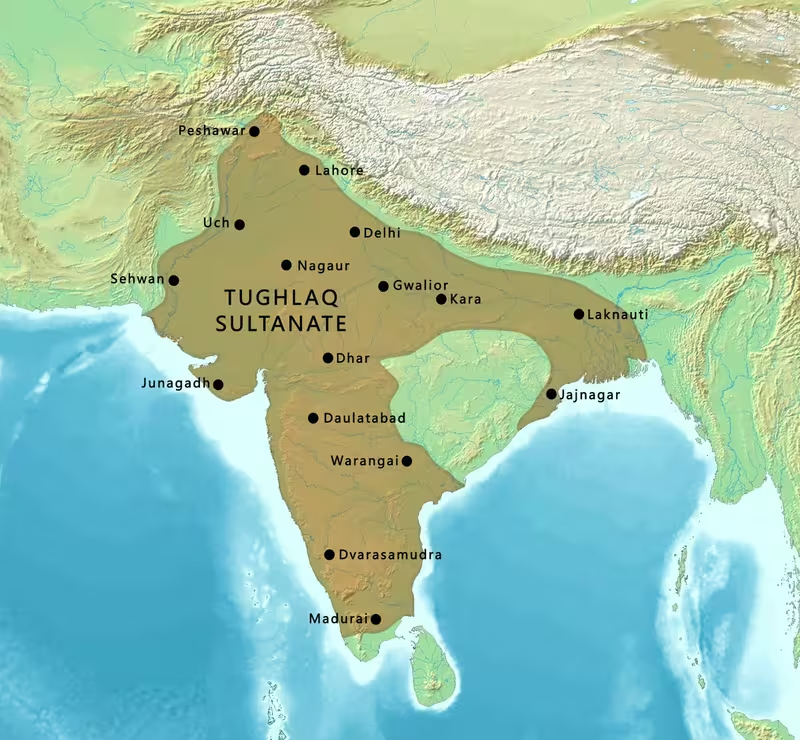
Overview
In 1320, Ghazi Malik seized Delhi from Khusro Khan and took the title Ghiyath al-Din Tughluq. That change of ruler founded the Tughlaq dynasty, the third dynasty of the Delhi Sultanate. It lasted until 1413, although its effective control over the sultanate had contracted sharply long before its formal end.
The Tughlaq period combined extraordinary territorial ambition with severe political and economic strain. Under Muhammad bin Tughluq, the Delhi Sultanate reached its greatest geographical extent. Campaigns carried its armies towards Bengal, Gujarat, Malwa, the Deccan, Telangana, the Tamil region, and Tirhut. For a time, Delhi claimed authority over most of the Indian subcontinent. Yet the same expansion made the empire difficult to administer. Rebellions multiplied, provinces separated from Delhi, tax demands damaged cultivation, and ambitious policies such as the transfer to Daulatabad and the introduction of token currency produced disruptive consequences.
The dynasty’s history is also marked by contrasting styles of rule. Ghiyath al-Din Tughluq established a new regime and fortified city. Muhammad bin Tughluq was intellectually accomplished and ambitious, but his campaigns, fiscal demands, punishments, and administrative experiments generated opposition on a large scale. Firoz Shah Tughluq ruled more gently in some respects and sponsored canals, bridges, schools, mosques, and other buildings, but his reign also saw religious intolerance, provincial difficulties, and the beginnings of a succession crisis.
After Firoz Shah’s death in 1388, rival factions struggled for power. Two civil wars divided the political centre, while provinces and local rulers asserted independence. Timur’s invasion in 1398–99 brought the crisis to its lowest point. Delhi was plundered, its population suffered mass killing, and the authority of the Tughlaq rulers was fatally weakened. Khizr Khan, formerly associated with Multan and Sindh, entered Delhi in 1414 and founded the Sayyid dynasty.
Rise to Power
The crisis of the Khalji dynasty
The Tughlaqs came to power during a period of instability in Delhi. The Khalji dynasty had ruled the Delhi Sultanate before 1320, but the death of Alauddin Khalji in 1316 was followed by palace arrests and assassinations. Khusro Khan eventually became sultan in June 1320 after killing Mubarak Khalji, a son of Alauddin Khalji.
Khusro Khan had previously been a Hindu slave who had been forcibly converted to Islam and had served the Delhi Sultanate as an army general. His seizure of power was accompanied by violence against members of the Khalji family. The account preserved in the historical record describes him as lacking the support of Delhi’s Muslim nobles and aristocrats. These groups therefore invited Ghazi Malik, the Khalji governor in Punjab, to lead an intervention.
Ghazi Malik accepted the invitation and marched towards Delhi. In 1320, he defeated and killed Khusro Khan, then assumed the throne under the name Ghiyath al-Din Tughluq. His accession marked both a change of dynasty and an attempt by the Delhi aristocracy to restore political order after the turbulence of the final Khalji years.
Ghiyath al-Din’s consolidation
After becoming sultan, Ghiyath al-Din rewarded the maliks, amirs, and officials who had helped him defeat Khusro Khan. Those who had served his predecessor were punished. This distribution of rewards and penalties helped establish the new political order, but it also tied the regime to the military and aristocratic groups that had made the change of dynasty possible.
Ghiyath al-Din altered taxation as well. According to his court historian Ziauddin Barani, he reduced the tax rate imposed on Muslims during the Khalji period but increased taxes on Hindus. Barani explained this policy in terms of preventing Hindu subjects from becoming wealthy enough to challenge the state. The policy reveals the unequal religious and fiscal structure of the sultanate, in which non-Muslim communities were subject to distinctive taxes and obligations.
The new sultan also addressed the military vulnerability of Delhi. He founded Tughlakabad, a city approximately six kilometres east of Delhi. Its fortifications were intended to provide a more defensible position against Mongol attacks. The city became one of the clearest architectural expressions of the new dynasty’s concern with defence and royal authority.
The early Deccan campaign
Ghiyath al-Din’s eldest son, Jauna Khan, later known as Muhammad bin Tughluq, was entrusted with military responsibilities. In 1321, Jauna Khan was sent towards Deogir to raid the Hindu kingdoms of Arangal and Tilang, regions associated with present-day Telangana.
The first attempt failed. Ghiyath al-Din then sent substantial reinforcements, instructing his son to undertake the campaign again. The second expedition succeeded. Arangal fell, was renamed Sultanpur, and its wealth, state treasury, and captives were transferred to Delhi. The campaign strengthened the resources of the new dynasty and extended the reach of the Delhi Sultanate into the Deccan and Telangana.
The methods used in this expansion were based on military conquest, plunder, tribute, and the movement of captives. These practices supplied the central treasury but also created resistance among the kingdoms and populations subjected to Delhi’s armies.
Bengal and the death of Ghiyath al-Din
Ghiyath al-Din expanded eastward after Muslim aristocrats in Lakhnauti invited him to intervene in Bengal against Shamsuddin Firoz Shah. He placed Delhi under the control of his son Ulugh Khan and led an army towards Lakhnauti during 1324–25. The campaign succeeded.
On the return journey, however, the sultan died in a collapsed wooden structure known as a kushk. The circumstances of his death became a matter of dispute. Several historians, including Ibn Battuta, al-Safadi, Isami, and Vincent Smith, later stated that Jauna Khan had arranged the collapse and thereby killed his father. According to this account, Jauna Khan and a Sufi preacher had learned that Ghiyath al-Din intended to remove them from Delhi after his return.
The official historical record was not uniform. One court historian offered an alternative account in which a lightning strike caused the collapse. Another historian, al-Badauni, attributed the structural failure to the movement of elephants and mentioned a rumour that the accident had been planned. The available accounts therefore preserve both an accident narrative and an accusation of patricide.
Ghiyath al-Din died in 1325 together with his favourite son, Mahmud Khan. Jauna Khan then succeeded him as Muhammad bin Tughluq.
Golden Age
The greatest territorial extent
The reign of Muhammad bin Tughluq represented the territorial high point of the Tughlaq dynasty. Between approximately 1330 and 1335, military campaigns brought the Delhi Sultanate to its widest extent. The sultan attacked or raided Malwa, Gujarat, the Mahratta region, Telangana, Kampila, Dhur-samundar, the Tamil region, Bengal, Chittagong, Sunarganw, and Tirhut.
This expansion was not a stable annexation of every region. Some territories were raided for wealth, while others were placed under the authority of governors or military officials. The scale of the campaigns nevertheless meant that the sultanate temporarily claimed power over most of the Indian subcontinent.
Military expansion supplied the state with loot, ransom payments, captives, and newly assessed revenues. It also produced an administrative problem that became increasingly severe: the further the armies moved from Delhi, the harder it became for the sultan and his officials to communicate with, provision, and discipline provincial authorities.
The cost of empire
Muhammad bin Tughluq’s distant campaigns were expensive. The sultanate needed large armies, regular payments, officials, and supplies. As the treasury was depleted, the government imposed heavier demands on the countryside.
The most severe tax increases occurred in the fertile lands between the Ganges and Yamuna rivers. The land tax on non-Muslims was raised tenfold in some districts and twentyfold in others. In addition, dhimmis, or non-Muslims living under Muslim rule, were required to surrender half or more of their harvested crop in crop taxes.
The consequences were destructive. Villages abandoned cultivation and fled into the forests. Some displaced people formed robber groups. Famine followed. The state responded with arrests, torture, and mass punishments, further increasing hostility towards the sultanate.
The tax system was not simply a matter of central assessment. Muhammad bin Tughluq frequently compensated soldiers, judges, advisers, wazirs, governors, district officials, and other servants by granting them the right to collect taxes from Hindu villages. These officials retained a portion and sent the remainder to the treasury. Ibn Battuta described the arrangement as a system in which officials could force the collection of revenue and keep part of what they gathered.
Such arrangements gave officials powerful incentives to extract as much as possible. They also made the central government dependent on local intermediaries whose interests did not always match those of the sultan. The combination of taxation, military pressure, and delegated authority contributed to corruption, rebellion, and the weakening of provincial loyalty.
Administration and Governance
The sultan and the nobility
The Tughlaq state was a centralized monarchy, but its authority depended on cooperation from military commanders, Muslim nobles, governors, religious officials, and local revenue collectors. The ruler appointed members of the royal family and Muslim aristocracy as na'ibs over iqta territories. These officials were expected to collect taxes and tribute, retain an agreed share, and transfer the remainder to the sultan’s treasury.
The system extended through layers of subcontracting. A na'ib could grant rights over villages to amirs and army commanders, who then collected produce and property from non-Muslim peasants. In theory, the arrangement provided the state with revenue and the nobles with income. In practice, the system could encourage excessive extraction and make rebellion possible when officials failed to meet their promises to Delhi.
An example from Firoz Shah’s reign illustrates this tension. In 1377, a noble named Shamsaldin Damghani contracted to administer the iqta of Gujarat and promised an enormous annual tribute. He attempted to collect the required amount by deploying Muslim amirs, but failed. He then withheld what he had collected and rebelled. Shamsaldin Damghani was eventually killed, while the soldiers and peasants of Gujarat did not support the war on behalf of the rebel nobility.
Religious policy and coercion
The Tughlaq rulers governed a religiously diverse population. The record describes distinctive taxes imposed on non-Muslims, including land taxes, crop taxes, and jizya. It also records campaigns against Hindu and Jain temples in the Deccan, including the Swayambhu Shiva Temple and the Thousand Pillar Temple.
Muhammad bin Tughluq was severe towards both non-Muslims and Muslims. His punishments included execution, torture, and public displays intended to warn others. His court historian Barani wrote that Muslim blood was shed frequently, while Ibn Battuta described prisoners being brought before the palace for execution, torture, or beating.
The targets of state violence included Muslim groups and officials suspected of opposition. Ibn Battuta recorded the execution or punishment of religious figures, including Sufis. He described the torture and eventual beheading of Sheikh Shinab al-Din after the man refused food sent by the sultan.
The reasons behind Muhammad bin Tughluq’s policies have been interpreted in different ways. Some historians have regarded him as attempting to enforce orthodox Islamic practice and promote jihad. Others have suggested that his conduct reflected mental instability. The evidence allows neither a simple celebration of his intellectual ambition nor a single explanation for all his actions.
Firoz Shah Tughluq altered the style of rule but not the religious hierarchy of the sultanate. In his memoir, he presented himself as a ruler who had banned the extreme forms of torture associated with earlier reigns. He listed punishments such as amputation, blinding, sawing people alive, crushing bones, pouring molten lead into throats, burning people, and driving nails into hands and feet as practices he had prohibited.
At the same time, Firoz Shah did not establish religious equality. He did not tolerate efforts by Shia, Mahdi, or Hindu groups to challenge Sunni authority. He also opposed the rebuilding of temples destroyed by his armies. He claimed that he converted Hindus to Sunni Islam by offering exemptions from taxes and jizya, as well as gifts and honours to new converts. At the same time, he expanded the collection of jizya and ended earlier exemptions for Hindu Brahmins.
Transfer to Daulatabad
One of Muhammad bin Tughluq’s most dramatic policies was the attempted transfer of the capital from Delhi to Deogir, which he renamed Daulatabad. The sultan ordered the Muslim population of Delhi—including members of the royal family, nobles, sayyids, shaykhs, and religious scholars—to move to the new administrative centre.
The policy may be understood as part of a broader attempt to govern the Deccan and use its religious and political elites in the expansion of the empire. Muhammad bin Tughluq wanted the population transferred to support his plans for a wider imperial mission. He also expected Sufis and other religious figures to help adapt Islamic symbolism to the political language of the empire and persuade inhabitants of the Deccan to convert.
The movement was coercive. Nobles who refused were punished, and non-compliance was treated as rebellion. When Mongol pressure appeared in Punjab, the sultan returned the elite to Delhi, although Daulatabad continued to function as an administrative centre.
The consequences were lasting. The aristocracy developed a deep hostility towards Muhammad bin Tughluq. At the same time, the movement created a stable Muslim elite in Daulatabad and contributed to the growth of the Muslim population in the Deccan. Even though the attempted transfer did not permanently replace Delhi, it connected the political history of northern India with the Deccan in a new way.
Token currency
Muhammad bin Tughluq also attempted to address the depletion of the state treasury by introducing brass and copper coins with the nominal value of silver coins. The experiment was intended to increase the available currency after costly military operations had exhausted the supply of precious-metal coins.
The policy failed because the new coins were easy to counterfeit. People could produce them from base metal available in their own homes. Ziauddin Barani wrote that houses became coin mints and that inhabitants of the provinces produced vast quantities of false copper coins to pay tribute, taxes, and jizya.
The government eventually withdrew the currency. The sultan had to buy back genuine and counterfeit coins at great expense. Ibn Battuta’s account describes mountains of coins accumulating within the walls of Tughlaqabad. The experiment damaged the treasury and became one of the best-known examples of the risks created by a currency policy that could not adequately control forgery.
Military Campaigns
Campaigns in the Deccan and south
The Tughlaq military programme relied on repeated expeditions into regions far from Delhi. The early capture of Arangal under Jauna Khan strengthened the dynasty’s position in the Deccan. Muhammad bin Tughluq continued this policy, attacking or plundering territories across central and southern India.
These campaigns brought wealth and captives to Delhi, but they also damaged the political foundations of the empire. Local rulers, military commanders, and communities were required to provide taxes and supplies, while distant governors gained opportunities to establish independent power.
Resistance intensified after 1327. The Muslim soldier Jalaluddin Ahsan Khan, a native of Kaithal in northern India, founded the Madurai Sultanate in the south. The Vijayanagara Empire also emerged in southern India as a direct response to attacks from the Delhi Sultanate and eventually helped free southern India from Delhi’s control.
In 1336, Kapaya Nayak of the Musunuri Nayak defeated the Tughlaq army and reconquered Warangal. These reverses demonstrated that the sultanate’s military superiority was not permanent and that local political formations could recover territory after Delhi’s armies had withdrawn.
Revolts and the shrinking empire
Revolts became routine during Muhammad bin Tughluq’s reign. His own nephew rebelled in Malwa in 1338. The sultan personally attacked him, captured him, and had him flayed alive. By 1339, eastern regions governed by local Muslim officials and southern territories controlled by Hindu rulers had declared independence.
The sultan lacked the resources and support needed to restore authority everywhere. In 1347, the Deccan revolted under Ismail Mukh, an Afghan. Ismail did not wish to continue as ruler and handed power to Zafar Khan, another Afghan who founded the Bahmanid Sultanate. The Deccan thereby became an independent Muslim kingdom and a long-term rival to northern authority.
Muhammad bin Tughluq died in March 1351 while attempting to pursue and punish rebels in Sindh and Gujarat. By the end of his reign, the Delhi Sultanate’s effective geographical control had contracted to areas north of the Narmada River.
Bengal under Firoz Shah
Firoz Shah Tughluq attempted to recover the earlier boundaries of the sultanate. In 1359, he waged war against Bengal for eleven months. The campaign did not bring Bengal back under Delhi’s authority. Bengal remained outside the Delhi Sultanate, demonstrating the limits of Firoz Shah’s military leadership.
His military capability was considered weaker than that of earlier rulers, particularly because of ineffective army leadership. Firoz Shah’s reign therefore concentrated more on internal projects and the management of the remaining kingdom than on large-scale reconquest.
Cultural Contributions
Architecture and urban foundations
The Tughlaq rulers patronised Indo-Islamic architecture on a considerable scale. Ghiyath al-Din founded Tughlakabad, a fortified city designed with defence against Mongol attacks in mind. Its creation expressed the priorities of the new dynasty: military security, central authority, and the establishment of a distinct royal centre.
Firoz Shah Tughlaq sponsored numerous building projects. These included irrigation canals, bridges, madrasas, mosques, and other Islamic structures. He is also associated with the installation of ancient stone pillars, or lats, near mosques. These pillars were older Hindu and Buddhist monuments, and their incorporation into the sultan’s construction programme connected the new Islamic court with the visible remains of earlier political and religious traditions.
The canals built during Firoz Shah’s reign continued in use into the nineteenth century. Their survival indicates the practical importance of the irrigation programme beyond the immediate political needs of the Tughlaq court.
Historical writing and memoirs
The Tughlaq period is unusually well represented in the writings of court historians and travellers. Ziauddin Barani served at the courts of Muhammad bin Tughluq and Firoz Shah. His accounts contain detailed observations on taxation, political conflict, punishments, noble factions, and the conduct of the sultans.
Shams-i Siraj Afif recorded events during Firoz Shah’s reign, including conspiracies and assassination attempts. Other accounts by Sirhindi and Bihamadkhani describe the civil wars that followed Firoz Shah’s death.
Firoz Shah himself left a memoir in which he described his policies, religious outlook, restrictions on torture, building projects, and efforts to encourage conversion to Sunni Islam. His self-presentation differs in emphasis from the descriptions of his court historians, but together these accounts provide insight into how the ruler wished his reign to be remembered.
The Moroccan traveller Ibn Battuta visited India in 1334, during the height of Muhammad bin Tughluq’s territorial power. He presented gifts including arrows, camels, horses, slaves, and other goods. The sultan gave him a large welcome gift, a furnished house, and appointment as a judge, with an annual salary that Ibn Battuta could collect from taxes on two and a half Hindu villages near Delhi.
Ibn Battuta’s memoir is both a travel account and an important description of the Tughlaq court. He recorded the wealth of royal gift-giving, the demands made by officials, the system of taxation, the treatment of prisoners, the severe punishments used by the sultan, and the seven-year famine beginning in 1335. His account also preserves information about the Qutb complex, including the Quwat al-Islam Mosque and the Qutb Minar.
Religion and court culture
The Tughlaq court was shaped by Sunni Islamic political and religious ideas, while ruling over large Hindu, Jain, and Muslim populations. The sultans used religious language to legitimise conquest, taxation, conversion, and the suppression of religious groups considered threatening.
The court also contained Sufis, scholars, judges, military officials, and Persianate writers. Their relationships with the sultan could be unstable. Religious status did not guarantee safety, as demonstrated by the punishments recorded against Sufis and other Muslim figures accused of disobedience or political opposition.
This combination of intellectual patronage and coercive power is central to understanding the cultural history of the dynasty. Muhammad bin Tughluq was described as knowledgeable in the Quran, Islamic jurisprudence, poetry, and other fields, yet the same ruler became associated with severe punishments and policies that caused widespread disruption.
Economy and Trade
Revenue extraction
The Tughlaq economy depended heavily on land revenue, tribute, crop taxes, and the wealth taken during military campaigns. In conquered areas, officials collected taxes from villages and sent a portion to the central treasury. The remainder supported the officials, soldiers, and nobles who administered the iqta system.
This arrangement could function when provincial officials were loyal and assessments were manageable. It became destructive when the state demanded more than rural communities could provide. The sharp increase in land and crop taxes during Muhammad bin Tughluq’s reign led peasants to abandon their villages and stop farming. The resulting decline in cultivation contributed to famine and reduced the fiscal base on which the state depended.
The treasury was further weakened by military expenditure. Armies were assembled for campaigns against distant regions and for planned invasions that never achieved their objectives. The state had to support soldiers and horses even when conquests failed to provide new revenue.
Failed campaigns towards Khurasan and China
Muhammad bin Tughluq planned campaigns against Khurasan and Iraq, including Babylon and Persia. He gathered a cavalry force of more than 300,000 horses near Delhi and maintained it for a year at state expense. Spies who claimed to have knowledge of Khurasan were rewarded for information about how the region might be attacked.
The campaign was abandoned before it began. The wealth accumulated through earlier raids had been exhausted, the provinces were too poor to support the army, and soldiers refused to remain in service without pay.
The sultan also sent 100,000 soldiers towards China through the Himalayas. Hindus blocked the mountain passes, preventing a safe retreat. Prithvi Chand II of Kangra defeated the army in the hills. Almost the entire force perished in the mountains, where weather, terrain, and the loss of retreat routes made survival impossible. The few soldiers who returned with news of the disaster were executed.
These failed expeditions reveal the distance between imperial ambition and administrative capacity. The Delhi court could assemble very large forces, but it could not necessarily feed, pay, or safely withdraw them.
Currency and fiscal crisis
The token currency experiment was designed to augment the silver coinage, but counterfeiting turned it into a liability. Because brass and copper coins could be produced easily, tax officials could not reliably distinguish authorised pieces from false ones. The treasury lost revenue while the public lost confidence in the currency.
The government’s decision to redeem both genuine and counterfeit coins placed an additional burden on the state. The failed experiment came after expensive campaigns and during a period of severe taxation, making it part of a broader fiscal crisis rather than an isolated mistake.
Slavery and markets
Military campaigns and raids produced captives who were enslaved. The Tughlaq sultans patronised markets for foreign and Indian slaves, and the trade continued during the reigns of Ghiyath al-Din, Muhammad bin Tughluq, and Firoz Shah.
Ibn Battuta’s memoir provides evidence of slavery within elite households and diplomatic exchange. He recorded having children with two slave women, one from Greece and another purchased in the Delhi Sultanate, as well as a daughter born to a Muslim woman he married in India. He also wrote that Muhammad bin Tughluq sent slave boys and girls as gifts with diplomatic missions to other countries, including China.
The movement of enslaved people was therefore connected to warfare, court society, household organisation, and diplomatic gift-giving.
Decline and Fall
The succession after Muhammad bin Tughluq
Muhammad bin Tughluq died in 1351 while campaigning against rebellion. A collateral relative, Mahmud Ibn Muhammad, ruled for less than a month. He was succeeded by Muhammad bin Tughluq’s forty-five-year-old nephew, Firuz Shah Tughluq.
Firoz Shah inherited a kingdom that had suffered from famine, abandoned villages, an exhausted treasury, and the loss of much of the former imperial territory. His reign lasted thirty-seven years and brought relative stability to the remaining sultanate, but it did not restore the empire to its earlier extent.
Firoz Shah’s court historians regarded him as more merciful than Muhammad bin Tughluq. His ban on certain forms of torture and his investment in canals and public buildings helped create a different image of kingship. Nevertheless, he maintained a hierarchical religious order, expanded jizya, supported forced conversion in some circumstances, and persecuted religious groups he considered opponents of Sunni authority.
Factional conflict
Firoz Shah’s later reign was weakened by struggles among his descendants and nobles. His favourite grandson died in 1376. After this loss, the sultan increasingly relied on his wazirs to implement Sharia throughout his territories.
Khan Jahan II, son of Firoz Shah’s favourite wazir Khan Jahan I, became a powerful court figure after his father’s death in 1368. He competed openly with Muhammad Shah, Firoz Shah’s son. Khan Jahan II persuaded the sultan to name his great-grandson as heir and attempted to have Muhammad Shah dismissed.
Firoz Shah instead dismissed Khan Jahan II. The crisis led to the wazir’s arrest and execution, a rebellion, and the first civil war. Muhammad Shah was expelled in 1387, and the sultan died in 1388.
The succession that followed was unstable. Tughlaq Khan assumed power but died in conflict. Abu Bakr Shah then ruled and died within a year. Muhammad Shah became sultan in 1390, but the conflict continued. By that time, all Muslim nobles aligned with, or suspected of supporting, Khan Jahan II had been seized and executed.
Revolts among rural and regional populations
The civil wars among the Muslim aristocracy coincided with rebellions among other populations. Hindu communities in the Himalayan foothills stopped paying jizya and kharaj to the sultan’s officials. Hindu peasants in the southern Doab also rebelled.
In 1390, Muhammad Shah attacked rebels near Delhi and in the southern Doab. The campaign included mass executions of peasants and the destruction of Etawah. Yet the use of force could not restore the former territorial structure of the sultanate. Much of India had already become a patchwork of smaller Muslim sultanates and Hindu kingdoms.
In the Lahore region and northwestern South Asia, Hindu groups reasserted self-rule. Muhammad Shah prepared to attack them with his son Humayun Khan as commander, but died in January 1394 before the campaign could begin. Humayun Khan became ruler and was murdered within two months. His brother, Nasir al-Din Mahmud Shah, then assumed the throne.
Two rival sultans
Nasir al-Din Mahmud Shah had little support among the nobles, wazirs, and amirs. The sultanate had lost control over nearly all its eastern and western provinces. In October 1394, rival factions in Delhi produced a second civil war.
Tartar Khan installed another ruler, Nasir al-Din Nusrat Shah, at Firozabad, a few kilometres from the first sultan’s seat of power. Mahmud Shah and Nusrat Shah each claimed to be the legitimate ruler of the Delhi Sultanate. Each controlled a small army supported by factions of the Muslim nobility.
The conflict lasted until Timur’s invasion in 1398. Battles occurred repeatedly, while amirs changed sides and political loyalties shifted. The rival courts were unable to present a united defence against an external invader.
Timur’s invasion
Timur, the Turco-Mongol ruler also known as Tamerlane, invaded in 1398–99. He defeated four armies of the Delhi Sultanate. Sultan Mahmud Khan fled as Timur approached Delhi.
The city was one of the richest in the world at the time, making its capture a major victory for Timur. Delhi was plundered for eight days. Its population was massacred, and more than 100,000 prisoners were killed. When citizens rose against the occupying army after the fall of the city, Timur’s soldiers carried out a retaliatory massacre.
The invasion compounded the damage caused by famine, civil war, fiscal breakdown, and provincial separation. Delhi could not quickly recover from the loss of population and wealth. The Tughlaq dynasty continued in name, but its ability to command the wider sultanate had been destroyed.
Timur is believed to have appointed Khizr Khan as his viceroy in Delhi before departing. Khizr Khan initially controlled Multan, Dipalpur, and parts of Sindh. He gradually expanded his power and entered Delhi victoriously on 6 June 1414. His victory ended Tughlaq rule and initiated the Sayyid dynasty.
Legacy
The Tughlaq dynasty left a complicated legacy. Its rulers created the Delhi Sultanate’s greatest territorial expansion, but the empire’s scale exceeded the capacity of the court to govern it consistently. The campaigns of Muhammad bin Tughluq connected Delhi with distant parts of the subcontinent through conquest, tribute, administration, and migration. They also generated resistance that helped produce new political formations.
The Deccan became especially important. The transfer to Daulatabad, even though it was reversed in part, helped establish a durable Muslim elite in the region. The collapse of Tughlaq authority contributed to the rise of the Bahmanid Sultanate and strengthened the political environment in which the Vijayanagara Empire developed.
The dynasty also shaped the architecture of Delhi and its surrounding region. Tughlakabad represented the defensive and monumental ambitions of the founding ruler. Firoz Shah’s canals, bridges, mosques, madrasas, and other structures demonstrated the importance of public works to medieval kingship. The continued use of some canals into the nineteenth century gave these projects a practical life far beyond the dynasty.
The Tughlaq period remains equally important for the history of governance. Its taxation system shows how delegated revenue collection could strengthen a court while also encouraging local exploitation. Its currency experiment illustrates the dangers of introducing token money without effective control over production and authentication. The transfer of the capital reveals the enormous human cost of attempting to reorganise a large empire through coercive migration.
The dynasty’s political collapse was not caused by one event alone. Heavy taxation, famine, rebellion, failed military expeditions, religious conflict, provincial independence, succession disputes, and noble factionalism accumulated over several decades. Timur’s invasion was the decisive external shock that exposed and accelerated this internal weakness.
The Tughlaqs are therefore remembered not simply as conquerors or failed reformers. Their rule demonstrates the tensions within a rapidly expanding medieval state: the need for revenue versus the capacity of rural society to provide it; the authority of the sultan versus the power of provincial elites; and the ambitions of a central court versus the political strength of distant regions.
Timeline
Foundation of the dynasty
Ghazi Malik defeats Khusro Khan, takes the title Ghiyath al-Din Tughluq, and establishes Tughlaq rule in Delhi.
First Deccan expedition
Jauna Khan is sent towards Deogir to attack Arangal and Tilang; the first attempt fails.
Capture of Arangal
After receiving reinforcements, Jauna Khan captures Arangal, renames it Sultanpur, and sends its wealth and captives to Delhi.
Campaign in Bengal
Ghiyath al-Din campaigns against Shamsuddin Firoz Shah in Bengal.
Death of Ghiyath al-Din
Ghiyath al-Din dies in the collapse of a wooden structure while returning from Bengal. Jauna Khan succeeds him as Muhammad bin Tughluq.
Transfer towards Daulatabad
Muhammad bin Tughluq orders Delhi’s Muslim elite to move to Deogir, renamed Daulatabad.
Territorial high point
The Delhi Sultanate reaches its greatest geographical extent during Muhammad bin Tughluq’s campaigns.
Reconquest of Warangal
Kapaya Nayak of the Musunuri Nayak defeats the Tughlaq army and reconquers Warangal.
Rebellion in Malwa
Muhammad bin Tughluq’s nephew rebels in Malwa and is captured and executed.
Independence of the Deccan
A revolt in the Deccan leads to the emergence of the Bahmanid Sultanate under Zafar Khan.
Accession of Firoz Shah
After Muhammad bin Tughluq dies during campaigns in Sindh and Gujarat, his nephew Firoz Shah Tughluq becomes sultan.
War with Bengal
Firoz Shah campaigns against Bengal for eleven months but fails to bring it back under Delhi’s control.
Rebellion in Gujarat
Shamsaldin Damghani’s failed revenue contract contributes to a rebellion against Delhi.
Death of Firoz Shah
Firoz Shah dies after a reign of thirty-seven years, and succession struggles intensify.
Second civil war
Rival Tughlaq sultans, Nasir al-Din Mahmud Shah and Nasir al-Din Nusrat Shah, claim authority from Delhi and Firozabad.
Timur invades Delhi
Timur defeats the sultanate’s armies, captures Delhi, and begins an eight-day period of plunder and massacre.
End of Tughlaq rule
The dynasty’s formal period ends after decades of political fragmentation and the devastation caused by Timur.
Rise of the Sayyids
Khizr Khan enters Delhi on 6 June and establishes the succeeding Sayyid dynasty.