Overview
Delhi, officially the National Capital Territory (NCT) of Delhi, stands as one of the world's most historically significant cities, having served as the capital of India for over eight centuries. Straddling the Yamuna River in North India, this megacity has witnessed the rise and fall of multiple empires, each leaving an indelible mark on its architecture, culture, and identity. From its establishment as the capital of the Delhi Sultanate in 1214 CE to its current status as the bustling capital of the Republic of India, Delhi has remained at the heart of Indian political, cultural, and economic life.
The city's strategic location on the Indo-Gangetic plains made it a coveted prize for successive rulers. The Delhi Sultanate, followed by the Mughal Empire, transformed the city into a magnificent imperial capital adorned with architectural masterpieces like the Red Fort, Jama Masjid, and Qutub Minar. When the British transferred their capital from Calcutta to Delhi in 1911, they built New Delhi as a planned city, adding another layer to Delhi's rich historical tapestry. Today, with a metropolitan population exceeding 28 million (as of 2018), Delhi ranks as India's second-largest city and continues to grow as a major global metropolis.
Delhi's significance extends beyond its political importance. As a UNESCO World Heritage site repository and a melting pot of diverse cultures, languages, and religions, the city represents the continuity of Indian civilization through medieval and modern periods. The National Capital Territory covers 1,484 square kilometers and shares borders with Haryana and Uttar Pradesh, serving as the gateway between India's north and south, east and west.
Etymology and Names
The name "Delhi" has evolved through numerous iterations across different historical periods and languages, reflecting the city's long and complex history. The modern name is believed to derive from "Dhillika," a Sanskrit term used in medieval inscriptions. Some scholars trace the etymology to "Dhilli" or "Dilli," terms used during the Mughal period when Persian was the court language.
In ancient Indian mythology and literature, the site is associated with "Indraprastha," the legendary capital city described in the epic Mahabharata as the capital of the Pandavas. While archaeological evidence of this mythological connection remains debated, the name Indraprastha continues to be used for certain areas of modern Delhi, linking the city to India's ancient cultural heritage.
Throughout the medieval period, various rulers referred to the city by different names based on their linguistic and cultural backgrounds. The Delhi Sultanate rulers used Arabic and Persian variants, while local populations continued using indigenous terms. The British colonial administration standardized the spelling as "Delhi," which has remained the official English name. In contemporary usage, Hindi speakers commonly use "Dilli," while the official designation "National Capital Territory of Delhi" was adopted in 1992 to reflect its special constitutional status.
Geography and Location
Delhi occupies a strategic position in North India on the Indo-Gangetic plains, one of the world's most fertile and historically significant regions. The city sits at coordinates 28.7041°N, 77.1025°E, at an elevation ranging from 200 to 250 meters above sea level. The western edge of the city extends into the tail end of the Aravalli mountain range, providing a natural defensive advantage that made it attractive to successive rulers throughout history.
The Yamuna River, a major tributary of the Ganges, flows through the eastern part of Delhi, historically dividing the city into distinct zones. While the river has been crucial for water supply and agriculture, Delhi primarily developed on the western bank, beyond the river's right bank. This geographical feature influenced settlement patterns and the city's expansion over centuries.
Delhi experiences a humid subtropical climate characterized by extreme seasonal variations. Summers are intensely hot with temperatures often exceeding 45°C, while winters can be surprisingly cold with temperatures occasionally dropping below 5°C. The monsoon season brings much-needed rainfall between July and September. This challenging climate, combined with the fertile alluvial soil and access to water, created ideal conditions for agriculture and sustained large urban populations throughout history.
The region's geography provided significant strategic advantages. Located at the crossroads of major historical trade routes, including the Grand Trunk Road connecting eastern and western India, Delhi controlled access to the rich agricultural plains of Punjab and the Gangetic heartland. The combination of defensive terrain, water resources, fertile land, and strategic location explains why successive rulers chose Delhi as their capital despite its extreme climate.
Ancient and Early Medieval History
While the mythological associations with Indraprastha connect Delhi to India's ancient past, concrete archaeological evidence of continuous settlement dates back over two millennia. The site has yielded artifacts from various periods, suggesting that the area around modern Delhi hosted multiple settlements throughout ancient Indian history, though none achieved the prominence Delhi would later attain.
The transformation of Delhi into a major political center began in earnest during the early medieval period. Various Hindu dynasties, including the Tomara and Chauhan Rajputs, established fortified settlements in the region. The Tomara dynasty is credited with founding "Dhillika" in the 8th-9th centuries CE, building fortifications that would later be expanded by successive rulers. The Chauhan dynasty, particularly Prithviraj Chauhan III, made the city their capital in the 12th century, constructing defensive walls and establishing it as a significant regional power center.
The turning point in Delhi's history came with the establishment of the Delhi Sultanate. Following Muhammad Ghori's invasions and the subsequent establishment of Islamic rule in North India, Delhi emerged as the capital of the first sultanate. In 1214 CE, Sultan Iltutmish formally declared Delhi the capital of the Delhi Sultanate, marking the beginning of over 800 years of continuous service as India's capital city—a distinction that sets Delhi apart from most other world capitals.
Delhi Sultanate Period (1214-1526)
The Delhi Sultanate period represents one of the most transformative eras in Delhi's history, establishing it as the preeminent political center of North India. Five successive dynasties ruled from Delhi during this period: the Mamluk (Slave) Dynasty, Khalji Dynasty, Tughlaq Dynasty, Sayyid Dynasty, and Lodi Dynasty. Each dynasty left its architectural and cultural imprint on the city, though they also faced constant challenges from internal rebellions and external invasions.
Iltutmish, who ruled from 1211 to 1236, consolidated the Sultanate's power and made Delhi truly imperial in character. His successors built multiple fortified cities in different parts of present-day Delhi, resulting in a complex urban landscape often referred to as the "Seven Cities of Delhi." Notable rulers like Alauddin Khalji (1296-1316) expanded the empire to its greatest extent and built the famous Alai Darwaza near the Qutub Minar. The Tughlaq dynasty, particularly Muhammad bin Tughlaq, is remembered for ambitious but often failed administrative experiments, including the temporary shift of the capital to Daulatabad in the Deccan.
The architectural legacy of the Delhi Sultanate period remains visible today. The Qutub Minar, begun by Qutb-ud-din Aibak and completed by Iltutmish, stands as a UNESCO World Heritage site and one of Delhi's most recognizable monuments. The sultanate period also saw the introduction and flourishing of Indo-Islamic architectural styles, combining Islamic design principles with Indian craftsmanship and motifs. Persian became the court language, and Delhi emerged as a major center of Islamic learning and culture in South Asia.
The Delhi Sultanate declined in the late 15th and early 16th centuries due to administrative weaknesses, provincial rebellions, and external threats. The final blow came in 1526 when Babur, the founder of the Mughal Empire, defeated Ibrahim Lodi at the Battle of Panipat, ushering in a new imperial age for Delhi.
Mughal Period (1526-1857)
The Mughal period represents Delhi's golden age as an imperial capital, though the city alternated with Agra for this distinction during much of the 16th and 17th centuries. Babur established Mughal rule in 1526, but it was his grandson Akbar (1556-1605) who truly consolidated the empire. Akbar preferred Agra and later built Fatehpur Sikri as his capital, though Delhi remained important as a secondary administrative center.
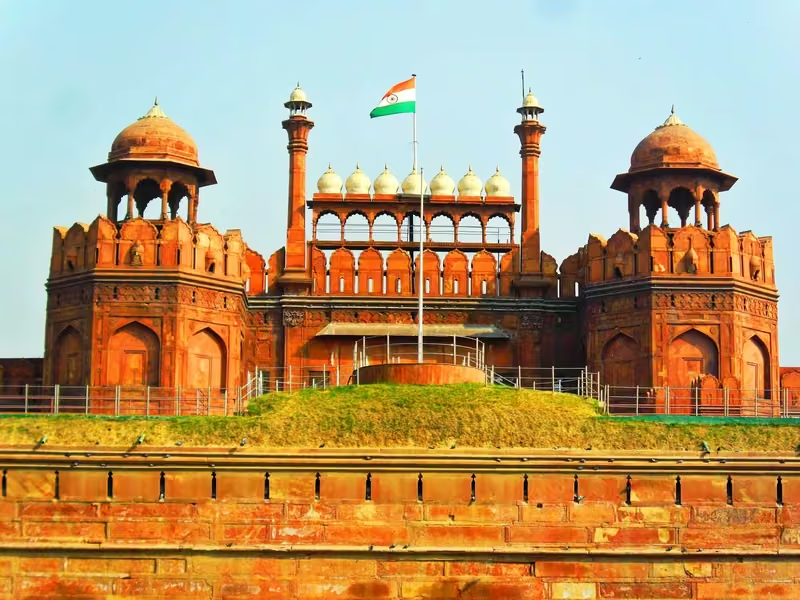
The apex of Delhi's Mughal glory came under Shah Jahan (1628-1658), who made the momentous decision to shift the capital from Agra back to Delhi permanently. In 1638, he commissioned the construction of Shahjahanabad, a new walled city that would become Old Delhi. The Red Fort (Lal Qila), completed in 1648, served as the palace fortress and symbol of Mughal power. Its Diwan-i-Aam (Hall of Public Audience) and Diwan-i-Khas (Hall of Private Audience) exemplified the grandeur of Mughal architecture. Shah Jahan also built the magnificent Jama Masjid, one of India's largest mosques, which still dominates Old Delhi's skyline.
The Mughal Empire's decline began after Aurangzeb's death in 1707. The 18th century witnessed repeated invasions by Persian ruler Nadir Shah (1739) and Afghan king Ahmad Shah Abdali (multiple times), who plundered Delhi's wealth. Despite political turmoil, the city remained a cultural center where Urdu poetry, music, and Indo-Islamic arts flourished. The last Mughal emperor, Bahadur Shah Zafar, held only nominal power when the British East India Company effectively controlled North India.
The Revolt of 1857 marked the definitive end of Mughal Delhi. The rebellion, which began as a sepoy mutiny, briefly restored Bahadur Shah Zafar as a symbolic figurehead. However, British forces recaptured the city, and Zafar was exiled to Burma. The British abolished the Mughal Empire, and Delhi fell under direct British rule, beginning a new chapter in its history.
British Colonial Period (1857-1947)
After 1857, Delhi lost its status as a capital as the British established Calcutta as the seat of their Indian empire. The city declined in importance, though it retained cultural significance and remained a major urban center. However, in 1911, King George V announced at the Delhi Durbar that the capital of British India would be transferred from Calcutta to Delhi, restoring the city's political preeminence.
The British commissioned architects Edwin Lutyens and Herbert Baker to design New Delhi, a planned city south of Shahjahanabad. Construction began in 1912, creating a city of wide boulevards, gardens, and imposing government buildings that contrasted sharply with the narrow lanes of Old Delhi. The centerpiece was Rashtrapati Bhavan (then Viceroy's House), completed in 1929, which combined European classical architecture with Indian motifs. The official inauguration of New Delhi as the capital took place on December 12, 1911, though the actual shift of government offices occurred gradually through the 1920s.
New Delhi represented British imperial power at its zenith, designed to inspire awe and demonstrate permanence. The geometric layout, centered on the Rajpath (then Kingsway), symbolized order and rationality. However, the colonial capital also became the focal point of India's independence movement. Major protests, demonstrations, and political activities that ultimately led to independence in 1947 centered on Delhi, making it both the symbol of British power and Indian resistance.
Capital of Independent India (1947-Present)
When India gained independence on August 15, 1947, Delhi naturally became the capital of the newly independent nation. The painful Partition of India resulted in massive population movements, with Muslim residents migrating to Pakistan and Hindu and Sikh refugees arriving from Pakistan. This demographic upheaval fundamentally changed Delhi's composition and accelerated its growth.
On January 26, 1950, when India's Constitution came into effect, New Delhi was confirmed as the capital of the Republic of India. The city's administrative structure evolved to address its unique position. On November 1, 1956, Delhi became a Union Territory, directly administered by the central government. This status reflected the city's national importance but limited local autonomy. In response to demands for greater self-governance, Delhi was designated the National Capital Territory on February 1, 1992, granting it a legislative assembly while the Lieutenant Governor retained significant powers.
Post-independence Delhi experienced explosive growth. From a population of around 1.4 million in 1951, it grew to over 16.8 million by 2011 (NCT population), with the metropolitan area reaching approximately 28.5 million by 2018. This growth brought significant challenges including housing shortages, infrastructure strain, pollution, and social tensions. However, the city also underwent massive development, including the construction of the Delhi Metro (inaugurated 2002), improved road networks, and modern commercial centers.
Today, Delhi serves not only as India's political capital but also as a major economic, cultural, and educational hub. It houses all three branches of the Indian government: the Parliament of India, Supreme Court of India, and Rashtrapati Bhavan (official residence of the President). The city represents India's diversity, with significant populations speaking Hindi, Punjabi, Urdu, and English, practicing Hinduism, Islam, Sikhism, and Christianity, and originating from all parts of India.
Political and Administrative Significance
Delhi's political significance derives from its eight centuries of continuous service as a capital city. As the seat of the Government of India, it houses the Rashtrapati Bhavan (President's residence), Parliament House (Sansad Bhavan), and the Supreme Court of India. The city hosts the Prime Minister's Office, all Union Government ministries, and foreign embassies, making it the diplomatic and administrative nerve center of the nation.
The National Capital Territory has a unique administrative structure. The Government of Delhi consists of a Lieutenant Governor appointed by the President of India, a Chief Minister (currently Rekha Gupta of BJP as per the provided data), and a unicameral Legislative Assembly with 70 seats. This hybrid system, where the Lieutenant Governor represents the central government while the Chief Minister leads the elected government, has sometimes led to conflicts over jurisdictional authority, particularly regarding policing and land use.
The Union Territory covers 1,484 square kilometers and is divided into eleven districts for administrative purposes. The Municipal Corporation of Delhi manages civic services, though this has been fragmented into multiple bodies over the years. The Delhi Police operates under the Union Home Ministry, not the territorial government, reflecting the city's strategic national importance.
Religious and Cultural Heritage
Delhi's religious landscape reflects its history as a crossroads of cultures and faiths. The city contains architectural and religious monuments spanning over 800 years, representing Hindu, Islamic, Sikh, and colonial Christian traditions. The Jama Masjid, India's largest mosque, dominates Old Delhi, while numerous Sikh gurudwaras commemorate events from Sikh history. Hindu temples, though fewer historical structures survive compared to Islamic monuments, include both ancient and modern sites of worship.
The city's cultural significance extends to literature, music, and arts. Delhi was the center of Urdu poetry and literature during the Mughal and post-Mughal periods, producing legendary poets like Mirza Ghalib. The tradition of Hindustani classical music flourished under Mughal and later patronage. Today, Delhi hosts major cultural institutions including the National Museum, National Gallery of Modern Art, and numerous theaters and performance spaces.
Delhi's food culture represents a unique fusion of influences. Mughlai cuisine, Punjabi flavors (influenced by post-Partition refugees), and street food traditions create a distinctive culinary identity. Areas like Chandni Chowk in Old Delhi remain famous for traditional foods, while newer areas showcase contemporary dining reflecting Delhi's cosmopolitan character.
Economic Role and Modern Development
Historically, Delhi's economy centered on its role as an administrative capital and trade hub. Located on the Grand Trunk Road, it facilitated commerce between eastern and western India. During the Mughal period, Delhi was renowned for crafts including textiles, jewelry, and metalwork. The colonial period saw industrial development, though Calcutta remained the primary commercial center until independence.
Post-independence economic liberalization transformed Delhi's economy. According to the provided data, the NCT's nominal GDP is ₹1,107,746 crore (approximately $130 billion), with a per capita income of ₹461,910 (approximately $5,500). The metropolitan area's economy is estimated at $273 billion (nominal) and $521.5 billion (PPP), making it one of India's wealthiest regions. The service sector dominates, including information technology, telecommunications, banking, and retail. Manufacturing exists primarily in satellite industrial areas.
Infrastructure development has been crucial to managing Delhi's growth. The Delhi Metro, one of the world's largest metro systems, has revolutionized urban transportation since 2002. The Indira Gandhi International Airport ranks among the world's busiest. However, rapid development has also created challenges, including severe air pollution (particularly in winter), water scarcity, and transportation congestion despite infrastructure improvements.
Monuments and Heritage Sites
Delhi contains three UNESCO World Heritage Sites: the Qutub Minar complex, Humayun's Tomb, and the Red Fort. The Qutub Minar, a 73-meter tall victory tower begun in 1199, represents the earliest Indo-Islamic architecture. Humayun's Tomb (1570), the first garden-tomb in India, inspired Mughal architecture including the Taj Mahal. The Red Fort represents the zenith of Mughal architectural achievement under Shah Jahan.
Beyond UNESCO sites, Delhi contains hundreds of protected monuments spanning different periods. These include Purana Qila (Old Fort), believed to occupy the site of ancient Indraprastha; Safdarjung's Tomb, the last major Mughal garden tomb; and Rashtrapati Bhavan, representing British colonial architecture. The Lotus Temple (Bahá'í House of Worship) and Akshardham Temple represent contemporary religious architecture.
Heritage conservation faces significant challenges in rapidly developing Delhi. While major monuments receive protection and maintenance, many smaller historical structures remain endangered by urban development, pollution, and neglect. Government efforts and civil society organizations work to document and preserve Delhi's vast architectural heritage, though balancing preservation with development needs remains an ongoing challenge.
Modern Challenges and Future
Contemporary Delhi faces multiple interconnected challenges. Air pollution consistently ranks among the world's worst, caused by vehicular emissions, industrial pollution, crop burning in neighboring states, and construction dust. The city has implemented measures including odd-even vehicle restrictions and increased public transportation, but progress remains slow.
Water scarcity presents another critical challenge. The Yamuna River, once Delhi's lifeline, is severely polluted. The city depends on water supplied from Haryana and Uttar Pradesh, creating inter-state disputes and vulnerability to supply disruptions. Population growth continues to outpace infrastructure development, straining housing, education, and healthcare systems.
Despite these challenges, Delhi continues to evolve as a global city. The Human Development Index (HDI) for Delhi stands at 0.839 (2018), ranking first among Indian states and territories. Literacy rates of 86.21% and improving sex ratios (868 females per 1000 males as per 2011 census) indicate social progress. The city's economy continues growing, attracting migrants from across India seeking opportunities.
Looking forward, Delhi's planners focus on sustainable development, pollution control, improved public transportation, and heritage conservation. The city aims to balance its role as a modern metropolis with preserving the historical and cultural legacy that makes it unique. As India's capital and largest metropolitan area, Delhi's success in addressing these challenges will significantly impact the entire nation.