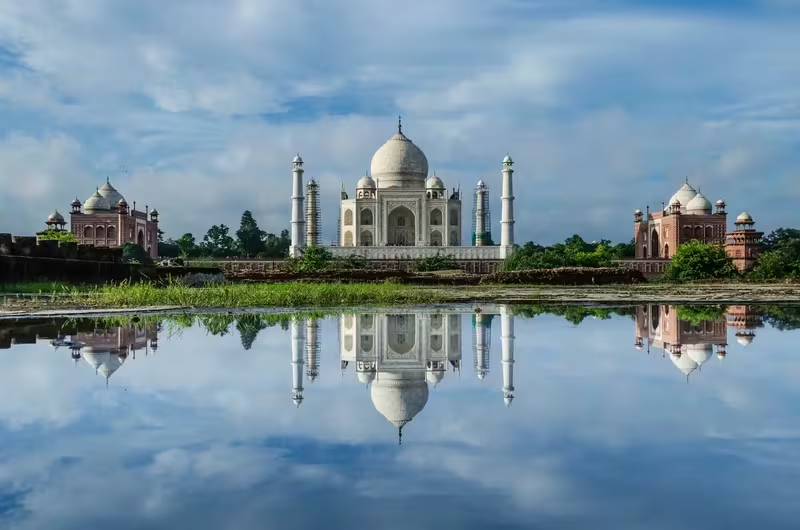
Overview
Agra is a historic city situated on the banks of the Yamuna River in the northern Indian state of Uttar Pradesh. Located approximately 230 kilometers southeast of the national capital Delhi and 330 kilometers west of the state capital Lucknow, Agra occupies a strategic position in the Indo-Gangetic Plain. Founded by Sikandar II, the city has evolved from its medieval origins to become one of India's most significant urban centers, both historically and in contemporary times.
With a population of approximately 1.6 million within the city limits and over 1.76 million in its metropolitan area, Agra ranks as the fourth-most populous city in Uttar Pradesh and the twenty-third most populous city in India. The city serves as the administrative headquarters of Agra Division and Agra District, playing a crucial role in the governance and economic development of the region. Beyond its administrative importance, Agra is internationally renowned for its architectural treasures and cultural heritage, making it one of the world's most visited tourist destinations.
Agra is also an integral part of the Braj region, an area of immense cultural and religious significance in Hinduism, particularly associated with the legends of Lord Krishna. This dual identity—as both a center of Mughal heritage and a component of the sacred Braj landscape—gives Agra a unique character that distinguishes it from other Indian cities. The city's economy, driven significantly by tourism, also encompasses traditional crafts, particularly marble inlay work and leather goods, as well as modern industries.
Geography and Location
Agra is positioned at coordinates 27.1767°N latitude and 78.0081°E longitude, occupying an area of 121 square kilometers in the western part of Uttar Pradesh. The city's elevation of approximately 170 meters (560 feet) above sea level places it on the relatively flat alluvial plains characteristic of the Yamuna River basin. This geographical setting has historically provided fertile agricultural land and facilitated trade and communication.
The Yamuna River, one of the most important tributaries of the Ganges, flows along Agra's eastern edge, shaping both the city's physical landscape and its historical development. The river has served as a vital water source, supported agriculture, and provided a natural defense barrier, influencing the location of important structures like the Agra Fort. However, in modern times, the Yamuna has faced significant environmental challenges, including pollution and reduced water flow.
Agra experiences a semi-arid climate characterized by three distinct seasons: a hot summer from April to June with temperatures often exceeding 45°C (113°F), a monsoon season from July to September bringing the majority of annual rainfall, and a cool winter from November to February when temperatures can drop to around 2-3°C (36-37°F). This climatic pattern has influenced architectural styles, with Mughal buildings incorporating features like water channels, gardens, and thick walls designed to moderate temperature extremes.
The city's strategic location on the Grand Trunk Road—one of Asia's oldest and longest major roads—has historically made it a crucial junction for trade and military movements. Its proximity to Delhi, approximately three hours by road or rail, has ensured Agra's continued relevance in regional economics and politics. The city is well-connected through multiple railway stations, including Agra Cantt and Agra Junction, as well as the Agra Airport (Kheria), though the latter primarily handles limited domestic flights.
Historical Background
Historical records indicate that Agra was founded by Sikandar II, though the precise date of the city's establishment remains a subject of scholarly discussion. The settlement's advantageous position on the Yamuna made it attractive to successive rulers seeking to control the fertile Doab region between the Yamuna and Ganges rivers.
While Agra's pre-medieval history remains somewhat obscure, the city gained prominence during the medieval period, particularly under the Delhi Sultanate and subsequently the Mughal Empire. The strategic location that had attracted earlier settlers continued to make Agra valuable to these Islamic dynasties, who recognized its potential as both an administrative center and a military stronghold.
The city is part of the Braj region, which encompasses a cluster of sacred sites associated with Hindu mythology and the worship of Lord Krishna. This religious-cultural geography predates the city's Islamic medieval development and continues to influence Agra's cultural identity. The convergence of Hindu devotional traditions with later Islamic architectural and cultural contributions has created a unique syncretic heritage.
Political and Administrative Significance
Agra serves as the headquarters of both Agra Division and Agra District, making it a key administrative center in Uttar Pradesh. The city is governed by the Agra Municipal Corporation, led by a mayor—currently Hemlata Divakar of the Bharatiya Janata Party (BJP)—and administered by a municipal commissioner, currently Ankit Khandelwal, IAS. This governance structure reflects India's democratic municipal administration system, with elected representatives working alongside appointed civil servants.
The city's administrative importance extends beyond its immediate boundaries, as Agra Division encompasses multiple districts in western Uttar Pradesh. This regional significance means that decisions made in Agra affect a much larger population and territory, positioning the city as a crucial link between state-level governance in Lucknow and local administration in smaller towns and villages.
Politically, Agra has historically been a significant constituency in both state and national elections. The city's large population and its position as a major urban center make it electorally important, and political parties invest considerable resources in maintaining support here. The city's political dynamics reflect broader patterns in North Indian politics, including caste-based voting patterns, religious community mobilization, and urban-rural divides.
Economic Role
Agra's economy is dominated by tourism, with millions of visitors arriving annually to see the city's world-famous monuments. This tourism sector supports a vast ecosystem of hotels, restaurants, guides, transportation services, and handicraft industries. According to available data, Agra's nominal GDP was approximately $1.53 billion in 2019-20, reflecting its economic significance within Uttar Pradesh.
Traditional industries continue to play an important role in Agra's economy. The city is particularly renowned for marble inlay work, a craft tradition inherited from Mughal artisans who created the decorative elements of the Taj Mahal and other monuments. Agra is also known for leather goods, including shoes, with the city hosting numerous small-scale manufacturing units and retail outlets. Additionally, Agra has developed food processing industries, taking advantage of the agricultural productivity of the surrounding regions.
Modern economic development has brought challenges alongside opportunities. The concentration of tourism has created economic dependence on a single sector, making the city vulnerable to disruptions such as those experienced during the COVID-19 pandemic. Environmental concerns, particularly air pollution affecting monument preservation, have also prompted calls for industrial regulation and urban planning reforms.
The city's infrastructure continues to develop, with projects like the Agra Metro and improved road networks aimed at supporting economic growth. The Agra Inner Ring Road and other transportation improvements reflect efforts to manage urban expansion while facilitating commerce and reducing congestion in the historic city center.
Religious and Cultural Importance
As part of the Braj region, Agra shares in the area's profound religious significance for Hindus, particularly devotees of Lord Krishna. Although Agra itself is not the primary center of Krishna worship—that distinction belongs to nearby Mathura and Vrindavan—the city's location within Braj gives it cultural associations that predate its Islamic architectural heritage.
The languages spoken in Agra reflect this layered cultural history. While Hindi is the official language and the most widely spoken, Urdu holds additional official status, reflecting the city's Islamic heritage. Braj Bhasha, a dialect associated with the Braj region and Krishna devotional literature, is also spoken, connecting contemporary Agra to its deeper cultural roots.
Agra's cultural identity has been shaped significantly by the Mughal period, which introduced Persian and Central Asian influences to the region. This cultural synthesis is visible not only in architecture but also in music, cuisine, and social customs. The city has been home to various forms of classical music and dance, and Mughlai cuisine remains an important part of Agra's culinary heritage.
Educational institutions like Dr. B.R. Ambedkar University contribute to Agra's role as a regional educational center. The presence of universities and colleges attracts students from surrounding areas, adding to the city's cultural vibrancy and economic activity.
Modern City
Contemporary Agra is a city navigating the complexities of rapid urbanization while attempting to preserve its historical heritage. With a population density of approximately 13,000 people per square kilometer, Agra faces typical urban challenges including traffic congestion, housing shortages, and infrastructure strain. The city's literacy rate of 73.11% indicates ongoing educational challenges, though this represents significant progress over previous decades.
Demographic patterns in Agra reveal important social issues. The sex ratio of 875 females per 1,000 males is notably skewed compared to the global average and reflects broader gender demographic challenges in North India. This imbalance has social implications and has prompted various government interventions aimed at addressing discrimination against girls and women.
Modern Agra is working to balance heritage conservation with urban development. The presence of UNESCO World Heritage Sites imposes restrictions on construction and industrial activity in certain zones, sometimes creating tension with development pressures. Air pollution, particularly from vehicular traffic and industrial emissions, poses threats to both public health and monument preservation, leading to periodic vehicle restrictions and industrial regulations.
The city's tourism infrastructure continues to expand, with hotels ranging from budget accommodations to luxury establishments catering to the diverse international visitor base. Agra is part of India's "Golden Triangle" tourist circuit along with Delhi and Jaipur, ensuring a steady flow of domestic and international tourists. The city is accessible via multiple transportation modes, including rail connections to major Indian cities, highways linking to Delhi and other regional centers, and limited air connectivity through Agra Airport.
Timeline
See Also
- Delhi - National capital approximately 230 km northwest of Agra
- Lucknow - Capital of Uttar Pradesh, 330 km east of Agra
- Mathura - Sacred city in the Braj region associated with Lord Krishna
- Uttar Pradesh - The state of which Agra is a major city