Overview
Mathura stands as one of the most ancient and continuously inhabited cities in India, with a documented history stretching back to approximately 1100 BCE. Located on the western bank of the Yamuna River in present-day Uttar Pradesh, this sacred city holds immense religious significance as the legendary birthplace of Lord Krishna, making it one of the seven holiest cities (Sapta Puri) in Hindu tradition. However, Mathura's importance extends far beyond its religious associations, as it served as a crucial economic hub positioned at the junction of major ancient caravan routes connecting northern and western India.
The city's strategic location on the Yamuna River, approximately 162 kilometers southeast of modern Delhi and 15 kilometers from the town of Vrindavan, made it a natural center for trade, culture, and political power throughout Indian history. During the ancient period, Mathura emerged as the capital of the Surasena kingdom and became renowned as a cosmopolitan center where Buddhism, Jainism, and early Hindu traditions flourished side by side. The city's cultural zenith came with the development of the Mathura school of art between the 1st and 4th centuries CE, which produced distinctive red and pink sandstone sculptures that influenced artistic traditions across the Indian subcontinent and beyond.
Today, Mathura remains a vibrant pilgrimage destination and administrative headquarters of Mathura district, with a population of approximately 441,894 according to the 2011 Census. The city continues to attract millions of devotees and tourists annually, particularly during the elaborate Holi celebrations that last for weeks and draw upon the region's deep association with Krishna's playful legends. The Mathura-Vrindavan Municipal Corporation administers this sacred landscape, balancing heritage conservation with modern urban development.
Etymology and Names
The name "Mathura" derives from the Sanskrit "Madhura," which appears in ancient texts and inscriptions. The etymology is traditionally connected to the word meaning "sweet" or "delightful," though scholars debate whether this reflects the city's pleasant location or is a later folk etymology. Throughout its long history, the city has been known by several variations of this name, reflecting different linguistic traditions and historical periods.
During the British colonial period, Mathura was commonly anglicized as "Muttra," a spelling that appears frequently in 19th-century documents, maps, and travelogues. This colonial-era name has since fallen out of use, with the original Sanskrit-derived "Mathura" being restored as the official name. The city is also referred to in devotional literature as part of "Braj" or "Brajbhoomi," the larger sacred landscape associated with Krishna's early life and exploits.
In regional languages, particularly the local Braj Bhasha dialect, the city is known as "Mathura Pura," with various devotional epithets emphasizing its sacred status. Ancient Buddhist texts mention the city as the capital of the Surasena Mahajanapada, one of the sixteen great kingdoms of ancient India, highlighting its political significance before its primary association with Krishna worship became dominant.
Geography and Location
Mathura occupies a strategic position on the western bank of the Yamuna River, situated on the alluvial plains of north-central India. The city lies approximately 162 kilometers (101 miles) southeast of Delhi and about 15 kilometers from Vrindavan, placing it within the broader Braj region of Uttar Pradesh. This location on the Yamuna provided essential water resources, fertile agricultural land, and facilitated riverine trade and transportation throughout ancient and medieval periods.
The terrain around Mathura consists of flat to gently undulating alluvial plains deposited by the Yamuna over millennia. The soil's fertility supported agricultural prosperity, while the relatively level landscape allowed for easy construction and expansion of urban settlements. The city's location at the junction of important ancient caravan routes connecting the Indo-Gangetic plain with western India and beyond made it a natural hub for commerce, cultural exchange, and political power.
Mathura experiences a subtropical climate characterized by hot summers, a monsoon season from July to September, and mild winters. Summer temperatures can exceed 45°C (113°F), while winter temperatures occasionally drop to around 5°C (41°F). The monsoon brings essential rainfall to support agriculture in the surrounding region. This climate pattern has remained relatively consistent throughout the city's history, shaping patterns of settlement, agriculture, and religious festivals.
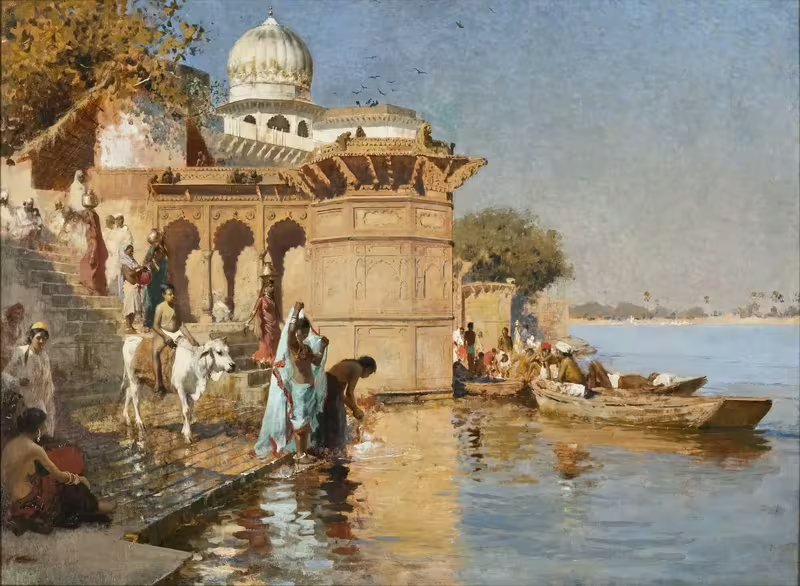
The Yamuna River, though much diminished in flow compared to ancient times, remains central to Mathura's identity and religious life. The river's ghats (stepped embankments) serve as sites for ritual bathing, cremation, and religious ceremonies, particularly during major festivals. The river also historically provided a transportation corridor connecting Mathura with Delhi to the northwest and Agra to the southeast, facilitating trade and political communications.
Ancient History
Archaeological evidence and textual references indicate that Mathura has been continuously inhabited since approximately 1100 BCE, making it one of India's oldest living cities. The earliest settlements likely developed due to the site's advantageous position on the Yamuna River and its location at the crossroads of major trade routes. While the legendary associations with Krishna's birth place the city firmly in Hindu mythological history, archaeological excavations have revealed material evidence of the city's ancient urban character.
During the Vedic period, Mathura emerged as the capital of the Surasena kingdom, one of the sixteen Mahajanapadas (great kingdoms) mentioned in Buddhist texts. This political significance established Mathura as a major power center in north-central India. The city's prosperity grew from its control of trade routes and agricultural surplus from the fertile Yamuna valley, supporting a large urban population and sophisticated culture.
The 6th century BCE marked a transformative period when Buddhism and Jainism spread throughout the region. Mathura became an important center for both religions, with numerous monasteries, stupas, and shrines constructed within and around the city. Buddhist sources describe Mathura as a major center of learning, attracting monks and scholars from across India and beyond. The famous site of Kankali Tila, a large Jain archaeological mound, has yielded hundreds of sculptures, inscriptions, and architectural fragments dating from the 2nd century BCE onward, demonstrating the city's importance to the Jain community.
By the turn of the Common Era, Mathura had developed into one of the largest and most cosmopolitan cities in the ancient world. Its population likely numbered in the hundreds of thousands, with diverse communities of Buddhists, Jains, Brahmins, merchants, and artisans living in relative harmony. The city's wealth supported elaborate religious and civic architecture, sophisticated arts and crafts, and a vibrant intellectual culture that would soon produce one of India's most influential artistic traditions.
The Mathura School of Art
Between approximately 100 and 400 CE, Mathura emerged as the center of a distinctive sculptural tradition known as the Mathura school of art. Working primarily in the region's characteristic pink and red mottled sandstone, Mathura's sculptors developed an indigenous Indian style that would profoundly influence artistic traditions across the subcontinent and beyond. Unlike the earlier Gandhara school in the northwest, which showed strong Greco-Roman influences, the Mathura style represented a purely Indian aesthetic sensibility.
Mathura sculptors pioneered the creation of the first iconic images of the Buddha in human form, moving beyond the earlier aniconic traditions that represented the Buddha through symbols alone. These Buddha images featured distinctively Indian physiognomy, with broad faces, heavy-lidded eyes, and serene expressions. The sculptures depicted the Buddha wearing diaphanous robes that clung to the body, revealing its underlying form—a characteristic that became a hallmark of the Mathura style. Similarly, Mathura artists created some of the earliest anthropomorphic representations of Jain Tirthankaras (spiritual teachers).
The Mathura school also produced some of the earliest surviving images associated with Krishna and other Hindu deities, reflecting the city's growing association with Vaishnavism. These sculptures displayed remarkable technical skill in rendering the human form, with particular attention to realistic anatomy, graceful postures, and expressive faces. The artists excelled at creating relief panels depicting narrative scenes from Buddhist Jatakas, Jain legends, and Hindu mythology.
The influence of the Mathura school extended far beyond the city itself. Mathura sculptures and sculptors traveled along trade routes to other parts of India, and the style influenced artistic developments in regions as distant as Sri Lanka and Southeast Asia. The Government Museum in Mathura today houses one of the world's finest collections of Mathura school sculptures, allowing visitors to appreciate this remarkable artistic heritage.
Religious and Cultural Significance
While Mathura's ancient history encompasses Buddhist, Jain, and early Hindu traditions, the city's identity became increasingly associated with Krishna worship from the medieval period onward. According to Hindu tradition, Mathura is the birthplace of Krishna, the eighth avatar of Vishnu, making it one of the most sacred sites in Vaishnavism. The city forms the heart of the Braj region, the landscape where Krishna's childhood and youth unfolded according to devotional texts like the Bhagavata Purana.
This religious significance made Mathura a major pilgrimage destination, with devotees from across India and beyond visiting to pay homage at sites associated with Krishna's life. The city is counted among the Sapta Puri, the seven sacred cities of Hinduism that are believed to offer moksha (liberation). Numerous temples dedicated to Krishna and related deities dot the cityscape, while the ghats along the Yamuna serve as sites for ritual bathing and religious ceremonies.
The city's cultural life revolves around Krishna-centered devotional traditions, particularly the elaborate celebration of festivals associated with the deity. Mathura's Holi celebrations are among the most famous in India, lasting for weeks and incorporating unique local traditions connected to Krishna's legendary playfulness. The city also celebrates Krishna Janmashtami (Krishna's birthday) with particular fervor, attracting hundreds of thousands of pilgrims.
Mathura has long been a center for classical music, dance, and devotional arts within the broader Braj cultural tradition. The Braj Bhasha dialect, though declining in everyday use, remains important in devotional poetry and song. The city's cultural institutions continue to preserve and promote these traditional arts, though they face challenges from modernization and changing social patterns.
Medieval and Early Modern Periods
During the medieval period, Mathura's fortunes fluctuated with changing political circumstances. The city was conquered by various Muslim dynasties from the 11th century onward, leading to periods of destruction and reconstruction. Many Hindu temples were demolished and replaced with mosques, reflecting the religious conflicts of the era. Despite these disruptions, Mathura maintained its religious significance for Hindu pilgrims, and the city's association with Krishna remained central to its identity.
The Mughal period brought both destruction and patronage to Mathura. While some Mughal emperors were hostile to Hindu religious sites, others adopted more tolerant policies. The city remained an important economic center due to its location on trade routes and its agricultural prosperity. The building of the fort associated with the legendary King Kansa reflects the continued importance of Mathura's mythological associations even during periods of non-Hindu rule.
Colonial Period and Modern Era
Under British colonial rule, Mathura was anglicized as "Muttra" and served as an important administrative center. The construction of the Mathura Junction railway station in the 19th century enhanced the city's connectivity, making pilgrimage easier and facilitating trade. British administrators and European travelers documented the city's religious life and monuments, though often through orientalist perspectives that emphasized the exotic and otherworldly aspects of Hindu devotion.
Following Indian independence in 1947, Mathura was designated as the administrative headquarters of Mathura district in Uttar Pradesh. The city has experienced significant growth and development, with its population expanding to over 440,000 by 2011. The Mathura-Vrindavan Municipal Corporation now administers the city, managing the challenges of urban development while attempting to preserve the area's rich religious and archaeological heritage.
Modern City and Tourism
Today, Mathura functions as both a living pilgrimage city and a modern urban center. The city attracts millions of visitors annually, particularly during major festivals like Holi and Janmashtami. Religious tourism forms a major part of the local economy, supporting numerous hotels, restaurants, and shops catering to pilgrims. The city is well-connected by rail through Mathura Junction and by road, lying on major highways connecting Delhi, Agra, and other cities.
The Government Museum in Mathura houses an extraordinary collection of ancient sculptures, particularly from the Mathura school, making it an important destination for those interested in Indian art history. The museum's holdings include masterpieces of Buddhist, Jain, and Hindu sculpture spanning nearly two millennia, though many of the finest pieces have also been dispersed to museums worldwide.
Archaeological sites within and around Mathura, including Kankali Tila and other ancient mounds, continue to yield important discoveries about the city's ancient past. However, rapid urbanization poses challenges for heritage conservation, with development pressures threatening many historical sites. Balancing the needs of a growing population with the preservation of Mathura's incomparable cultural heritage remains an ongoing challenge for city administrators and heritage advocates.
The modern city maintains its multilingual character, with Hindi serving as the primary official language alongside Urdu. The traditional Braj Bhasha dialect, though declining, remains important in religious contexts and traditional arts. The population includes diverse religious communities, though Hindu pilgrims and residents connected to temple activities form a significant portion of the city's character and economy.
Timeline
Ancient Settlement
Mathura established as a settlement on the Yamuna River (circa)
Capital of Surasena
Emerges as capital of Surasena Mahajanapada
Buddhist Center
Becomes important center for Buddhism and Jainism (circa)
Mathura School of Art
Flourishing of distinctive Mathura sculptural tradition begins
Artistic Peak
Mathura school reaches its artistic zenith
Medieval Conquests
City experiences destruction during medieval invasions
Colonial Period
Comes under British colonial administration
Indian Rebellion
Participation in Indian Rebellion of 1857
Independence
Becomes part of independent India, district headquarters of Uttar Pradesh
Modern Census
Population recorded as 441,894
See Also
- Vrindavan - Nearby sacred town associated with Krishna's youth
- Agra - Historic Mughal city located southeast of Mathura
- Delhi - National capital and historic city northwest of Mathura
- Yamuna River - Sacred river on whose banks Mathura is located