Overview
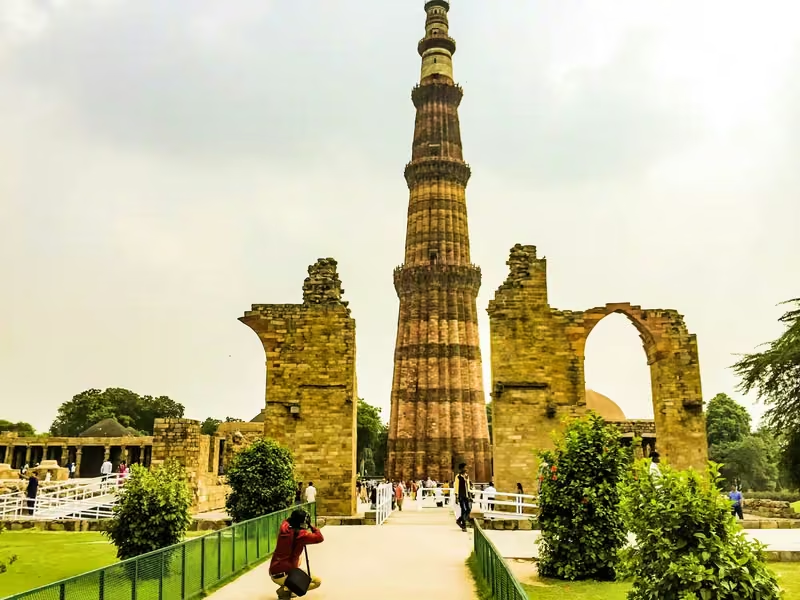
The Qutub Minar stands as one of India's most recognizable landmarks and a masterpiece of Indo-Islamic architecture. Rising approximately 73 meters (240 feet) into the Delhi sky, this magnificent minaret and victory tower represents a pivotal moment in Indian history - the establishment of Islamic rule in the region following the Ghurid conquest. Located in the Qutb complex in Mehrauli, South Delhi, the monument is now recognized as a UNESCO World Heritage Site and remains one of the most-frequented heritage destinations in the city.
Constructed primarily between 1199 and 1220 CE, the Qutub Minar was initiated by Qutab-ud-din Aibak, the founder of the Delhi Sultanate, after his victory over Prithviraj Chauhan, the last Hindu ruler of Delhi. Though Aibak only managed to complete the first storey before his death, successive rulers of the Delhi Sultanate continued the construction, each leaving their architectural mark on this towering structure. The monument comprises five distinct storeys, each separated by ornamental balconies, and features intricate calligraphy and verses from the Quran carved into its red sandstone and marble surfaces.
The tower's 399 steps once allowed visitors to climb to the top and survey the Delhi landscape, though public access to the interior has been prohibited since 1981 for safety reasons. The Qutub Minar is not merely an isolated monument but forms the centerpiece of the larger Qutb complex, which includes several other historically significant structures including the Quwwat-ul-Islam Mosque, the Iron Pillar of Delhi, and the Alai Darwaza. Together, these monuments tell the story of Delhi's transition from Hindu to Islamic rule and the synthesis of Persian, Turkish, and Indian architectural traditions that would define the region for centuries to come.
History
The Ghurid Conquest and Birth of the Delhi Sultanate
The story of the Qutub Minar begins with the dramatic transformation of Delhi's political landscape at the turn of the 13th century. In 1192 CE, Muhammad Ghori defeated Prithviraj Chauhan in the decisive Second Battle of Tarain, ending Rajput rule over Delhi and opening the door for Islamic dominance in northern India. Following this victory, Ghori appointed his trusted slave-general, Qutab-ud-din Aibak, as the governor of his Indian territories.
When Muhammad Ghori was assassinated in 1206, Aibak declared his independence and established himself as the first Sultan of Delhi, founding what historians call the Slave Dynasty (also known as the Mamluk Dynasty). It was during this period of consolidation and celebration of Islamic conquest that Aibak conceived the idea of constructing a grand victory tower that would serve multiple purposes: as a minaret from which the call to prayer (adhan) could be broadcast, as a symbol of Islamic military triumph, and as a visible assertion of the new religious and political order in Delhi.
Construction Under Multiple Dynasties
Qutab-ud-din Aibak initiated construction of the Qutub Minar in 1199 CE, but his ambitions exceeded his lifetime. Historical records indicate that he only managed to complete the basement or first storey of the tower before his death in 1210. The construction was continued by his successor and son-in-law, Iltutmish (ruled 1211-1236), who added three more storeys to the structure, bringing it close to its current impressive height.
The tower's construction represents a remarkable achievement in medieval engineering and craftsmanship. Workers quarried and transported massive blocks of red sandstone, then carved them with intricate geometric patterns, floral motifs, and Arabic calligraphy. Each storey features distinct architectural characteristics, with varying diameters that create a tapering effect - the base diameter is approximately 14.3 meters, gradually reducing to about 2.7 meters at the top.
The Tughlaq Restoration
The Qutub Minar's history includes several instances of damage and restoration. The most significant reconstruction occurred in 1368 during the reign of Firuz Shah Tughlaq, the third ruler of the Tughlaq Dynasty. Lightning had struck and damaged the top storeys of the tower, necessitating extensive repairs. Firuz Shah not only rebuilt the damaged portions but also added a fifth storey and crowned the structure with a cupola (dome), completing the tower in a form close to what we see today, though with subsequent modifications.
Later Modifications and British Period
The monument underwent further changes during the British colonial period. In 1828, Major Robert Smith undertook restoration work and replaced Firuz Shah's cupola with a new pillared dome in a Mughal-influenced style. However, this addition was deemed architecturally incongruous and was removed in 1848 under the orders of Viscount Hardinge, then Governor-General of India. The removed cupola was placed in the gardens to the southeast of the tower, where it remains today, known as "Smith's Folly."
A tragic incident in 1981 fundamentally changed visitor access to the monument. An electrical failure caused panic among schoolchildren visiting the tower, resulting in a stampede that killed 45 people. Following this tragedy, authorities permanently closed the interior of the Qutub Minar to the public, though the monument remains fully accessible for exterior viewing and photography.
Architecture
Design and Structure
The Qutub Minar represents a masterful synthesis of Persian, Turkish, and Indian architectural traditions, creating a distinctive Indo-Islamic style that would influence monument construction throughout the Delhi Sultanate period. The tower is essentially a tapering cylindrical column divided into five distinct storeys, each marked by projecting balconies supported by intricate corbelling.
The tapering design serves both aesthetic and structural purposes. The decreasing diameter from base to summit creates a sense of upward momentum and height, while also providing stability by concentrating mass at the foundation. The tower's slight tilt of approximately 65 centimeters (25 inches) to the southwest has been stable for centuries, suggesting that the builders possessed sophisticated understanding of weight distribution and foundation engineering.
Building Materials
The primary construction material is red sandstone, sourced from local quarries, which gives the monument its distinctive warm, earthy color. The lower storeys are predominantly red sandstone, while the upper storeys incorporate more white and buff-colored marble, creating visual variety and highlighting the different phases of construction. The alternating angular and circular fluting on the tower's surface adds textural complexity and plays with light and shadow throughout the day.
The Five Storeys
Each storey of the Qutub Minar possesses unique architectural characteristics:
First Storey (Aibak's Construction): The base level features alternately angular and circular fluting, with sharp-edged prismatic projections alternating with circular fluting. This storey showcases the most robust construction and includes bands of intricate calligraphy.
Second and Third Storeys (Iltutmish's Addition): These levels maintain circular fluting throughout and feature inscriptional bands containing verses from the Quran and details about the tower's construction and purpose.
Fourth and Fifth Storeys (Tughlaq Reconstruction): The uppermost storeys, rebuilt by Firuz Shah Tughlaq after lightning damage, show slightly different architectural treatments reflecting 14th-century aesthetic preferences while maintaining harmony with the lower levels.
Decorative Elements and Calligraphy
One of the most striking features of the Qutub Minar is its extensive use of Arabic calligraphy carved into stone. These inscriptions serve both decorative and documentary purposes, containing verses from the Quran, particularly those emphasizing divine sovereignty and the triumph of Islam, as well as historical information about the tower's construction and the rulers who commissioned various phases.
The calligraphic bands alternate between different styles of Arabic script, predominantly Naskh and Kufic, executed with remarkable precision by skilled craftsmen. The geometric and floral patterns that accompany the inscriptions demonstrate the Islamic artistic tradition's emphasis on aniconic (non-representational) decoration, creating complex visual rhythms through abstract forms rather than figurative representation.
Structural Innovation
The Qutub Minar's 399-step internal staircase spirals upward through the tower's core, an engineering achievement that required precise calculation of weight loads and spatial planning. Though no longer accessible to visitors, this staircase represents sophisticated medieval understanding of circular geometry and structural mechanics.
The projecting balconies at each storey level are supported by muqarnas (honeycomb-like corbelling), a decorative architectural element borrowed from Persian and Central Asian traditions. These balconies originally served both aesthetic and functional purposes, providing platforms from which the call to prayer could be delivered across the surrounding area.
Cultural and Historical Significance
Symbol of Islamic Authority
The Qutub Minar functioned as far more than a mere minaret or architectural showpiece. It served as a powerful statement of Islamic political and religious authority in a predominantly Hindu region. Victory towers of this type, known as "manara" in Persian, had precedents in Afghanistan and Persia, but the Qutub Minar's scale exceeded these earlier examples, asserting the Delhi Sultanate's ambitions and capabilities.
The tower's height ensured that the call to prayer could be heard across a considerable distance, bringing the rhythm of Islamic religious practice to a landscape previously defined by Hindu temple bells and rituals. Its visibility from various points across Delhi made it an unavoidable reminder of the political transformation that had occurred with the establishment of Muslim rule.
Part of the Qutb Complex
The Qutub Minar cannot be fully understood in isolation from the broader Qutb complex in which it stands. The adjacent Quwwat-ul-Islam Mosque, one of the first mosques built in India, was constructed using materials from demolished Hindu and Jain temples, creating a complex layering of religious and architectural histories. The famous Iron Pillar of Delhi, dating from the 4th century Gupta period, stands within the mosque courtyard, representing continuity with earlier Indian civilizations.
This juxtaposition of architectural elements from different periods and traditions makes the Qutb complex a palimpsest of Delhi's layered history, where each ruler and dynasty left their mark while incorporating elements of what came before.
Influence on Later Architecture
The Qutub Minar established architectural precedents that influenced monument construction throughout the Delhi Sultanate and later the Mughal period. Its fusion of Islamic architectural vocabulary with Indian materials, craftsmanship traditions, and aesthetic sensibilities created a template for Indo-Islamic architecture that would evolve over subsequent centuries.
An unfinished attempt to surpass the Qutub Minar, known as the Alai Minar, stands nearby in the Qutb complex. Commissioned by Alauddin Khalji around 1311 with the intention of building a tower twice the height of the Qutub Minar, this ambitious project was abandoned after reaching only about 24.5 meters, leaving a massive rubble core that testifies to both architectural ambition and the practical limits of medieval construction techniques.
UNESCO World Heritage Status
In 1993, UNESCO inscribed the Qutub Minar and its monuments as a World Heritage Site, recognizing the complex's outstanding universal value. The designation specifically cited Criterion (iv): "an outstanding example of a type of building, architectural or technological ensemble or landscape which illustrates a significant stage in human history."
The UNESCO citation emphasizes several aspects of the site's significance:
Architectural Innovation: The monument represents the beginning of Indo-Islamic architecture in the Indian subcontinent, demonstrating how different architectural traditions merged to create new forms.
Technical Achievement: The tower's height, structural stability, and decorative sophistication showcase advanced medieval engineering and craftsmanship.
Historical Testimony: The Qutub Minar and associated structures document the establishment of Islamic political authority in northern India and the cultural transformations that accompanied this historical shift.
Artistic Excellence: The calligraphic inscriptions, geometric patterns, and architectural proportions represent high points of Islamic artistic achievement adapted to the Indian context.
The World Heritage designation has enhanced the monument's protection and brought increased international attention, though it has also created challenges related to managing high visitor numbers while preserving the structure's integrity.
Conservation and Current Condition
Preservation Challenges
As with many ancient monuments, the Qutub Minar faces ongoing conservation challenges. Air pollution in Delhi, which has reached severe levels in recent decades, poses a significant threat to the sandstone surfaces. Sulfur dioxide and other pollutants react with the stone, causing erosion, discoloration, and weakening of the surface layers - a process known as stone cancer or stone decay.
The monument's sandstone composition makes it particularly vulnerable to moisture penetration. Seasonal monsoon rains and Delhi's extreme temperature variations cause expansion and contraction cycles that can exacerbate cracks and accelerate deterioration. The Archaeological Survey of India (ASI), which maintains the monument, conducts regular monitoring and undertakes conservation interventions as needed.
Seismic Vulnerability
Delhi falls in a seismically active zone, and historical records document several earthquakes that have affected the Qutub Minar. The tower's height and mass make it potentially vulnerable to seismic activity, though its slight tilt has remained stable for centuries, suggesting inherent structural resilience. Modern engineering studies have examined the monument's seismic resistance and informed conservation strategies designed to enhance stability without compromising historical authenticity.
Archaeological Survey of India's Role
The ASI has undertaken multiple conservation campaigns since assuming responsibility for the monument in the early 20th century. These interventions have included:
- Structural stabilization: Addressing cracks, reinforcing foundations, and monitoring the tower's tilt
- Surface conservation: Cleaning stone surfaces, removing biological growth, and applying consolidation treatments where necessary
- Documentation: Creating detailed architectural surveys, photographic records, and condition assessments
- Environmental monitoring: Installing sensors to track temperature, humidity, pollution levels, and structural movement
Balancing conservation needs with public access remains an ongoing challenge. The ASI must maintain the monument's accessibility as a tourist attraction and educational resource while protecting it from damage caused by environmental factors and visitor impact.
Visitor Experience
Planning Your Visit
The Qutub Minar complex typically sees heavy visitation, particularly during the cooler months from October through March. Morning visits offer the best light for photography and smaller crowds. The monument opens at sunrise and closes before sunset, with the best viewing occurring in the golden hours of early morning and late afternoon when the red sandstone glows warmly.
Visitors should allocate at least 2-3 hours to properly explore the entire Qutb complex, which extends well beyond the tower itself. The site includes the Quwwat-ul-Islam Mosque, Iron Pillar, Alai Darwaza, Alai Minar, and various smaller structures and archaeological remains spread across landscaped gardens.
Facilities and Accessibility
The Archaeological Survey of India has developed the site with visitor amenities including:
- Accessibility: Paved pathways throughout the complex make wheelchair access possible, though some areas remain challenging due to historical uneven surfaces
- Interpretive Signage: Information panels in multiple languages explain the historical and architectural significance of various structures
- Audio Guides: Available for rent, providing detailed commentary as visitors tour the site
- Guided Tours: Professional guides can be hired at the entrance, offering deeper insights into the monument's history and architecture
- Facilities: Restrooms, drinking water, and a small cafeteria serve visitor needs
Photography is permitted throughout the complex, making the Qutub Minar a favorite destination for both amateur and professional photographers. The dramatic vertical lines of the tower and the interplay of light on stone surfaces provide exceptional photographic opportunities.
How to Reach
The Qutub Minar's location in South Delhi makes it readily accessible by various transportation modes:
Metro: The Delhi Metro's Yellow Line includes a stop named "Qutub Minar" (station code 166), located approximately 1 kilometer from the monument. Auto-rickshaws and e-rickshaws are readily available from the metro station to the monument entrance.
By Road: The monument is well-connected by Delhi's road network. Parking facilities are available near the entrance, though spaces fill quickly during peak seasons. Many visitors opt for app-based taxi services, which provide convenient door-to-door service.
Airport Distance: The monument is approximately 15-20 kilometers from Indira Gandhi International Airport, typically a 30-45 minute drive depending on traffic conditions.
Nearby Attractions
The Mehrauli area, where the Qutub Minar is located, contains numerous other historical sites worth exploring:
- Mehrauli Archaeological Park: An extensive complex of tombs, mosques, and monuments spanning multiple historical periods
- Jamali Kamali Tomb and Mosque: A beautifully preserved early Mughal period monument with intricate decorative work
- Balban's Tomb: One of the earliest surviving Delhi Sultanate tombs
- Hauz-i-Shamsi: A 13th-century reservoir constructed during Iltutmish's reign
- Jahaz Mahal: A Lodi period structure whose shape resembles a ship
The area can easily occupy a full day for visitors interested in comprehensively exploring Delhi's medieval heritage.
The Qutub Minar in Contemporary Culture
Tourism and Economic Impact
The Qutub Minar ranks among India's most visited heritage sites, attracting millions of domestic and international tourists annually. This visitation generates significant economic activity through entrance fees, local employment, and supporting businesses including restaurants, hotels, and craft shops in the surrounding Mehrauli area.
The monument's iconic status makes it a standard inclusion in Delhi tourism itineraries, often combined with visits to other major attractions such as the Red Fort, Humayun's Tomb, and India Gate. Its proximity to South Delhi's residential and commercial areas also makes it accessible for regular visits by Delhi residents, who use the complex's gardens as spaces for leisure and photography.
Educational Value
The Qutub Minar serves crucial educational functions, hosting thousands of student groups annually who come to study medieval Indian history, architecture, and the dynamics of cultural synthesis. The monument provides tangible evidence of historical processes often encountered only in textbooks, making it an invaluable resource for experiential learning.
School curricula across India include the Qutub Minar as a case study in multiple contexts: the establishment of the Delhi Sultanate, the development of Indo-Islamic architecture, and the processes of cultural transformation following political conquest. Universities and research institutions continue to study various aspects of the monument, from its structural engineering to its inscriptional content, generating ongoing scholarship that deepens our understanding of medieval Indian civilization.
Timeline
Legacy and Continuing Significance
The Qutub Minar endures as one of India's most powerful architectural symbols, representing both a specific historical moment - the establishment of Islamic rule in northern India - and broader themes of cultural transformation, architectural innovation, and the synthesis of diverse traditions. Its continued prominence in India's cultural landscape speaks to its success in transcending its original function as a victory monument to become a universally appreciated masterpiece of human creativity.
For architectural historians, the Qutub Minar remains an essential study in how architectural styles adapt and transform when different cultural traditions encounter one another. The monument demonstrates that great architecture often emerges from cultural contact and fusion rather than isolation, incorporating elements from multiple sources to create something genuinely new.
For visitors, whether Indian or international, the Qutub Minar offers a tangible connection to a distant past. Standing before the soaring tower, one can contemplate the ambitions of medieval rulers, the skills of craftsmen working with simple tools, and the complex processes through which societies transform over time. The monument's survival through eight centuries of political upheaval, natural disasters, and environmental change testifies to both the quality of its construction and the continued value societies place on preserving connections to their multifaceted pasts.
As Delhi continues its rapid modernization and growth into a 21st-century megacity, the Qutub Minar serves as an anchor to the region's deep historical roots. It reminds contemporary Indians and visitors from around the world that the present is built upon layers of past achievement, and that understanding history enriches our experience of the present and our vision for the future.
See Also
- Delhi Sultanate - The political entity that commissioned the monument
- Qutab-ud-din Aibak - Founder of the Slave Dynasty who initiated construction
- Indo-Islamic Architecture - The architectural tradition exemplified by the Qutub Minar
- Qutb Complex - The broader archaeological complex surrounding the tower
- Mehrauli - The historic neighborhood where the monument is located
- UNESCO World Heritage Sites in India - Other monuments with similar international recognition


