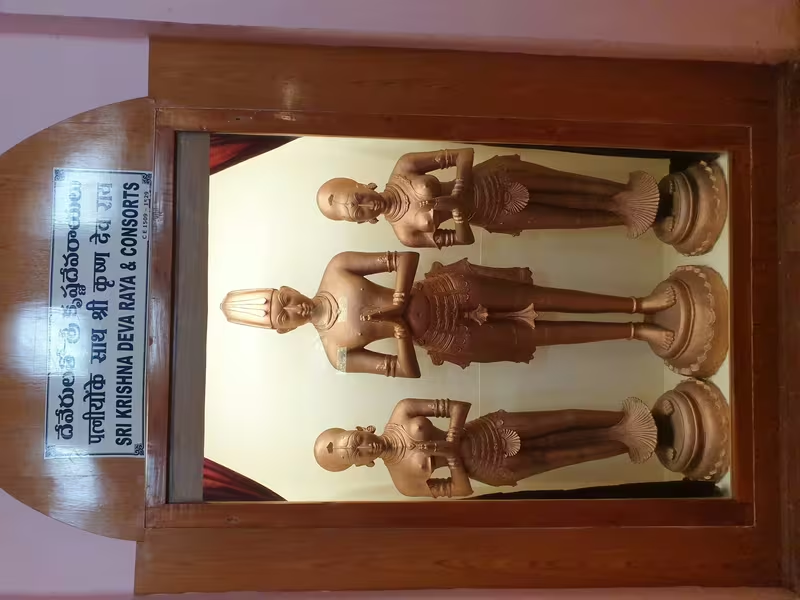

The Weeping Prince: How Krishnadevaraya Inherited an Empire
The oil lamps flickered in the royal bedchamber, casting restless shadows across the carved stone walls of Vijayanagara's palace. Outside, the capital city of the greatest empire in South India hummed with anxious whispers. Inside, a young prince wept.
The Deathbed Vigil
It was 1509, and Prince Krishnadevaraya—thirty-eight years old but still considered young by the standards of imperial succession—had not left his half-brother's side for three days. King Viranarasimha lay dying, his breath growing shallower with each passing hour. The physicians had done all they could. Now it was a matter of waiting.
Krishnadevaraya pressed his forehead against the edge of the ornate bed, his tears soaking into the silk coverlets. He had always looked up to Viranarasimha, who had ruled the Vijayanagara Empire with steady competence since their father's death. Their father, Tuluva Narasa Nayaka, had been a military commander who seized power to prevent the empire's disintegration, establishing the Tuluva dynasty. Now that dynasty's future hung in the balance.
From the doorway, courtiers watched in silence. Some exchanged meaningful glances. The empire needed a successor, and there were several senior claimants with stronger claims than this grief-stricken prince. Krishnadevaraya was known more for his scholarly pursuits and his devotion to literature than for the ruthless political acumen required to hold together an empire constantly threatened by the Deccan Sultanates to the north.
What none of them knew—what even Krishnadevaraya himself did not suspect—was that the dying king had already made his choice.
In the shadows near the bed stood Timmarusu, the empire's prime minister. His weathered face revealed nothing, but his mind was working furiously. For weeks, he had counseled Viranarasimha on the succession. The king had other options: experienced generals, ambitious nobles, even distant relatives with royal blood. But Viranarasimha had seen something in his younger half-brother that others missed.
"He has our father's heart," the king had whispered to Timmarusu days earlier, when he could still speak clearly. "And more importantly, he has the wisdom to listen."
The Unexpected Succession
As dawn broke on the fourth day, Viranarasimha stirred. The room fell silent. Krishnadevaraya lifted his head, hope and dread warring in his chest.
The dying king's eyes opened. With tremendous effort, he raised one trembling hand and pointed directly at his half-brother. His voice, when it came, was barely a whisper, but in the hushed chamber, every word carried with the weight of imperial decree.
"Krishnadevaraya... shall be... emperor."
The prince's eyes widened in shock. Around the room, courtiers leaned forward, some gasping audibly. Senior nobles exchanged dark glances. This was not the succession they had anticipated.
"Brother, no," Krishnadevaraya protested, his voice breaking. "I am not ready. There are others more—"
"You are ready," Viranarasimha interrupted, mustering his last reserves of strength. "Timmarusu will guide you. Trust him as I have. Protect the empire... from those who would see it fall."
The king's hand fell back to the bed. His eyes closed for the final time. Viranarasimha, ruler of Vijayanagara, was dead.
Krishnadevaraya remained frozen, tears streaming down his face, unable to process what had just happened. In the span of a single breath, he had lost his brother and gained an empire. The weight of it threatened to crush him.
Timmarusu stepped forward and placed a firm hand on the new emperor's shoulder. "Your Majesty," he said quietly, using the title deliberately. "The empire needs you now."
Around them, the courtiers were already calculating their positions in this new order. Some knelt immediately in obeisance. Others hesitated, their ambitions suddenly complicated by this unexpected turn. But all recognized that the succession had been declared, witnessed by dozens, and backed by Timmarusu—the most powerful man in the empire after the emperor himself.
Krishnadevaraya would later credit Timmarusu as "the architect of his rise to the throne," according to historical accounts. In that moment of overwhelming grief and responsibility, the prime minister's steady presence was the only thing keeping the young emperor from collapsing under the weight of his inheritance.
Baptism by Fire
The doubters did not have to wait long to test the new emperor.
Within months of Krishnadevaraya's coronation, scouts brought urgent news to the capital. The Deccan Sultans, sensing opportunity in the transition of power, had launched coordinated raids on Vijayanagara's northern territories. Towns were being plundered, temples desecrated, and the empire's prestige was under direct assault.
In the council chamber, senior generals argued for caution. "Your Majesty should remain in the capital," one grizzled commander insisted. "Let us handle this threat. You have not yet consolidated your position."
But Krishnadevaraya surprised them all. The scholarly prince who had wept at his brother's deathbed had transformed into something else entirely. "I will lead the army myself," he declared, his voice carrying an authority that silenced the room.
Timmarusu smiled slightly. Perhaps Viranarasimha had seen more clearly than any of them.
The young emperor's first campaign was a revelation. Portuguese travelers Domingo Paes and Duarte Barbosa, who would later visit his court, recorded accounts of his military prowess. Krishnadevaraya didn't just command from the rear—he personally led charges, tended to wounded soldiers, and demonstrated an uncanny ability to change battle plans mid-fight, turning potential defeats into stunning victories.
When Sultan Mahmud of the Bahmani Sultanate met Krishnadevaraya's forces in battle, he expected to face a green, untested ruler. Instead, he found himself severely wounded and routed. Yusuf Adil Shah was killed in the campaign, and the strategically vital Raichur Doab was annexed to Vijayanagara.
The raids and plunder of Vijayanagara towns by the Deccan sultans—a constant plague for decades—came to an abrupt end. The young emperor had announced his arrival on the stage of Indian politics not with words, but with decisive military action.
The Siege of Udayagiri
By 1514, Krishnadevaraya had set his sights on an even more ambitious target: the subjugation of Odisha and its powerful Gajapati kingdom.
The fortress of Udayagiri stood as the key to the entire campaign—a massive stronghold perched on rocky heights, considered impregnable by its defenders. The Gajapati kings had ruled from here for generations, and their military reputation was formidable.
Krishnadevaraya surveyed the fortress from a nearby hilltop, his commanders gathered around him. The siege would require patience, ingenuity, and resources. But the emperor who had once been dismissed as too scholarly, too gentle for the throne, had developed a reputation for achieving the impossible.
The siege of Udayagiri became legendary. Krishnadevaraya employed a combination of military pressure and psychological warfare, cutting off supply lines while simultaneously offering honorable terms. When the fortress finally fell, it marked a turning point in South Indian geopolitics.
The subjugation of Odisha in 1514 made Krishnadevaraya the dominant ruler of the Indian peninsula. The poet Mukku Timmana, who witnessed these triumphs, would later praise him as the "Destroyer of the Turks," a title that reflected his string of victories against the Sultanates.
The Emperor's Court
But Krishnadevaraya was not merely a conqueror. As his military reputation grew, so too did his court's cultural magnificence.
In the great throne room of Vijayanagara, the emperor who had once wept helplessly at his brother's deathbed now received tribute from defeated kings. The Gajapati ruler himself came to pay homage, acknowledging Krishnadevaraya's supremacy.
Yet what struck visitors most was not the emperor's military might, but his cultivation of arts and scholarship. The court became home to the Ashtadiggajas—eight legendary Telugu poets including Allasani Peddana and Mukku Timmana. Literary activity flourished not only in Telugu but also in Sanskrit, Kannada, and Tamil.
Timmarusu, the prime minister who had guided Krishnadevaraya's rise, watched with satisfaction as the young prince he had championed became the embodiment of both warrior and scholar. The empire was experiencing what would later be called a golden age.
Krishnadevaraya himself composed poetry, including the Telugu masterpiece Amuktamalyada, celebrated for its literary and devotional value. The emperor who commanded armies by day spent his evenings debating literary theory with his court poets, or exchanging witty banter with Tenali Ramakrishna, the clever poet who became his advisor and friend.
The Golden Age
By 1520, when Krishnadevaraya achieved a decisive victory against the Sultan of Bijapur, his reputation had spread far beyond South India. When the Mughal emperor Babur surveyed the rulers of India, he considered Krishnadevaraya the most powerful, ruling over the most extensive empire in the subcontinent.
In his palace study, surrounded by manuscripts and scrolls, the emperor reflected on his unlikely journey. He remembered the terrified young prince who had knelt at his brother's deathbed, certain he was unworthy of the throne. He remembered Timmarusu's steady hand on his shoulder, the prime minister's unwavering faith in his potential.
The Ashtadiggajas poets gathered around him on these evenings, and they would discuss not just literature, but philosophy, statecraft, and the nature of power itself. Krishnadevaraya had learned that true strength lay not in military might alone, but in the cultivation of culture, the patronage of arts, and the wisdom to surround oneself with brilliant minds.
He had been conferred with numerous honorific titles: Andhra Bhoja ("Bhoja of Andhra"), Karnatakaratna Simhasanadeeshwara ("Lord of the Jewelled Throne of Karnataka"), Mooru Rayara Ganda ("Lord of Three Kings"). But perhaps the most meaningful was Gaubrahmana Pratipalaka—"Protector of Cows and Brahmins"—a title that reflected his role as defender of dharma and culture.
Legacy of the Weeping Prince
On a clear evening in the later years of his reign, Emperor Krishnadevaraya stood on the palace ramparts, gazing out over Vijayanagara. The city sprawled below him in magnificent splendor—temples with gilded towers, bustling markets, gardens and palaces that drew admiration from visitors across the known world.
Domingo Paes and Duarte Barbosa, the Portuguese travelers who had come to his court, stood nearby. They would later write accounts describing him as "an able administrator and an exceptional military commander" who personally tended to wounded soldiers—a detail that revealed the compassionate heart beneath the warrior's armor.
Krishnadevaraya thought back to that terrible night in 1509, when he had knelt weeping beside his dying brother, overwhelmed by grief and unworthiness. Viranarasimha had seen something in him that he could not see in himself. And Timmarusu had nurtured that potential into reality.
The young prince who thought himself unready had become the greatest emperor in Indian history, presiding over the empire at its political and cultural zenith. He had defeated the sultans of Bijapur, Golconda, the Bahmani Sultanate, and the Gajapatis of Odisha. He had expanded the empire to unprecedented heights. But perhaps more importantly, he had proven that a ruler could be both warrior and poet, both conqueror and patron of arts.
When Krishnadevaraya died on October 17, 1529, he left behind an empire at its peak and a legacy that would echo through Indian history. The weeping prince had become a legend—remembered not just for his military victories, but for ushering in a golden age when South India shone with unprecedented brilliance.
His story remains a testament to the unpredictability of history, the wisdom of seeing potential where others see only weakness, and the transformative power of responsibility thrust upon those who doubt themselves most. In the annals of Indian history, few rulers achieved what Krishnadevaraya accomplished in his twenty-year reign. And it all began with a young prince weeping at his brother's deathbed, unaware that he was about to inherit greatness.