Overview
At the Beas River in the summer of 326 BCE, Alexander's army refused to march farther east. Beyond the river lay the territories of the Gangaridai and the Prasii, a powerful kingdom that modern historians generally identify with the Nanda Empire. Greek accounts described this eastern power as possessing an army many times larger than the Macedonian force. Whether the numbers were accurate or deliberately exaggerated, the report reveals how formidable the Nandas appeared to soldiers who had already spent years campaigning across Asia.
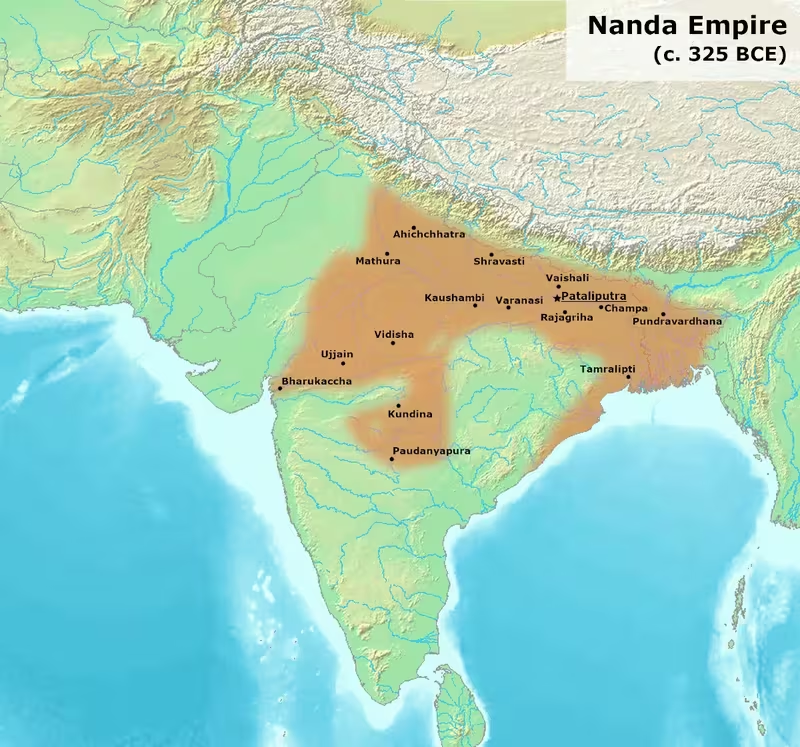
The Nanda Empire grew from Magadha, a kingdom in the middle and lower Gangetic region. Its capital was Pataliputra, located near present-day Patna, at the meeting point of the Ganges and Son rivers. From this strategic centre, the Nandas consolidated the achievements of the Haryanka and Shaishunaga rulers and created what appears to have been the first great empire of northern India. Their authority extended across much of the Gangetic plain and probably reached Kalinga in the east, while control of Avanti and other western or central territories is considered probable but not equally certain.
The dynasty is remembered through several contrasting traditions. Buddhist, Jain, Puranic, and Greco-Roman accounts agree that the Nandas possessed immense wealth and that the final ruler was overthrown by Chandragupta Maurya. They differ, however, over the dynasty's ancestry, the names and order of its kings, the length of its rule, and the exact limits of its empire. The Nandas therefore stand at the intersection of historical evidence and later political memory: they were powerful enough to alarm Alexander's troops, yet their reputation for heavy taxation and unpopular rule helped justify their replacement by the Mauryas.
Rise to Power
Magadha before the Nandas
The Nandas did not create Magadha's power from nothing. Earlier Haryanka and Shaishunaga rulers had already expanded the kingdom and established its importance in the middle Gangetic region. Magadha's geographical position was particularly favourable. Pataliputra stood near major rivers that connected the kingdom with routes across the Gangetic plain. The surrounding region possessed fertile land, forests, timber, and access to elephants, all of which supported agriculture, transport, and warfare.
The location of Magadha also placed it near the political centres of northern India. Earlier Magadhan rulers had competed with or subordinated neighbouring regions such as Kosala, Kashi, and Avanti. The Nandas inherited these opportunities for expansion and appear to have pursued them on a larger scale.
Historians have proposed different reasons for Magadha's political success. Some have suggested that the region was relatively distant from the heartland of Brahmanical orthodoxy and that this created a more open environment for new political and religious movements. This interpretation remains disputed. Another theory gave a major role to Magadha's supposed monopoly over iron resources, but that argument has also been challenged because Magadha did not possess an exclusive hold over iron and intensive iron mining in the historical region began later than the period in question. Access to the mineral-rich Chota Nagpur Plateau and to other raw materials was nevertheless potentially valuable.
Traditions about the dynasty's founder
The identity and ancestry of the first Nanda ruler are uncertain. The Puranas name the founder as Mahapadma and describe him as the son of the Shaishunaga king Mahanandin. At the same time, they state that his mother belonged to the Shudra varna. The Buddhist tradition gives the dynasty an “unknown lineage,” while the Mahavamsa calls its founder Ugrasena, originally a man from the frontier who fell into the hands of robbers and later became their leader.
Greco-Roman and Jain traditions preserve a different story. According to accounts associated with Diodorus and Curtius, the founder was the son of a barber. The barber supposedly gained access to the royal household, became the former queen's favourite, and seized power through murder and deception. Jain accounts recorded in the Avashyaka Sutra and the Parishishtaparvan similarly connect the first Nanda king with a barber and, in one version, with a courtesan mother.
These accounts may contain hostile political judgments rather than neutral biography. Low social origin was a recurring theme in stories about dynasties that displaced older ruling families. Yet the barber ancestry appears in both Jain and Greco-Roman traditions, which developed separately. For this reason, some historians regard it as more historically plausible than the Puranic claim of direct Shaishunaga descent, though certainty is impossible.
The conflicting traditions also reveal an important feature of Nanda history. Later writers were concerned not only with what the Nandas had achieved but also with whether their origins gave them legitimate authority. The dynasty's critics portrayed its founder as an outsider who rose through intrigue. Other traditions implied that the Nandas claimed Kshatriya status. The Jain account of the last Nanda king's daughter marrying Chandragupta Maurya because Kshatriya women were expected to choose their husbands suggests that the Nanda court presented itself as part of the warrior ruling class.
The chronology problem
The dates of Nanda rule are not firmly established. The Sri Lankan Buddhist tradition gives the dynasty a reign of 22 years, leading historians Irfan Habib and Vivekanand Jha to place it approximately between 344 and 322 BCE. Upinder Singh proposes a broader chronology beginning around 364 or 345 BCE and ending around 324 BCE. Another theory, based on astronomical calculations and an interpretation of the Hathigumpha inscription, places the rise of the first Nanda ruler as early as 424 BCE.
The ancient texts disagree substantially. The Matsya Purana assigns 88 years to Mahapadma alone, while some manuscripts of the Vayu Purana give the entire dynasty a duration of 40 years. The Buddhist scholar Taranatha gives the Nandas 29 years. The Jain writer Merutunga, writing in the fourteenth century, describes nine Nanda kings whose combined rule lasted 155 years, but his chronology would place them much earlier than the dates generally used for the dynasty associated with Alexander's invasion.
For the late fourth-century BCE Nanda Empire, the most commonly used working chronology is approximately 344–322 BCE, though both dates should be treated as approximate. The relationship between an earlier Nanda phase and the later imperial dynasty remains unresolved.
Golden Age
A new imperial power
The Nandas appear to have transformed Magadha from a powerful regional kingdom into an extensive imperial state. The Puranas describe Mahapadma as an “ekarat,” or sole ruler, suggesting a monarchy with a strong central authority. They also credit him with destroying or subduing a long list of Kshatriya ruling groups, including the Maithalas, Kasheyas, Ikshvakus, Panchalas, Shurasenas, Kurus, Haihayas, Vitihotras, Kalingas, and Ashmakas.
The word “destroyed” need not mean that every population in these territories was physically eliminated. It may refer to the removal of independent ruling houses, the absorption of their territories, or the replacement of local rulers by subordinate authorities. The Nanda state may therefore have combined a strongly controlled core in Magadha and the eastern Gangetic plain with more flexible arrangements in distant regions.
The empire's capital at Pataliputra was ideally suited to this political system. Rivers allowed the movement of people, goods, and armies. The Ganges connected Pataliputra with the eastern and western Gangetic regions, while the Son opened routes toward central India. A capital at this junction could coordinate expansion while drawing on the agricultural resources of the plains.
Western and northern reach
Greek accounts describe a great kingdom east of the Jhelum River. Its rulers are called the kings of the Gangaridai and the Prasii. “Prasii” is generally connected with the Sanskrit Prachya, meaning eastern people, while “Gangaridai” is linked to the Gangetic plain. The capital, called Palibothra, is generally identified as Pataliputra.
The Greek descriptions imply that the Nanda sphere of power extended far beyond Bihar. Alexander expected to confront the ruler of this eastern kingdom if he continued from Punjab toward the Ganges. This expectation suggests that the Nanda state, or a political formation under its influence, reached at least as far as the western Gangetic region.
The Panchalas occupied the Ganges valley northwest of Kosala. There are no clear records of conflict between the Panchalas and earlier Magadhan rulers, so their incorporation may have occurred during the Nanda period. The Kuru territory, including Kurukshetra, lay west of Panchala. Greek references to the authority of the Gangaridai and Prasii over this area may provide indirect evidence of Nanda expansion.
The Shurasenas ruled around Mathura. Greek accounts identify them as subordinate to the king of the Prasii. If this report is accurate, the Nandas exercised authority over a significant section of the upper Gangetic region. The Ikshvaku territory of Kosala, in present-day Uttar Pradesh, may also have come under Nanda power. A later literary reference to a Nanda military camp at Ayodhya suggests a campaign or continuing presence in Kosala, although it does not by itself prove permanent annexation.
Kalinga and the east
The Nandas appear to have held at least part of Kalinga, a coastal region corresponding broadly to present-day Odisha and parts of Andhra Pradesh. The main evidence is the Hathigumpha inscription of the later ruler Kharavela. It states that a Nanda king excavated a canal in Kalinga and removed a Jain image from the region.
The inscription is difficult to interpret precisely. It describes the canal as having been constructed “ti-vasa-sata” years earlier. This expression has been read either as “three hundred” or “one hundred and three” years. The inscription therefore confirms a remembered Nanda connection with Kalinga but does not provide an uncontested date for the conquest or the canal's construction.
The canal reference is significant because it suggests more than a brief raid. Irrigation works required organisation, labour, and an interest in the region's agricultural infrastructure. At the same time, the inscription does not establish how directly Kalinga was administered or how long Nanda authority lasted there.
Central India and the Deccan
Nanda control of Avanti is considered highly probable. Avanti, centred in central India, had long been an important political region, and the Shaishunagas were said in the Puranas to have subdued its rulers. Jain traditions describe the Nandas as successors of Palaka, the son of the Avanti ruler Pradyota, and say that the Nandas captured Ujjayini. These accounts may preserve a memory of Magadhan expansion into central India.
The Haihayas of the Narmada valley may also have come under Nanda influence. Their capital was Mahishmati. Such control would have been strategically valuable because the Narmada valley connected northern and central India. It would also have helped explain how the Mauryas later possessed authority in regions west and south of the traditional Magadhan core.
The position of the Vitihotras is less clear. Puranic traditions associate them with the Haihayas, but other passages place them in relation to the Shaishunagas and the older Pradyota line. The Nandas may have removed or subordinated a surviving local ruler, but the evidence is not conclusive.
Claims that the Nandas ruled south of the Vindhya range are even more uncertain. The Ashmakas occupied the Godavari valley, and a theory connects Nanda rule with the place-name “Nau Nand Dehra,” interpreted as the abode of the nine Nandas. Punch-marked coins from the Amaravathi hoard include imperial-standard pieces associated with Magadhan dynasties, including the Nandas and Mauryas. Yet the coins cannot establish when the region was annexed or whether they represent direct political control.
Much later inscriptions from the Kuntala region list the Nandas, Guptas, Mauryas, Rashtrakutas, Chalukyas, Kalachuris, and Hoysalas as successive rulers. Because these inscriptions date from around the twelfth century CE, they cannot reliably prove Nanda rule in present-day Karnataka. The Mauryan Empire certainly reached parts of southern India, but there is no satisfactory account explaining when or how that expansion began under the Nandas.
Administration and Governance
Central authority and regional autonomy
The surviving evidence for Nanda administration is limited. The Puranic description of the Nanda ruler as ekarat points toward an integrated monarchy rather than a loose collection of independent states. The dynasty's reputation for taxation, military organisation, and wealth also suggests that the court possessed mechanisms for extracting resources from a large territory.
Greek accounts, however, describe political arrangements that may have been more varied. Arrian refers to territories beyond the Beas as being governed by aristocracies that exercised authority with justice and moderation. Greek writers also name the Gangaridai and the Prasii separately, even while presenting them as subject to a common king. These details may indicate a confederation, a layered empire, or simply the Greek tendency to divide unfamiliar political geography into separate peoples.
A useful interpretation is that Nanda control was strongest in the Magadhan heartland and the central Gangetic plain. Frontier regions may have retained local dynasties, aristocracies, or administrative customs while acknowledging the authority of the Nanda monarch. Buddhist legends support this possibility. They state that Chandragupta initially failed when he attacked the Nanda capital but succeeded after gradually conquering the empire's frontier areas. Although the story is shaped by later narrative purposes, it suggests a distinction between the heavily defended core and the more negotiable periphery.
Ministers and officials
Jain traditions preserve the names of several ministers associated with the Nandas. Kalpaka is described as the minister of the first Nanda king. He is said to have accepted office reluctantly but then encouraged an aggressive policy of expansion. The story may reflect the memory of a powerful ministerial role in the early empire.
The same tradition presents ministerial offices as hereditary. After the death of Shakatala, a minister of the last Nanda king, the post was offered to his son Sthulabhadra. Sthulabhadra refused and became a Jain monk, after which his brother Shriyaka accepted the office. Whether this succession occurred exactly as described cannot be verified, but the account suggests that elite families played an important role in the administration.
The existence of prominent ministers does not mean that the Nanda monarchy was weak. On the contrary, hereditary administrative families could strengthen the state by preserving expertise and continuity. They could also become politically influential and create tensions at court.
Taxation and measurement
Ancient traditions repeatedly associate the Nandas with heavy taxation. The Mahavamsa says that the last Nanda ruler taxed a wide range of goods, including skins, gums, trees, and stones. This list may be literary, but it conveys the impression of a government seeking revenue from many sectors of the economy rather than relying only on land taxes.
A commentary on Panini's grammar, the Kashika, refers to Nandopakramani manani, interpreted as a measuring standard introduced under the Nandas. The phrase may indicate an official system of weights or measures. Standardisation would have been useful for taxation, trade, state procurement, and the circulation of coinage.
The Nandas are also associated with the use or introduction of a new currency system and punch-marked coins. A hoard from ancient Pataliputra may belong to the Nanda period, though its precise date is uncertain. The combination of standardised measures, coinage, and extensive taxation offers one possible explanation for the dynasty's enormous wealth.
Military Campaigns
The imperial army
The Nanda military was famous before it was ever tested against Alexander. Curtius reports that the king identified as Agrammes possessed 200,000 infantry, 20,000 cavalry, 3,000 elephants, and 2,000 four-horse chariots. Diodorus gives the elephant corps as 4,000. Plutarch gives still larger figures: 200,000 infantry, 80,000 cavalry, 6,000 elephants, and 8,000 chariots.
These numbers are difficult to accept literally. Greek writers often relied on reports from local informants, and populations facing an invading army had reasons to exaggerate the size of a distant enemy. The figures may also have reflected the combined military resources of a large kingdom rather than a single force assembled in one place. Even if the totals were inflated, the repeated emphasis on infantry, cavalry, elephants, and chariots indicates that the Nanda state was believed to command substantial military resources.
The elephant corps was especially important in the imagination of Greek soldiers. War elephants could disrupt formations, intimidate cavalry, and serve as mobile platforms for fighters. The Nanda reputation for possessing thousands of elephants may have contributed to the Macedonian troops' refusal to advance beyond the Beas.
Expansion in northern India
The Puranic list of defeated Kshatriya groups presents the Nandas as conquerors of much of northern and central India. Each identification must be treated cautiously, but the list covers a broad arc: Mithila north of Magadha, Kashi and Kosala to the west, Panchala and Kuru country farther northwest, Mathura and the Shurasena region, Kalinga in the east, and Haihaya and Ashmaka territories farther south.
The Nandas likely used a combination of direct conquest, subordination, and the replacement of local ruling houses. In some regions, existing elites may have continued to administer their territories under imperial oversight. In others, the Nandas may have installed officials or maintained military camps.
A passage in the Kathasaritsagara refers to a Nanda camp at Ayodhya. Though the work is much later, the reference fits a wider picture of Nanda campaigning in Kosala. The Jain tradition that a Nanda minister subjugated the entire country up to the coast similarly portrays the dynasty as pursuing a broad expansionist programme.
Alexander and the Beas mutiny
Alexander invaded northwestern India between 327 and 325 BCE. His army crossed the Indus and fought in the territories of several rulers, including King Porus. After years of campaigning, the Macedonian force reached the Beas River. The country beyond it was associated with the Gangaridai and the Prasii and was ruled, according to modern interpretations, by the Nanda king Dhana Nanda.
The prospect of fighting this kingdom contributed to the soldiers' mutiny. They had already begun expressing a desire to return home at Hecatompylos in 330 BCE. Resistance in northwestern India, difficult terrain, distance from Macedonia, and the prospect of facing a much larger army intensified their opposition. At the Beas, they refused to proceed.
Alexander eventually withdrew. The Nanda army never met the Macedonian army in battle, so the encounter is best understood as a strategic and psychological victory for the eastern kingdom rather than a battlefield triumph. The Nandas helped shape the limits of Alexander's Indian campaign simply by being powerful enough—or being believed powerful enough—to make further advance unacceptable to his exhausted troops.
Cultural Contributions
Pataliputra as a centre of learning
The Nanda capital was not only a political and economic centre. The Brihatkatha tradition describes Pataliputra as the home of both Lakshmi, the goddess of material prosperity, and Sarasvati, the goddess of learning. It associates the city with grammarians such as Varsha, Upavarsha, Panini, Katyayana, Vararuchi, and Vyadi.
Much of this account is regarded as unreliable folklore, and the dates of the named scholars are not all secure. It is nevertheless plausible that some grammarians who preceded Patanjali lived during or near the Nanda period. Pataliputra's political importance, wealth, and access to scholars would have created favourable conditions for intellectual activity.
The connection between the Nandas and grammar is also reflected indirectly in the reference to Nanda standards of measurement in the Kashika commentary on Panini. This does not prove a formal royal academy, but it suggests that Nanda rule was remembered in relation to administrative and intellectual standardisation.
Religious life
The Nandas appear to have ruled in a religiously plural environment. According to the interpretation of Bronkhorst cited in the historical tradition, the Nandas and Mauryas patronised religions associated with the Greater Magadha region, especially Jainism and Ajivikism. The rulers did not, however, appear to force their subjects to convert or to discriminate systematically against other religions.
Buddhist sources preserve important memories of the dynasty, even though the Nandas themselves are not presented as major Buddhist patrons in the surviving accounts. Jain traditions are more prominent in stories about Nanda ministers and court politics. Shakatala's son Sthulabhadra is said to have rejected ministerial office and become a Jain monk.
The relationship between the Nandas and Brahmanical traditions is debated. One interpretation holds that Magadha lay outside the central area of Vedic Brahmanism and that the rise of the Nandas and Mauryas weakened established Brahmanical patronage. Other scholars have criticised a sharp division between eastern and western religious cultures and have argued that the evidence does not support treating the Shramana traditions of Magadha as simply non-Brahmanical or anti-Brahmanical. The surviving evidence is too limited to reduce Nanda religious policy to a single formula.
Architecture and public works
Few securely identified Nanda monuments survive. A polished granite fragment from Kumhrar at Pataliputra has been interpreted by K. P. Jayaswal as a pre-Mauryan or Nanda-period keystone from a trefoil arch gateway. The stone bears mason's marks in three archaic Brahmi letters and has Mauryan polish on two sides. Its original structure and date remain matters of interpretation.
The Hathigumpha inscription provides a clearer, though still indirect, connection between the Nandas and public works. It credits a Nanda king with excavating a canal in Kalinga. The inscription's dating expression is disputed, but the reference indicates that Nanda rule was remembered in relation to irrigation and regional infrastructure.
These fragments should not be turned into a picture of a fully documented Nanda architectural style. Much of the monumental material later associated with Pataliputra belongs to the Mauryan period or cannot be securely dated. The evidence does, however, suggest that the Nanda state had the resources to sponsor construction and public works.
Economy and Trade
The wealth of the Nandas
The Nandas became almost proverbial for wealth. The Mahavamsa says that the last Nanda king accumulated treasure worth 80 kotis, or 800 million, and buried it in the bed of the Ganges. The story may be symbolic rather than a literal financial account, but it reflects the dynasty's powerful association with hoarded wealth.
The same tradition says that the king expanded taxation to include skins, gums, trees, and stones. Such details portray a government that sought revenue from natural resources, craft production, and commercial goods. They also help explain why later Buddhist traditions described the Nandas as greedy and oppressive.
A Tamil verse attributed to Mamulanar refers to the “untold wealth of the Nandas.” The verse has been interpreted in two ways: it may say that the wealth was swept away and submerged by the floods of the Ganges, or that it was deliberately hidden in the river. Both readings preserve the same central image of extraordinary riches connected with the Nanda treasury.
A passage in Xenophon's Cyropaedia describes the king of India as exceptionally wealthy and interested in arbitrating disputes among western Asian kingdoms. The work is set in the sixth century BCE, before the generally accepted Nanda period, so it cannot be used as direct evidence. H. C. Raychaudhuri suggested that Xenophon's image of a wealthy Indian monarch may nevertheless have been influenced by knowledge of the contemporary Nanda king.
Currency and standards
The Nandas may have introduced or reorganised a currency system based on punch-marked coins. The Kashika's reference to a Nanda measuring standard supports the possibility of administrative reforms intended to make economic transactions more regular. A state that collected taxes in many forms would benefit from common units of weight and value.
The Amaravathi hoard includes imperial-standard punch-marked coins associated with Magadhan dynasties, including the Nandas and Mauryas. Because the hoard contains coins from more than one dynasty, it cannot by itself reveal when the region entered the Nanda sphere. It does, however, show the broader circulation of Magadhan monetary forms.
Trade and geography
Pataliputra's position on the Ganges and Son made it a natural hub for movement between eastern India, the central Gangetic plain, and routes toward the northwest. Fertile agricultural land supported the capital and its army. Forests provided timber, while nearby areas supplied elephants and other resources useful to the state.
The possible Nanda presence in Kalinga would have connected the empire with eastern coastal zones. Control or influence in Avanti and the Narmada region would have opened routes toward central and western India. The empire's wealth was therefore likely based on a combination of agrarian surplus, taxation, resource extraction, and long-distance exchange.
Decline and Fall
An unpopular dynasty
Ancient accounts are remarkably consistent in describing the last Nanda king as unpopular, although the language they use is shaped by later political and moral judgments. Diodorus reports that Porus considered the contemporary Nanda king a man of worthless character who lacked the respect of his subjects because of his low origin. Curtius gives a similar account. Plutarch, describing traditions about Chandragupta's meeting with Alexander, says that the Nanda king was hated and despised because he was wicked and of low birth.
The Sri Lankan Buddhist tradition emphasises greed and oppressive taxation. The Puranas describe the Nandas as adharmika, meaning that they did not follow the norms of righteous conduct. These descriptions may have served to legitimise the Mauryan takeover: if the Nandas were low-born, greedy, or unrighteous, their defeat could be represented as the restoration of proper political order.
Still, the repetition of these themes suggests that dissatisfaction with the dynasty may have been real. A large empire required substantial revenue to support its army and administration. Taxation that strengthened the state could simultaneously alienate cultivators, merchants, local elites, and religious communities. The Nandas' social origins may also have made them vulnerable to criticism from groups that valued hereditary Kshatriya legitimacy.
Chandragupta Maurya and Chanakya
The Nanda dynasty was overthrown by Chandragupta Maurya, supported by his mentor and later minister Chanakya. The details of the conquest are preserved in sources written at different times and cannot all be verified. Some accounts present Chandragupta as unrelated to the Nandas, while others describe him as a member of the Nanda family.
The 11th-century writers Kshemendra and Somadeva call Chandragupta a “son of the genuine Nanda.” A later commentary by Dhundiraja on the Vishnu Purana names Chandragupta's father as Maurya, the son of the Nanda king Sarvatha-siddhi and a woman named Mura. The Puranas themselves do not establish this relationship. These traditions may represent attempts to connect the Mauryas to the preceding dynasty and explain how Chandragupta gained access to the throne.
The Buddhist text Milinda Panha describes a war between the Nanda general Bhaddasala, or Bhadrashala, and Chandragupta. It gives enormous casualty figures: 10,000 elephants, 100,000 horses, 5,000 charioteers, and a billion foot soldiers. The numbers are clearly exaggerated, but the story conveys the impression of a violent and large-scale struggle rather than a peaceful succession.
The conquest may have proceeded in stages. Buddhist legends say that Chandragupta failed when he first attacked the Nanda capital but later succeeded by taking the frontier territories one by one. Whether literally accurate or not, this narrative fits the possibility that Nanda authority was stronger around Pataliputra than in distant regions.
By approximately 322 BCE, the Nanda dynasty had been displaced and Chandragupta had established the Maurya Empire. The Mauryas inherited the Nanda capital, the administrative core of Magadha, and much of the imperial territory assembled by their predecessors.
Legacy
The Nandas occupy a crucial place in the transition from the age of regional mahajanapadas to the age of large territorial empires. They expanded the power of Magadha beyond the middle Gangetic region and created a political structure that the Mauryas could inherit and enlarge. The Mauryan Empire is more fully documented and left a stronger monumental record, but its rise depended in part on the resources, institutions, and territorial networks developed under the Nandas.
Their military reputation also shaped the history of Alexander's invasion. Alexander's army did not fight the Nandas, yet the prospect of confronting their forces helped bring the campaign to an end at the Beas. The Nandas thus influenced the encounter between the Macedonian world and northern India without appearing directly on a battlefield described by Greek historians.
The dynasty's reputation for wealth has lasted equally strongly. Later accounts connected the Nandas with vast treasuries, hidden riches, taxation, and standardised measures. These memories may preserve the effects of a state that had learned to mobilise resources on an imperial scale.
At the same time, the Nandas demonstrate the difficulty of writing early Indian political history. Their founder may have been Mahapadma, Ugrasena, or another ruler remembered under different names. Their chronology may have begun earlier than the fourth century BCE. The number of kings, their names, and the exact extent of their territory vary between Buddhist, Jain, Puranic, and Greco-Roman accounts. Archaeology and inscriptions confirm particular aspects of their activity but do not yet provide a complete narrative.
The most balanced view sees the Nandas as powerful state-builders whose central authority, taxation, military organisation, and territorial expansion made Magadha the dominant political force in northern India. Their fall was not simply the collapse of an incapable dynasty. It was the transfer of an already formidable imperial structure to Chandragupta Maurya.