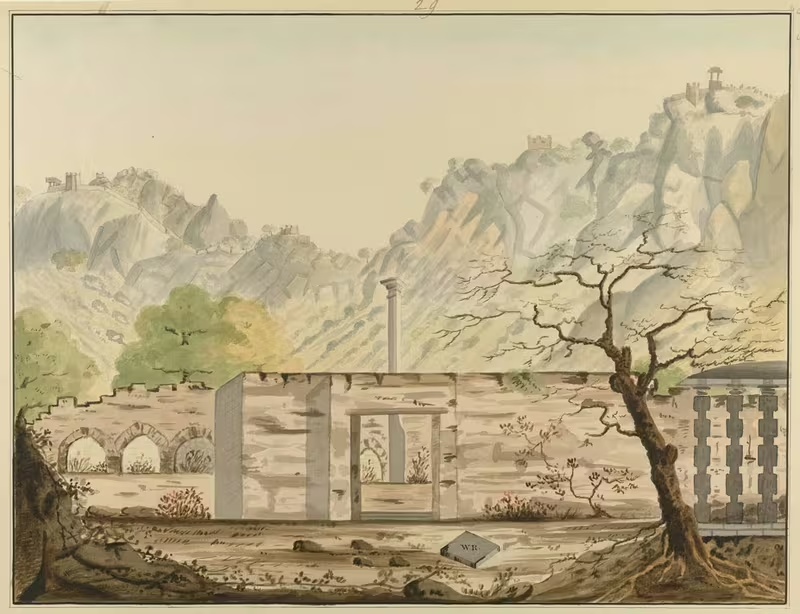
Overview
In 1325, amid the political disorder that followed the fall of the Kakatiya kingdom, Prolaya Vema Reddi established a new power in the Telugu country. The Reddy Kingdom, also known as the Kondavidu Reddy Kingdom, eventually ruled much of coastal and central Andhra, with influence extending into parts of Rayalaseema. It survived from 1325 to 1448, although its territories and political branches changed substantially during that period.
The kingdom emerged after the Delhi Sultanate captured Warangal in 1323 and brought the former Kakatiya domains under the command of Ulugh Khan. Tughlaq authority proved difficult to maintain. Conflict among the occupying forces and resistance from local Telugu warriors weakened central control, and by 1347 the Tughlaqs had lost the region. Musunuri leaders rose in Coastal Andhra, Recherla rulers became powerful in Telangana, and the Reddis established themselves along the coast.
The Reddy rulers were connected to the military and administrative world of the Kakatiyas. Their earlier family designations included Reddi, Raddi, Rattodi, and Rattakudi. The term was associated with village headmen responsible for organising cultivation and collecting taxes, while members of such families could also hold high military office. A copperplate record describes the founder’s grandfather as a sainya-nayaka, or commander of forces.
Rise to Power
Prolaya Vema Reddi, also known as Komati Vema, founded the kingdom in about 1325. His authority grew from the collapse of established Kakatiya rule and the inability of the Delhi Sultanate to impose lasting control over the Telugu region. The new kingdom was therefore not simply an administrative continuation of the Kakatiyas; it was a regional power formed by a warrior lineage with roots in the earlier military order.
The first capital was at Addanki. Prolaya Vema was succeeded by Anavota Reddi, who consolidated the kingdom and established Kondavidu as the capital. Its position and fortifications were important in a landscape where the Reddy rulers faced repeated pressure from the Recherla Velamas and their Bahamani allies.
Golden Age
At its greatest extent, the Reddy Kingdom stretched from Cuttack in Odisha to Kanchi in the south and Srisailam in the west. Its core lay in coastal and central Andhra, while its influence also reached the Palnadu region and areas now associated with Rayalaseema. The kingdom’s power was expressed not only through territorial control but also through a chain of fortified centres.
Kondavidu became the principal political and military centre. Other important forts included Kondapalli, around 20 kilometres north-west of present-day Vijayawada, as well as Bellamkonda, Vinukonda, and Nagarjunakonda. These strongholds guarded routes and regional centres and demonstrate the importance of hill fortifications to Reddy statecraft.
A separate branch was established at Rajahmundry in 1395. It later became independent, creating a political division within the wider Reddy sphere. This branch remained an important power in the Godavari region even as Kondavidu faced increasing pressure from Vijayanagara and other rivals.
Administration and Governance
Reddy administration followed the principles associated with the Dharmasutras. Agriculture formed the main fiscal base, and one-sixth of the agricultural surplus was collected as tax. This measure reflects the continuing importance of village cultivation and agrarian revenue to the kingdom’s political structure.
The rulers also intervened in the conditions of trade. During Anavota Reddi’s reign, customs duties and taxes on trade were lifted. The policy is associated with the expansion of commerce, and merchants settled in large numbers near the port of Motupalli. The port connected the kingdom to maritime trade and gave the coastal territory an economic role beyond subsistence agriculture.
Religious institutions were also part of administration and patronage. Brahmins received grants of land, known as agraharas, and earlier grants were restored. Vedic studies were encouraged, linking royal authority with learned institutions and temple networks.
Military Campaigns
The Reddy Kingdom was shaped by warfare from its beginning. Its creation followed resistance to Tughlaq rule, while its consolidation required competition with neighbouring Telugu warrior lineages. The Recherla Velama rulers were especially important rivals, and their alliances with the Bahmani rulers increased the military pressure on Kondavidu.
The Reddys responded through fortification. Kondavidu and Kondapalli were major hill forts, while Bellamkonda, Vinukonda, and Nagarjunakonda formed part of the broader defensive landscape. The available historical record highlights the forts more clearly than individual battlefield victories, but their scale indicates a sustained effort to protect the kingdom from invasion and regional rivalry.
The political balance shifted in the fifteenth century. In 1424, Kondavidu was annexed by the Vijayanagara Empire. Rajahmundry, governed by the separate branch, was conquered by the Gajapatis approximately twenty-five years later. These events brought the principal Reddy territories under larger regional powers.
Cultural Contributions
The Reddy period was an important era for Telugu literary development. The kings also supported Sanskrit learning, and several members of the ruling family were described as scholars and authors. Kumaragiri Reddi, Kataya Vema Reddi, and Pedakomati Vema Reddi are especially associated with this literary court culture.
Errapragada, also called Errana, was the court poet of Prolaya Vema Reddi and the final member of the Telugu Kavitraya, or Trinity of Poets. He completed the Telugu translation of the Mahabharata, including the Aranya Parva, which Nannaya Bhattu had left incomplete. Errapragada also wrote the Hari Vamsa and Narasimha Purana. His Telugu translation of the Ramayana in Chapu poetic form is now lost. Srinatha and Potana were other major poets associated with the period.
The rulers strongly patronised Hindu institutions. Prolaya Vema Reddi granted numerous agraharas and was praised with the title Apratima-Bhudana-Parasurama. He sponsored major repairs at the Mallikarjuna Swami temple at Srisailam and built a flight of steps from the Krishna River to the shrine. The Narasimha Swamy temple at Ahobilam was built during his reign, and he was credited with constructing 108 temples dedicated to Shiva.
The dynasty’s tutelary deity was Mullamguramma, originally a village goddess associated with Mullanguru in Guntur district. Peddakomati Vema Reddi built a temple for her and endowed it with three villages to support regular worship. In later court tradition at Rajamahendravaram, she was incorporated into the Shaivite religious world and identified with Uma, or Parvati.
Economy and Trade
Agriculture supplied the kingdom’s principal revenue, with a standard tax of one-sixth of the surplus. Coastal geography created additional opportunities. Motupalli served as a maritime port, and the removal of customs duties under Anavota Reddi encouraged merchants to settle nearby. This combination of agrarian taxation, port activity, and reduced trade levies helped connect the inland political centres with coastal commerce.
Decline and Fall
The kingdom’s decline resulted from several pressures rather than a single collapse. Rivalry with the Recherla Velamas and their Bahamani allies challenged Kondavidu’s security, while the Rajahmundry branch’s independence weakened political unity. The expanding Vijayanagara Empire ultimately annexed Kondavidu in 1424.
The Rajahmundry branch survived longer but was later conquered by the Gajapatis. The Reddy Kingdom is generally dated to 1448, marking the end of its independent political presence, even though competition over coastal Andhra continued. The Gajapatis themselves eventually lost control of the coast after Gajapati Prataparudra Deva was defeated by Krishna Deva Raya of Vijayanagara.
Legacy
The Reddy Kingdom’s legacy rests on the political consolidation of post-Kakatiya Andhra, its network of forts, its support for temples and Brahmanical learning, and its contribution to Telugu literary history. Its rulers connected military authority with agrarian administration, religious patronage, and coastal trade. Kondavidu, Motupalli, Srisailam, Ahobilam, and the works of Errapragada all preserve aspects of this medieval regional tradition.
Timeline
Fall of Warangal
The Delhi Sultanate captures Warangal, ending Kakatiya rule and creating political instability in the Telugu country.
Foundation of the Reddy Kingdom
Prolaya Vema Reddi establishes the Reddy Kingdom, initially based at Addanki.
Anavota Reddi succeeds Prolaya Vema
Anavota Reddi consolidates the kingdom and establishes Kondavidu as its capital.
Rajahmundry branch established
A subsidiary Reddy branch is founded at Rajahmundry and later becomes independent.
Kondavidu annexed
The Vijayanagara Empire annexes Kondavidu.
End of the Reddy Kingdom
The independent Reddy political order comes to an end amid Vijayanagara and Gajapati expansion.