Overview
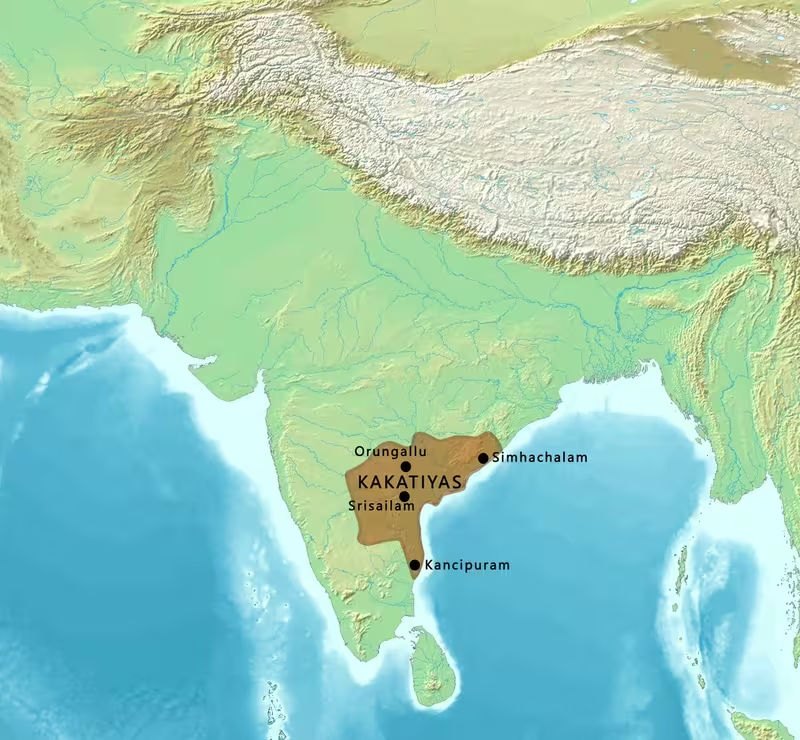
At the height of Kakatiya power, the fortified city of Orugallu stood at the centre of a kingdom that connected the dry uplands of Telangana with the prosperous deltas of the Godavari and Krishna rivers. The Kakatiyas ruled much of the eastern Deccan from the twelfth to the fourteenth century. Their territories covered most of present-day Telangana and Andhra Pradesh and, at different times, extended into parts of eastern Karnataka, northern Tamil Nadu, and southern Odisha.
The dynasty's political history began much earlier than its period of sovereignty. For more than two centuries, Kakatiya chiefs served first under the Rashtrakutas and later under the Western Chalukyas. They held military commands, governed fiefs, fought rival chiefs, and gradually established a territorial base around Anumakonda, now Hanamkonda. In 1163, Rudradeva—also called Prataparudra I—issued an inscription that presented the Kakatiyas as a sovereign power rather than as Chalukya feudatories.
The dynasty's greatest territorial expansion came under Ganapati Deva, who brought the Telugu-speaking lowland deltas into the Kakatiya political sphere. His successor Rudrama Devi continued to defend and fortify the kingdom. Prataparudra II, the last major Kakatiya ruler, faced the growing military power of the Delhi Sultanate. After the capture of Orugallu in 1323, Kakatiya rule ended, although resistance to the Delhi Sultanate soon produced new Telugu political formations.
Kakatiya history is preserved through a large body of inscriptions, literary works, forts, temples, and irrigation structures. Around a thousand stone inscriptions and twelve copper-plate inscriptions are associated with the period, although many records have been lost through the destruction of buildings and later political changes. These surviving materials reveal a society more fluid than the rigid caste ideal described in some later accounts. They also document the growth of Telugu as an administrative and cultural language, the recruitment of peasants into military service, the spread of temple patronage, and the construction of reservoirs in landscapes previously limited by water scarcity.
Rise to Power
Early chiefs and the name Kakatiya
The earliest history of the family is partly genealogical and partly legendary. Kakatiya rulers traced their ancestry to Durjaya, a legendary chief associated with ancient Andhra. Other ruling houses in the region also claimed descent from Durjaya, and little independent information survives about him.
Recently identified copper plates from Kodad in present-day Suryapet district provide early evidence for the family's name and ancestry. Written in Sanskrit using Telugu script and dated to 890 CE, the records mention early Kakatiya ancestors including Saamanta Vetti and Vigraha Vetti, as well as the chiefs Gunda I, Gunda II, and Gunda III. These figures served as military commanders under the Vengi Chalukya king Bhima I. The plates also record grants to temples in a village called Kakarti, near Kondapalli. They therefore connect the family name with an ancestral place and offer the oldest known epigraphic evidence for the name associated with the Kakatiyas.
The spelling of the name was not fixed in the medieval period. Inscriptions and coins use forms such as Kakatiya, Kakatiyya, Kakita, Kakati, and Kakatya. The name could be placed before a ruler's name, producing forms such as Kakatiya-Prataparudra. Some rulers also had alternative names. Venkata and Venkataraya may have been alternative names for Prataparudra I; one coin is described as bearing the form Venkata-Kakatiya.
Several explanations for the name have been proposed within the historical record. The Bayyaram tank inscription, issued during the reign of Ganapati Deva, states that the ninth-century chief Venna lived at Kakati and that his descendants therefore became known as Kakatishas, or “lords of Kakati.” The modern location of this Kakati remains uncertain. Different identifications have connected it with Kakati village in Karnataka or with Kanker in Chhattisgarh. Another later literary tradition places the family's ancestors at Kandarapura, identified with modern Kandhar in Maharashtra, but this tradition has no supporting evidence from other records.
A fifteenth-century commentary gives a different explanation. It connects the family name with a tutelary goddess named Kakati, described as a form of Durga. The worship of a goddess called Kakati or Kakatamma is attested in later literary and inscriptional evidence. One theory proposes that Kakati was originally a Jain goddess, perhaps Padmavati, who later came to be regarded as a form of Durga. The available evidence does not establish one explanation conclusively. A place called Kakati may have contained a shrine to the family's tutelary goddess, allowing both geographical and religious associations to become part of the dynasty's identity.
Rashtrakuta and Chalukya connections
The early Kakatiyas appear in the political world of the Deccan as military chiefs and feudatories. An interpretation of the Mangallu and Bayyaram inscriptions proposes that they were not merely subordinates of the Rashtrakutas but a branch of the Rashtrakuta family. This interpretation remains debated.
The Mangallu inscription of 956 CE was issued by the Vengi Chalukya prince Danarnava at the request of the Kakatiya chief Gunda IV. It names Gunda IV's ancestors as Gundiya-Rashtrakuta, or Gunda III, and Eriya-Rashtrakuta, or Erra. These names suggest that Gunda IV may have been connected with the Rashtrakuta military establishment rather than simply being a subordinate of the Vengi Chalukyas.
The Bayyaram tank inscription supplies another genealogical list. The names in the two records are sufficiently similar to suggest that they refer to the same family. The meaning of the suffix “Rashtrakuta,” however, is uncertain. It may indicate that the chiefs served the Rashtrakutas. Alternatively, it may reflect descent from the Rashtrakuta family. The phrase Rashtrakuta-kutumbinah appears in Rashtrakuta-period copper plates for officers and subjects of the Rashtrakuta administration, while the Kakatiya records describe their early chiefs as samantas, or feudatory rulers. This distinction has supported different interpretations of their status.
The family's royal insignia also enters the debate. Kakatiya records refer to Garuda, the mythical bird associated with Vishnu, as a royal emblem. The Bayyaram inscription calls Beta I Garudamka-Beta, apparently associating him with the emblem. The Rashtrakutas and other Deccan dynasties connected with the Vrishni clan also used Garuda imagery. One interpretation therefore sees the Kakatiya emblem as evidence of a Rashtrakuta connection. Another possibility is that Jain influence helped explain the symbol, since the yaksha of the Jain tirthankara Shantinatha is represented by Garuda.
The Kakatiyas later adopted the varaha, or boar, emblem used by the Chalukyas of Kalyani when their political allegiance shifted. These changes in dynastic symbols reflect the political networks within which the early Kakatiyas operated. They were not isolated rulers emerging suddenly in the twelfth century; they developed through service to larger Deccan powers and through control of military and agrarian territories.
The first Kakatiya chiefs
The earliest known chief is Venna, or Vanna, who probably ruled around 800–815 CE. He was said to descend from Durjaya and to have ruled from Kakati. His successors included Gunda I, Gunda II, and Gunda III. The Bayyaram inscription compares these three rulers to three figures named Rama: Parashurama, Dasharatha's Rama, and Balarama. Such comparisons belong to the language of royal praise and do not provide a straightforward narrative of their reigns.
Gunda III died during the invasion of the Vengi Chalukya kingdom by the Rashtrakuta ruler Krishna II around 895 CE. Krishna II took the Kurravadi region, possibly modern Kuravi, from the Vengi Chalukyas and probably appointed Gunda III's son Erra as governor there. Little is known about Erra's son Betiya.
Gunda IV, who ruled around 955–995, assisted the Vengi Chalukya prince Danarnava in gaining the throne after a succession dispute. When the Rashtrakuta empire collapsed and Danarnava was killed in 973, Gunda IV attempted to establish an independent principality at Kuravi. The Mudugonda Chalukyas, displaced from Kuravi, appealed to the Kalyani Chalukyas, who had replaced the Rashtrakutas as a major power. Gunda IV was probably defeated and killed by the Kalyani Chalukya forces.
His son Beta I accepted Kalyani Chalukya suzerainty and received the fief of Anumakonda, modern Hanamkonda. The settlement later became a Kakatiya capital. Beta I also distinguished himself in Chalukya campaigns against the Cholas during the reign of Someshvara I. His acceptance of Chalukya authority gave the family a stable territorial base from which it could expand.
Prola I, who ruled approximately from 1052 to 1076, took part in Chalukya military campaigns and strengthened Kakatiya authority around Anumakonda. He defeated local chiefs and obtained Anumakonda as a hereditary fief. The Chalukya king also granted Beta II the Sabbi-1000 province, a region of approximately one thousand villages centred on Vemulavada. Beta II was followed by his sons Durgaraja and Prola II.
Prola II ruled approximately from 1116 to 1157. His efforts to enlarge Kakatiya influence brought him into conflict with the Velanati Choda ruler Gonka II. Prola II died in battle around 1157 or 1158. His son Rudradeva inherited a political position that was stronger than that of an ordinary feudatory. Within a few years, Rudradeva would transform that position into sovereignty.
Golden Age
Rudradeva and the declaration of sovereignty
The 1149 Sanigaram inscription of Prola II is the last known record describing the Kakatiyas as feudatories. The 1163 inscription from Anumakonda, issued by Rudradeva, is the earliest known record to describe the dynasty as sovereign. Rudradeva is also known as Prataparudra I, Kakatiya Rudradeva, Venkata, and Venkataraya. His reign is dated approximately 1158–1195 by one reconstruction and 1163–1195 by another.
The change from feudatory to sovereign was not merely a ceremonial adjustment. The Kakatiyas had to suppress other Chalukya subordinates and establish their authority across the Telangana region. Their independence emerged during the decline of Western Chalukya power in the twelfth century. Rudradeva's reign therefore marks the political foundation of the Kakatiya kingdom.
The language of official records also changed during this period. Earlier records had commonly used Kannada, reflecting the political world of the Chalukyas and Rashtrakutas. After the assertion of sovereignty, inscriptions increasingly used Telugu. This linguistic change accompanied the formation of a regional state whose authority was expressed through the language of the populations it sought to bring together.
Rudradeva was succeeded by his brother Mahadeva, who ruled approximately from 1195 to 1199. Mahadeva's short reign preceded the accession of his son Ganapati Deva, whose long rule transformed the scale of the kingdom.
Ganapati Deva and territorial expansion
Ganapati Deva ruled approximately from 1199 to 1262, although another chronology places the end of his reign around 1260. His expansion followed a broader thirteenth-century pattern in which the Yadavas, Hoysalas, and Kakatiyas extended their authority into linguistically related regions. In the Kakatiya case, expansion moved beyond the traditional Telangana uplands into the lowland delta zones of the Godavari and Krishna rivers.
The political importance of this expansion went beyond the acquisition of territory. The uplands and lowlands had distinct economic and social environments. The dry uplands were associated with peasants, artisans, and warriors, while the deltas had larger and more established temple institutions and a significant Brahmin presence. Bringing these areas under one dynasty connected communities that had not previously possessed a strong shared political identity. The movement of cultural forms between the uplands and lowlands encouraged a wider sense of affinity among Telugu speakers.
Ganapati also strengthened Orugallu, the capital established in 1195. A massive granite wall was built around the city. Ramps allowed defenders to reach the ramparts from within, and the fortifications included a moat and numerous bastions. The capital's defensive system reflected the requirements of a kingdom that had expanded into a contested Deccan political environment.
Economic policy formed another part of Ganapati's rule. He encouraged merchants to trade overseas and abolished taxes apart from a fixed duty. The policy supported merchants who undertook long-distance journeys in an environment where travel involved substantial risk. The record also attributes the creation of the man-made Pakhal Lake to Ganapati. The construction of such reservoirs had both economic and political consequences: it expanded cultivation, created networks of obligation, and tied local communities to the authority of the ruling house.
Ganapati's reign is often treated as the high point of Kakatiya expansion. By the thirteenth century, the kingdom was one of four major Hindu monarchies dominating South India and the Deccan. Its territory extended from near Anagondi in the west toward Kalyani in the north-east, and south-east toward areas associated with Kanei and Ganjam. The precise limits changed over time, and political control was mediated through local chiefs, but the Kakatiyas had become a major regional power.
Rudrama Devi
Rudrama Devi ruled approximately from 1262 to 1289, although alternative dates extend her reign to about 1295. She is one of the few queen regnants in Indian history. The records disagree about whether she was the widow or the daughter of Ganapati Deva; the broader succession tradition presents her as his successor and as a ruler who inherited the responsibilities of a large and contested kingdom.
Rudrama's reign continued the defensive policies associated with Orugallu. She raised the height of Ganapati's granite wall and added a second earthen curtain wall measuring approximately 1.5 miles, or 2.4 kilometres, in diameter. This outer defence had an additional moat about 150 feet, or 46 metres, wide. The combined fortifications made the capital a carefully structured defensive centre rather than simply a royal residence.
The queen faced threats from the Seuna Yadavas of Devagiri. A fragmentary Kannada inscription records that the Kakatiya general Bhairava defeated a Yadava army, probably during or after 1263. The episode may refer to the repulsion of an invasion by the Yadava ruler Mahadeva. A coin of Mahadeva bears the Kakatiya varaha emblem alongside Yadava symbols; one interpretation is that the Kakatiya emblem was placed on captured or reissued coins to mark the victory.
Rudrama was married to Virabhadra, an Eastern Chalukyan prince of Nidadavolu selected for the marriage by Ganapati. The political significance of the marriage lay in the relationship between the Kakatiya court and the eastern Chalukyan region. Rudrama's rule demonstrates that the Kakatiya state could accept female sovereignty at a time when control over the kingdom depended on military leadership, dynastic legitimacy, and the management of powerful local figures.
The Venetian traveller Marco Polo, who probably visited India sometime between 1289 and 1293, commented on Rudrama's rule and character in flattering terms. His account is external to the Kakatiya inscriptional tradition, and its details must be read in that context, but it indicates that her reign was visible to visitors moving through the political and commercial world of the Indian Ocean.
Rudrama eventually abdicated in favour of her grandson when it became clear that Alauddin Khalji's expansion into the Deccan created a serious danger. Her reign thus stands between the age of Kakatiya consolidation and the period when northern sultanate armies began to attack the kingdom directly.
Prataparudra II
Prataparudra II began his reign in 1289, or possibly 1295 according to an alternative chronology, and ruled until 1323. He was the son of Mummadamba, one of Rudrama Devi's daughters. His reign opened with the continuation of Kakatiya regional power but ended under the pressure of repeated Delhi Sultanate invasions.
The earliest biography of Prataparudra is the sixteenth-century Prataparudra Caritramu. Because it was written long after his reign, it cannot be treated as a straightforward contemporary account. Muslim writers including Isami and Firishta provide accounts of his defeats by northern armies, while the Kannada Kumara-Ramana-charita offers information about his relations with the Kampili kingdom. Taken together, these records show how the memory of Prataparudra was shaped by later political needs as well as by the events of his lifetime.
Administration and Governance
A layered political system
Kakatiya government grew out of a feudatory order. Early chiefs received fiefs from the Rashtrakutas and Kalyani Chalukyas, governed territories on behalf of superior rulers, and developed their own military resources. When the Kakatiyas became sovereign, they did not erase all local authorities. Instead, they incorporated many chiefs into a hierarchy of allegiance centred on the royal court.
This structure allowed the dynasty to govern a broad and environmentally diverse territory. Local chiefs retained influence, while the Kakatiya king claimed authority over military service, land grants, forts, and strategic regions. The expansion into the Godavari and Krishna deltas required the dynasty to connect existing institutions in the lowlands with the political and military networks of the uplands.
The title nayaka represented one important element of this system. It denoted warrior status, but the Kakatiya period provides evidence that it was not restricted to a hereditary elite. People could acquire the title regardless of birth. The recruitment of peasants into the army helped create a new warrior class and opened a route to social mobility. Military service therefore linked the rural population with the expansion of the state.
The decline of the older landed nobility was another feature of this process. Kakatiya rulers granted lands formerly controlled by established nobles to people of lower status. These grants helped secure military and political loyalty while diluting the power of entrenched aristocratic groups. The result was not an egalitarian society in the modern sense, but it was a political order in which status could be reshaped through royal service and military responsibility.
Language and records
The shift from Kannada to Telugu in Kakatiya inscriptions after the dynasty's assertion of sovereignty is a significant indicator of political change. Sanskrit continued to be used in inscriptions and literary works, especially in genealogies, religious praise, and formal descriptions of royal authority. Telugu increasingly served as a language through which the dynasty addressed regional society.
The surviving inscriptions include records of temple donations, land grants, military achievements, genealogies, and public works. Religious endowments are especially common, which means that the surviving record is weighted toward temples and elite patronage. Even so, the inscriptions reveal a wide range of people and activities: rulers, generals, local chiefs, merchants, temple personnel, cultivators, and communities connected with irrigation works.
The evidence does not support a simple picture of a fixed social order. Most Kakatiya records do not specify the varna of the ruling family. When they do, they commonly describe the Kakatiyas as Shudras. A smaller group of copper-plate records presents them as Kshatriyas, particularly in genealogies that connect them with the solar dynasty and legendary rulers such as Rama. The Kshatriya language in these panegyrics may have expressed warrior qualities rather than a literal account of inherited social class.
The same tension appears in descriptions of occupation and social identity. Caste and birth mattered in the society, but occupation was not necessarily fixed by birth. The evidence suggests that political and military service could change a person's position. The growth of a settled agrarian population also brought formerly nomadic tribal groups into a more permanent rural order.
Religion and patronage
The Kakatiya religious landscape included Jainism, Shaivism, and other Hindu traditions. Historian P. V. P. Sastry proposed that the earliest Kakatiya chiefs may have followed Jainism. This argument draws on similarities between Kakatiya traditions and the Govindapuram Jain inscription of the Polavasa chiefs. In both cases, an ancestor gains military strength through the grace of a goddess: Padmavati or Padmakshi in the Kakatiya-associated tradition, and Yakshesvari in the Polavasa record.
Later tradition states that Prola II was initiated into Shaivism by the Kalamukha teacher Ramesvara Pandita. Shaivism then became associated with the family. The names of later rulers—Rudra, Mahadeva, Harihara, and Ganapati—are also consistent with Shaiva affiliation, although names alone cannot provide a complete account of personal belief or state policy.
Temple patronage served religious, social, and political purposes. In the lowlands, temples had long been connected with trade, social networking, and competition for grazing and agricultural rights. In the uplands, the creation of temples often accompanied the construction and maintenance of reservoirs. Endowments to temples helped establish political hierarchies, organise labour, and connect royal authority with local society.
Kakatiya religious patronage was therefore not separate from administration. A temple might receive land, labour, water, and revenue; a reservoir could support agriculture and a temple network; and a local chief could strengthen his position by associating himself with a royal foundation. The surviving records show these relationships more clearly than they describe the religious lives of ordinary people.
Military Campaigns
Consolidation in Telangana
The early Kakatiyas expanded through military service and regional conflict. Gunda III served in the Rashtrakuta campaign against the Vengi Chalukyas. Gunda IV attempted to establish an independent principality at Kuravi after the collapse of Rashtrakuta authority. Beta I later served the Kalyani Chalukyas and participated in campaigns against the Cholas.
Under Prola I and Prola II, the family consolidated the Anumakonda region and defeated local chiefs. Prola II's death in conflict with Gonka II of the Velanati Chodas shows the limits of Kakatiya power before sovereignty. Rudradeva inherited this military tradition and used the weakening of the Chalukya order to remove rival subordinates and establish an independent kingdom.
The Kakatiya army was not composed only of a narrow hereditary warrior class. The recruitment of peasants into military service expanded the kingdom's manpower and created new relationships between the state and rural society. The title nayaka embodied this connection between military office and social advancement. Local commanders could acquire authority through royal recognition, landholding, and service.
Expansion toward the deltas
Ganapati Deva's campaigns in the 1230s extended Kakatiya power from Telangana into the Godavari and Krishna delta regions. The campaign results brought Telugu-speaking lowland populations into the same political framework as the upland kingdom. Control of the deltas also gave the Kakatiyas access to more densely settled and agriculturally productive regions.
The state did not simply impose a uniform administration on these areas. Existing local chiefs, temple institutions, and landed groups remained important. Kakatiya authority was created by placing these local networks within a wider system of allegiance. The resulting political formation was regional but not culturally uniform; its significance lay in connecting communities through language, military service, trade, irrigation, and royal patronage.
Conflict with the Seuna Yadavas
Rudrama Devi's reign was marked by conflict with the Seuna Yadavas of Devagiri. The Yadavas were another major Deccan power and had their own expansionist interests. A fragmentary Kannada inscription attributes a victory over a Yadava army to the Kakatiya general Bhairava. The event probably belongs to or follows 1263 and may be related to an invasion by the Yadava ruler Mahadeva.
The defensive success was important because it demonstrated the ability of the Kakatiya kingdom to resist a powerful neighbouring dynasty during the reign of a queen regnant. Rudrama also continued the fortification of Orugallu, making the capital the military centre of the kingdom.
The Delhi Sultanate's first attacks
The Kakatiya kingdom attracted the attention of the Delhi Sultanate because of its wealth and the possibility of securing tribute and plunder. The first major northern attack came in 1303. Malik Chajju, the nephew of the Delhi minister Nusrat Khan Jalesari, and Fakhruddin Jauna led the expedition. The Kakatiya army resisted them, and the campaign ended in disaster for the invaders at the Battle of Upparapalli.
The outcome changed in 1309, when Malik Kafur, a Gujarati general serving Alauddin Khalji, led a better-prepared campaign. Kafur organised a month-long siege of Orugallu, which ended successfully in February 1310. Prataparudra was not removed from power, but he had to acknowledge a subordinate relationship with Delhi. He performed symbolic acts of obeisance and agreed to pay annual tribute.
The tribute reportedly included twenty thousand horses and one hundred elephants at the time of the settlement. The Koh-i-Noor diamond is also said to have passed from Kakatiya possession to Alauddin during this period. The political significance of the siege was greater than the immediate transfer of wealth: it showed that the Kakatiya capital could be reached and compelled the king to recognise the military superiority of the Delhi Sultanate.
Prataparudra later joined the sultanate's campaign against the Pandyan empire in the south. He used the situation to suppress vassals in Nellore who had treated his reduced status as an opportunity to assert independence. This episode demonstrates the double pressure facing the Kakatiya ruler: he had to satisfy Delhi while also maintaining authority over his own subordinate chiefs.
Renewed conflict and the fall of Orugallu
In 1318, Prataparudra failed to deliver the annual tribute. He argued that the journey was too dangerous because of the possibility of attack. Sultan Mubarak Shah responded by sending Khusrau Khan, another Gujarati general, against Orugallu. This army possessed military technologies unfamiliar in the region, including trebuchet-like machines. Prataparudra was forced to submit again. The sultanate arranged a public demonstration of submission in which the Kakatiya ruler bowed toward Delhi from the ramparts of Orugallu. The tribute was revised to one hundred elephants and twelve thousand horses.
The arrangement did not last. A revolution in Delhi removed the Khalji dynasty and brought Ghiyasuddin Tughlaq to power in 1320. Prataparudra used the political disruption to reassert independence. Tughlaq sent his son, Jauna Khan, against the Kakatiyas in 1321.
The first Tughlaq campaign encountered internal dissension. Rumours that the sultan had died caused officers to abandon the army, and the siege was lifted after approximately six months. Prataparudra interpreted the retreat as a victory and opened the royal grain stores for public feasting. The decision reflected confidence in the kingdom's survival but also consumed supplies that would become crucial during the next campaign.
Jauna Khan returned in 1323 with a reinforced army. The second siege lasted five months. Orugallu's defenders were short of supplies, and the army was battle-weary. The capital finally fell, and the Kakatiya kingdom ended. The city was renamed Sultanpur under Tughlaq rule.
Accounts differ in detail concerning Prataparudra's death. It appears probable that he took his own life near the Narmada River while being taken north as a prisoner. The surviving narratives therefore connect the end of the dynasty with both the physical capture of Orugallu and the disappearance of its final ruler.
Cultural Contributions
Forts and urban architecture
Orugallu, the Kakatiya capital, was designed as a fortified political centre. Ganapati Deva constructed a massive granite wall with internal ramps, a moat, and numerous bastions. Rudrama Devi raised the wall and added a second earthen defensive circuit approximately 2.4 kilometres in diameter, with another broad moat.
The fortifications reveal the importance of urban defence in the Kakatiya state. Orugallu was not merely a palace city. It was a military headquarters, a centre of administration, and a symbol of sovereignty. The city's architectural form changed as the kingdom faced new threats, particularly from the north.
Warangal Fort, the modern expression of the Orugallu complex, remains the best-known monument associated with the capital. Its surviving features are part of a wider Kakatiya tradition that combined stone construction, earthen fortifications, gateways, moats, and carefully planned access routes. Golconda Fort is also listed among the notable examples of Kakatiya architectural development, although the site later underwent further histories and transformations.
Temples
The Kakatiya period developed a distinctive architectural style that built upon earlier Deccan forms. The Thousand Pillar Temple at Hanamkonda, the Ramappa Temple at Palampet, and Kota Gullu at Ghanpur are among the most notable examples. These monuments reveal the importance of temple patronage in Kakatiya society and demonstrate the technical and artistic capabilities of the period.
The Thousand Pillar Temple is associated with Hanamkonda, the earlier Kakatiya base and one of the dynasty's capitals. Its name expresses the dense arrangement of its supports and the visual effect of a complex whose structure is organised through multiple pillars. The temple belongs to the period when the Kakatiyas were turning a regional fief into a sovereign kingdom.
The Ramappa Temple at Palampet represents the mature architectural culture of the dynasty. Its association with Kakatiya patronage places it within the network of temples, reservoirs, and political authority that developed in the uplands. The temple's survival, together with the continued memory of its builders, makes it a central monument for understanding Kakatiya art.
Kota Gullu at Ghanpur provides another example of the period's temple construction. Together, these buildings show that Kakatiya architectural activity extended beyond the capital. Temples were built in different landscapes and served as institutions through which rulers and local elites organised worship, landholding, labour, and social relationships.
Irrigation and reservoirs
The construction of irrigation tanks was among the Kakatiyas' most consequential achievements. Approximately five thousand reservoirs were built in the uplands by warrior families subordinate to the dynasty. The dry Deccan plateau presented significant limits to agriculture, and the creation of tanks altered the possibilities for settlement and cultivation.
The large reservoirs at Pakhal and Ramappa are particularly well known. Ganapati Deva is associated with the creation of Pakhal Lake. These works collected and stored water, supported cultivation, and helped stabilise communities in areas where agriculture depended on seasonal rainfall and local water management.
The tanks also had political importance. Their construction and maintenance required labour, land, technical knowledge, and continuing organisation. Warrior families who built or supervised them gained authority, while the dynasty benefited from the growth of agrarian production and more settled populations. The reservoirs therefore joined environmental management to state formation.
Many of the tanks continued to be used after the end of Kakatiya rule. Their survival offers a direct connection between medieval public works and later rural life. It also shows why the dynasty's legacy cannot be reduced to royal genealogies or military campaigns: its infrastructure changed the physical and economic landscape of the uplands.
Literature and historical memory
Kakatiya-period and post-Kakatiya literature includes Sanskrit and Telugu works such as Prataparudriyam, Krida-bhiramamu, Panditaradhya-charitamu, Sivayogasaramu, Nitisara, Niti-sastra-muktavali, Nrutya-ratnavali, and Pratapa-charita. Later works include Siddhesvara-charitra, Somadeva-rajiyamu, Palnativira-charitra, Velugotivari-vamsavali, and Velugotivari-vamsacharitra.
These texts do not all provide the same kind of evidence. Some are concerned with religion, ethics, courtly culture, or genealogy. Others preserve narratives about rulers and regional conflicts. Their value lies partly in showing how Kakatiya rule was remembered and reinterpreted after the dynasty's fall.
The Prataparudra Caritramu is especially important for the history of memory. Written in the sixteenth century, it presents a favourable and partly legendary account of Prataparudra II. It claims that he survived his capture, met the sultan, was recognised as an incarnation of Shiva, returned to Orugallu, and released the Padmanayakas from their allegiance. The account also presents Vijayanagara as an ally of Prataparudra, an anachronistic claim that served to legitimise later warrior elites.
This kind of historical revision began soon after the dynasty's fall. A stone inscription dated 1330 describes Prolaya Nayaka as a restorer of order in the manner of Prataparudra. By presenting himself as a righteous successor, Prolaya Nayaka drew legitimacy from the memory of the fallen king. Later, as Muslim rulers became more integrated into Deccan society, the sharp opposition between a Hindu Prataparudra and Muslim rulers became less useful. Historical memory continued to change according to the needs of later political communities.
Economy and Trade
Agrarian expansion
The Kakatiya economy depended heavily on agriculture, and agricultural expansion was closely connected with irrigation. The dry uplands of Telangana had fewer natural advantages than the river deltas, but the construction of tanks made cultivation possible across wider areas. As reservoirs multiplied, communities became more settled and the state gained a stronger agrarian base.
The expansion of the peasant population incorporated groups that had previously lived more nomadic lives. Settlement brought people into closer relationships with local chiefs, temples, military commanders, and royal officers. The process also created new opportunities for recruitment into the army. Agricultural society and military society were therefore not separate spheres; the Kakatiya state drew soldiers and local authority from the same expanding rural world.
In the deltas of the Godavari and Krishna, agriculture developed within older and more densely populated institutional environments. Temples, Brahmin settlements, local chiefs, and merchants all had established interests. Kakatiya expansion worked by bringing these networks into the kingdom rather than replacing them entirely.
Merchants and overseas trade
Ganapati Deva is credited with encouraging merchants to trade abroad. He abolished taxes apart from a fixed duty, reducing the number of levies that might have discouraged commerce. The policy also supported merchants who travelled long distances and faced considerable danger.
The available account does not specify all the routes, commodities, or ports involved. It does, however, indicate that the Kakatiya state recognised the value of external trade and sought to create predictable conditions for merchants. A fixed duty could provide revenue while avoiding the uncertainty of multiple local taxes.
Commercial policy complemented territorial expansion. Control over the Godavari and Krishna regions brought the Kakatiyas into closer contact with lowland commercial networks, while the fortified capital and roads linking uplands and deltas supported the movement of people and goods. Temples also served as centres of social and economic organisation, particularly in the lowlands.
Land, temples, and political authority
Land grants were central to the relationship between rulers, temples, Brahmins, warriors, and local elites. The surviving inscriptions often record religious donations, so they reveal a political economy in which temple endowments were a visible means of displaying royal generosity and creating durable institutional ties.
In the uplands, land grants and reservoir construction worked together. A temple endowment could be linked with the management of a tank, while local warrior families could strengthen their position through responsibility for both military and hydraulic works. These arrangements created a network of obligations that reached from the royal court to villages and agricultural communities.
The weakening of older landed nobles also changed the distribution of resources. By granting land to people of lower status, Kakatiya rulers created new dependants and military supporters. These grants did not abolish hierarchy, but they made hierarchy more dependent on royal favour and service.
Decline and Fall
The Kakatiya kingdom did not collapse because of a single isolated event. Its decline resulted from the interaction of external invasion, tribute obligations, internal political pressures, and the military transformation of the Deccan.
The first Delhi Sultanate expedition in 1303 failed. The Kakatiya army resisted Malik Chajju and Fakhruddin Jauna at Upparapalli. The failure may have encouraged Prataparudra to believe that the kingdom could withstand northern armies. Malik Kafur's campaign in 1309 demonstrated otherwise. The month-long siege of Orugallu succeeded, and Prataparudra accepted a subordinate position while remaining on the throne.
Tribute placed pressure on the kingdom's resources and on the ruler's authority over his own vassals. Prataparudra's participation in the southern campaign of 1311 gave him an opportunity to suppress rebellious chiefs in Nellore, but it also tied Kakatiya policy to the demands of the Delhi Sultanate. When he failed to provide tribute in 1318, the resulting campaign forced another public submission.
The political crisis in Delhi after the removal of the Khaljis gave Prataparudra a chance to reassert independence in 1320. Yet the Tughlaq state was able to recover. Jauna Khan's first expedition faltered because of internal dissension and rumours of the sultan's death. The Kakatiya response, including public feasting from the royal grain stores, celebrated the retreat but left the capital less prepared for a renewed siege.
The second Tughlaq campaign in 1323 was better organised. Orugallu endured a five-month siege, but supplies ran low and the defenders were exhausted. The capital fell, was renamed Sultanpur, and was incorporated into the Delhi Sultanate. Prataparudra was taken prisoner. The most probable account holds that he died by suicide near the Narmada while being taken north.
Tughlaq control lasted only around a decade. The end of Kakatiya rule produced political and cultural disarray, as the former kingdom fragmented among several local powers. Families such as the Reddies and Velamas acquired control over parts of the territory. The political order created by the Kakatiyas had disappeared, but the regional networks it had strengthened did not vanish.
Legacy
The Musunuri recovery of Warangal
By about 1330, Musunuri Nayakas who had served as Kakatiya army chiefs united different Telugu clans and recovered Warangal from the Delhi Sultanate. They ruled for approximately half a century. Their rise shows that the military and political networks created during the Kakatiya period remained powerful after the dynasty's fall.
The Musunuri recovery was not a simple restoration of the old kingdom. It took place in a changed Deccan, where local chiefs, new warrior groups, and expanding sultanates competed for authority. Nevertheless, the recovery of Warangal drew directly on the continued importance of the Kakatiya capital and on the legitimacy associated with defending Telugu lands.
By the fifteenth century, the successor states had yielded to larger powers, including the Bahmani Sultanate and the Sangama dynasty, which developed into the Vijayanagara Empire. The Kakatiya period thus formed part of a longer transition from regional kingdoms to larger transregional states.
Telugu cultural affinity
The Kakatiyas helped connect the uplands and lowlands of the Telugu-speaking region. Before their expansion, these areas had distinct economic, social, and political environments. Kakatiya rule did not erase those differences, but it placed them within a shared political framework.
The use of Telugu in inscriptions after sovereignty was declared reinforced this connection. Telugu became more than a spoken language shared by separate communities; it increasingly served as a language of public authority and regional identity. Cultural forms travelled in both directions: innovations developed in the uplands were refined in the lowlands and returned to the Deccan, while institutions and traditions from the deltas influenced the upland kingdom.
This process created a cultural affinity that outlasted the dynasty. Later Telugu warrior groups and regional powers could invoke Kakatiya memory because the dynasty had provided a political model for the unity of Telugu lands.
Irrigation and landscape
The Kakatiya tanks remain among the dynasty's most tangible legacies. Their construction altered settlement patterns, expanded cultivation, and created durable relationships between villages, warrior families, temples, and rulers. The continued use of many reservoirs shows that the works were not temporary expressions of royal power but long-term investments in the landscape.
The tanks also complicate the idea of a medieval dynasty as a purely military institution. Kakatiya authority depended on water management, agricultural expansion, and the organisation of labour. Forts and temples made the dynasty visible, but reservoirs enabled communities to survive and grow in the dry uplands.
Architecture and heritage
The Thousand Pillar Temple, Ramappa Temple, Warangal Fort, Golconda Fort, and Kota Gullu remain central to the study of Kakatiya architecture. They show a combination of structural innovation, temple patronage, defensive planning, and regional artistic expression.
The monuments should be understood within their broader environment. A temple belonged to a system of donations, landholding, water management, ritual, and social organisation. A fort represented not only military strength but also the administrative centre of a kingdom. A tank connected agricultural production with the authority of local chiefs and the royal court.
The Kakatiya architectural legacy therefore extends beyond individual buildings. It includes a style of political and environmental construction in which cities, temples, and reservoirs supported one another.
The changing memory of the dynasty
Later claims of Kakatiya descent were not always historically reliable. A family that ruled Bastar during the British Raj associated itself with Annamaraja, presented as a brother of Prataparudra II. The genealogy supporting this connection was published in 1703 and records only eight generations over nearly four centuries, making the claim chronologically difficult to sustain. Such genealogies nevertheless served a political purpose by legitimising claims to rule and warrior status.
The memory of Prataparudra underwent a similar transformation. Early post-Kakatiya inscriptions portrayed later leaders such as Prolaya Nayaka as restorers of order in the manner of the last Kakatiya king. The sixteenth-century Prataparudra Caritramu developed a more elaborate sacred and political narrative, presenting the king as an avatar of Shiva and connecting him with later warrior groups and Vijayanagara.
These traditions are valuable not because every detail is historically accurate, but because they show how the Kakatiya past remained politically useful. Successor communities drew on the dynasty to explain their authority, regional identity, and warrior status. The Kakatiyas survived not only in monuments and inscriptions but also in the social memories of the Deccan.