Overview
Around 187 BCE, the Mauryan emperor Brihadratha was killed while reviewing his troops. His commander-in-chief, Pushyamitra, took the throne of Magadha and established a new ruling house: the Shunga dynasty. The change marked the end of the Mauryan Empire and the beginning of a more fragmented political age in northern and central India.
The Shunga Empire was centred on Pataliputra, the old Mauryan capital, and controlled important parts of the former Mauryan heartland. Its authority certainly extended to Ayodhya. Later Shunga rulers also held court at Besnagar, or modern Vidisha, in eastern Malwa. The empire did not retain the full territorial unity associated with the Mauryas. Mathura appears to have remained outside direct Shunga control for much of the period, while Kabul and much of the Punjab passed to Indo-Greek rulers and the Deccan became associated with the Satavahana dynasty.
The dynasty is remembered for warfare, especially its conflicts with Indo-Greek forces, Kalinga, and the Satavahanas. It is also associated with important developments in art, philosophy, education, and Sanskrit learning. The stone expansion of monuments at Sanchi, the artistic work at Bharhut, the rise of Mathura sculpture, and the composition of Patanjali's Mahabhashya all belong to the cultural world of this period.
The Shunga age is also the subject of an enduring historical debate. Some Buddhist accounts portray Pushyamitra as a persecutor of Buddhist institutions, while inscriptions and monuments indicate that Buddhist activity continued under Shunga rule. The evidence points toward a politically decentralised society in which royal patronage, local donations, religious competition, and regional independence all played a part.
Rise to Power
The Shunga dynasty emerged from the crisis of the late Mauryan state. According to historical reconstructions, Pushyamitra was the Senani, or commander-in-chief, of Brihadratha Maurya. During a review of the Guard of Honour, Pushyamitra assassinated the emperor and assumed the throne. The event is generally placed around 184 or 187 BCE, approximately fifty years after the death of Ashoka.
The political circumstances behind the coup are not fully known. The surviving accounts do not provide a detailed explanation of the late Mauryan military or administrative crisis. What is clear is that Pushyamitra inherited the central Magadhan territories rather than the entire Mauryan imperial system. His kingdom was based on the old core of the empire, with Pataliputra as its principal capital.
The Shunga name itself requires caution. The dynasty is commonly called the Shunga or Sunga dynasty because later literary traditions use that name, especially the Vishnu Purana. In the epigraphic record, however, the name appears only once in a disputed form. An inscription at Bharhut refers to the “Sugas” during whose rule a gateway and stonework were made. The term may mean the Shungas, but it could also refer to another group, sometimes read as the Sughanas. Other inscriptions associated with the period do not clearly identify the ruling house as Shunga.
The Vishnu Purana gives a succession of ten rulers beginning with Pushyamitra and ending with Devabhuti. It describes Pushyamitra as a general who killed his sovereign and seized the kingdom. The list names Agnimitra, Sujyeshtha, Vasumitra, Ardraka, Pulindaka, Ghoshavasu, Vajramitra, Bhagavata, and Devabhuti after him. The sequence is important, but the reign dates of most of these rulers cannot be fixed securely.
Pushyamitra's authority was strongest in the central region around Magadha and Ayodhya. The Dhanadeva-Ayodhya inscription refers to a local ruler who claimed to be the sixth descendant of Pushyamitra. It also records that Pushyamitra performed two Ashvamedha sacrifices at Ayodhya. These rituals were associated with royal sovereignty and victory, and the inscription suggests that Ayodhya was an important Shunga centre.
The western limit of Shunga authority is less certain. No archaeological evidence of direct Shunga rule has been found at Mathura. The Yavanarajya inscription instead indicates that Mathura was under Indo-Greek control during part of the period between approximately 180 and 100 BCE, and perhaps later as well. The Shungas may have exercised influence in areas farther south, including the Narmada region, but literary claims about the extent of their empire are not uniformly supported by inscriptions or archaeology.
Golden Age
The Shunga Empire did not possess a single clearly documented golden age comparable to the best-known phases of the Mauryas or Guptas. Its history is better understood as a period of reconstruction after imperial collapse. The dynasty retained a Magadhan centre while political power was distributed among regional rulers, cities, military groups, and smaller kingdoms.
Pushyamitra's long reign—given as thirty-six years, from approximately 187 to 151 BCE—was the most substantial phase of early Shunga power. He established the dynasty, defended its central territories, and is associated with the revival of Brahmanical rituals. His son Agnimitra succeeded him. Agnimitra is also known from Kalidasa's later drama Malavikagnimitra, where he appears as a ruler connected with Vidisha and as the central figure in a story of courtly relationships and intrigue. The play was composed much later, in the Gupta period, and cannot be treated as a straightforward contemporary biography.
After Agnimitra's death, Shunga power weakened quickly. The empire continued for several generations, but inscriptions and coins indicate that much of northern and central India consisted of independent kingdoms and city-states. The later ruler Bhagabhadra is associated with Vidisha and with the Heliodorus pillar, one of the most valuable records of Shunga-era diplomacy.
The political geography of the period was therefore varied. Pataliputra remained the dynastic capital, but Vidisha served as an important courtly and strategic centre. Ayodhya was under Shunga authority or the authority of a ruler closely connected with the dynasty. Mathura was contested or controlled by Indo-Greek and later local powers. The Deccan was associated with the Satavahanas, while the northwest was divided among Indo-Greek and other regional rulers.
Administration and Governance
The Shunga administration is difficult to reconstruct because the surviving record is limited. Unlike the Mauryan period, for which literary and inscriptional evidence provides a more extensive picture of imperial institutions, the Shunga period is represented by scattered inscriptions, coins, literary references, and monuments.
The state was a monarchy centred on Magadha. Pushyamitra's original position as commander-in-chief is important: the dynasty arose through a military seizure of power rather than an uncontested succession. The early Shunga kings appear to have controlled a core territory around Pataliputra and Ayodhya, while their influence beyond that zone varied over time.
The political order was probably not uniformly centralised. After Agnimitra, independent city-states and smaller kingdoms became increasingly visible. Regional rulers issued their own coins, and political authority was divided among the Shungas, Indo-Greek kings, Satavahanas, local dynasties, and other powers. The existence of such regional polities does not necessarily mean that every area was permanently hostile to the Shungas, but it does show that the dynasty did not command the entire northern Indian landscape as the Mauryas had once done.
The Dhanadeva inscription at Ayodhya demonstrates the importance of dynastic descent and local royal authority. Dhanadeva described himself as a descendant of Pushyamitra, suggesting that connections to the Shunga house could remain politically meaningful even where direct imperial administration was limited.
The Heliodorus pillar provides another view of the political system. It records the dispatch of Heliodorus, a Greek ambassador from the court of the Indo-Greek king Antialcidas, to the court of Bhagabhadra at Vidisha. The inscription suggests that diplomacy could connect courts that had previously been military opponents. It also indicates that the Shunga polity had a recognised royal court capable of receiving foreign envoys.
The script used during the period was a form of Brahmi. It represented Sanskrit and stood between earlier Mauryan and later Kalinga forms of Brahmi. Inscriptions from the period therefore provide evidence not only for political history but also for the development of writing and the public use of Sanskrit.
The available evidence does not permit a detailed account of Shunga taxation, provincial bureaucracy, land administration, or military organisation. It does, however, reveal a monarchy operating within a politically plural environment, where local courts, religious establishments, urban communities, and regional powers were important participants in public life.
Military Campaigns
War and political competition shaped the Shunga period. The dynasty fought both foreign and Indian powers, including the Indo-Greeks, Kalinga, the Satavahana dynasty, and possibly the Panchalas and the Mitras of Mathura.
Conflicts with the Indo-Greeks
The Indo-Greek wars are the best-known military conflicts of the dynasty, although their exact chronology and outcome remain uncertain. Around 180 BCE, the Greco-Bactrian ruler Demetrius is thought to have conquered the Kabul Valley and advanced across the Indus. Some reconstructions propose that he entered northern India to challenge Shunga power.
The Indo-Greek ruler Menander I is also associated with an advance into the Gangetic region. It is unclear whether he personally led the campaign, joined an expedition, or was connected with a wider coalition of rulers. The Milindapanha presents Menander as a convert or at least a serious interlocutor of Buddhism, while some Indian traditions describe the Yavanas, or Greeks, as military aggressors.
The Yuga Purana describes an Indo-Greek advance through Saketa, followed by an approach to Kusumadhvaja, another name for Pataliputra. It presents the city as a magnificent fortified centre with hundreds of towers and dozens of gates, and describes the anticipated destruction of its mud walls. The same account says that the Yavanas did not remain in Pataliputra for long because civil conflict broke out in Bactria.
Western accounts also preserve a tradition that Greek forces advanced as far as the Ganges and Pataliputra. However, the surviving records do not establish whether the city was captured, temporarily occupied, or merely threatened. The military history of the Indo-Greek-Shunga conflict should therefore be treated as a series of probable encounters rather than a completely reconstructed campaign.
Another battle is described in Kalidasa's Malavikagnimitra. Vasumitra, identified as Pushyamitra's grandson, is said to have defeated a squadron of Greek cavalry on the Sindhu River while accompanied by one hundred soldiers. Pushyamitra then completed an Ashvamedha sacrifice. The river may have been the Indus, but it may also have been the Sindh or Kali Sindh in the Ganges basin. A battle deep in the northwest would imply a wide Shunga expansion that is difficult to reconcile with the archaeological evidence, so the location remains uncertain.
Other Wars
The Shungas also fought Kalinga and the Satavahana dynasty. The sources identify these conflicts but do not provide enough detail to reconstruct their campaigns, dates, or territorial outcomes. The same is true of possible conflicts with the Panchalas and the Mitras of Mathura.
The Shunga state therefore existed within a competitive political system. Its rulers had to defend the Magadhan core, maintain authority over connected territories such as Ayodhya, and respond to pressure from Indo-Greek rulers in the northwest and regional powers in central and southern India.
Cultural Contributions
The Shunga period witnessed major developments in art, architecture, education, philosophy, and religious expression. Its art is often contrasted with the imperial Mauryan style. Mauryan court art had been strongly influenced by Persian forms, especially in the treatment of polished stone and monumental architecture. Shunga-period art retained elements of popular and local traditions while developing them on a larger and more elaborate scale.
Sanchi
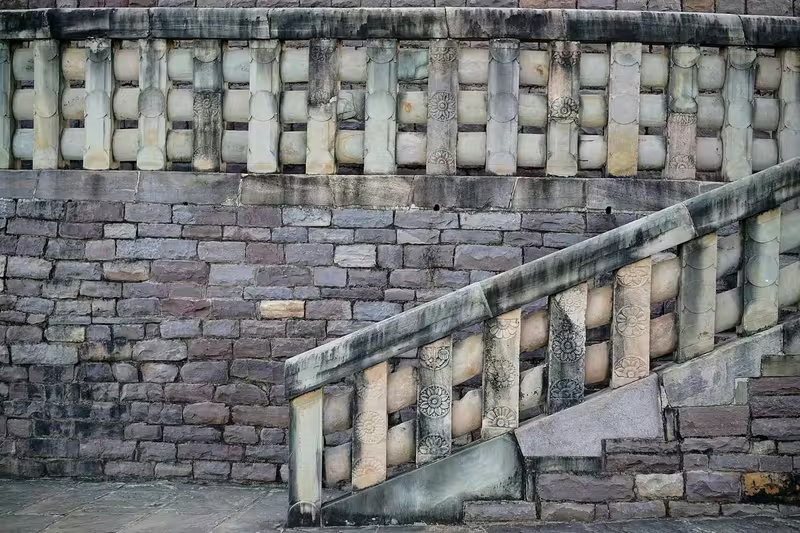
The monuments at Sanchi preserve some of the clearest evidence for Shunga-period artistic activity. The original brick Great Stupa, begun under Ashoka, was expanded during the later Shunga period. Its stone casing increased the structure to almost twice its earlier size. The dome was flattened near the top and crowned with three superimposed parasols enclosed within a square railing.
A high circular drum was built around the dome, allowing ritual circumambulation. A second stone pathway at ground level was enclosed by a stone balustrade. The railings of the Great Stupa were primarily architectural rather than pictorial; they did not yet carry the elaborate reliefs associated with the later gateways. Their inscriptions and construction are generally dated to approximately 150 BCE.
Stupas 2 and 3 at Sanchi are also associated with the Shunga period. Their stone casings and balustrades, as well as the medallions, belong to different stages of development. The medallions are dated to about 115 BCE, while some gateway carvings are dated to around 80 BCE or later. The highly decorated gateways themselves belong to the following Satavahana period according to the inscriptional evidence.
The relics of Sariputra and Mahamoggallana are said to have been placed in Stupa 3. The sculptural style at Sanchi shows close similarities with the work at Bharhut and with the peripheral railings at Bodh Gaya.
The question of royal sponsorship remains open. Some accounts connect construction at Sanchi with Pushyamitra or Agnimitra, and one tradition suggests that Pushyamitra destroyed the original stupa while Agnimitra rebuilt it. Other scholars argue that the numerous donative inscriptions show that construction was supported mainly by private individuals and collective groups rather than by the Shunga court. The monuments are therefore securely associated with the Shunga period, but not necessarily with direct dynastic patronage.
Bharhut
Bharhut became an important centre of Buddhist art during the period. Its stupa was decorated with stone railings, gateways, medallions, and narrative reliefs. A Bharhut inscription records that Dhanabhuti, son of Vachhi and descendant of a figure named Agaraju, caused a gateway to be made and presented stonework during the rule of the “Sugas.”
This inscription is valuable but ambiguous. Dhanabhuti does not appear in the Shunga royal lists, and the dedication of a Buddhist monument by a local ruler or elite donor does not prove that he belonged to the Shunga dynasty. He may have been a tributary, a neighbouring ruler, or the ruler of a territory such as Kosala or Panchala. The inscription nevertheless suggests that Bharhut existed within a political world in which Shunga authority was recognised or at least relevant.
Mathura Art
The Shunga period also saw the development of the Mathura artistic tradition. Mathura is often treated as an indigenous counterpart to the more Hellenistic Gandharan style that developed in Afghanistan and the northwestern frontier. The growth of Mathura art demonstrates that major artistic innovation was taking place in central and northern India even while political authority was divided.
The art of the period included small terracotta images, larger stone sculptures, architectural decoration, and symbolic representations connected with religious communities. Elements of folk art and Mother-goddess traditions continued, but artists rendered them with greater technical control and monumental ambition.
Literature and Philosophy
The Shunga period is associated with important developments in Sanskrit learning and Brahmanical thought. Patanjali's Mahabhashya was composed during this broad period. The work is significant for the history of Sanskrit grammar and intellectual culture.
The period is also associated with the composition of the Yoga Sutras, although the precise dating and authorship of texts attributed to Patanjali are matters of scholarly discussion. The political and religious environment of the Shungas formed part of a wider age in which philosophical traditions, ritual practices, and competing religious communities were developing.
Kalidasa's Malavikagnimitra is a much later work, but its central character, Agnimitra, is a Shunga king. The play reflects how the dynasty was remembered in later Sanskrit literary culture. Its depiction of court intrigue and romance is not a direct historical record, but it preserves the name and image of one of the dynasty's early rulers.
Religion and the Question of Buddhist Persecution
The religious history of the Shunga period is controversial. Pushyamitra is described in some Buddhist accounts as a hostile ruler who sought to destroy Buddhist institutions. The Ashokavadana, preserved in the Divyavadana, says that he attacked the Kukkutarama monastery at Pataliputra, killed monks, and later offered a reward for the head of a Buddhist monk at Sakala in the Punjab.
Tibetan historical traditions associated with Taranatha also preserve accounts of Buddhist persecution. These narratives have contributed to the idea that Pushyamitra promoted Brahmanism by suppressing Buddhism. Pushyamitra is also associated with the revival of Brahmanical rituals, including animal sacrifices that Buddhist traditions say had been prohibited under Ashoka. In contrast, Banabhatta's Harshacharita calls Pushyamitra an Anarya, or non-Aryan, showing that later traditions did not preserve a single consistent image of him.
Other evidence complicates the persecution narrative. Buddhist activity continued at Sanchi, Bharhut, Bodh Gaya, and possibly Bengal during the Shunga period. The Great Stupa at Sanchi was enlarged and encased in stone, while Bharhut received major architectural decoration. A terracotta tablet found at Tamralipti has been cited as evidence for the continued presence of Buddhism in Bengal.
Several inscriptions at the Mahabodhi Temple refer to royal women connected with rulers named Brahmamitra and Indragnimitra. One records a gift by Nagadevi, the wife of King Brahmamitra. Another records a gift by Kurangi, wife of King Indragnimitra, together with Srima of the royal palace shrine. These rulers are not securely part of the Shunga genealogy. Brahmamitra is otherwise associated with Mathura, while Indragnimitra is uncertain. Their dedications nevertheless show that Buddhist institutions could receive support from members of regional royal families during the period.
The evidence therefore permits several interpretations. Pushyamitra may have acted against particular Buddhist institutions in particular places, while Buddhist communities continued to flourish elsewhere. The accounts of large-scale persecution may also have been amplified by later religious memory. Since the Shunga state was decentralised, the policy of a ruler in Pataliputra may not have determined the actions of every local ruler or community.
It is safest to describe the period as one of Brahmanical revival and competition with Buddhism, rather than as a uniformly anti-Buddhist age. Buddhist monuments expanded, but the extent of direct Shunga royal patronage remains uncertain.
Economy and Trade
The available evidence does not permit a detailed reconstruction of Shunga economic policy, taxation, or commercial institutions. Coins and inscriptions demonstrate that monetary circulation and local political authority continued across northern and central India, but they also reveal the fragmentation of power after the early rulers.
Much of the region contained small kingdoms and city-states that issued their own coinage. This pattern indicates a politically diverse economy rather than a single tightly integrated imperial system. The existence of major centres such as Pataliputra, Ayodhya, Vidisha, Mathura, Bharhut, Sanchi, Bodh Gaya, and Tamralipti points to active urban and religious networks, although the surviving record does not allow their commercial relationships to be described in detail.
Monumental construction depended on sustained organisation and material resources. The stone casing and balustrades at Sanchi, the railings and reliefs at Bharhut, and the development of architectural centres at Bodh Gaya show that artisans, donors, quarrying networks, and local communities could support substantial projects. The inscriptions associated with these monuments often name individual donors or families, suggesting that religious construction was funded through a combination of personal, collective, and possibly royal contributions.
The Heliodorus pillar also demonstrates that the political world of the Shungas was connected to Indo-Greek courts. Diplomatic exchange did not necessarily mean continuous trade, but it confirms that rulers and envoys moved between the northwestern and central Indian political spheres.
Decline and Fall
The decline of the Shunga Empire began soon after the death of Agnimitra, the dynasty's second ruler. The empire rapidly disintegrated, and much of northern and central India became divided among independent kingdoms and city-states. The dynasty continued to exist, but its direct authority became increasingly limited.
Several factors contributed to this weakening. The Shungas faced military competition from Indo-Greek rulers, Kalinga, the Satavahanas, and other regional powers. The empire's decentralised structure made it difficult for later rulers to preserve the territorial unity established by Pushyamitra. In some regions, local dynasties and city-states issued their own coins and developed independent political identities.
The later Shunga rulers are poorly documented. The Vishnu Purana preserves a list of ten kings, but the dates and achievements of most cannot be securely established. Bhagabhadra is the best-known later ruler because of the Heliodorus pillar at Vidisha. The inscription records a diplomatic relationship with the Indo-Greek king Antialcidas and identifies Bhagabhadra as the ruler at whose court Heliodorus served.
Devabhuti, the final Shunga emperor, ruled approximately from 83 to 73 BCE. Later accounts describe him as overfond of the company of women, but this portrayal comes from hostile or moralising tradition and should not be treated as an objective biography. What is clearer is that Devabhuti was assassinated by his minister Vasudeva Kanva.
Vasudeva then established the Kanva dynasty around 73 BCE. Puranic tradition later states that the Andhra, or Satavahana, ruler Simuka attacked the Kanvas and destroyed the remaining Shunga and Kanva power in central India, probably around Vidisha. This suggests that the Shungas may have survived as a weak remnant after the main dynastic change, although the chronology and precise political sequence remain uncertain.
Legacy
The Shunga Empire occupies an important place in the transition between the Mauryan and later regional worlds. It did not recreate the Mauryan Empire, but it preserved a Magadhan monarchy after the collapse of Mauryan rule and shaped the political landscape of northern and central India for more than a century.
Its military history reflects the interaction of Indian and Indo-Greek powers. The conflicts with the Yavanas, the campaigns associated with Vasumitra, and the diplomatic mission of Heliodorus show that warfare and diplomacy connected the Gangetic plain, central India, the northwest, and the Hellenistic world.
Its cultural legacy is equally important. Sanchi and Bharhut preserve some of the finest examples of early Buddhist architectural decoration. The growth of Mathura art established a major indigenous sculptural tradition. Sanskrit learning and philosophical reflection developed during the period, while Brahmanical rituals received renewed royal attention.
The relationship between the Shungas and Buddhism remains unresolved. Some Buddhist texts remember Pushyamitra as a persecutor, while monuments and inscriptions demonstrate that Buddhist institutions survived and expanded. The most balanced interpretation recognises both the possibility of local or episodic conflict and the continued vitality of Buddhist communities under a politically fragmented state.
The Shunga period also illustrates the limits of dynastic labels. The name “Shunga” describes a ruling house, but the political world of the period included local kings, urban communities, Indo-Greek courts, Buddhist donors, Brahmanical ritualists, and emerging regional dynasties. Its history cannot be reduced either to a simple Brahmanical reaction against Buddhism or to a straightforward continuation of Mauryan imperial rule.
Timeline
Rise of Pushyamitra
Commander-in-chief Pushyamitra kills the Mauryan emperor Brihadratha during a military review and establishes the Shunga dynasty.
Formation of the Shunga Realm
The new dynasty consolidates a kingdom centred on Magadha and Pataliputra, with authority extending into nearby regions.
Indo-Greek Pressure
Indo-Greek forces associated with Demetrius and later Menander become involved in conflicts with the Shungas and other Indian powers.
Agnimitra Succeeds Pushyamitra
After a reign traditionally given as thirty-six years, Pushyamitra is succeeded by his son Agnimitra.
Expansion at Sanchi
The Great Stupa at Sanchi receives a major stone casing, balustrades, and structural enlargement during the Shunga period.
Development of Sanchi Stupa 3
The medallions and associated architectural work at Sanchi Stupa 3 belong to the later Shunga period.
Heliodorus at Vidisha
The Indo-Greek ambassador Heliodorus is sent by King Antialcidas to the court of Shunga ruler Bhagabhadra.
Later Shunga Period
Political authority is increasingly divided among local kingdoms and city-states across northern and central India.
End of the Dynasty
Devabhuti is assassinated by his minister Vasudeva Kanva, who establishes the Kanva dynasty.