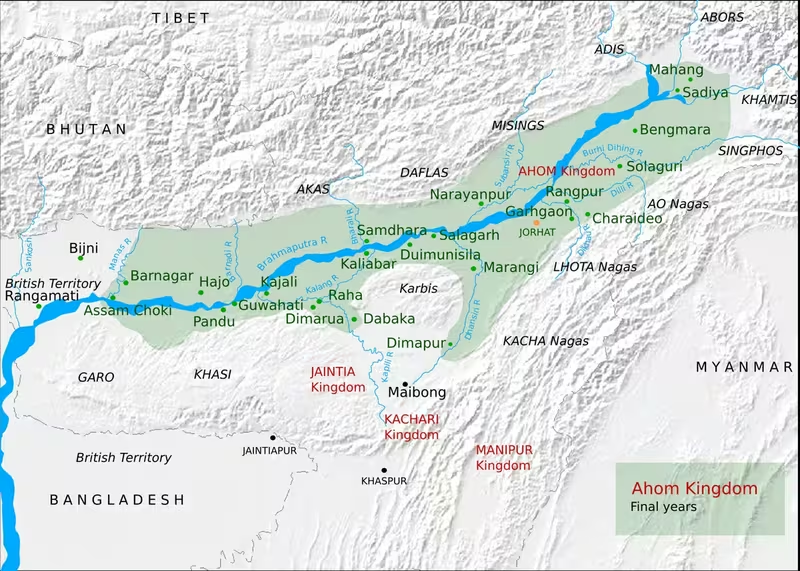
Overview
The Ahom Kingdom emerged in the Brahmaputra Valley and endured, in conventional historical reckoning, from 1228 to 1826. Its beginnings are traditionally associated with Sukaphaa, a Tai prince connected with Möng Mao, who crossed the Patkai range and entered the eastern Brahmaputra Valley with followers, chiefs, and common settlers. The kingdom that eventually developed from this migration incorporated large parts of present-day Assam and became one of the longest-lasting political formations in the region.
The conventional foundation date is not beyond dispute. The surviving Buranji traditions offer conflicting dates for Sukaphaa’s migration, journey, and first settlement. Some accounts place the beginning of the migration in 1215, others in 1248, while another tradition associates Sukaphaa’s accession with 1362. Modern scholarship has also questioned whether the Möng Mao polity described in later traditions existed in the form implied by the conventional chronology. On the basis of Dehong Tai chronicles and Chinese evidence, Christian Daniels has proposed 1336–37 or 1348–49 as possible alternative dates for the establishment of the Ahom polity in Assam.
The early Ahom settlement was a small Tai polity based on wet-rice agriculture, water management, and political forms associated with the Tai world. It was not initially a fully developed territorial state. Guha characterises the late fourteenth-century polity as a “state-like organisation” and identifies the reign of Suhungmung, from 1497 to 1539, as the period when it “leaped into statehood.” During the sixteenth century, the conquest of the Chutia kingdom, the incorporation of Baro-Bhuyan territories, and expansion toward the Dikhou-Dhansiri region transformed the kingdom.
This expansion also changed the society ruled by the Ahom dynasty. The kingdom became multi-ethnic, and the category “Ahom” remained politically flexible. Communities could be incorporated into Ahom clans through a process known as Ahomisation. By the later period, the Tai Ahom population constituted a minority within the wider kingdom. Assamese-speaking Hinduised subjects, Chutia elites, Kachari groups, Baro-Bhuyans, hill communities, artisans, warriors, scribes, and religious specialists all contributed to the formation of Ahom Assam.
The kingdom is particularly remembered for its resistance to Mughal expansion. During the seventeenth century, Ahom forces fought repeated Mughal campaigns and eventually fixed the western frontier at the Manas River. Yet military success did not prevent internal stresses. The political order weakened after the Moamoria rebellion, dynastic disputes, and the growing influence of powerful nobles. Burmese intervention from 1817 onward further devastated the kingdom. Following the First Anglo-Burmese War, the Treaty of Yandabo in 1826 transferred control to the East India Company.
Rise to Power
Sukaphaa and the eastern Brahmaputra Valley
In the conventional narrative, Sukaphaa entered the Brahmaputra Valley in 1228 after crossing the Patkai mountains from Möng Mao. He is said to have begun with a small group of followers and to have been joined by other Tai chiefs and common settlers during the journey. Traditional accounts give the number of people who entered Assam with him as approximately 9,000, although the chronology and details of this migration remain debated.
Sukaphaa’s destination was Upper Assam, at the eastern end of the Brahmaputra Valley. The landscape was made up of forests, marshes, undulating ground, fertile riverbanks, and communities practising different forms of agriculture. The Ahom settlers did not simply transform an empty wilderness. They entered a region that already contained settled populations, political powers, wet-rice cultivators, shifting cultivators, and established systems of water control.
The Ahoms contributed techniques of embankment construction, wet-rice cultivation, and water management. They helped convert selected forested and marshy areas into level fields capable of retaining water. This process supported the expansion of wet-rice agriculture in territories under their control. It was not, however, an uncomplicated technological transfer. Groups such as the Kacharis already cultivated wet rice and controlled important riverbanks and water supplies. Agricultural expansion therefore involved competition, warfare, negotiation, and adaptation.
Sukaphaa’s early relations with the Moran and Barahi communities illustrate the political character of this expansion. Traditional accounts describe him as forming alliances with groups willing to join his polity while using force against those who resisted. Over time, many communities were incorporated into Ahom clans. The people absorbed into the political order were often described as kha, and ceremonial adoption allowed them to enter the social and political structure of the kingdom.
The early Ahom polity was organised around clans and settlements rather than a uniformly administered territory. It has been described as a loose confederacy of several mungs centred on a dominant mung. Its authority was limited, and it maintained allegiance and tribute relationships with Möng Mao. Later, as Möng Mao declined and Möng Kawng became more influential, the political connections of the Ahom rulers shifted. By the early fifteenth century, the Ahoms had ceased paying tribute.
Charaideo and the Dangarias
Sukaphaa is traditionally associated with the establishment of Charaideo as the principal centre of the early kingdom, conventionally dated to 1253. He also established two important offices: the Burhagohain and the Borgohain. These offices, known together with the king as the Dangarias, were central to the political organisation of the kingdom.
In the 1280s, the Burhagohain and Borgohain received independent territories. Their authority was partly hereditary and partly connected with political selection. The system created a balance between the king and the two great counsellors. The Dangarias controlled territories, people, and paiks, while the king retained the central position in the political order.
The kingdom’s early vulnerability became visible toward the end of the fourteenth century. It experienced internal disputes, the killing of a king, an interregnum, and rebellions by subordinate Ahom chiefs. These conflicts show that the early kingdom was not yet a firmly centralised monarchy. Its political cohesion depended on negotiations among the royal family, great nobles, clans, and incorporated communities.
The name of the polity also changed over time. The Ahoms traditionally called their domain Mong Dun Shun Kham, conventionally until 1401. The name has been associated with the Assamese expression xunor-xophura, or “casket of gold.” In the fifteenth century, the kingdom adopted the name Assam, a term connected in the historical account with Shan or Shyam.
Sudangphaa and the movement toward sovereignty
The crisis of the late fourteenth century ended with the installation of Sudangphaa Bamuni Konwar, who had been born and raised in a Brahmin household at Habung. The Burhagohain and Borgohain identified him as a descendant of an earlier king and placed him on the throne. His accession brought a new relationship between the Ahom court and Brahmin communities.
Sudangphaa established a Brahmin settlement near the capital. Brahmanical influence remained limited at first, but it marked an important change in court politics. Several rebellions followed, reportedly in opposition to this influence, but Sudangphaa suppressed them and consolidated his authority.
One rebel invited a military expedition from Möng Kawng, called Nara in the Buranjis. The expedition confronted Sudangphaa in 1401. He defeated it and concluded a treaty fixing the boundary between the two polities at the Patkai range. The treaty was important because it marked a movement from implicit subordination to explicit sovereignty. It also accompanied the transition from Mong Dun Shun Kham to Assam.
Sudangphaa established a new capital at Charagua and weakened the older clan allegiances that had held the early polity together. In their place, he strengthened the authority of the king and introduced the singarigharutha, the royal coronation ceremony of the Ahom kings. The ceremony expressed royal sovereignty, legitimacy, and authority in a distinctly Ahom political framework.
The kingdom still faced resistance from Naga groups and neighbouring powers. A conflict with the Dimasa kingdom in 1490 ended in a negotiated peace because the Ahoms were not strong enough to defeat the Dimasas directly. At the same time, the Ahom monarchy continued to cultivate relations with Brahmins and Indo-Aryanised tribal groups, helping to consolidate its authority over a politically diverse region.
Golden Age
Suhungmung and the creation of a larger state
The reign of Suhungmung Dihingia Raja, from 1497 to 1539, marked the most decisive early phase of Ahom expansion. The militia was consolidated around 1510, and the kingdom began extending its authority beyond the earlier settlement zones.
In 1512, Ahom forces expanded into Panbari in Habung, a dependency of the Chutia kingdom. A larger conflict with the Chutias began in 1513 and ended with the annexation of the Chutia kingdom in 1523. This conquest transformed the Ahom political order. The Ahoms absorbed Chutia nobles, commanders, skilled workers, professional groups, warriors, and technical knowledge.
The Chutia conquest provided the Ahoms with personnel and institutions useful for a developing state. It also brought the kingdom into contact with hill peoples such as the Miris, Abors, Mishmis, and Daflas. The conquest placed the brine springs of Sadiya under Ahom control and, according to one interpretation, gave the kingdom access to metals arriving through connections with China. The spoils and new resources strengthened the treasury and armed forces.
In 1527, the Baro-Bhuyans ruling in the Rowta-Temoni region of central Assam were relocated to the north bank of Upper Assam. They were absorbed into the expanding state as scribes and warriors. This incorporation further broadened the administrative and military base of the kingdom.
The kingdom confronted Bengal under Turbak in 1532. Ahom forces suffered significant losses but defeated the invading leadership and pursued the retreating army as far as the Karatoya River. In 1536, after repeated contact with the Kachari kingdom, Ahom authority extended to the Kolong River in Nagaon.
Expansion toward the Dimasa capital at Dimapur was less conclusive. Ahom armies advanced up the Dhansiri and occupied Dimapur twice, but they did not permanently annex the city or the upper Dhansiri Valley. Effective administration remained concentrated in Marangi and the lower Dhansiri Valley under the Marangikhowa Gohain.
A multi-ethnic kingdom
The consequences of sixteenth-century expansion were social as well as territorial. Assamese-speaking Hinduised subjects came to outnumber the Tai Ahoms. The incorporation of the Chutia kingdom widened the range of artisan skills available to the state and increased the division of labour.
Suhungmung adopted the title Swarganarayana, or Swargadeo, to strengthen the legitimacy of Ahom kingship among new subjects. This title also contributed to distinctions between the high nobility and commoners and to the development of class consciousness within the kingdom.
The state created new offices to govern the expanded territories. The Borpatrogohain office was named after a Chutia administrative position. The Sadiyakhowa Gohain governed the frontier acquired from the Chutias, while the Marangikhowa Gohain administered territories acquired from the Kacharis. These offices were associated with the Borgohain and Burhagohain lineages.
The Ahom court also moved closer to Brahmanical political culture. The Chutia conquest has been identified as an important stage in the Brahmanisation of the court, although the Ahom kings were not formally initiated into Hinduism until 1648. Ahom identity itself was reshaped through conflict and interaction with the Chutias and other communities.
The Ahom kingdom’s institutional relationship with its ministers also changed. Traditional nobles and Brahmin literati became increasingly aligned, and a broader ruling class developed. When Ahom armies pursued the Bengal invaders toward the Karatoya, the kingdom’s rulers began to see themselves, aspirationally, as heirs to the older Kamarupa tradition.
Pratap Singha and the mature state
The Ahom Kingdom took its mature form under Pratap Singha, who ruled from 1603 to 1641. His reign was shaped by sustained conflict with the Mughals and by the need to reorganise the kingdom’s military and administrative institutions.
In 1609, the older kinship-based phoid system was reorganised into the khel system. The paik, or state serviceman, could be permanently assigned to non-royal institutions through royal grants. This made the system more adaptable to a growing kingdom but also increased the state’s capacity to regulate labour and service.
Pratap Singha established the offices of Borbarua and Borphukan. The Borbarua functioned as a military and judicial head in the eastern territories, while the Borphukan exercised military and civil authority in the west and acted as the king’s viceroy. These offices increased the number of members in the Patra Mantris, or council of ministers, to five.
The court also developed closer connections with Hindu institutions. The practice of using Brahmins for diplomatic missions, patronising Hindu establishments, and adopting Hindu names alongside Ahom names began during this period. The Assamese language entered the court, briefly coexisting with Tai-Ahom before eventually replacing it as the principal court language.
The state’s military and administrative arrangements developed in response to external pressure. The kingdom’s relationship with the Koches became particularly important after the Koch kingdom divided in 1581. Between 1603 and 1614, the Ahoms supported Koch Hajo as a buffer against Mughal expansion from Bengal. When Koch Hajo collapsed in 1614, Mughal authority reached the Barnadi River, bringing the Ahoms into direct and sustained conflict with the Mughal Empire.
Administration and Governance
The Swargadeo and the Patra Mantris
The Ahom kingdom was ruled by a king known as the Swargadeo, or Chao-Pha in Ahom. The king was expected to descend from Sukaphaa. Succession generally followed primogeniture, but the great Gohains could sometimes select another descendant or depose an enthroned ruler.
The Burhagohain and Borgohain remained the two principal counsellors established in the early period. Their territories were treated as distinct political regions. The Burhagohain governed the area between Sadiya and the Gerelua River on the north bank of the Brahmaputra, while the Borgohain’s territory extended westward toward the Burai River.
In 1527, Suhungmung added the Borpatrogohain. The territory of this third Gohain lay between those of the Burhagohain and Borgohain. Together, these offices formed the core of the Patra Mantris. From the reign of Supimphaa, one minister held the position of Rajmantri or prime minister and received the service of an additional thousand paiks.
Pratap Singha’s creation of the Borbarua and Borphukan offices added further administrative capacity. The Borbarua exercised military and judicial authority east of Kaliabor in areas not governed directly by the Dangarias. The Borphukan governed the western territories from Guwahati and held both civil and military responsibilities.
Governors and regional offices
Royal princes governed important territories. The Charing Raja administered the region around Joypur on the right bank of the Burhidihing and stood as heir apparent. The Tipam Raja and Namrup Raja held the next positions in succession. Other royal family members were assigned mels, and their holders were known as Meldangia or Melkhowa Rajas.
Royal women also received individual mels. By the reign of Rajeswar Singha, twelve such territories existed, including the important Raidangia mel of the chief queen.
Frontier governors combined military command and regional administration. Their offices included:
- Sadiya Khowa Gohain, based in Sadiya and responsible for territory acquired from the Chutia kingdom.
- Marangi Khowa Gohain, responsible for territory west of the Dhansiri near Naga groups.
- Solal Gohain, who governed much of Nagaon and part of Chariduar.
- Kajalimukhiya Gohain, who administered Kajalimukh and maintained relations with Jaintia and Dimarua.
- Khamjangia Gohain, who governed Khamjang in the Naga Hills.
- Tungkhungia Gohain, who governed Tingkhong.
- Banlungia Gohain, who administered Banlung in the Dhemaji region.
- Bhatialia Gohain, who governed Bhati, later replaced by the Borpatrogohain.
- Dihingia Gohain, who administered the Dihing region.
- Kaliaboria Gohain, who governed Kaliabor.
- Jagiyal Gohain, who served under the Borbarua and maintained relations with seven tribal chiefs known as the Sat Raja.
Lesser governors were called Rajkhowas. They governed territories such as Bacha, Darrang, Solaguri, Abhaypur, and Tapakuchi.
The kingdom also maintained relationships with dependent or tributary rulers. There were fifteen such vassal states, including Darrang, Rani, Beltola, Luki, Barduar, Dimarua, Gobha, and Neli. Jaintia, Dimasa, and Manipur sometimes acknowledged Ahom overlordship or paid tribute. The relationship was expressed through the idea of thapita sanchita, meaning “established and preserved.”
The paik and khel systems
The Ahom state depended on the paik system, a form of corvée labour. It was neither feudal in the strict sense nor identical to the systems described as “Asiatic.” The system was reorganised in 1608 by Momai Tamuli Borbarua.
A common subject was a paik. Four paiks formed a got. At any given time, one member of the got performed direct service for the king while the others cultivated the fields of the serving member. This arrangement allowed the state to mobilise labour while maintaining agricultural production.
Paiks were organised into khels, or departments. A Bora commanded twenty paiks, a Saikia one hundred, and a Hazarika one thousand. A Rajkhowa commanded three thousand, while a Phukan commanded six thousand. Paiks could serve in agriculture, construction, transport, administration, craft production, or the military.
The system was central to the kingdom’s strength during the Mughal wars. It enabled the rapid mobilisation of soldiers, boatmen, labourers, and specialists. By the eighteenth century, however, it had become increasingly burdensome and inflexible. Its weakness contributed to the political and social crises that preceded the Moamoria rebellion.
Land measurement and records
The Ahom state surveyed land and maintained records of service and settlement. Supatphaa became familiar with Mughal land measurement while living in Kamrup before his accession. After the major wars with the Mughals, he ordered a similar system to be introduced throughout the kingdom.
Surveyors came from Koch Behar and Bengal. The work began in Sibsagar and later extended to Nagaon. Rudra Singha supervised the Nagaon settlement. Fields were measured with a nal, a bamboo pole twelve feet long. The area was calculated in luchas, bighas, and puras: one lucha measured 144 square feet, while a bigha measured 14,400 square feet and four bighas made one pura.
The records were maintained by the Darabdhara Barua. Cultivated and occupied land was surveyed, while homesteads and jungles were excluded. Important grants, especially revenue-free lands assigned to Brahmins or religious institutions, could be recorded on copper plates known as tamrapatra or phali. Paper records were called perakagaz or perakakat and were preserved in wooden boxes.
Social hierarchy
Ahom society contained several ranked groups. The Satgharia Ahom, or “Ahom of the seven houses,” consisted of the royal family, the Burhagohain and Borgohain families, and four priestly lineages: the Deodhai, Mohan, Bailung, and Chiring Phukan. These lineages maintained exogamous marriage relationships.
The wider aristocracy included landed nobles and spiritual authorities who were not subject to ordinary taxation. The apaikan chamua were gentry freed from khel service but liable to money taxes. The paikan chamua included artisans, literati, and skilled non-manual workers. The kanri paik performed manual labour, while licchous, bandi-beti, and other serfs and bondsmen occupied the lowest positions.
Movement between social levels was possible. Momai Tamuli Borbarua, for example, rose from a bondsman’s position to become the first Borbarua under Pratap Singha.
Rank was publicly expressed through restrictions on clothing, ornaments, transport, housing, and ceremonial objects. Decorated leather footwear was reserved for kings and nobles, while commoners used wooden or flat sandals. The right to use elephants, palanquins, umbrellas, canopies, decorated japis, ceremonial seats, carpets, jewellery, and precious metals was carefully regulated.
These rules also applied to religious and ethnic communities. Under Suramphaa, Hindus were prohibited from wearing certain gold ornaments, and Hindu women were restricted from wearing elaborate mekhela chadors. Ahoms were expected to live according to prescribed rank. Such restrictions show that the kingdom’s social order combined political status with increasingly visible caste and religious distinctions.
Military Campaigns
Military organisation
The Ahom military included infantry, cavalry, elephants, artillery, espionage, and a large river fleet. Martial paiks received land or service rights in return for military obligations. They were organised through gots and khels and commanded by officers such as Boras, Saikias, Hazarikas, Rajkhowas, and Phukans.
Weapons included swords, spears, bows, arrows, guns, matchlocks, and cannons. Firearms were introduced in the early sixteenth century, and Ahom troops developed skills in manufacturing guns, artillery, matchlocks, and gunpowder. The Kharghariya Phukan supervised gunpowder production.
The navy was especially important because the Brahmaputra and its tributaries shaped movement and warfare. Warships known as bacharis resembled Bengali kosahs and could carry between seventy and eighty men. They were light, fast, and difficult to sink. By the later period, many were armed with guns. The Naobaicha Phukan and Naosaliya Phukan commanded the naval forces.
Forts were built at strategic locations. Ahom soldiers were trained for night attacks, and their commanders used the rivers and fortified terrain to offset the numerical strength of larger invading armies.
Conflict with the Chutias, Kacharis, and Bengal
The annexation of the Chutia kingdom between 1513 and 1523 was the foundation of the Ahom state’s major sixteenth-century expansion. It gave the kingdom control of Sadiya and surrounding areas and brought new military, technical, and administrative resources under Ahom authority.
Relations with the Kacharis alternated between conflict and negotiation. Ahom forces reached the Kolong River by 1536, but expansion in the Dhansiri region remained limited. The Ahoms occupied Dimapur twice without permanently annexing it.
The invasion led by Turbak from Bengal in 1532 tested the new state. Although the Ahoms suffered heavy losses, they defeated the invading leadership and pursued the retreating force toward the Karatoya. The campaign encouraged the Ahom court to imagine itself as heir to the older political legacy of Kamarupa.
The Ahom–Mughal conflicts
The sustained Ahom–Mughal conflict began after the Mughal advance into Bengal and Koch territories. When Koch Hajo collapsed in 1614, Mughal power reached the Barnadi River. The Battle of Samdhara in 1616 marked an early phase of the confrontation.
The political disorder following the illness of Shah Jahan in 1657 created new opportunities for the Ahoms. As Shuja’s forces withdrew from Bengal, Mughal Kamrup faced pressure from both Koches and Ahoms. Ahom forces under Tangchu Sandhikui occupied Guwahati, Pandu, and Saraighat in 1659. They later took Kamrup and Dhubri, while Jay Narayan was installed under Ahom protection at Ghila Vijaypur.
Aurangzeb responded by sending Mir Jumla II in 1662. The Mughal invasion occupied Garhgaon, the Ahom capital. The Ahom army initially struggled to resist and could not hold the capital. The conflict nevertheless continued, and the Mughals did not establish a permanent conquest of the kingdom.
At the Battle of Saraighat, Ahom forces halted a major Mughal attempt to advance farther into the Brahmaputra Valley. The battle became a defining episode in the memory of Ahom resistance, although the kingdom subsequently experienced a decade of political disorder. During this period, nobles exercised extraordinary power, and seven kings were placed on and removed from the throne. Mughal control returned to Kamrup for several years.
The conflict ended decisively at the Battle of Itakhuli in 1682. The Ahoms defeated the Mughals and pushed them west of the Manas River. The Manas became the permanent western boundary of the kingdom, remaining so until British annexation.
Later campaigns
Rudra Singha, who ruled from 1696 to 1714, brought the kingdom to what the historical account describes as its zenith. He subdued the Dimasa and Jaintia kingdoms and prepared to extend Ahom influence westward. He also considered a confederacy of Hindu rulers in eastern India against the Mughals. His plans were not carried out because he died in 1714.
Under Rajeswar Singha, the Ahom court intervened in Manipur. Manipur’s king Jay Singha appealed for help in recovering his kingdom from Burmese occupation. An initial expedition sent through the Naga Hills was defeated, but a second expedition in 1767, sent along the old Raha route, succeeded in restoring the Manipur ruler.
These campaigns took place during a period when the signs of political and institutional decline were becoming more visible. The military system remained powerful but increasingly depended on a social order under severe pressure.
Cultural Contributions
Chronicles and historical memory
The Buranjis are among the most distinctive products of the Ahom political tradition. These chronicles recorded political events, royal actions, diplomacy, warfare, and administrative matters. Traditional accounts attribute the beginning of official chronicle writing to Sukaphaa and describe a continuous practice of recording royal events.
The surviving evidence is more complicated. The oldest surviving Ahom text, the Snake Pillar inscription, dates from the reign of Suhungmung. Linguistic studies indicate that the Ahom script developed between the late fourteenth and sixteenth centuries. The written chronicle tradition therefore appears to have taken shape over time rather than existing in its fully developed form from the beginning of Sukaphaa’s reign.
By the late medieval period, the Ahom kingdom was known as a kaghazi raj, or a kingdom of records. The Buranjis remain essential to the reconstruction of Ahom history, but their dates and early narratives must be assessed carefully. The Tai-Ahom sixty-year calendar, known as the tao singa cycle, creates difficulties when dates are converted into the Common Era. Some dates in later chronicles appear to have been inserted incorrectly or without a reliable calendar reference.
Religion and the court
The Ahom state preserved Tai religious traditions while incorporating Brahmanical, Vaishnava, and Shakta practices. Brahmanical influence became increasingly important from the late fourteenth century and expanded sharply after the sixteenth-century conquests. The kings, however, were not formally initiated into Hinduism before 1648.
Pratap Singha patronised Hindu establishments and used Brahmins in diplomatic roles. Later kings supported Vaishnava Satras and temple institutions. Gadadhar Singha came into conflict with the Vaishnava Satras because of their growing political and social influence and began a widespread persecution of Vaishnavites.
Rudra Singha initially restored the Vaishnava Satras and took initiation from the Auniati Gosain, an influential Brahmanical Sattradhikar. Later, he became inclined toward Shaktism, which he considered more suitable for a monarch. He invited the Shakta Brahmin Krishnaram Bhattacharya, also known as Parvatiya Gosain, from Bengal.
Siva Singha came strongly under the influence of Brahmins and astrologers. In 1722, astrologers predicted that his reign would soon end because of the influence of Chatra-bhanga-yoga. He therefore transferred the royal umbrella and throne to his wife Phuleswari, who received the title Bar-Raja.
Phuleswari intervened in religious affairs and caused the humiliation of Shudra Mahantas. After her death, Siva Singha’s other wives, Ambika and Sarbeswari, successively held the position of Bar-Raja. The persecution of Shudra Mahantas and their followers contributed to the social tensions that later erupted in the Moamoria rebellion.
Architecture and water management
Ahom rulers sponsored palaces, defensive structures, temples, tanks, and civic works. The metropolitan complex at Rangpur included the Talatal Ghar, Rang Ghar, and Gola Ghar. Garhgaon contained the Kareng Ghar. These buildings represented the political power and technical capacity of the later kingdom.
Temple construction expanded particularly during the late medieval period. Important Ahom-period religious buildings include the Sivasagar, Jaysagar, and Gaurisagar temple groups; the Rudrasagar temple; Negheriting Shiva Temple; Rangnath Temple; Manikarneswar Temple; Dirgheshwari Temple; Hatimura Temple; Kedar Temple; Basistha Temple; Sukreswar Temple; Umananda Temple; and Rudreswar Temple.
Water tanks were an equally important feature of the landscape. They addressed water shortages and served religious and ceremonial purposes. Temples were often built along their banks. Notable tanks include the Sivasagar, Jaysagar, Gaurisagar, Lakshmisagar, and Vishusagar tanks. The number of tanks excavated by Ahom rulers has been estimated at about two hundred.
Music, dance, and symbols
Music and dance were widely practised and received royal patronage. Ahom kings valued Mughal music and sent musicians to Delhi to study it. Officials such as the Gayan Barua were appointed to promote musical activities.
Lion imagery was associated with Ahom kingship. The Satsari Assam Buranji records lion emblems on three gates of Garhgaon and describes the lion as one of the symbols used in royal installation ceremonies. The motif formed part of a composite political culture that combined Ahom traditions with influences from the wider Brahmaputra Valley.
During the modern Tai-Ahom revival, the winged lion was standardised and popularised as Ngi-ngao-kham. Revivalist writers describe it as the royal insignia of the kingdom, and it has appeared on flags, publications, medals, and other modern emblems. The historical form of the symbol was not fixed, however. The representation changed over time, and no Ahom coin bearing the figure has been securely identified in the evidence discussed here.
Economy and Trade
Agriculture and labour
Wet-rice agriculture was central to the Ahom economy. The Tai settlers brought traditions of embankment construction, irrigation, water retention, and rice cultivation, but they built upon agricultural practices already present in Assam. The state relied on the labour of paiks for cultivation, construction, transport, military service, and public works.
The expansion of the kingdom brought new agricultural lands and communities into the state. Population growth is evident between approximately 1500 and 1770. Pratap Singha systematised settlement and population distribution, while adult male inhabitants were recorded for state service in registers known as paikar piyalar kakat.
Trade and money
Trade commonly operated through barter, and the circulation of money remained limited for much of the kingdom’s history. Currency included cowries, rupees, and gold coins. The first coins were introduced by Jayadhwaj Singha in the seventeenth century, even though personal service under the paik system continued.
External trade increased during the reign of Rudra Singha, leading to wider circulation of money. Inscriptions from the reign of Siva Singha record prices for rice, ghee, oil, pulses, goats, and pigeons in connection with temple worship. These records suggest that a barter economy was gradually giving way to greater use of money as Assam’s economic ties with neighbouring regions developed.
The kingdom had no silver mines of its own. Silver therefore entered through trade. Contact with Tibet was particularly important. A coin of Jayadhwaj Singha bears a Chinese character on each side. The characters have been interpreted variously as “treasury of your honour” or “currency of Tibet.” They were also used by the Chinese in Lhasa between 1792 and 1836 with the meaning “Tibetan currency.”
The coin may have been intended to facilitate trade with Chinese-speaking people arriving through Tibet. Rudra Singha is also said to have encouraged extensive trade with Tibet and intercourse with other nations while restricting the movement of foreigners within the kingdom. Some silver coins of his reign may have been struck using metal acquired through such trade.
Urban centres
Only a small proportion of the population lived in towns. Important urban centres included Rangpur, Garhgaon, Guwahati, and Hajo. Rangpur, the later capital, was described by Captain Welsh in 1794 as extending for about twenty miles and being densely populated, although its population did not exceed ten thousand people.
The kingdom’s urban centres served as capitals, administrative headquarters, military bases, religious sites, and centres of craft production. Their scale should not be confused with the much larger urban populations of some contemporary imperial capitals.
Decline and Fall
The Moamoria rebellion
By the middle of the eighteenth century, the Ahom Kingdom had become an overburdened hierarchical structure supported by a weak institutional base and limited economic surplus. The paik system, which had helped mobilise the kingdom against the Mughals, was increasingly outdated. Social conflicts deepened, and religious policy alienated important groups.
The persecution associated with the later Tungkhungia rulers, especially the treatment of Vaishnavite communities and Shudra Mahantas, contributed to the Moamoria rebellion. The rebellion began in 1769 and continued into the early nineteenth century. Rebel forces captured and held the capital at Rangpur for several years before being removed with British assistance under Captain Welsh.
The repression that followed produced severe depopulation through migration and executions. The rebellion was not fully resolved, however, and the central authority of the Ahom monarchy remained badly weakened.
Dynastic and noble conflicts
The kingdom’s internal problems were not limited to popular rebellion. Dynastic claimants competed for the throne, and powerful nobles influenced succession. The disorder following the Battle of Saraighat had already demonstrated the political danger of noble factionalism: seven kings were placed on the throne and deposed during a decade of instability.
During the later period, the authority of ministers and military officers grew as the royal institutions weakened. Kirti Chandra Borbarua became highly influential during the reigns of Pramatta Singha and Rajeswar Singha. The burning of Buranjis attributed to Kirti Chandra represents the destruction of historical records during a period of political conflict.
Rajeswar Singha’s reign witnessed extensive temple building and military activity, but it also marked the end of Ahom supremacy and glory in the historical account. Signs of decay were already visible, and later rulers inherited a kingdom weakened by social conflict, political factionalism, and declining administrative effectiveness.
Burmese invasions and the Treaty of Yandabo
Internal conflicts between dynastic claimants invited Burmese intervention. The kingdom faced repeated Burmese invasions from 1817 onward. Burmese depredations between 1817 and 1825 reduced the population by an estimated one-third. Together with the effects of the Moamoria rebellion, this left only approximately seven or eight lakh people by the time of British annexation.
British intervention followed the First Anglo-Burmese War. The Treaty of Yandabo in 1826 transferred control of the kingdom to the East India Company. This treaty ended the Ahom Kingdom as an independent political order and brought the Brahmaputra Valley into a new colonial framework.
Legacy
The Ahom Kingdom’s legacy rests on several interconnected achievements. It created a durable state in the Brahmaputra Valley, developed institutions capable of managing a large and diverse population, and transformed a small Tai polity into a multi-ethnic kingdom. Its political identity was not based on a fixed ethnic population alone. Through Ahomisation, communities entered the ruling order, while the meaning of “Ahom” changed across time.
The kingdom’s resistance to Mughal expansion remains central to the history of northeastern India. The victories culminating in the Battle of Itakhuli ensured that the Manas River remained the western frontier until British annexation. The Ahom military system, based on paiks, river forces, forts, firearms, and local knowledge, enabled the kingdom to withstand repeated campaigns by a much larger empire.
The Buranji tradition provides another enduring legacy. Although its early chronology is debated and its manuscripts must be critically evaluated, the practice of recording political events distinguishes the Ahom historical tradition. The kingdom’s reputation as a kaghazi raj reflects the importance attached to records, offices, land surveys, diplomatic exchanges, and royal administration.
Ahom architecture remains visible in Assam through the Rang Ghar, Talatal Ghar, Kareng Ghar, Gola Ghar, temples, palaces, tanks, and fortified sites. These structures reveal the relationship between political authority, water management, religious patronage, and public works. The large tanks associated with temples also demonstrate the practical and ceremonial dimensions of Ahom construction.
The kingdom’s cultural legacy is composite. Tai-Ahom traditions interacted with Chutia, Kachari, Assamese, Brahmanical, Vaishnava, Shakta, Mughal, Tibetan, and other regional influences. Assamese gradually replaced Tai-Ahom as the court language, while Ahom political forms survived in modified institutions. The resulting culture cannot be reduced either to a single ethnic tradition or to a simple process of assimilation.
Modern Tai-Ahom revival movements have also renewed interest in the kingdom’s symbols, script, chronicles, and royal imagery. The winged lion, known in modern revivalist usage as Ngi-ngao-kham, has become a prominent emblem, although its modern form should not automatically be projected backward onto every phase of Ahom history.
The end of the kingdom in 1826 did not erase its historical importance. The Ahom period continues to shape interpretations of Assam’s political past, its regional identity, its architectural heritage, and its place in the history of resistance to imperial expansion.
Timeline
Traditional foundation date
Sukaphaa is conventionally said to have entered the Brahmaputra Valley after crossing the Patkai range from Möng Mao. The chronology remains disputed.
Charaideo established
Sukaphaa is traditionally associated with establishing Charaideo as the principal centre of the early polity.
Dangaria territories organised
The Burhagohain and Borgohain received independent territories and became major balancing powers alongside the king.
Sudangphaa comes to the throne
Sudangphaa Bamuni Konwar was installed after a period of dynastic crisis and strengthened the authority of the monarchy.
Treaty at the Patkai
Sudangphaa defeated a Möng Kawng expedition and concluded a treaty that fixed the boundary and expressed Ahom sovereignty.
Reign of Suhungmung begins
Suhungmung initiated the expansion and institutional transformation that turned the Ahom polity into a fuller territorial state.
Chutia kingdom annexed
The Ahoms absorbed Chutia territories, elites, military personnel, artisans, and administrative resources.
Conflict with Turbak
Ahom forces defeated the invading leadership from Bengal and pursued the retreating army toward the Karatoya River.
Khel system reorganised
The paik system was reorganised into khels, increasing the administrative and military capacity of the kingdom.
Battle of Samdhara
The battle marked the beginning of the sustained Ahom–Mughal conflict after Mughal expansion into Koch and Kamrup territories.
Mir Jumla invades
Mughal forces under Mir Jumla occupied Garhgaon, but the invasion did not result in permanent conquest.
Battle of Saraighat
Ahom forces halted a major Mughal advance in the Brahmaputra Valley.
Battle of Itakhuli
The Ahoms defeated the Mughals and fixed the western frontier at the Manas River.
Rudra Singha becomes king
The kingdom entered a powerful phase under Rudra Singha, who subdued Dimasa and Jaintia territories.
Moamoria rebellion begins
A major rebellion exposed the social and institutional weaknesses of the later Ahom state.
Burmese intervention
Repeated Burmese invasions devastated the weakened kingdom and further reduced its population.
Treaty of Yandabo
After the First Anglo-Burmese War, control of the kingdom passed to the East India Company.