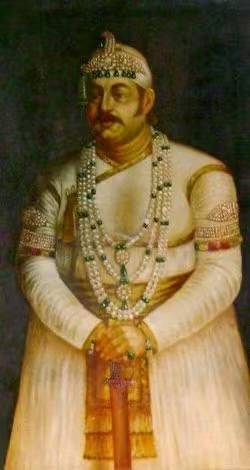
Overview
In 1724, as Mughal authority weakened, Mir Qamar-ud-Din Khan defeated Mubariz Khan in the Deccan and began ruling independently. This moment marked the foundation of the Asaf Jahi dynasty, the house that governed Hyderabad State and produced the rulers popularly known as the Nizams.
The Asaf Jahis emerged from the Mughal administrative and military world but developed an autonomous political order in the Deccan. Their early territory extended from the Narmada River in the north to Trichinopoly in the south, and from Masulipatnam in the east to Bijapur in the west. Across more than two centuries, the dynasty combined Mughal political traditions with strong patronage of Indo-Persian culture, language, and literature.
The family had arrived in India in the late seventeenth century and entered Mughal service. Its rise therefore reflected both inherited connections at the imperial court and the opportunities created by the fragmentation of Mughal power after Aurangzeb's death in 1707.
Rise to Power
The founder, Mir Qamar-ud-Din Siddiqi, belonged to a family with Central Asian and Mughal connections. His grandfather, Nawab Khwaja Abid Siddiqi, was born at Aliabad near Samarkand, in the kingdom of Bukhara, in present-day Uzbekistan. Khwaja Abid's father, Alam Shaik, was known as a Sufi and a man of letters, while his mother came from the family of Mir Hamdan, a distinguished Sayyid of Samarkand. The first Nizam's mother was also connected to the Mughal elite: she was the daughter of Sadullah Khan, Shah Jahan's grand vizier from 1645 to 1656.
Khwaja Abid served Aurangzeb after the emperor's success in the war of succession. Aurangzeb appointed him governor of Ajmer and later Multan, giving him the title Qalich Khan. He was especially valued during the early years of Aurangzeb's reign, when the emperor was consolidating power and restoring peace in newly acquired territories. Qalich Khan's son, Ghazi ud-Din Khan Feroze Jung I, became a military general under Aurangzeb. Under his command, Hyderabad was besieged and later occupied by the Mughals.
Mir Qamar-ud-Din himself became a noble and courtier under the Mughal emperor Muhammad Shah. He helped negotiate a peace treaty with Nader Shah but became disillusioned with the intrigues at Delhi. While returning to the Deccan, where he had earlier served as subedar, he was forced into conflict with Mubariz Khan. The confrontation was connected to a plot by Muhammad Shah against him. Mubariz Khan's attempt failed, and he was killed in 1724.
After this victory, Mir Qamar-ud-Din assumed the title Nizam-ul-Mulk and conducted himself as an independent ruler. Muhammad Shah had earlier granted him the title Asaf Jah. The new ruler established Asaf Jahi rule over Golconda, with Aurangabad as the capital.
Golden Age
The reign of Asaf Jah II, Nizam Ali Khan Siddiqi, formed a major chapter in the dynasty's history. Born on 24 February 1734, he became subedar of the Deccan at the age of twenty-eight and ruled for almost forty-two years, the longest period among the Nizams identified in the historical record here.
One of his most consequential decisions was the transfer of the Deccan capital from Aurangabad to Hyderabad. He also worked to consolidate the Nizam's empire during a period of intense political pressure. The House of Paigah provided important support, and Asaf Jah II sought protection against the Marathas and Tipu Sultan of Mysore through a mutual protection treaty with the British.
His death in 1803, at the age of sixty-nine, closed a long phase of consolidation. He was buried in the Mecca Masjid beside his mother, Umda Begum. The later rulers inherited a state shaped by his political choices, including its Hyderabad-centered administration and its relationship with the British.
Administration and Governance
The Asaf Jahi state grew out of the Mughal system of provincial government. The founder had been viceroy of the Deccan, an office described as administering six Mughal governorates. Independence did not erase this institutional background; instead, it allowed the Nizam to turn provincial authority into hereditary rule.
The title Asaf Jah became central to the dynasty's identity. Nasir Jung, Muzaffar Jung, and Salabat Jung are treated separately in lists of rulers because they were not granted the title Asaf Jah by the Mughal emperor. This distinction shows that Mughal recognition continued to carry political meaning even after the Hyderabad rulers had become effectively autonomous.
The dynasty's administration combined courtly, military, and regional relationships. The support of the House of Paigah was important during Asaf Jah II's reign, while British military arrangements became increasingly significant. During the minority of Asaf Jah VI, regents and guardians exercised authority on behalf of the young ruler. Sir Salar Jung I became the sole regent after Shar-ul-Ummul's death in 1881 and was remembered as both administrator and regent.
Military Campaigns
Military conflict shaped the dynasty from its beginning. The battle with Mubariz Khan in 1724 allowed Asaf Jah I to establish independent authority. The new state also inherited the strategic pressures of the Deccan, where Maratha power and the Kingdom of Mysore posed major challenges.
Asaf Jah II is described as having protected the Deccan from attacks by the Marathas and Tipu Sultan of Mysore. His mutual protection treaty with the British was therefore both a military measure and a political adjustment. It helped him defend the Nizam's territories during a critical period, although it also linked Hyderabad's security to a powerful external ally.
The dynasty faced internal disturbances as well. During the accession of Asaf Jah V in 1857, Rohillas attacked the Residency on 17 July. Sir Salar Jung suppressed the attack firmly. Trouble also began in Solapur, where the local Maharaja was unable to control the situation. These episodes reveal the instability surrounding the Hyderabad state during the wider upheaval of 1857.
Cultural Contributions
The Asaf Jahis were major patrons of Indo-Persian culture, language, and literature. Their court offered an established setting for Persianate intellectual and literary traditions, while Hyderabad became the principal political center of the dynasty after the capital moved from Aurangabad.
The later Nizams expanded this patronage into modern educational and scientific institutions. Asaf Jah VII, Mir Osman Ali Khan, received instruction in English, Urdu, and Persian from eminent scholars. His reign was associated with the establishment of Osmania University, the Nizamia Observatory, Osmania General Hospital, Osmania Medical College, Government Nizamia General Hospital, and Begumpet Airport, described as South India's first airport.
Asaf Jah VII was also remembered for support extending across religious communities. He made annual donations to various temples and gave Rs 10 lakh to Banaras Hindu University and Rs 5 lakh to Aligarh Muslim University. These actions contributed to his reputation as a secular ruler, although the political and social history of Hyderabad was more complex than any single description.
Asaf Jah V purchased the Nizam's Rubath, an accommodation building for pilgrims from Hyderabad State travelling to Mecca. This purchase illustrates the dynasty's role in supporting religious travel as well as courtly culture.
Economy and Trade
The surviving account gives limited detail about taxation, currency, and commercial policy. It does, however, show that the dynasty supported a broad institutional economy. Hyderabad's development included universities, hospitals, an observatory, a general hospital system, a state bank, and an airport.
The Nizam's Rubath also connected Hyderabad State to pilgrimage networks extending to Mecca. More broadly, the dynasty's territorial position—between northern, southern, eastern, and western Deccan zones—made control of the region strategically important. The available record emphasizes political and institutional development rather than providing a detailed account of trade volume or revenue administration.
Decline and Fall
The Asaf Jahi state survived the collapse of Mughal authority by converting imperial office into hereditary sovereignty. Its political environment nevertheless remained unstable. The dynasty faced Maratha and Mysorean pressure, attacks on the Residency, local disturbances, and the growing influence of the British.
The final Nizam was Mir Osman Ali Khan, Asaf Jah VII. Born at Purani Haveli in Hyderabad on 5 April 1886, he received an education suited to his position as heir apparent and married Dulhan Pasha Begum in 1906. He is reported to have fathered thirty-four children, including sixteen sons and eighteen daughters.
Asaf Jah VII was the last ruling Nizam of Hyderabad State. In 1948, he signed the instrument of accession, joining Hyderabad to India. This marked the end of the dynasty's rule as an independent princely authority. Later descendants retained titular associations for a time: Mukarram Jah succeeded his grandfather as titular Nizam in 1967, and Muhammad Azmat Ali Khan succeeded his father as titular Nizam in 2023. The Indian government abolished the titles in 1971.
Legacy
The Asaf Jahi legacy remains especially visible in Hyderabad's built environment and public institutions. Osmania University, hospitals, the state bank, the Nizamia Observatory, and Begumpet Airport reflect the later dynasty's investment in education, health, science, finance, and transport.
The dynasty also preserved a distinctive Indo-Persian cultural world in the Deccan. Its history connects Central Asian family origins, Mughal service, regional military politics, British alliances, and the transition to independent India. Members of the wider family continue to participate in debates about Hyderabad's heritage. Najaf Ali Khan, a grandson of Asaf Jah VII, has been known for his interest in Hyderabad's heritage and has criticized the Telangana government over the neglect of historic structures and hospitals built by the seventh Nizam.