Overview
Around 345 CE, a new kingdom emerged from Banavasi in the forested and riverine country of northern Karnataka. Its founder, Mayurasharma, is remembered in the Talagunda inscription as a Brahmin who abandoned his studies after a humiliating confrontation at Kanchi and took up arms against the Pallavas. The kingdom that followed became known as the Kadamba dynasty, after the Kadamba tree associated with its family traditions and homeland.
The Kadambas ruled northern Karnataka and the Konkan from Banavasi, in the present-day Uttara Kannada district. Their period marked a major change in the political history of the region. Before their rise, ruling families such as the Mauryas and Satavahanas had controlled Karnataka from political centres located outside the region. The Kadambas, together with their contemporaries the Western Gangas, represented some of the earliest locally rooted dynasties to establish autonomous kingdoms in the southern Deccan.
The dynasty's importance was not limited to the size of its territory. Its rulers gave Kannada an administrative role at a time when royal records in the Deccan were often composed in Sanskrit or Prakrit. The Kadamba period therefore forms an important early stage in the history of Kannada as a language of political authority. The dynasty also supported Vedic institutions, Jain establishments, Hindu temples, and, in more limited and debated ways, Buddhist institutions.
Kadamba political power was strongest under Kakusthavarma and again under Ravivarma. It did not, however, develop into a permanently centralized empire. Branches of the family ruled different regions, and internal division repeatedly affected the kingdom's stability. Around 540 CE, the Chalukyas of Badami conquered the principal Kadamba kingdom. The dynasty nevertheless survived in subordinate and regional forms, including the Kadambas of Goa, Halasi, and Hangal.
Rise to Power
Traditions of origin
The Kadamba origin traditions combine royal genealogy, religious mythology, and memories of local identity. One legend describes a three-eyed, four-armed warrior named Trilochana Kadamba, identified as the father of Mayurasharma, emerging from the sweat of Shiva beneath a Kadamba tree. Another tradition says that Mayurasharma was born to Rudra and the earth goddess. A third connects his birth with the sister of a Jain monk and a Kadamba tree.
Later traditions add further details. An inscription from around 1189 claims that Kadamba Rudra, described as the founder of the kingdom, was born in a forest of Kadamba trees. Because reflections on his limbs resembled peacock feathers, he was called Mayuravarman. The Talagunda inscription gives yet another sacred explanation, saying that Mayurasharma was anointed by Skanda, the six-faced god of war.
These accounts should not be read as straightforward biographies. They show how later communities explained the dynasty's name, authority, and relationship with both local landscape and major religious traditions. The Kadamba tree was central to the family's identity, while references to Shiva, Skanda, Rudra, and Jain connections reflect the religiously diverse environment in which the dynasty was remembered.
The social origin of the Kadambas remains debated. The Talagunda and Gudnapur inscriptions identify the family with the Manavya gotra and the Haritiputra lineage. This linked them to the Chutus of Banavasi, who had been associated with the Satavahana political order. Several historians interpret the inscriptions as evidence of Brahmin origin and emphasize the family's Vedic studies, sacrifices, and grants to Brahmins.
Other historians have proposed that the Kadambas emerged from a local tribal community. The association with the Kadambu tree and references to the Kadambu people in Sangam literature have been used in support of this interpretation. Some scholars have connected the Kadambas with a Kadambu group involved in conflict with the Cheras. The question is not settled, and the surviving inscriptions permit more than one reading of the dynasty's early social identity.
There may also have been a transition in royal self-presentation. Mayurasharma used the name ending in “Sharma,” associated with Brahmin identity, while his successor Kangavarma used “Varma,” a title associated with warrior status. The Gudnapur inscription describes Mayurasharma's grandfather and teacher as Veerasharma and his father as Bandhushena, while also saying that Mayurasharma developed the character of a Kshatriya. This may preserve a memory of a political transformation in which a learned family assumed royal and military authority.
The Kanchi episode
The Talagunda inscription provides the fullest surviving account of the kingdom's foundation. Mayurasharma travelled to Kanchi with his guru and grandfather, Veerasharma, to pursue Vedic studies at a ghatika, or school. Kanchi was an important centre of learning under the Pallavas. According to the inscription, a misunderstanding involving Mayurasharma and a Pallava guard, or possibly an official connected with a horse sacrifice, led to a quarrel.
The incident had dramatic consequences. Mayurasharma abandoned his studies, swore vengeance against the Pallavas, and took up arms. He gathered followers and attacked Pallava forces and frontier guards. He then established himself in the dense forests of the Sriparvata or Srisailam region, from where he conducted prolonged warfare against the Pallavas and other local rulers.
The inscription describes the transformation in striking ritual language. The hand that had previously grasped sacrificial grass, fuel, stones, the ladle, clarified butter, and the offering vessel now drew a sword. The image presents the foundation of the kingdom as a movement from ritual learning to martial sovereignty.
The historical details behind the story are not entirely clear. Mayurasharma may have taken advantage of a period of Pallava weakness. Some historians associate his rise with the disruption caused by the northern ruler Samudragupta's campaign in the south. Samudragupta's Allahabad inscription claims a victory over Vishnugopa of Kanchi, and the disturbance of Pallava authority may have created an opportunity for a new power in the western Deccan.
The exact territorial settlement is also debated. The Pallava king Skandavarman appears to have accepted Mayurasharma's authority over territory extending from the western coast toward a region described in the inscription as Premara or Prehara. This name has been interpreted as ancient Malwa, the Tungabhadra region, or the Malaprabha area of central Karnataka. The uncertainty reflects the difficulty of matching early place names with modern geography.
A fragmentary inscription at Chandravalli mentions the Abhiras and Punnatas, two powers that may have bordered Mayurasharma's kingdom. Other interpretations suggest that he subdued the Traikutas, Abhiras, Pariyathrakas, Shakasthanas, Maukharis, Punnatas, and Sendrakas. Whether all these groups were directly conquered or merely brought into a tributary relationship is not certain. The broad pattern, however, is clear: the new kingdom grew through a combination of armed conflict, tribute, and recognition by an established power.
Mayurasharma's journey to Kanchi also suggests that advanced Vedic learning was more accessible there than in Banavasi at the time. His experience connected the western Karnataka region with the major intellectual and political centres of the south. It also became a powerful founding narrative: the Kadamba kingdom was represented as the product of local initiative, military ability, and resistance to external authority.
Golden Age
Early expansion
Mayurasharma was succeeded by his son Kangavarma around 365 CE. Kangavarma faced the Vakatakas, whose power extended into parts of the Deccan. The conflict appears to have been serious, but the Kadamba kingdom retained its independence. One interpretation identifies his opponent as Prithvisena, while another connects the fighting with Vidyasena of the Basin branch of the Vakatakas. Neither account indicates a decisive and permanent Vakataka annexation of Kadamba territory.
Kangavarma's successor Bhageerath, who came to power around 390 CE, is credited with recovering territory lost in the earlier conflict. The Talagunda inscription describes him as the sole lord of the Kadamba land and compares him with the great ocean, or Sagara. This language is royal praise, but it indicates that later Kadamba memory viewed Bhageerath as a restorer of the kingdom.
Raghu succeeded Bhageerath and died fighting the Pallavas around 435 CE. Some inscriptions present him as having secured the kingdom for his family. His death illustrates the continuing military pressure on Banavasi. The Kadamba realm lay between several competing powers, and its rulers had to defend their authority against both major dynasties and local chiefs.
Kakusthavarma and political diplomacy
The high point of early Kadamba power came under Kakusthavarma, who came to the throne around 435 CE. The Talagunda record calls him an ornament of the family, while inscriptions from Halasi and Halmidi also speak of him with exceptional respect. His importance rested not only on warfare but also on diplomacy and dynastic marriage.
Kakusthavarma maintained relations with powerful families far beyond the immediate Banavasi region. One daughter was married to Madhava of the Western Ganga dynasty. Another is identified in later interpretations as having married Skandagupta, the son of Kumaragupta of the Gupta dynasty. A further daughter, Ajitabhattarika, married the Vakataka prince Narendrasena. The Kadambas also maintained connections with the Alupas of South Canara and other subordinate or neighbouring families.
These marriages reveal the ambition of the Kadamba court. The dynasty was not simply a regional power defending a small territory. Its rulers sought recognition through alliances with the Gangas, Vakatakas, and Gupta-linked families. Such relationships could support peace, create military partnerships, and raise the status of the Banavasi court.
Traditions also connect the Kadamba court with the Sanskrit poet Kalidasa. Some historians believe he visited during Bhageerath's reign; others place the visit under Kakusthavarma. One interpretation holds that Chandragupta II sent Kalidasa to negotiate a marriage alliance. The evidence is not conclusive, but the tradition indicates that the Kadamba court was remembered as a participant in the wider Sanskritic political and literary world.
Division of the kingdom
Kakusthavarma's successors faced renewed pressure from the Pallavas. Santivarma, who came to power around 455 CE, was described as personally attractive and prosperous enough to wear three crowns. When the Pallava threat intensified, he divided the kingdom and entrusted its southern portion to his younger brother Krishnavarma.
This division created the Triparvata branch. Its capital has been identified either with Devagiri in the modern Dharwad region or with Halebidu. The evidence is incomplete, and the precise location remains uncertain. The branch's existence, however, is clear from inscriptions and later records.
The division may have been a practical arrangement rather than an immediate sign of collapse. A royal prince or close relative could govern a distant region, respond quickly to military threats, and preserve the dynasty's control over frontier territories. At the same time, separate branches created opportunities for rivalry and competing claims to the throne.
Krishnavarma's reign is difficult to reconstruct because few inscriptions survive from his rule. Records issued by his sons credit him with efficient government and an ashvamedha, or horse sacrifice. He may have died in battle against the Pallavas. His successor Vishnuvarma initially acknowledged Santivarma of Banavasi but eventually accepted Pallava suzerainty. By around 485 CE, Vishnuvarma's son Simhavarma was ruling the Triparvata branch while maintaining a relatively low-profile relationship with Banavasi.
In the northern part of the kingdom, Santivarma's brother Shiva Mandhatri ruled for more than a decade from around 460 CE. Santivarma's son Mrigeshavarma came to the throne around 475 CE. Mrigeshavarma fought the Pallavas and Gangas with considerable success. The Halasi plates describe him as a destroyer of an eminent Ganga family and as a destructive fire to the Pallavas. His queen, Prabhavati of the Kekaya family, bore him a son named Ravivarma.
Ravivarma's restoration
Ravivarma, who came to power around 485 CE, was the last Kadamba ruler to restore the kingdom to something like its earlier strength. His reign lasted until around 519 CE and is documented by inscriptions dated from his fifth to his thirty-fifth regnal years. These records describe conflicts within the royal family as well as campaigns against the Pallavas, Gangas, Vakatakas, and regional rulers.
Ravivarma is credited with defeating the Vakatakas and dealing successfully with the Punnatas, Alupas, Kongalvas, and Pandyas of Uchchangi. He also confronted the Triparvata branch. According to one interpretation, he killed Vishnuvarma and ended the independence of that branch. He is also said to have overcome the successors of Shiva Mandhatri at Uchchangi.
The scope of Ravivarma's authority is difficult to measure. His Davanagere record, dated to his final regnal year around 519 CE, has been interpreted as claiming sovereignty extending across southern India as far as the Narmada. The language may be royal exaggeration, and the precise political meaning of the claim is uncertain. It nevertheless shows how the Kadamba court represented Ravivarma's position: as a ruler whose protection was sought by peoples across a broad part of the Deccan.
Ravivarma's administration also displayed religious breadth. In his thirty-fourth regnal year he granted land south of the Asandi Bund to a Buddhist sangha. The grant is important because it demonstrates that Kadamba patronage was not restricted to one religious community. A Mahadeva temple constructed during his reign was also mentioned in a Greek account of the period.
Ravivarma appointed his brothers Bhanuvarma and Shivaratha to govern from Halasi and Uchchangi. This continued the practice of placing members of the royal family in important regional centres. It strengthened dynastic supervision but also made the kingdom dependent on cooperation among several branches of the ruling house.
Administration and Governance
The king and royal officials
Kadamba rulers used the title Dharmamaharaja, meaning “righteous king,” and followed several administrative practices associated with earlier Indian monarchies. Their inscriptions present the king as both a protector of social order and the centre of political authority. Some rulers were also described as learned men.
Mayurasharma was called a master of the Vedas. Vishnuvarma was praised for his knowledge of grammar and logic, while Simhavarma was described as skilled in learning. These descriptions were not merely personal compliments. Royal learning formed part of the ideal of kingship represented in inscriptions and grants.
The king stood at the head of the judicial and administrative order. Officials mentioned in records include the chief minister, or Pradhana; the household steward, or Manevergade; the council secretary, or Tantrapala or Sabhakarya Sachiva; and scholarly elders, known as Vidyavriddhas. Other officers included a physician, private secretary, chief secretary, chief justice, revenue officers, and writers and scribes.
The chief justice was known as the Dharmadhyaksha. Revenue officers included the Rajjukas, while Lekhakas recorded official decisions and grants. The Bhojaka and Ayukta also appear among the administrative officers. The precise duties of every title are not always clear, but together they show a government with differentiated fiscal, judicial, secretarial, and military functions.
Provincial administration
The kingdom was divided into provinces called Mandalas or Deshas. Provinces contained districts known as Vishayas. Nine such districts have been identified in the surviving evidence. Beneath the district was the Mahagrama, or taluk, which included numerous villages. Groups of ten villages were described as Dashagramas.
The village was the smallest administrative unit. It appears to have enjoyed a degree of local freedom under a headman called the Gramika. In some records, village affairs involved local landholders and elders. An inscription from the Shikaripura area indicates that women could occasionally serve as village headmen and counsellors and could hold land.
The Gavundas were especially important. They were elite landholders who acted as intermediaries between the king and agricultural communities. They collected taxes, maintained revenue records, and helped support the royal military establishment. Because they controlled land and had local authority, their cooperation was essential to the functioning of the kingdom.
Some territories remained under hereditary local families. The Alupas, Sendrakas, Kekeyas, and Bhataris appear in this context. These families could serve as subordinate rulers while retaining local authority. The Kadamba political system therefore combined royal officials, provincial governors, hereditary chiefs, and village institutions.
Royal princes and regional government
The appointment of princes to provincial positions was a central feature of Kadamba administration. A crown prince could assist the monarch in the capital and gain practical experience in central government. Other royal family members governed distant regions.
Kakusthavarma appointed his son Krishnavarma as viceroy of Triparvata. Ravivarma placed his brothers Bhanuvarma and Shivaratha at Halasi and Uchchangi. These appointments helped keep major territories within the control of the ruling family. They also offered potential successors experience in military command, revenue administration, and relations with local elites.
The system had weaknesses. When regional princes or branches developed independent power, succession disputes could become military conflicts. The division between Banavasi and Triparvata ultimately contributed to instability, even though it may initially have been intended to improve defence and administration.
Taxation and grants
The inscriptions mention a wide range of taxes. The most general land tax was one-sixth of agricultural produce. Other levies included Perjunka on land, Vaddaravula as a social-security payment to the royal family, Bilkoda as a sales tax, and Kirukula as another land-related levy.
Pannaya was a betel tax, while professional taxes were imposed on groups such as oilmen, barbers, and carpenters. Kara and anthakara are described as internal taxes. Panaga was associated with eleemosynary holdings, Utkota with presents to kings, and Hiranya with cash payments.
The capital Banavasi contained eighteen mandapikas, or toll and customs centres. Their presence indicates that the city was a major centre of exchange and that the state derived revenue from goods entering the capital. Urban taxation complemented taxes on land and agricultural production.
Land grants were used to reward religious institutions, Brahmins, officials, and military service. When a warrior died defending the kingdom or protecting local communities, his family could receive a social-service grant known as Kalnad or Balgacu. The grant might consist of a small plot, several villages, or a larger territorial unit, depending on the warrior's status.
These grants were often commemorated by hero stones. The inscription on the stone praised the dead person's courage, while the associated land grant provided material support to the family. The system connected royal authority, military service, local memory, and landholding.
Military Campaigns
Warfare against the Pallavas
The central military event in Kadamba origin tradition was Mayurasharma's revolt against the Pallavas. After leaving Kanchi, he assembled followers, defeated Pallava forces and frontier guards, and established himself in the Sriparvata forests. His campaigns against the Pallavas and local chiefs eventually allowed him to claim sovereignty.
The conflict was probably prolonged rather than a single decisive battle. The Talagunda inscription refers to warfare and tribute, while later historical interpretations suggest that Mayurasharma used forest terrain and a mobile force to challenge a larger power. The Pallava king Skandavarman ultimately appears to have recognized the Kadamba kingdom's authority over territory south of the Malaprabha or in an adjacent region, depending on the interpretation of the place names.
The Pallavas remained a major rival throughout the fifth century. Raghu died fighting them around 435 CE. Mrigeshavarma later claimed victories against them. Ravivarma continued the struggle and is said to have defeated the Pallava king Chandadanda, a name associated with Santivarman of the Pallava line.
Conflicts with the Vakatakas
The Vakatakas were another important power in the Kadamba political environment. Kangavarma fought them after succeeding Mayurasharma. The conflict may have involved Prithvisena or Vidyasena, but the surviving evidence does not provide a fully consistent account.
Bhageerath is remembered as having recovered Kadamba losses from this conflict. Ravivarma later claimed a victory over the Vakatakas. These wars show that the Kadamba kingdom was not only a southern frontier state facing the Pallavas. It was also involved in the wider political competition of the Deccan.
Regional powers and military organization
Kadamba records refer to campaigns involving the Gangas, Punnatas, Alupas, Kongalvas, and Pandyas of Uchchangi. Some of these groups may have been subordinate chiefs rather than fully independent kingdoms. The language of victory in royal inscriptions often compresses complex relationships into claims of conquest.
The Kadamba army included officers such as the Jagadala, Dandanayaka, and Senapati. Military organization was associated with the principle of Chaurangabala, or fourfold army. The kingdom also appears to have used guerrilla tactics, especially in the difficult forest and hill country through which Mayurasharma first established power.
Cattle raids formed another important part of the military world. Numerous hero stones commemorate men and women who died defending cattle against raiders. Their number indicates that herds were economically valuable and that control over cattle could lead to armed conflict between villages, chiefs, and neighbouring communities.
Military service was commemorated in public form. Hero stones often combined inscriptions with relief sculpture and were intended to honour, and in some contexts deify, the fallen. Their distribution across Karnataka preserves evidence of conflicts that royal inscriptions do not always describe in detail.
Cultural Contributions
Religion and patronage
The religious identity of the Kadamba ruling house is debated. Many historians describe the dynasty as Brahmanical and connected with the Vedic tradition. The Talagunda inscription begins with an invocation to Shiva and records Mayurasharma's journey to Kanchi to study the Vedas. Other inscriptions mention Vedic grants and royal sacrifices, including the ashvamedha associated with Krishnavarma.
These details have led some scholars to describe the early Kadambas as Shaivas or as rulers committed to Brahmanical traditions. Other interpretations emphasize the possibility that some rulers were Vaishnavas. References to the worship of Vishnu and descriptions of certain rulers as brahmanya or parama-brahmanya have been used to support that view.
At the same time, the dynasty maintained sustained connections with Jainism. A copper-plate grant of Kakusthavarma begins with the formula “Victory to Lord Jina.” Archaeological surveys have recorded at least seven Jain inscriptions at Halasi. Mrigeshavarma is said to have donated an entire village for Jain religious observances and to have supported a Jain monk of the Yapaniya order and a Jain temple at Palasika, the modern Halasi.
Later rulers, including Ravivarma and Harivarma, continued to patronize Jain institutions and scholars. The names of Jain teachers such as Pujyapada, Niravadya Pandita, and Kumaradatta appear in inscriptions. Jainas also held important positions in the army and administration.
Jain practice in this period was not uniform. The spread of image worship, temple construction, and ritual donation changed the relationship between lay communities and ascetic institutions. These developments helped support Jain temples but also altered older ideals centred on renunciation and the quest for salvation.
Hindu sects including the Goravas, Kapalikas, Pasupatas, and Kalamukhas were also present in the region. Vedic education was organized through agraharas and ghatikas. Balligavi and Talagunda became centres of learning, while Banavasi was associated with both Buddhist and Jain intellectual activity.
The extent of royal Buddhist patronage is less certain. A grant by Ravivarma to a Buddhist sangha demonstrates at least one important instance of support. The Chinese traveller Xuanzang later described Banavasi as having one hundred sangharamas and ten thousand scholars associated with Mahayana and Hinayana Buddhism. Some historians, however, argue that the Buddhist remains around Banavasi may belong more strongly to the earlier Maurya and Chutu period and that direct Kadamba patronage was limited.
The evidence therefore points to a religiously plural kingdom. Brahmanical institutions were prominent, Jainism received substantial and sustained royal support, and Buddhist communities remained present, even though the scale of Kadamba Buddhist patronage is debated.
Language and inscriptions
The Kadamba period is crucial in the history of Kannada. Inscriptions from earlier centuries in the Deccan were often written in Prakrit. By around the fourth century, records increasingly used Sanskrit for genealogy and praise while retaining Prakrit for practical sections. From about the fifth century, Prakrit declined and Sanskrit became dominant in many formal records.
In Kannada-speaking areas, however, inscriptions increasingly used Kannada alongside Sanskrit. The Kadambas, Western Gangas, and Badami Chalukyas played important roles in this development. Royal genealogies and panegyrics often remained in Sanskrit, while boundaries and details of land grants were written in Kannada.
The Halmidi inscription, traditionally dated to around 450 CE, is especially important. It is generally regarded as one of the earliest substantial Kannada inscriptions and is associated with the Kadamba political environment. A bilingual inscription discovered at the Praneshvara temple at Talagunda has been dated to around 370 CE and has been interpreted in recent reports as an even earlier Kannada inscription. The relationship between these records and the history of written Kannada continues to be discussed.
The importance of the inscriptions extends beyond language. They preserve names of rulers, officials, villages, taxes, religious institutions, agricultural fields, irrigation works, and political relationships. The Talagunda, Gudnapur, Birur, Shimoga, Muttur, Hebbatta, Chandravalli, Halasi, and Halmidi records are among the key materials for reconstructing Kadamba history.
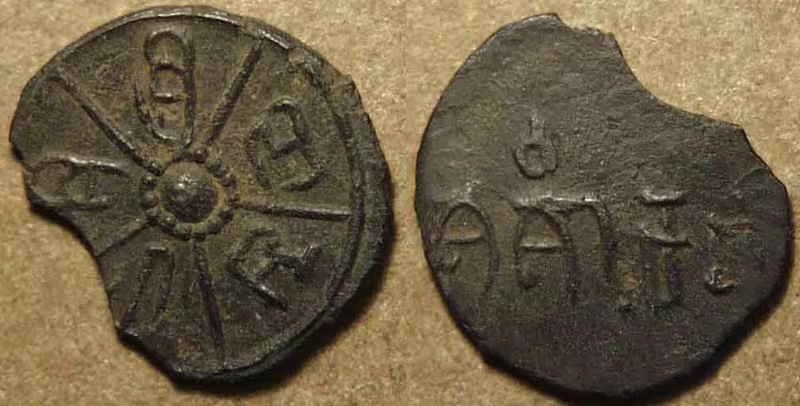
Some Kadamba coins also carry Kannada legends. A fifth-century copper coin found at Banavasi, bearing the inscription “Srimanaragi” in Kannada script, has been interpreted as evidence that a mint may have existed at Banavasi and produced coins with Kannada inscriptions.
Architecture
Kadamba architecture is associated with a distinctive temple form. A typical structure has a square garbhagriha, or sanctum, connected to a larger mantapa, or hall. Above the sanctum rises a pyramidal shikhara composed of horizontal, stepped, and relatively undecorated stages, ending in a kalasha or stupika.
The style is often treated as an early contribution to Karnataka temple architecture. Its forms were later adapted by other dynasties, including the Chalukyas and Hoysalas. The Kadamba style should therefore be understood not only as a group of surviving buildings but also as a formative architectural vocabulary.
The Talagunda pillar inscription mentions a Mahadeva temple at Sthanagundur Agrahara. This has been identified with the Praneshvara temple at Talagunda. Inscriptions of Queen Prabhavati and her son Ravivarma indicate that the temple existed by the late fifth century. Architectural evidence and the inscription have also been used to suggest that an earlier structure may have stood at the site as early as the third century under the Chutus.
Halasi preserves several important Kadamba-associated temples. The Hattikesavara temple includes perforated screens near its doors. The Kallesvara temple has octagonal pillars. The Bhuvaraha Narasimha temple and the Ramesvara temple display related architectural features, including a sukhanasa projection over the vestibule in the latter.
Kadamba-associated architecture also appears outside the principal Banavasi region. At Arvalem in Goa, three rock-cut Vedic cave temples were cut from laterite. Their plain pillars, half-halls, and sanctums containing images of Surya, Shiva, and Skanda connect them with the religious and architectural environment of the dynasty.
Later Kadamba branches developed under the influence of the ornate style of the Kalyani Chalukyas. The Mahadeva temple at Tambdi Surla in Goa, built in the late twelfth or thirteenth century, is associated with the Kadambas of Goa. Other examples include the Tarakeshvara temple, the Madhukeshwara temple at Banavasi, and the twelfth-century Kadambeshvara temple at Rattihalli. These later buildings should not be confused with the earliest Kadamba structures, but they show the durability of the dynasty's architectural identity.
Society and memorial traditions
Kadamba-period society included rulers, Brahmins, Jain teachers and lay communities, landholding Gavundas, farmers, pastoralists, merchants, artisans, soldiers, and local chiefs. Buddhist and Jain literature describes a society organized through varna distinctions, although the relationship between religious texts and everyday social practice was complex.
Jain and Brahmanical texts gave different accounts of marriage rules and social rank. Some Buddhist and Jain writings placed the Kshatriya above the Brahmin, while Brahmanical literature presented a different hierarchy. The evidence indicates that social distinctions were recognized but also that communities could be assimilated into broader political and religious structures.
Hero stones provide unusually vivid evidence of social values. Karnataka contains a large concentration of such memorials, many dated between the fifth and thirteenth centuries. Most commemorate men, but some honour women who died defending cattle or fighting enemies. Other stones remember animals and dependants.
The Gollarahatti and Atakur inscriptions commemorate dogs that died fighting wild boar. A Kadamba inscription from the Goa branch records a king who died from grief after losing his pet parrot to a cat. Another stone at Kuppatur honours a bonded servant who killed a man-eating tiger with a club before dying of his wounds.
These memorials reveal a world in which courage, loyalty, protection of cattle, and service to a household or community could justify public commemoration. They also show that heroic status was not limited to kings and aristocrats.
Physical education and martial training were widely valued. Wrestling, fist fighting, archery, hunting, and exercises formed part of elite and popular culture. Literary works distinguish between mushtiyuddha, or fist fighting, and mallayuddha, or wrestling. Wrestlers were classified by age, weight, skill, stamina, and proficiency, and successful fighters could receive recognition and special diets.
Hunting was a royal pastime and a test of endurance. Literary descriptions include hunting from chariots, ambushing deer near water, and using specially selected dogs. Sculptures depict hunting and archery scenes, including women taking aim from chariots. These traditions provide context for understanding the military culture of the Kadamba court.
Economy and Trade
Agriculture and pastoralism
The Kadamba economy depended on both cultivation and pastoralism. Inscriptions from areas corresponding to modern Shimoga, Bijapur, Belgaum, Dharwad, and Uttara Kannada mention cattle raids, cowherds, shepherds, and pastoral settlements.
Mixed farming was common. Communities combined cultivation with grazing, while wealthy Gavunda landholders controlled significant agricultural and pastoral resources. Grain production and the number of cattle possessed were both measures of prosperity.
Pastoral settlements included cowherd villages and shepherd hamlets. The Bedas, described as semi-nomadic hill communities, relied more heavily on forest products, hunting, and cattle raiding. They sold stolen cattle and products such as meat, sandalwood, timber, and forest produce to merchants. The evidence reflects conflict and economic marginality, but it also shows that forest communities were connected to wider markets.
Land was classified according to its use. Wet or cultivable land was called nansey, bede, gadde, or nir mannu. Paddy fields could be described as akki gadde or bhatta mannu. Dry land was called punsey, while garden land was known as totta.
Crops included paddy, barley, sugarcane, areca nut, millet, wheat, pulses, plantains, coconuts, and flowers used in temples. The variety of crops indicates a mixed agricultural economy adapted to different soils, water conditions, and local markets.
Irrigation and landholding
Water management was a major concern of both rulers and local elites. Copper plates and stone inscriptions describe village boundaries, fields, soil types, existing water tanks, irrigation channels, streams, and repairs to reservoirs.
The construction or repair of a tank could increase the value of dry land by making it suitable for wet cultivation. The state imposed taxes on newly irrigated land, suggesting that rulers actively encouraged the conversion of dry fields into productive wetland.
Land could be held individually or collectively. Inscriptions distinguish Brahmadeya holdings, associated with individual grants to Brahmins, from non-Brahmadeya holdings, which could be managed collectively. These categories appear in South Indian records from the third or fourth century onward.
Village communities participated in the management of fields and water resources. Elite patrons, from kings to Mahajanas, might claim part of the land or a share of produce irrigated by a tank. Irrigation therefore involved both state authority and local arrangements.
Urban centres and trade
Urban centres depended largely on the surplus of the rural hinterland. Banavasi was the principal Kadamba capital and an important commercial settlement. Excavations show that it had been occupied during the Satavahana period, while later evidence identifies it as a fortified Kadamba capital.
A fifth-century copper-plate inscription describes Banavasi as the ornament of the Karnata country and says that it possessed eighteen mandapikas. These toll stations suggest a regulated flow of goods and a substantial commercial economy.
Urban records refer to merchants selling diamonds, cloth, grain, and other goods. Merchant guilds acted as corporate bodies. Temples, palaces, fortifications, markets, and streets associated with courtesans formed part of the urban landscape. These features indicate that towns served simultaneously as administrative centres, religious hubs, commercial markets, and royal residences.
A later Chalukya inscription refers to Banavasi and its corporate body, or Nagara, as a witness to a land grant. This suggests that the city's collective institutions retained importance after Kadamba political independence had ended.
Decline and Fall
Succession and division
The Kadamba kingdom's strength depended heavily on the cooperation of several branches of the royal family. The division created under Santivarma, with Krishnavarma governing Triparvata, helped address military pressure but also created rival centres of authority.
The Triparvata branch eventually accepted Pallava overlordship. Vishnuvarma's earlier allegiance to Santivarma was followed by submission to the Pallavas, while Simhavarma later ruled with a lower-profile relationship to Banavasi. The existence of competing branches made the kingdom vulnerable to internal conflict and external intervention.
Ravivarma temporarily restored central power. His campaigns against the Triparvata branch and other regional rulers show that reunification required force. After his death around 519 CE, however, the political balance again shifted.
The Chalukya conquest
Harivarma, described as Ravivarma's peaceful son, succeeded him around 519 CE. According to the Bannahalli plates, Harivarma was killed when Krishnavarma II of the Triparvata branch raided Banavasi around 530 CE. This reunited the Kadamba branches under Krishnavarma II, but the result did not restore lasting independence.
The Chalukyas of Badami had originally been Kadamba vassals governing from Badami. By around 540 CE, they had accumulated enough power to conquer the Kadamba kingdom. The conquest ended the principal Kadamba state as an independent power.
The fall was therefore not caused by a single defeat alone. It followed decades of military pressure, succession disputes, branch divisions, shifting alliances, and the rise of a former subordinate power. The Pallavas and Vakatakas had challenged Kadamba authority earlier, but the Chalukyas ultimately absorbed the kingdom into a larger Deccan empire.
Survival through regional branches
Kadamba political identity did not disappear after the conquest. The family fragmented into a number of smaller branches that ruled under the authority of larger Kannada empires, especially the Chalukyas and later the Rashtrakutas. These branches survived for more than five centuries in different regions.
Important later branches included the Kadambas of Goa, Halasi, and Hangal. Other Kadamba centres are associated with Vainad, Belur, Bankapura, Bandalike, Chandavar, and Jayantipura. Their history belongs to later periods and cannot simply be treated as a continuation of the independent Banavasi kingdom, but their existence shows the resilience of the family and its political name.
Legacy
The Kadamba dynasty occupies a foundational place in the history of Karnataka. Its rulers established an autonomous kingdom in a region that had previously been governed by dynasties whose principal centres lay elsewhere. Banavasi became a durable political and cultural centre, and the Kadamba experience helped define Karnataka as an enduring regional entity.
The dynasty's most lasting contribution was the political use of Kannada. Sanskrit remained central to royal genealogy, religious invocation, and panegyric writing, but Kannada increasingly appeared in administrative details, land boundaries, and official records. The Halmidi inscription and later Kadamba records demonstrate the growing use of the language in public authority.
The Kadambas also helped shape the religious landscape of the western Deccan. They supported Vedic education and Brahmanical institutions, extended repeated patronage to Jain temples and teachers, and showed tolerance toward Buddhist communities and other sects. Their religious policy was not uniform, and the personal affiliations of individual rulers remain debated, but the surviving evidence points to a plural environment.
Their architectural legacy endured long after their political supremacy ended. The stepped pyramidal tower, square sanctum, and restrained early temple forms associated with the Kadambas influenced later Karnataka architecture. Subsequent rulers, including the Chalukyas and Hoysalas, adapted and elaborated these ideas.
The dynasty also survives in modern public memory. Karnataka's annual Kadambotsava celebrates the Kadamba kingdom. The Kannada film Mayura, based on a novel by Devudu Narasimha Sastri, presents a popular literary and cinematic interpretation of Kadamba history. The royal lion emblem associated with the Kadambas is used by Goa's Kadamba Transport Corporation, and India's naval base at Karwar is named INS Kadamba.
These modern references do not reproduce the historical kingdom exactly, but they show how the dynasty has become a symbol of regional political origins, Kannada identity, and the heritage of Karnataka and Goa.