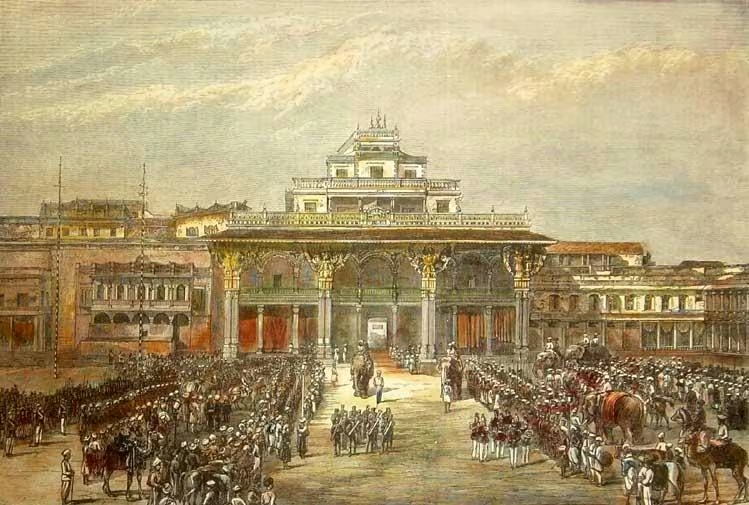
Overview
Around 1399, near the modern city of Mysuru, a small political unit emerged under the Wadiyar family. It would eventually become the Kingdom of Mysore, a state whose political form changed repeatedly over more than five centuries. It began as a feudatory associated with the Vijayanagara Empire, asserted its autonomy as Vijayanagara weakened, expanded across much of southern India, became a sultanate under Hyder Ali and Tipu Sultan, and was later restored as a Wadiyar-ruled princely state under British paramountcy.
The name “Mysore” therefore refers to more than a single, unchanging kingdom. Its territory, institutions and ruling authority shifted substantially over time. The early Wadiyar rulers governed a relatively small inland state. By the seventeenth century, Mysore had become a powerful regional kingdom. Under Hyder Ali and Tipu Sultan, it controlled territory extending from the Western Ghats toward the Coromandel plain and from southern Karnataka into parts of Tamil Nadu and Kerala. After Tipu's defeat and death in 1799, the British divided much of his kingdom and installed a young Wadiyar prince in the reduced state.
The later history of Mysore was marked by administrative experimentation, education, industrial development and cultural patronage. Although British officials took direct control between 1831 and 1881, authority was returned to the Wadiyars through an instrument of rendition. During the reigns of Krishnaraja Wodeyar IV and Jayachamaraja Wadiyar, Mysore was widely regarded as one of the more developed and urbanised regions of South Asia. It became known for its palaces, music, literature, public institutions, industries and support for the fine arts.
Mysore acceded to the Union of India in 1947. Its political identity continued through Mysore State and, after the integration of Kannada-speaking regions, the present-day state of Karnataka.
Rise to Power
Origins and historical memory
The early history of the Wadiyar family combines dynastic tradition with fragmentary documentary evidence. According to traditional accounts, two brothers, Yaduraya and Krishnaraya, founded the state near present-day Mysuru. Yaduraya is said to have married Chikkadevarasi, a local princess, and to have assumed the title “Wodeyar,” a Kannada term meaning “lord.” The family retained this title in different forms throughout its history.
The precise origins of the family remain debated. Some historians have proposed a northern origin associated with Dwarka, while others have located the family's beginnings within Karnataka. The first unambiguous reference to the Wodeyar family appears in sixteenth-century Kannada literature from the reign of the Vijayanagara ruler Achyuta Deva Raya. The earliest surviving inscription issued by the Wodeyars dates to 1551, during the rule of the petty chief Timmaraja II.
These records show that the dynasty's historical rise took place within the political world of Vijayanagara. The early Mysore rulers did not begin as independent emperors. They were local chiefs operating under a larger imperial structure.
Feudatory beginnings under Vijayanagara
The Wodeyars ruled as vassals of the Vijayanagara Empire until the empire's decline after 1565. During this period, the territory associated with Mysore gradually expanded. It reportedly included thirty-three villages defended by a force of approximately 300 soldiers. King Timmaraja II conquered surrounding chiefdoms, while Bola Chamaraja IV became the first Wodeyar ruler described as having significant political importance.
Bola Chamaraja IV withheld tribute from the nominal Vijayanagara monarch Aravidu Ramaraya. This action signalled a growing willingness to test the limits of feudatory dependence. The weakening of Vijayanagara created opportunities for local rulers, but it also placed them in a competitive political environment involving neighbouring chiefs, sultanates and Maratha forces.
The decisive early step toward autonomy came under Raja Wodeyar I. He wrested control of Srirangapatna from the Vijayanagara governor Aravidu Tirumalla. The action appears to have received tacit approval from Venkatapati Raya, the Vijayanagara ruler governing from Chandragiri. Raja Wodeyar I also annexed Channapatna to the north from Jaggadeva Raya, turning Mysore into a regional political factor.
By 1612–13, the Wodeyars exercised considerable autonomy. They continued to acknowledge the nominal overlordship of the Aravidu dynasty, but tribute and revenue transfers to Chandragiri ceased. This distinguished Mysore from some major Nayaka chiefs of the Tamil country, who continued to pay the Chandragiri rulers into the 1630s.
Expansion in the seventeenth century
The Wodeyars attempted to expand northward, but the Bijapur Sultanate and its Maratha subordinates obstructed these ambitions. In 1638, Bijapur armies under Ranadullah Khan besieged Srirangapatna, though the siege was effectively repelled. Mysore's expansion then turned increasingly southward and westward.
Narasaraja Wodeyar acquired Satyamangalam, in the region of modern northern Erode. His successor, Dodda Devaraja Wodeyar, expanded into western Tamil regions, capturing areas around Erode and Dharmapuri after repulsing the chiefs of Madurai. Mysore also successfully dealt with an invasion by the Keladi Nayakas of the Malnad.
These campaigns did not produce a stable or uncontested frontier. Mysore's access to the coast remained limited. The Nayaka chiefs of Ikkeri controlled parts of the Kanara coast, while the rulers of Kodagu controlled the hill country between the Mysorean interior and the western seaboard. Mysore's conflicts with these powers brought mixed results: it annexed Periyapatna but suffered a reversal at Palupare.
Chikka Devaraja and the consolidation of power
Chikka Devaraja, who ruled from 1672 to 1704, was the most notable of Mysore's early kings. His reign coincided with major changes in the Deccan, where Maratha and Mughal power pressed into territories formerly controlled by regional states. Chikka Devaraja survived these pressures through strategic alliances with both the Marathas and the Mughals, while also extending Mysore's territory.
Under his rule, Mysore came to include Salem and Bangalore in the east, Hassan in the west, Chikkamagaluru and Tumkur in the north, and Coimbatore in the south. The kingdom now occupied a substantial part of the southern Indian interior, extending from the Western Ghats toward the western edge of the Coromandel plain.
The kingdom remained landlocked. Chikka Devaraja's attempts to acquire a route to the coast brought Mysore into conflict with Ikkeri and Kodagu. His policies reveal a central feature of Mysorean state formation: expansion was shaped not only by conquest but also by the geography of the plateau, the passes through the Ghats, and the political control of coastal and hill territories.
After 1704, under Kanthirava Narasaraja II, known as the “Mute King,” Mysore maintained its position through a careful combination of alliance, negotiation, subordination and annexation. Historians differ over the exact political relationship between Mysore and the Mughal Empire. Some interpret Mughal records of regular tribute, or peshkash, as evidence that Mysore was formally a tributary. Others argue that the Mughals may have regarded Mysore as an ally in the competition between Mughal and Maratha power in southern India.
As Mughal authority declined in the 1720s, the political situation became more complicated. Mughal residents at Arcot and Sira each claimed tribute. Krishnaraja Wodeyar I handled these pressures cautiously, while continuing to contain the chiefs of Kodagu and the Marathas.
Golden Age
The shift from Wodeyar monarchy to ministerial power
During the reign of Chamaraja Wodeyar VII, political power increasingly passed to two influential ministers from Kalale near Nanjangud. Nanjarajiah served as Dalwai, or military and executive minister, while Devarajiah served as Sarvadhikari, or chief minister. For approximately three decades, the Wodeyar rulers remained titular heads while the Kalale brothers exercised much of the practical authority.
This arrangement created the political setting in which Hyder Ali rose from relative obscurity. Hyder was a captain in the Mysorean army who gained prominence during the military conflicts of the period. His victory over the Marathas at Bangalore in 1758 resulted in the annexation of Maratha territory and enhanced his reputation. The king rewarded him with the title “Nawab Haider Ali Khan Bahadur.”
The Wodeyars remained the nominal rulers, but real power increasingly rested with Hyder Ali and, after his death, his son Tipu Sultan.
Hyder Ali's expansion
Hyder Ali's rise coincided with a period of intense competition in southern India. The European trading companies were transforming themselves into territorial powers. The Nizam, as the Mughal subahdar of the Deccan, pursued his own ambitions. The Marathas sought new positions in the south after their defeat at Panipat. Meanwhile, the French and British competed for influence in the Carnatic.
The British victory under Sir Eyre Coote over the French forces commanded by the Comte de Lally at the Battle of Wandiwash in 1760 helped establish British supremacy in South Asia. Mysore became one of the last major powers capable of resisting the expansion of British influence.
By 1761, Maratha power in the immediate region had weakened. Hyder Ali captured the Keladi kingdom, defeated the rulers of Bilgi, Bednur and Gutti, invaded the Malabar Coast and took Calicut in 1766. Mysore's northern frontier reached Dharwad and Bellary. The kingdom had become a major power in the subcontinent.
Hyder Ali combined military ability with administrative skill. His expansion brought Mysore into direct conflict with the Marathas, the Nizam and the British. During the First Anglo-Mysore War, the British allied with the Marathas and the Nizam in an effort to halt his rise. Although Hyder Ali suffered defeats at Chengam and Tiruvannamalai, the British rejected his overtures for peace until his army had moved close to Madras. He then successfully compelled the British to negotiate.
Between 1764 and 1772, Hyder Ali fought three wars against the Maratha armies of Peshwa Madhavrao I. He suffered serious defeats and was required to pay tribute and war expenses. Hyder had expected British assistance under the 1769 treaty, but the British remained outside the conflict. Their neutrality and his subsequent defeats deepened his distrust of Britain.
In 1777, Hyder recovered territories previously lost to the Marathas, including Coorg and parts of the later Malabar District. He also defeated Maratha forces at Saunshi.
By 1779, Hyder Ali had captured areas in modern Tamil Nadu and Kerala. Mysore's territory covered approximately 80,000 square miles, or 205,000 square kilometres. The kingdom had reached its maximum geographical extent during a period of rapid military expansion, though its hold over every region was not equally secure.
The Second Anglo-Mysore War
Hyder Ali's advance into the south brought a new phase of conflict with the British. In 1779, he assembled an army of around 80,000 men, mostly cavalry, and moved through the Ghats. Villages were burned as his forces descended, and he began besieging British forts in northern Arcot.
The Second Anglo-Mysore War included important Mysorean successes. At Pollilur, Mysorean forces used rocket artillery effectively. Hyder also achieved initial successes at Arcot. The British position improved after Sir Eyre Coote arrived.
On 1 June 1781, Coote defeated Hyder Ali at the Battle of Porto Novo. The victory was achieved despite a substantial numerical disadvantage and was regarded as one of the major British military successes in India. The British followed it with another victory at Pollilur on 27 August and a further defeat of Mysorean troops at Sholinghur a month later.
Hyder Ali died on 7 December 1782 while the war was still underway. His son Tipu Sultan succeeded him and continued the conflict. Tipu recaptured Baidanur and Mangalore. By 1783, neither side had achieved a decisive overall victory, but French support for Mysore declined after the peace settlement in Europe.
The Treaty of Mangalore, concluded in 1784, ended hostilities temporarily and restored territories to the status quo ante bellum. Its political significance was considerable: it was the last occasion when an Indian power dictated terms to the British, who had to negotiate from a weakened position.
Tipu Sultan and the struggle for independence
Tipu Sultan inherited a powerful but pressured state. He continued to resist British expansion and also confronted the Marathas and the Nizam. Between 1785 and 1787, Mysore fought the Maratha Empire in a series of conflicts. Tipu's victory at the siege of Bahadur Benda led to a peace agreement involving mutual gains and losses.
Tipu also attempted to build alliances beyond the immediate region. He sought support from Revolutionary France, the Amir of Afghanistan, the Ottoman Empire and Arabia. These efforts did not produce direct military assistance. His attempts to draw the Nizam, the Marathas and other powers into a coordinated struggle against the British likewise failed.
Tipu's attacks on Travancore in 1790 proved decisive in changing the political balance. Travancore was a later British ally, and the campaign ended in defeat for Tipu. The resulting hostility culminated in the Third Anglo-Mysore War.
The British, supported by the Marathas and the Nizam, attacked Mysore from several directions. They captured Coimbatore, though Tipu's counterattack reversed many of their gains. In 1792, Lord Cornwallis led the allied forces in the siege of Srirangapatna. Tipu was defeated and forced to sign the Treaty of Srirangapatna.
The treaty divided half of Mysore among the allies. Two of Tipu's sons were held as hostages. The defeat severely reduced Mysore's territory but did not end Tipu's attempts to restore his military and economic strength. He reorganised the state and sought diplomatic support abroad, while the British watched his contacts with France and other powers.
Administration and Governance
Early structures
The surviving record of Mysore's administration during its Vijayanagara-feudatory phase is limited. Clearer signs of an organised and independent government appear under Raja Wodeyar I. He is remembered as sympathetic toward peasants, or raiyats, who were reportedly protected from increases in taxation during his reign.
During the rule of Narasaraja Wodeyar, the kingdom issued gold coins called Kanthirayi phanam. These resembled coins of the former Vijayanagara Empire and indicated that Mysore had developed institutions of sovereignty while still drawing upon established imperial symbols.
Chikka Devaraja's reforms
Chikka Devaraja reorganised the internal administration to meet the needs of an expanding kingdom. A postal system was established, and important financial reforms were introduced. Several small taxes replaced direct taxes, increasing the burden of land taxation on peasants.
The king is said to have taken a personal interest in revenue collection. The treasury reportedly accumulated 90,000,000 pagodas, earning him the epithet “Nine Crore Narayana,” or Navakoti Narayana. In 1700, he sent an embassy to the court of Aurangzeb. He received the title Jug Deo Raja and permission to sit on an ivory throne.
Chikka Devaraja also founded district offices known as Attara Kacheri. The central secretariat consisted of eighteen departments and was modelled on Mughal administrative lines. This did not make Mysore a simple copy of Mughal government, but it shows how regional rulers adapted institutions associated with larger imperial systems.
Administration under Hyder Ali and Tipu Sultan
Under Hyder Ali, the kingdom was divided into five provinces, or Asofis, of unequal size. These contained a total of 171 taluks, also called par ganas. Under Tipu Sultan, the state encompassed approximately 160,000 square kilometres and was divided into 37 provinces and 124 taluks.
Each province had a governor, or Asof, and a deputy governor. A taluk was administered by an Amildar, while groups of villages were placed under a Patel. The central administration consisted of six departments headed by ministers, each assisted by an advisory council of up to four members.
This system combined provincial administration, revenue collection and local intermediaries. It also supported Tipu's attempts to regulate production and trade. State factories produced cannons and gunpowder, while depots handled the sale and distribution of goods.
British commissioners and administrative change
After Tipu's defeat, the remaining Mysorean territory became a princely state under the British. Purnaiah, who had served under Tipu, continued as Dewan and acted as regent for the child ruler Krishnaraja III. The British appointed Barry Close as Resident and took control of Mysore's foreign policy. The state was required to pay an annual tribute and a subsidy for the maintenance of a British army.
In 1831, following the Nagar revolt and allegations of maladministration, the British took direct control. A succession of commissioners administered Mysore. Sir Mark Cubbon, who served from 1834 to 1861, established an efficient administrative system and made Bangalore the capital of the directly administered territory.
Under British commissioners, the state was divided into four divisions and later into eight districts: Bangalore, Chitradurga, Hassan, Kadur, Kolar, Mysore, Shimoga and Tumkur. It contained 120 taluks and 85 taluk courts. Lower-level administration used Kannada, while the commissioner’s office supervised departments including revenue, post, police, public works, medicine, animal husbandry, justice and education.
During Lewin Bowring's tenure as chief commissioner from 1862 to 1870, the Registration Act, Indian Penal Code and Code of Criminal Procedure came into effect. The judiciary was separated from the executive branch.
Restoration of Wadiyar authority
A successful Wadiyar lobby supported the restoration of dynastic rule. In 1881, power was transferred back to the Wadiyars through an instrument of rendition. Chamaraja Wadiyar X became ruler, while a British Resident remained at the Mysore court and a Dewan managed much of the administration.
C. V. Rungacharlu became the first Dewan after the rendition. Under his administration, Mysore established the first Representative Assembly in British India, with 144 members. Subsequent Dewans expanded the state's institutions.
K. Seshadri Iyer, who served from 1883, supported gold mining at the Kolar Gold Fields, initiated the Shivanasamudra hydroelectric project in 1899 and helped supply Bangalore with electricity and piped drinking water. P. N. Krishnamurti created the Secretariat Manual and the Co-operative Department in 1905. V. P. Madhava Rao focused on forest conservation, while T. Ananda Rao completed the planning of the Kannambadi Dam.
Sir M. Visvesvaraya became Dewan in 1909. During his tenure, the Mysore Legislative Assembly expanded from 18 to 24 members and gained the power to discuss the state budget. The Mysore Economic Conference was developed into committees concerned with industry and commerce, education and agriculture, and its work appeared in English and Kannada.
Major projects associated with this period included the Kannambadi Dam, Mysore Iron Works at Bhadravathi, Mysore University, the University Visvesvaraya College of Engineering, the Mysore State Railway Department and several industries. Visvesvaraya was later awarded the Bharat Ratna in 1955.
Sir Mirza Ismail became Dewan in 1926 and continued this programme of development. He expanded the Bhadravathi Iron Works, established cement and paper factories there, and supported the launch of Hindustan Aeronautics Limited. He also founded the Brindavan Gardens associated with the Krishnaraja Sagar project and built a high-level canal from the Kaveri River to irrigate approximately 120,000 acres in modern Mandya district.
Military Campaigns
Conflicts before the sultanate
Mysore's military history began with the gradual consolidation of territory around the original Wadiyar domain. The early rulers fought neighbouring chiefs and navigated the decline of Vijayanagara. Raja Wodeyar I's seizure of Srirangapatna was especially important because it gave Mysore control of a strategically valuable centre.
The kingdom's later expansion brought it into conflict with the Bijapur Sultanate, Maratha forces, the Nayakas of Ikkeri, the rulers of Kodagu and the chiefs of Madurai. Mysorean forces repelled the 1638 Bijapur siege of Srirangapatna and pushed southward into Tamil regions. The kingdom also faced reversals, especially when seeking access to coastal areas controlled by other powers.
The Anglo-Mysore Wars
The four Anglo-Mysore Wars were the central military struggle of eighteenth-century Mysore.
The First Anglo-Mysore War began when the British allied with the Marathas and the Nizam to restrain Hyder Ali. Although Hyder suffered defeats at Chengam and Tiruvannamalai, he recovered strategically by advancing close to Madras. The British then agreed to peace.
The Second Anglo-Mysore War began after the political alignments of the region shifted. Hyder's 1779 campaign brought his army through the Ghats and into northern Arcot. Mysorean success at Pollilur demonstrated the effectiveness of its rocket artillery. The British recovered under Sir Eyre Coote, whose victories at Porto Novo, Pollilur and Sholinghur altered the course of the war. Tipu continued the struggle after Hyder's death, and the Treaty of Mangalore ended the conflict in 1784.
The Third Anglo-Mysore War followed Tipu's attack on Travancore. British forces, supported by the Marathas and the Nizam, invaded from multiple directions. The siege of Srirangapatna in 1792 forced Tipu to sign a treaty surrendering half of his kingdom and giving two sons as hostages.
The Fourth Anglo-Mysore War ended Mysore's independence. Tipu continued to seek foreign support and rebuild his forces, but the British were determined to prevent a renewed alliance between Mysore and France. In 1799, British and allied forces besieged Srirangapatna. Tipu Sultan died defending the city. Large areas of his kingdom were annexed and divided between the British and the Nizam. The remaining territory was restored to the Wadiyar family as a princely state.
Mysorean rockets
Mysore's military technology became especially influential through its use of iron-cased rockets. Hyder Ali and Tipu Sultan developed rockets in which iron cylinders held the combustion powder. The stronger container allowed greater internal pressure and therefore greater thrust than earlier paper-bodied rockets.
The rockets were attached to long bamboo sticks and could be fired in mass attacks. Their range may have reached more than a kilometre, and later accounts describe ranges approaching two kilometres. Their accuracy was limited, but large numbers could create serious disruption, particularly against cavalry. Some rockets had sharpened blades mounted on them and spun when fired.
Hyder Ali deployed specialised rocket troops, while Tipu expanded their number and organisation. Accounts describe Tipu's force as increasing from roughly 1,200 rocket troops to a corps of around 5,000. Mysorean rockets were used at Srirangapatna in 1792 and 1799, and British accounts describe the dramatic explosion of a rocket magazine during the final siege.
After Tipu's defeat, the British captured Mysorean rockets and sent examples to England. Lieutenant General Thomas Desaguliers of the Royal Artillery at Woolwich examined their design. British experiments eventually contributed to the development of the Congreve rocket, which was used during the Napoleonic Wars.
Cultural Contributions
Religion and royal patronage
The religious history of the Wodeyars was not uniform. The early rulers are described as followers of Jainism, while later kings adopted Vaishnavism and forms of Shaivism. Raja Wodeyar I was associated with devotion to Vishnu. Dodda Devaraja Wodeyar received the title “Protector of Brahmins,” reflecting his support for Brahmin institutions. Krishnaraja Wodeyar III was devoted to Chamundeshwari, a form of the goddess Durga.
Historians differ in their interpretation of the religious positions of particular rulers. Some describe Chikka Devaraja as a Srivaishnava, while others emphasise that the evidence does not show a consistent anti-Veerashaiva policy. Accounts of a Jangama or Veerashaiva uprising during his reign differ in their details. One historical interpretation describes the killing of four hundred Jangamas, while another notes that Veerashaiva literature is silent on the episode.
Jainism continued to receive royal patronage even after its political prominence declined. Mysore rulers made endowments to Jain monastic institutions at Shravanabelagola. Records associate members of the Wodeyar family with the Mahamastakabhisheka ceremony there, and with personal acts of worship in several years between 1659 and 1953.
The Dasara festival became closely connected with Mysore's royal identity. Raja Wodeyar I initiated its celebration in the city, drawing upon the traditions of the former Vijayanagara royal family. The festival remains one of the most recognisable elements of Mysore's cultural heritage.
Literature and the Kannada court
The Mysore period is often regarded as a golden age in the development of Kannada literature. The court supported Brahmin and Veerashaiva writers, while several rulers themselves wrote or composed music. Older genres of philosophy and religious writing continued, but new forms also became popular, including chronicles, biographies, histories, encyclopaedias, novels, dramas and musical treatises.
Yakshagana, a folk form combining dramatic performance and music, gained popularity. English literature and classical Sanskrit also influenced later Kannada writing.
Govinda Vaidya of Srirangapatna wrote Kanthirava Narasaraja Vijaya, a eulogy of Narasaraja I. Composed in sangatya metre, it describes the king's court, popular music and musical forms in twenty-six chapters.
Chikka Devaraja is credited with Gita Gopala, a musical treatise inspired by Jayadeva's Sanskrit Gita Govinda but composed with its own structure in saptapadi metre. Other important writers included the Brahmin poet Lakshmisa and the itinerant Veerashaiva poet Sarvajna. Female writers such as Cheluvambe, Helavanakatte Giriyamma, Sri Rangamma and Sanchi Honnamma also made notable contributions.
King Narasaraja II authored fourteen Yakshaganas in different languages, all written in Kannada script. Krishnaraja Wodeyar III was a prolific Kannada writer and received the honorific Abhinava Bhoja. More than forty works are associated with him, including Sritattvanidhi and Saugandika Parinaya.
The movement toward modern Kannada prose developed gradually. Kempu Narayana's Mudramanjusha, published in 1823, contained early elements of modern prose. Muddanna's Adbhuta Ramayana and Ramaswamedham, published in 1895 and 1898, treated an ancient epic through a modern literary perspective.
Basavappa Shastry served in the courts of Krishnaraja Wodeyar III and Chamaraja Wadiyar X. Known as the “Grandfather of Kannada theatre,” he wrote Kannada dramas and translated Shakespeare's Othello as Shurasena Charite. He also translated Sanskrit works, including those of Kalidasa and Abhijnana Shakuntala.
Music
The Mysore court became a major patron of music under Krishnaraja Wodeyar III and his successors Chamaraja Wadiyar X, Krishnaraja Wodeyar IV and Jayachamaraja Wadiyar. The court's musical culture combined royal patronage, music education, European musical influences, publishing and recording.
Krishnaraja Wodeyar III was himself a musician and musicologist. He composed javalis and devotional songs in Kannada under the title Anubhava Pancharatna. His compositions used the mudra “Chamundi” or “Chamundeshwari,” referring to the Wodeyar family deity.
Under Krishnaraja Wodeyar IV, a distinct Mysore school of music developed, emphasising raga and bhava. The palace's Royal School of Music institutionalised instruction. Carnatic compositions were printed, and royal musicians used European staff notation.
Western music also received encouragement. Margaret Cousins's piano concerto with the Palace Orchestra formed part of centenary celebrations for Beethoven in Bangalore. During Jayachamaraja Wadiyar's period, the court sponsored recordings of Russian composer Nikolai Medtner and others. The palace band made commercial gramophone recordings, and the court acquired instruments including the horn violin, theremin and calliaphone.
Among the court's celebrated musicians was Veena Sheshanna, who was associated with the reign of Chamaraja Wadiyar X and received the title Vainika Shikhamani. Mysore Vasudevacharya composed in Sanskrit and Telugu and was patronised by four generations of Mysore rulers.
H. L. Muthiah Bhagavatar composed approximately 400 works in Sanskrit, Kannada, Telugu and Tamil under the pen name “Harikesha.” T. Chowdiah became a leading violinist and mastered a seven-stringed violin. He was appointed court musician in 1939 and received titles including Sangeeta Ratna and Sangeeta Kalanidhi.
Printing, education and social change
Christian missionaries helped establish printing presses in Mysore. Hermann Mögling was associated with the publication of ancient and contemporary Kannada works, including the Pampa Bharata and Jaimini Bharata. A Kannada Bible, a bilingual dictionary and the newspaper Kannada Samachara also appeared during the early nineteenth century.
English education expanded under British influence. The first English-medium schools appeared in Mysore in 1833. By 1881, the state reportedly had around 2,087 English-medium schools. Bangalore Central College was established in 1870, Maharaja's College in 1879, Maharani's College in 1901 and Mysore University in 1916. St. Agnes College in Mangalore followed in 1921.
The spread of education, print and missionary criticism contributed to changes in social attitudes. Laws passed in 1894 abolished marriage for girls below the age of eight. Widow remarriage and marriage for destitute women were encouraged. In 1923, some women received permission to vote in elections.
These changes did not eliminate social inequality. The period also saw resistance to British rule, including the Kodagu uprising of 1835 and the Kanara uprising of 1837. The growth of modern nationalism connected Mysore's political life with wider movements across India.
Painting and theatre
Mysore painting developed within the broader cultural environment of the court. Artists including Sundarayya, Ala Singarayya and B. Venkatappa created works influenced by the Bengal Renaissance.
The Kannada stage drew upon classical English and Sanskrit drama as well as Yakshagana. Public access to Carnatic music expanded through broadcast systems installed on palace grounds. Together, literature, theatre, painting and music made Mysore an important centre of southern Indian culture.
Architecture
Royal palaces
Mysore became known as the “City of Palaces.” The most prominent palace is the Amba Vilas Palace, commonly called Mysore Palace. An earlier complex was destroyed by fire, and the Queen-Regent commissioned a new building designed by the English architect Henry Irwin in 1897.
The palace combines Hindu, Islamic, Indo-Saracenic and Moorish elements. Its design used cast-iron columns and roof frames. Granite columns support cusped arches on the portico, while a tall tower rises toward a gilded dome with an umbrella-like finial. Additional domes surround the main structure.
The interior contains marbled walls, a teakwood ceiling decorated with images of Hindu deities and a Durbar Hall leading toward a private inner hall through silver doors. Semi-precious stones are set into the floor, and a stained-glass roof is supported by columns and arches. The marriage hall, or Kalyana Mantapa, is known for its octagonal stained-glass dome and peacock motifs.
The Lalitha Mahal Palace was built in 1921 under the direction of E. W. Fritchley for Krishnaraja Wodeyar IV. Its Renaissance style drew upon English manor houses and Italian palazzos. The central dome was reportedly modelled on St Paul's Cathedral in London. Italian marble stairs, polished wooden floors and Belgian cut-glass lamps are among its notable features.
The Jaganmohan Palace was commissioned in 1861 and completed in 1910. Its three-storeyed structure includes domes, cupolas and finials. It later became the Chamarajendra Art Gallery.
Other royal structures included the Lokaranjan Mahal, built in 1880 as a summer palace and initially used as a school for the royal family, and the Rajendra Vilas Palace on Chamundi Hill. The latter was commissioned in 1922 and completed in 1938 in an Indo-British style.
Temples and religious buildings
The Chamundeshwari Temple stands atop Chamundi Hill. Its earliest structure was consecrated in the twelfth century, and later Mysore rulers extended and patronised it. Krishnaraja Wodeyar III added a Dravidian-style gopuram in 1827. The temple includes silver-plated doors and images of deities, as well as an image of Krishnaraja Wodeyar III with his three queens.
Mysore's fort and palace complex contain temples built over several centuries. These include the Prasanna Krishnaswamy Temple, dating to 1829; the Lakshmiramana Swamy Temple, whose earliest structures date to 1499; and the Trinesvara Swamy Temple, associated with the late sixteenth century.
The Shweta Varaha Swamy Temple was built by Purnaiah with features influenced by Hoysala architecture. The Prasanna Venkataramana Swami Temple, built in 1836, contains twelve murals of Wodeyar rulers.
Outside Mysore, the Venkataramana Temple at Bangalore Fort is known for its yali, or mythical-beast, pillars. The Ranganatha Temple at Srirangapatna is another major monument associated with the region's religious landscape.
Srirangapatna and Tipu Sultan's buildings
Tipu Sultan built the Dariya Daulat Palace in Srirangapatna in 1784. The wooden palace follows an Indo-Saracenic style and is known for ornamental arches, striped columns, floral designs and painted decoration.
Murals on the western wall depict Tipu's victory over Colonel Baillie's army at Pollilur near Kanchipuram in 1780. One scene presents Tipu holding a fragrant bouquet while the battle continues. The painting distinguishes French soldiers from British troops through their moustaches.
The Gumbaz mausoleum, also built by Tipu in 1784, houses the graves of Tipu Sultan and Hyder Ali. Its granite base supports a dome of brick and pilasters.
Tipu's Tiger, an automaton associated with Tipu Sultan, expresses the political symbolism of the tiger and the ruler's hostility toward the British East India Company. The carved and painted wooden casing shows a tiger mauling a nearly life-sized European man. Internal mechanisms move the man's hand, produce a wailing sound and make the tiger grunt. A side panel reveals a small pipe organ with eighteen notes.
The automaton was taken from Tipu's summer palace after British troops captured Srirangapatna in 1799. It was sent to Britain and first displayed publicly in 1808 at East India House in London. It later entered the Victoria and Albert Museum, where it remains part of the exhibition on the imperial courts of South India.
Economy and Trade
Agrarian foundations
Most people in Mysore lived in villages and depended on agriculture. Grains, pulses, vegetables and flowers were cultivated. Sugarcane and cotton were important commercial crops.
The agrarian population included landlords known as vokkaliga, zamindar and heggadde. These landholders employed landless labourers and commonly paid them in grain. Smaller cultivators might also work as labourers when necessary.
The availability of land and the relatively sparse population allowed kings and landlords to carry out large public and religious works, including palaces, temples, mosques, dams and tanks. No rent was charged simply for owning land. Instead, landowners paid a cultivation tax that could amount to as much as half of the harvested produce.
State production under Tipu Sultan
Tipu Sultan sought to control and expand economic activity through state trading depots. These were established in different parts of Mysore and in foreign locations including Karachi, Jeddah and Muscat. Mysorean products were sold through these depots.
The state used French technology in carpentry and smithing. Chinese methods were applied to sugar production, while techniques from Bengal supported sericulture. State factories at Kanakapura and Taramandelpeth produced cannons and gunpowder.
Mysore held monopolies over several essential goods, including sugar, salt, iron, pepper, cardamom, betel nut, tobacco and sandalwood. The state also controlled sandalwood incense oil and the mining of silver, gold and precious stones.
Sandalwood was exported to China and the Persian Gulf. Sericulture developed in twenty-one centres within the kingdom. The Mysore silk industry, begun during Tipu's rule, later suffered from global economic depression and competition from imported silk and rayon, but revived during the second half of the twentieth century.
Economic change under British rule
The subsidiary alliance altered Mysore's fiscal system. Taxes were increasingly collected in cash and used for the army, police, civil administration and public institutions. A portion of the revenue was transferred to England as what was described as the “Indian tribute.”
The change disrupted older economic arrangements. Peasants resisted the loss of traditional revenue systems and the demands of cash taxation. British land reforms associated with Cornwallis came into effect after 1800, while administrators including Reade, Munro, Graham and Thackeray attempted to improve economic conditions.
Traditional textile production suffered. Manchester, Liverpool and Scottish mills competed successfully with handweaving, except in the production of the finest cloth and coarse cloth used by rural communities. Similar pressures affected other occupations.
The Goniga community lost its monopoly over gunny-bag weaving. The Uppar community's traditional saltpetre production was undermined by imported chemical substitutes. The Ganiga community, which supplied oils, was affected by kerosene imports. Foreign enamel and crockery damaged local pottery, while mill-made blankets displaced the country-made kambli.
These changes contributed to the formation of a new middle class made up of agents, brokers, lawyers, teachers, civil servants and physicians. The group included people from different castes and reflected a more flexible, though still unequal, social structure.
Development under the later Mysore state
The restored princely state used public administration to promote education, industry, agriculture, transport and power generation. The Kolar Gold Fields began large-scale development during Seshadri Iyer's tenure. The Shivanasamudra hydroelectric project, initiated in 1899, was among the earliest major efforts of its kind in India.
The Mysore Iron Works at Bhadravathi, the Bhadravathi cement and paper factories, railways and irrigation projects expanded the state's productive infrastructure. The Krishnaraja Sagar project and the Kaveri high-level canal supported irrigation in Mandya.
These initiatives formed part of the reason Mysore acquired a reputation as a developed and urbanised princely state. They also created institutions that continued to serve the region after independence.
Decline and Fall
Mysore's decline as an independent power resulted from a combination of external alliances, military defeat and the changing balance of power in South Asia.
The eighteenth-century kingdom faced the Marathas, the Nizam, Travancore and the British. Hyder Ali and Tipu Sultan achieved important successes, but they could not maintain a stable coalition against the British. French assistance was limited and later withdrawn. Tipu's efforts to secure aid from France, Afghanistan, the Ottoman Empire and Arabia did not produce direct military support.
The defeat in the Third Anglo-Mysore War reduced Mysore's territory and resources. The 1792 Treaty of Srirangapatna forced Tipu to surrender half of his kingdom and give two sons as hostages. His later military and diplomatic recovery efforts were closely monitored by the British.
In the Fourth Anglo-Mysore War, Tipu died defending Srirangapatna in 1799. His death ended Mysore's independence and the period of Mysorean hegemony over southern India. Large areas were annexed by the British and the Nizam. The remaining territory was converted into a princely state, and the five-year-old Krishnaraja Wodeyar III was placed on the throne.
The Wadiyars regained authority but not full sovereignty. The British controlled Mysore's foreign relations, maintained troops in the state and demanded annual payments. Relations deteriorated in the 1820s. The Nagar revolt at the end of that decade gave the British grounds to cite maladministration, and in 1831 they took direct control.
For fifty years, Mysore was administered by British commissioners. The period included improvements in administration and infrastructure but also severe hardship. In 1876–77, a devastating famine struck the state. Estimated mortality ranged from 700,000 to 1,100,000 people, or nearly one-fifth of the population.
The Wadiyar dynasty's supporters successfully lobbied for restoration. In 1881, the instrument of rendition returned authority to the dynasty. Chamaraja Wadiyar X became ruler, with a British Resident and a Dewan continuing to oversee important aspects of administration.
After Chamaraja's death, Krishnaraja Wodeyar IV ascended the throne as a child in 1895. His mother, Maharani Kemparajammanniyavaru, acted as regent until he assumed authority on 8 February 1902. His long reign was associated with industrial, educational, agricultural and cultural development.
His successor, Jayachamaraja Wadiyar, continued as ruler after Mysore acceded to independent India on 9 August 1947. He served as Rajapramukh of Mysore until 1956. The States Reorganisation Act transformed the political structure, and his position became that of Governor of the enlarged Mysore State. From 1963 to 1966, he served as the first Governor of Madras State.
Legacy
The Kingdom of Mysore's legacy rests on several overlapping histories.
First, it represents the long political development of a regional state. The Wadiyars began as local chiefs within the Vijayanagara political order. They became autonomous rulers after the empire's decline, expanded through warfare and diplomacy, and established a kingdom that influenced much of southern India.
Second, Mysore was a major centre of resistance to British expansion. Hyder Ali and Tipu Sultan confronted the British in four wars. Their military campaigns did not prevent British supremacy, but they delayed it and exposed the limits of British power. Mysorean rockets, developed through the use of iron cylinders, influenced British rocket design and became part of the history of global military technology.
Third, the history of Mysore illustrates the complexity of religious and cultural patronage. Jain institutions continued to receive royal support, while Vaishnava, Shaiva and goddess traditions shaped courtly life. The Dasara festival, linked by the Wodeyars to Vijayanagara traditions, remains central to Mysore's public identity.
Fourth, the later state left a strong institutional legacy. Representative government, education, public works, irrigation, electricity, railways, industry and higher education expanded under the Dewans and Wadiyar rulers. Mysore University, engineering education, industrial projects at Bhadravathi, the Kolar Gold Fields and hydroelectric development all formed part of this transformation.
Finally, Mysore's cultural legacy remains visible in Kannada literature, Carnatic music, Mysore painting, Yakshagana and architecture. The city's palaces and temples, Srirangapatna's monuments and the musical traditions of the royal court continue to shape the heritage of Karnataka. The kingdom's history is therefore not confined to dynastic succession: it is also a history of changing political authority, technological innovation, cultural patronage and the formation of modern South India.