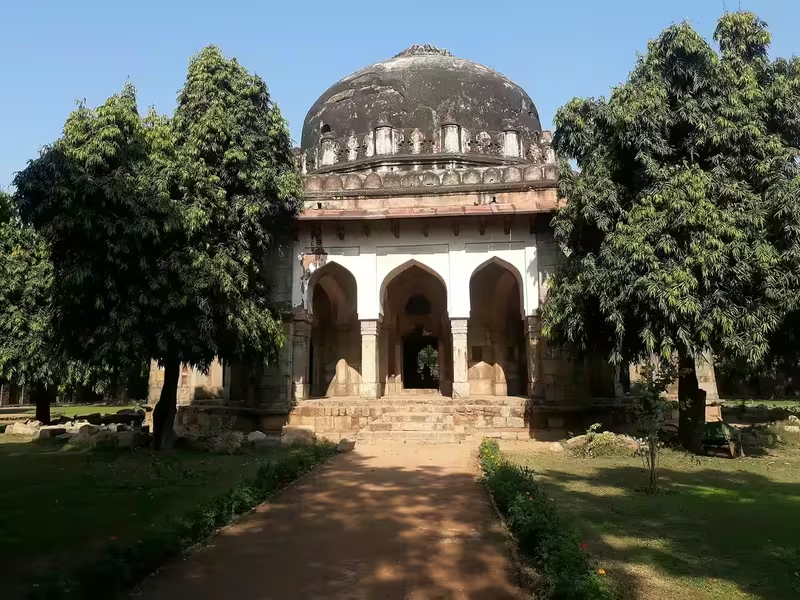
Overview
On 19 April 1451, Bahlul Khan Lodi took the throne of Delhi after the last Sayyid ruler, Alauddin Alam Shah, voluntarily abdicated in his favour. This transfer brought the Lodi family to power and began the fifth and final dynasty of the Delhi Sultanate. The Lodis ruled until 1526, when Ibrahim Lodi was defeated and killed by the Timurid ruler Babur at the Battle of Panipat.
The dynasty emerged from the political world of Punjab, where Afghan and Turkish chiefs exercised considerable influence. Bahlul Lodi’s authority rested partly on his ability to hold these chiefs together through personal leadership. Under his rule, the sultanate recovered strength through warfare, especially against the Sharqi dynasty of Jaunpur. His successors continued efforts to consolidate power, though they faced persistent tensions between the sultan and powerful Pashtun nobles.
The three Lodi rulers—Bahlul, Sikandar, and Ibrahim—had sharply different political profiles. Bahlul was a forceful coalition-builder and military leader. Sikandar combined territorial expansion with administrative discipline, patronage of learning, and the development of Agra. Ibrahim attempted to establish a more absolute style of kingship, but his policies intensified opposition among nobles and relatives. These internal divisions made it possible for Babur to intervene in North India.
Rise to Power
Before becoming sultan, Bahlul Khan Lodi was closely associated with Sirhind in Punjab. He was the nephew and son-in-law of Malik Sultan Shah Lodi, the governor of Sirhind, and succeeded him in that position during the reign of the Sayyid ruler Muhammad Shah. Muhammad Shah raised Bahlul to the status of a Tarun-Bin-Sultan, a recognition of his growing political importance.
Bahlul was described as the most powerful among the Punjab chiefs. His influence did not come from a fully centralized bureaucracy but from his ability to command the loyalty, or at least the cooperation, of a loose confederacy of Afghan and Turkish leaders. The provinces contained turbulent chiefs whose submission could not be taken for granted. Bahlul’s strong personality and military energy helped bring them under control and gave renewed vigour to the government.
The Sayyid dynasty’s final ruler, Alauddin Alam Shah, abdicated in favour of Bahlul. Bahlul consequently ascended the throne of the Delhi Sultanate on 19 April 1451. His accession was not simply a change of royal family; it marked the rise of an Afghan or Turco-Afghan ruling house whose political strength was rooted in the military aristocracy of North India.
The main challenge of Bahlul’s reign came from the Sharqi dynasty of Jaunpur. Much of his time was spent fighting the Jaunpur Sultanate. The conflict ended with the annexation of Jaunpur to Bahlul’s dominions. In 1486, he placed his eldest surviving son, Barbak, on the throne of Jaunpur. The Sharqis continued to control Bihar and from there reoccupied Jaunpur, but Bahlul’s forces again drove them back toward Bihar.
Golden Age
The Lodi period reached its greatest level of administrative energy under Sikandar Lodi, although the dynasty’s political structure remained dependent on negotiations and struggles with powerful nobles. Sikandar Khan Lodi, born Nizam Khan, was Bahlul’s second son. He succeeded his father after Bahlul’s death on 17 July 1489 and took the title Sikandar Shah. He had been nominated as successor and was crowned on 15 July 1489, though the surviving account gives these two dates in an order that is difficult to reconcile.
Sikandar inherited a sultanate that Bahlul had expanded through warfare. His own most important territorial achievement was the conquest and annexation of Bihar from the Sharqis. This strengthened Lodi authority farther east and extended the dynasty’s reach beyond its Punjab and Delhi foundations.
Sikandar also gave the dynasty a new political centre. In 1504, he re-founded Agra as a Muslim city and shifted the capital from Delhi to Agra. The move placed the court closer to territories that had become central to Lodi expansion. Sikandar built mosques in Agra and patronized trade and commerce, helping establish the city as an important centre of the sultanate.
His reign also saw efforts to impose greater discipline on the nobility. Pashtun nobles could act with considerable independence, but Sikandar compelled them to submit their accounts to a state audit. This policy limited individualistic tendencies and strengthened the administrative authority of the sultan. The measure did not eliminate factionalism, but it represented a deliberate attempt to make the government more orderly and accountable.
Administration and Governance
The Lodi state was an Islamic sultanate whose political authority was exercised through the sultan, provincial officials, military leaders, and landed or revenue-holding elites. Afghan and Turkish chiefs were especially important. Bahlul’s success came from managing this loose coalition, while Sikandar sought to regulate it more closely.
The dynasty’s rulers styled themselves as deputies of the Abbasid caliphs. In this way, they acknowledged the authority of a united caliphate over the Muslim world, even as they governed the Delhi Sultanate independently. The sultans provided cash stipends and granted revenue-free lands to Muslim religious scholars, or ulama, Sufi shaikhs, claimed descendants of Muhammad, and members of the Quraysh tribe.
Taxation reflected religious distinctions. Muslim subjects were required to pay the zakat tax as a religious obligation. Non-Muslims were required to pay the jizya tax in return for state protection. In some areas, Hindus also paid an additional pilgrimage tax. At the same time, Hindu officers served in the revenue administration, showing that the functioning of the state depended on officials from more than one religious community.
Sikandar Lodi established sharia courts in several towns with significant Muslim populations. These courts enabled qazis to administer Islamic law to both Muslim and non-Muslim subjects. His religious policies were strongly shaped by Sunni orthodoxy. The accounts describe the destruction of Hindu temples in northern India and the execution, with the approval of the religious authorities, of a Brahman who maintained that Hinduism was as truthful as Islam. Sikandar also prohibited Muslim women from venerating the mausoleums of Muslim saints and banned the annual procession of the spear associated with the Muslim martyr Masud Salar.
These policies should be understood as part of Sikandar’s effort to demonstrate Islamic credentials and secure the support of the ulama. They also reveal the tension between the religious ideals promoted by the court and the practical diversity of the society over which the Lodi state ruled.
Persian was used for revenue records and remained an important language of administration and elite culture. Hindavi also functioned as a semi-official language in the period preceding Mughal rule. The linguistic environment of the sultanate was therefore not limited to a single spoken or literary tradition.
Military Campaigns
Military expansion was central to the formation and survival of the Lodi state. Bahlul spent much of his reign campaigning against the Sharqi rulers of Jaunpur. His eventual annexation of Jaunpur was the dynasty’s major early achievement. Although the Sharqis retained Bihar for a time and briefly recovered Jaunpur, Bahlul’s forces repulsed them again.
Sikandar continued the eastern struggle and conquered Bihar. The victory removed a major Sharqi base and consolidated Lodi authority in the eastern part of the sultanate. His reign combined these campaigns with efforts to bring provincial officials and nobles under closer supervision.
Ibrahim Lodi inherited an expanded but politically fragile state in 1517. He possessed the qualities of an excellent warrior, but his decisions were described as rash and politically imprudent. His attempt to impose royal absolutism came before he had strengthened the administration or increased the military resources available to the crown. Instead of producing a more powerful monarchy, repression widened opposition.
Soon after his accession, Ibrahim faced a rebellion involving his older brother, Jalaluddin Lodi, in the region around Jaunpur. Ibrahim gathered military support and defeated him by the end of the year. He then arrested Pashtun nobles who had opposed him and replaced them with his own appointees. This action deepened the hostility of other nobles, including those who supported Dariya Khan, the governor of Bihar.
Ibrahim also faced conflict with Rana Sanga, the Rajput ruler of Mewar. Sanga expanded his kingdom and fought the Lodi ruler in several battles. The political instability of Ibrahim’s reign gave regional powers opportunities to challenge Delhi.
The crisis finally drew in Babur, the Timurid ruler of Kabul. Daulat Khan Lodi, governor of Punjab, invited Babur to invade in response to insults and grievances associated with Ibrahim. Ibrahim’s uncle, Alam Khan, also betrayed him by supporting the Mughal invader. Babur later accused Rana Sanga of sending an invitation as well, but this claim has not been widely accepted by scholars.
Cultural Contributions
The Lodi sultans supported Islamic institutions and Persianate court culture. Sikandar Lodi was himself a poet who composed Persian verse under the pen name Gulrukhi. He also patronized learning and ordered the translation of Sanskrit medical works into Persian. These activities connected the court to both Persian literary culture and the intellectual traditions of India.
Architecture during the dynasty included the construction of mosques, particularly under Sikandar at Agra. The re-foundation of Agra as a Muslim city in 1504 was both an urban and political project. It created a new centre for the court at a time when Lodi power was expanding eastward and southward from its earlier base in Delhi and Punjab.
Religion shaped public policy and court patronage. Revenue-free grants supported ulama, Sufi shaikhs, and families claiming sacred descent. At the same time, Sikandar’s policies toward Hindu temples and Hindu religious expression were coercive. The Lodi period therefore combined literary and institutional patronage with policies that sought to enforce Sunni norms and distinguish Islamic authority from other religious traditions.
Economy and Trade
Sikandar Lodi explicitly patronized trade and commerce, but the dynasty’s later finances were placed under pressure by wider disruptions. By the time Ibrahim came to the throne, the political structure of the state had weakened, trade routes had been abandoned, and the treasury had been depleted.
The account of the dynasty’s decline connects this problem to the collapse of a Deccan coastal trade route in the late fifteenth century. When supply lines from the coast to the interior broke down, the Lodi state could no longer protect or effectively use the route. Trade declined, reducing revenue and leaving the government more vulnerable to internal political problems.
This economic weakness mattered militarily. A state dependent on a powerful but divided nobility needed reliable revenue to maintain armies and reward supporters. With the treasury depleted and provincial loyalties uncertain, Ibrahim faced rebellions without the administrative and military resources required to suppress them permanently.
Decline and Fall
Ibrahim Lodi’s reign brought the dynasty’s internal tensions to the surface. His effort to create a more absolute monarchy alienated nobles who expected a greater degree of autonomy. The removal and arrest of opponents did not resolve the conflict; it encouraged further resistance. His brother, uncle, provincial governors, and Pashtun chiefs all became involved in the struggle.
At the same time, the sultanate faced external pressure. Rana Sanga challenged Lodi authority in the west, while Babur watched developments from Kabul. Daulat Khan’s invitation gave Babur an opening to intervene, and Alam Khan’s support weakened Ibrahim’s position from within the ruling family itself.
Babur’s army entered the Punjab and advanced toward Delhi. At Panipat in April 1526, Babur brought approximately 24,000 men equipped with muskets and artillery. Ibrahim assembled a much larger army, reported at around 100,000 soldiers and 1,000 elephants. Yet numerical superiority did not compensate for his lack of experience against gunpowder weapons and the rivalries within his forces.
Babur pressed his advantage from the beginning of the battle. Ibrahim was killed on the battlefield along with approximately 20,000 of his men. His death ended the Lodi dynasty. Rather than placing Alam Khan on the throne, Babur declared himself emperor over Ibrahim’s territories. The remaining Lodi lands were absorbed into the new Mughal Empire.
Resistance did not end immediately. Ibrahim’s brother Mahmud Lodi declared himself sultan and continued to oppose Mughal forces. He supplied around 4,000 Afghan soldiers to Rana Sanga at the Battle of Khanwa in 1527. After the defeat there, Mahmud fled eastward and challenged Babur again at the Battle of Ghaghra in 1529.
Legacy
The Lodi dynasty was brief compared with several earlier ruling houses, but it occupied a decisive position in the history of North India. Bahlul Lodi rebuilt the authority of Delhi through a coalition of Afghan and Turkish chiefs and through the conquest of Jaunpur. Sikandar Lodi expanded this foundation by annexing Bihar, shifting the capital to Agra, regulating noble accounts, and supporting commerce and learning.
The dynasty’s achievements were inseparable from its weaknesses. Its political system depended heavily on relationships between the sultan and powerful Pashtun nobles. When Ibrahim tried to replace this negotiated order with premature absolutism, factional resistance intensified. Financial pressures, regional rebellions, and the intervention of Babur turned a succession crisis into a dynastic collapse.
The Battle of Panipat in 1526 is therefore both the final event of Lodi history and the opening of Mughal history. Babur’s victory ended the Delhi Sultanate’s Lodi phase and established the Mughal Empire in the subcontinent. The Lodi experience also shaped the political environment inherited by the Mughals: a North Indian sultanate with contested provincial loyalties, Afghan military elites, Persianate administration, and a capital increasingly connected with Agra.