Overview
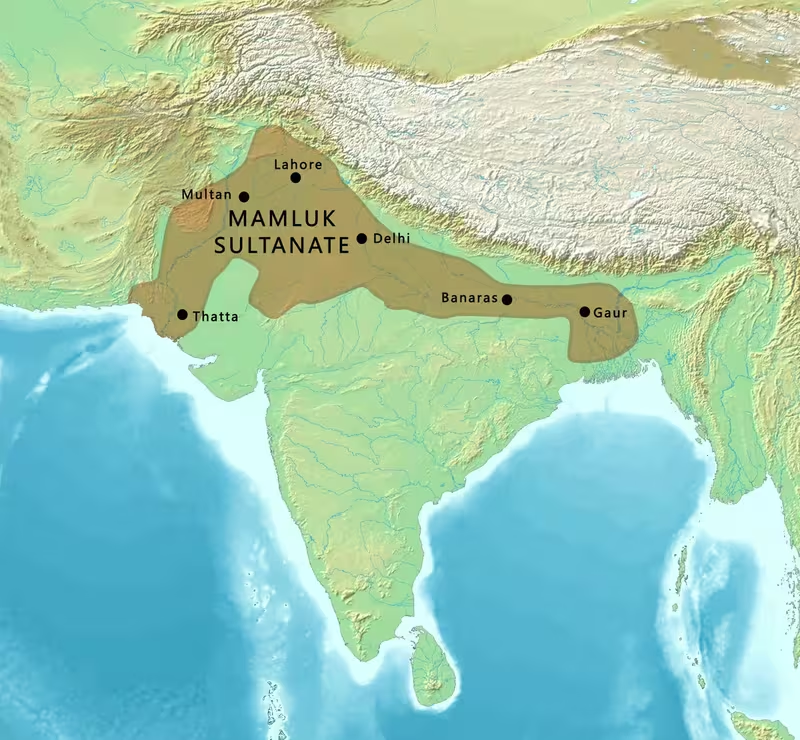
In 1206, the assassination of Muhammad of Ghor transformed the political map of northern India. The Ghurid Empire had no male heir, and its territories divided among former Mamluk generals. In Delhi, Qutb ud-Din Aibak, a Turkic military commander of slave origin, assumed power and established the ruling line later called the Mamluk Dynasty or Slave Dynasty.
The name describes the dynasty’s origins rather than a single, continuous household. In historical writing, the Mamluk Sultanate of Delhi is an umbrella term for three related ruling phases: the Qutbi dynasty from 1206 to 1211, the first Ilbari or Shamsi dynasty from 1211 to 1266, and the second Ilbari dynasty from 1266 to 1290. These rulers governed territories inherited from the Ghurids and gradually made Delhi the centre of a durable sultanate.
The Mamluks were soldiers of slave origins who had converted to Islam. Across the Islamic world, such military personnel had developed into a powerful political class. In India, their rise produced a state shaped by military command, competing nobles, provincial authority, and the need to respond to Mongol pressure. The dynasty also left an important architectural legacy, especially in Delhi’s Qutb complex.
Rise to Power
Before becoming sultan, Qutb ud-Din Aibak served as a Ghurid administrator from 1192 to 1206. During this period, he led campaigns into the Gangetic plain and established control over some newly conquered areas. His authority was therefore rooted in military service and provincial governance before the collapse of Ghurid rule.
Muhammad of Ghor was assassinated in 1206. Because he left no male heir, former Mamluk commanders established separate centres of power. Taj-ud-Din Yildoz took control of Ghazni, Muhammad bin Bakhtiyar Khilji held Bengal, Nasir-ud-Din Qabacha ruled Multan, and Qutb ud-Din Aibak became sultan at Delhi. This division created both an opportunity and a threat: Aibak had to defend his position against other former Ghurid commanders who also claimed authority.
Aibak temporarily quelled the rebellions of Qabacha in Multan and Yildoz in Ghazni. He made Lahore his capital and consolidated his authority through an administrative hold over Delhi. His reign was brief. In 1210, he died in Lahore after injuries sustained while playing polo; his horse fell, and he was impaled on the pommel of his saddle.
Aibak was followed by Aram Shah, whose reign lasted only from 1210 to 1211. A powerful group of forty nobles, known as the Chihalgani, opposed him and invited Shams-ud-din Iltutmish, then governor of Badaun, to take the throne. Iltutmish defeated Aram Shah on the plain of Jud near Delhi in 1211. The later fate of Aram Shah is uncertain.
Golden Age
The strongest phase of Mamluk consolidation came under Iltutmish, who ruled from 1211 to 1236. He shifted the capital from Lahore to Delhi and, according to the historical account, trebled the exchequer. He defeated both Nasir-ud-Din Qabacha of Multan and Tajuddin Yildoz of Ghazni, eliminating major rivals who claimed the Delhi throne.
Iltutmish also faced the consequences of upheaval across Central and western Asia. In 1221, Genghis Khan defeated the Khwarazmshah Jalal-ud-din Mangabarni at the Battle of the Indus. Mongol forces had entered the wider political environment around northern India, creating a serious strategic danger. Iltutmish managed to keep India unaffected by the invasions of Genghis Khan and his successors while consolidating his own position.
After Genghis Khan’s death, Iltutmish retook territories that had been lost. Bengal, which had been controlled by the Turko-Afghan general Bakhtiyar Khilji and his successors of the Khalji dynasty of Bengal, was incorporated into the Delhi Sultanate in 1227. These developments made Iltutmish’s reign a period of territorial recovery and institutional strengthening.
The years after Iltutmish were considerably less stable. His death in 1236 was followed by a rapid succession of rulers and factional struggles. Rukn-ud-din Feroze ruled for only seven months, while his mother, Shah Turkan, effectively directed the government. Both were assassinated by the Chihalgani in November 1236.
Razia al-Din, better known as Razia Sultana, then took the throne. She was the first female Muslim ruler in India and initially impressed the nobles through her administrative ability. Her reign also revealed the social and political tensions within the ruling elite. Her association with Jamal-ud-Din Yaqut, an African officer, provoked racial antagonism among nobles and clergy who were primarily Central Asian Turks. These groups already resented the rule of a female monarch.
Razia was defeated by the nobleman Malik Altunia, whom she agreed to marry. Her half-brother Muiz-ud-din Bahram seized the throne with the support of the Chihalgani and defeated the combined forces of Razia and Altunia. The couple fled toward Kaithal, where their remaining forces abandoned them. They were later captured, robbed, and killed by Jats on 14 October 1240.
Administration and Governance
The Mamluk state was a sultanate whose authority depended heavily on the military strength and political skill of its ruler. The succession after Iltutmish shows that the throne was not protected by a simple, uncontested hereditary principle. Nobles, governors, military commanders, and court factions could determine who ruled Delhi.
The Chihalgani played a central role in this politics. Its members helped remove Aram Shah, Shah Turkan, and later rulers, but their collective power also produced disorder. During the reign of Muiz-ud-din Bahram from 1240 to 1242, the group constantly quarrelled. The Mongols invaded Punjab and sacked Lahore during this period. Bahram was too weak to respond effectively, and the Chihalgani eventually besieged him in Delhi’s White Fort and put him to death.
Ala-ud-din Masud, who ruled from 1242 to 1246, was effectively controlled by the Chihalgani. His fondness for entertainment and wine, along with his growing desire for power, alienated the chiefs. They replaced him with Nasiruddin Mahmud, another grandson of Iltutmish.
Nasiruddin Mahmud was known for his religious devotion and for aiding poor and distressed people. In practice, however, much of the state’s day-to-day administration was handled by his deputy, Ghiyath-ud-din Balban. This arrangement allowed Balban to build the authority that later enabled him to become sultan.
Balban ruled from 1266 to 1287 and attempted to restore the power of the crown. He broke up the Chihalgani, sought strict loyalty to the sultan, and established an efficient espionage system. He also built fortified outposts with garrisons in areas affected by disorder. His approach was based on central authority, surveillance, and military readiness.
Military Campaigns
Military consolidation began under Aibak, who defended Delhi against the claims of Yildoz and Qabacha. The struggle was not simply a conflict between an established kingdom and outside invaders; it was also a contest among former Ghurid commanders over the political inheritance of Muhammad of Ghor.
Iltutmish’s victories over Qabacha and Yildoz secured Delhi against two important rivals. His recovery of territory after the death of Genghis Khan strengthened the sultanate, while the incorporation of Bengal in 1227 extended Delhi’s authority farther east.
Mongol pressure remained a recurring danger. The Mongols invaded Punjab during Bahram’s reign and sacked Lahore, exposing the weakness created by factional politics in Delhi. Under Balban, the sultanate repelled repeated invasions by Mongol forces, including attacks associated with the Chagatai Khanate. Balban’s frontier outposts and garrisons were part of his wider effort to prevent external attacks and internal rebellion from reinforcing one another.
Balban also suffered a personal and political loss when his favourite son, Prince Muhammad, died in the Battle of the Beas River against the Mongols. The episode demonstrates the continuing military pressure faced by the sultanate even during Balban’s strong rule.
Cultural Contributions
The Mamluk period marked an important stage in the development of Indo-Islamic architecture in northern India. Qutb ud-Din Aibak initiated the Quwwat-ul-Islam, or “Might of Islam,” mosque in the Qutb complex at Delhi. It was begun in 1193 to mark his victory over the Rajputs. The Qutb Minar is also associated with Aibak and the complex, although the surviving account presents its construction in connection with the early period of his rule.
The Qutb complex later became the setting for the tomb of Iltutmish, built in 1235. Iltutmish also commissioned the Hauz-i-Shamsi reservoir south of the Qutb Minar and a madrasa around it. His reign saw the construction of Gandhak ki Baoli, a stepwell associated with the Sufi saint Qutbuddin Bakhtiar Kaki.
In 1231, Iltutmish built Sultan Ghari near Vasant Kunj as the mausoleum of his eldest son, Prince Nasiru'd-Din Mahmud. It is identified as the first Islamic mausoleum in Delhi. Balban’s tomb, located in the Mehrauli Archaeological Park, represents another surviving architectural connection with the dynasty.
The ruling elite retained Turkish as its main language and continued to identify itself with a Turkic military culture. The historical account contrasts these “men of the sword” with Persian “men of the pen,” reflecting a distinction between military commanders and Persianate literati and administrators.
Economy and Trade
The surviving historical account gives limited detail about taxation, trade routes, markets, or specific monetary systems. It does, however, indicate the importance of state finance: Iltutmish is credited with trebling the exchequer after moving the capital to Delhi.
Territorial expansion also had economic and administrative implications. The incorporation of Bengal in 1227 and the recovery of territories after Genghis Khan’s death brought additional regions under Delhi’s authority. Reservoirs, stepwells, madrasas, forts, and garrisons demonstrate the state’s ability to direct resources toward urban, religious, and military projects. Beyond these indications, the precise organization of revenue and commerce is not established by the available account.
Decline and Fall
The dynasty’s decline was closely connected to instability in succession and the power of competing nobles. After Iltutmish, a series of short reigns allowed the Chihalgani to intervene repeatedly in the government. Their influence could remove ineffective rulers, but their rivalry also weakened the central state.
Balban restored royal authority for a time, subdued the Chihalgani, and defended the sultanate against Mongol invasions. After his death in 1287, however, the throne again passed to a young and ineffective ruler. Muiz-ud-din Muhammad Qaiqabad ignored state affairs and, after four years, suffered a paralytic stroke.
In 1290, Qaiqabad was murdered by a Khalji chief. His three-year-old son, Kayumars, nominally succeeded him, but the child could not preserve the dynasty. Jalal-ud-Din Firuz Khalji overthrew the last Mamluk ruler and established the Khalji dynasty. With this transfer of power, the Mamluk period of the Delhi Sultanate came to an end.
Legacy
The Mamluk Dynasty created the political foundation of the early Delhi Sultanate after the collapse of Ghurid authority. Its rulers faced a difficult combination of rival commanders, ambitious nobles, provincial autonomy, and Mongol pressure. The state survived these challenges unevenly: Iltutmish and Balban strengthened central power, while weaker rulers exposed the dangers of factional politics.
Its architectural legacy remains especially visible in Delhi and its surrounding historic landscape. The Qutb Minar complex, Quwwat-ul-Islam mosque, Hauz-i-Shamsi, Sultan Ghari, the tomb of Iltutmish, and Balban’s tomb preserve the material record of the dynasty’s rule. The period also stands out for Razia Sultana’s brief reign, which challenged assumptions about political authority in the sultanate.
Although the dynasty ended with the Khalji takeover in 1290, the institutions, political practices, and monuments associated with its rulers continued to shape the history of the Delhi Sultanate.