Overview
In 1917, tenants in Champaran district of Bihar challenged a colonial indigo system that compelled them to cultivate the crop for very little payment. Their protest became the Champaran Satyagraha, Mahatma Gandhi’s first satyagraha movement in British India and his first major political undertaking after returning from South Africa.
The movement combined local peasant grievances with Gandhi’s method of non-violent resistance. Its negotiated settlement required indigo planters to return 25% of unlawfully collected funds and helped bring about the dismantling of the Teenkathia system. Within a decade, the planters had left the area.
Background
Under colonial-era tenancy arrangements, many farmers had to grow indigo on a portion of their land. This obligation was known as the Panchkathia or Teenkathia system. Indigo was used to produce dye, but the tenants received little compensation and had limited control over how their land was used.
The arrival of artificial dye made by the Germans reduced the demand for natural indigo. Some tenants paid higher rent to escape the cultivation requirement. During the First World War, however, German dye became unavailable and indigo became profitable again. The pressure to grow it was renewed, producing widespread anger among the tenants.
The wider Indian political movement was also divided. Moderates advocated greater Indian participation within the colonial system, while radicals in Bengal supported violent methods to overthrow British rule. Champaran offered a different direction: organised mass protest based on satyagraha.
Prelude
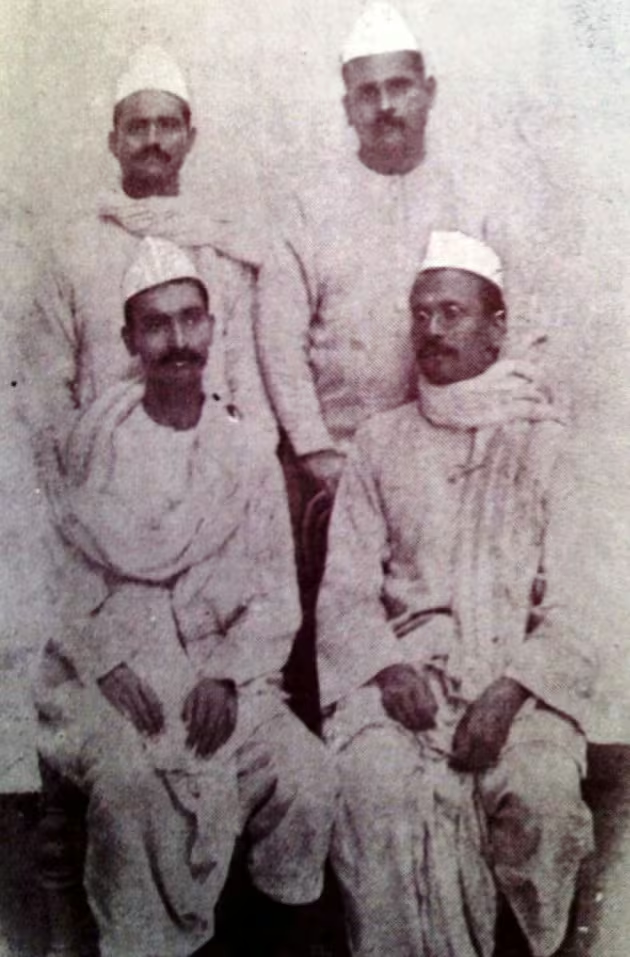
Raj Kumar Shukla, a local peasant, repeatedly urged Gandhi to investigate the conditions in Champaran. Gandhi accepted the invitation and travelled there with figures including Rajendra Prasad, Mazhar ul-Haq, Mahadeo Desai, Narhari Parekh and J. B. Kripalani. Brajkishore Prasad, Anugraha Narayan Sinha, Ramnavmi Prasad and Shambhusharan Varma also participated.
When colonial authorities ordered Gandhi to leave, he refused. He chose to face punishment rather than abandon the investigation. This refusal marked his first act of passive resistance, or civil disobedience, on Indian soil.
The Event
Gandhi and his associates examined the complaints of the tenants and gathered attention around the coercive cultivation system. The movement did not seek to replace one form of authority with another through violence. Instead, it used public investigation, organised protest and refusal to accept an unjust official order.
Key Phases
The first phase involved Gandhi’s arrival in Champaran and his investigation of tenant grievances. The second began with his refusal to obey the order to leave. The third followed when his efforts contributed to the creation of a Government Commission of Inquiry, on which Gandhi served.
Turning Points
The decisive turning point was Gandhi’s willingness to accept punishment while remaining in Champaran. His subsequent participation in the inquiry transformed scattered grievances into an official political issue. The negotiated settlement then required planters to reimburse the peasants and dismantle the Teenkathia arrangement.
Participants
Peasant Tenants
The tenants opposed compulsory indigo cultivation, poor payment and the loss of control over their land. Raj Kumar Shukla’s appeal brought their grievances to Gandhi’s attention.
Gandhi and His Associates
Gandhi led the investigation and civil disobedience campaign. Rajendra Prasad, Mazhar ul-Haq, Mahadeo Desai, Narhari Parekh and J. B. Kripalani were among those who joined him.
Indigo Planters and Colonial Authorities
The planters benefited from the tenancy arrangements, while colonial authorities initially ordered Gandhi to leave. The eventual inquiry and settlement compelled the planters to make concessions.
Aftermath
The settlement returned 25% of unlawfully collected funds to the peasants and, more importantly, dismantled the Teenkathia system. The planters gradually lost their position in the area and had left within a decade.
Historical Significance
Champaran demonstrated that satyagraha could mobilise ordinary farmers around specific economic injustices. It gave direction to India’s youth and freedom struggle and helped establish non-violent civil disobedience as a practical alternative to both cautious constitutional politics and revolutionary violence.
Legacy
The centenary celebrations began on 10 April 2017 with a national conclave of Gandhian thinkers, philosophers and scholars. On 13 May, the Indian Postal Department issued three commemorative stamps and a miniature sheet. The concluding ceremony took place at Motihari on 10 April 2017. The idea of Champaran was also connected with “Swachhagraha,” linking Gandhi’s politics to the emphasis on cleanliness.
Historiography
Champaran is commonly presented as the first popular satyagraha movement in India. Its importance lies not only in the compensation won by the tenants, but also in the political method it established: investigation of local suffering, collective action, civil disobedience and negotiated reform.