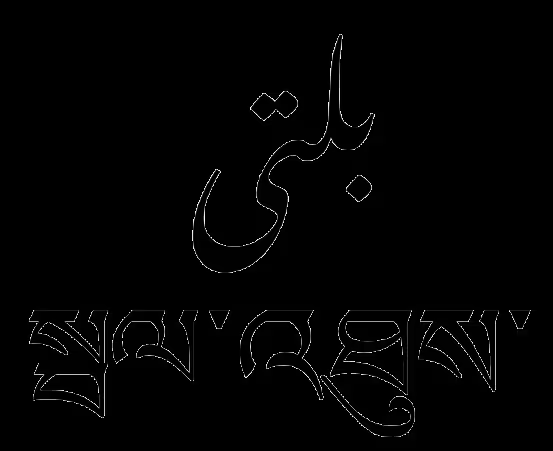
Balti Language: A Tibetic Voice of Baltistan and Ladakh
From the highland region of Baltistan to Ladakh’s Nubra Valley and Kargil district, Balti preserves a distinctive branch of Tibetic speech. It retains many sounds of Old Tibetan that were lost in Standard Tibetan and differs from Standard Tibetan in its sound system and accentual pattern. Balti has a simple pitch-accent system in multisyllabic words, whereas Standard Tibetan has a more complex pitch system that includes tone contour.
The language is spoken primarily by the Balti people in Gilgit-Baltistan, Pakistan, and in Kargil and Nubra in Ladakh, India. It is also used by migrant communities in cities including Karachi, Lahore, Peshawar, Islamabad, and Quetta, and among Balti migrants in several northern Indian cities. Its written history reflects major religious and cultural changes: Tibetan script was used from 727 CE, while Perso-Arabic writing became dominant after the Baltis converted to Islam in the late fourteenth century. In the modern period, scholars and activists have worked to adapt both systems to Balti phonology and to preserve the language’s cultural identity.
Origins and Classification
Linguistic Family
Balti is a Tibetic language within the Sino-Tibetan language family. It is closely related to Ladakhi. Unlike many neighboring languages of northern Pakistan, including Pashto, Khowar, and Shina, which are described as Indo-Aryan or Iranic, Balti is Sino-Tibetan.
Its relationship with Ladakhi places it within the wider Tibetan linguistic sphere, although Balti differs from Standard Tibetan in several important ways. The language has retained sounds of Old Tibetan that disappeared from Standard Tibetan, and its pitch-accent system is comparatively simple.
Origins
Balti is natively spoken in Baltistan, the region associated with the Balti people in Gilgit-Baltistan, Pakistan. It is also spoken in Kargil and Nubra in Ladakh, India. The available historical account identifies its early written period rather than a precise date or place of linguistic origin.
Historically, Buddhists in Leh used the term “Balti” for all Muslims in Ladakh. This usage reflects the religious and regional associations attached to the name in Ladakh’s historical society.
Historical Development
Tibetan-Script Period (727–Late Fourteenth Century)
Balti was written with a version of the Tibetan script from 727 CE, when Baltistan was conquered by Tibetans. The Tibetan writing tradition remained in use until the last quarter of the fourteenth century.
The earlier writing system is significant because Balti later developed in ways distinct from Standard Tibetan while retaining features associated with older Tibetan speech. Modern attempts to revive Tibetan writing for Balti build on this earlier history but add letters for sounds and loanwords found in the contemporary language.
Conversion and Perso-Arabic Writing
In the late fourteenth century, the Baltis converted to Islam. After this change, the Perso-Arabic script replaced Tibetan writing. The Perso-Arabic system was widely used even though it did not originally contain letters for seven Balti sounds.
This created a gap between the language’s phonology and its written representation. In 1985, Yusuf Hussain Abadi added seven new letters to the Perso-Arabic script for Balti. These additions made the script more complete for writing the language. He also added four letters to the Tibetan script.
Modern Period
Since Pakistan gained control of the region in 1948, Urdu words have entered local dialects and languages, including Balti. Modern Balti also uses English words, while Arabic and Persian have contributed vocabulary through religious influence. For dozens of newly invented or introduced things, Balti has no native names or vocabulary, so Urdu and English terms are used instead.
Balti scholars, clerical scholars, and social activists have attempted to standardize and unify the Perso-Arabic script. Other academics have promoted the revival of the Tibetan Balti, or Yige, alphabet. These efforts are connected not only with literacy but also with preserving indigenous Balti and Ladakhi culture and ethnic identity.
Scripts and Writing Systems
Tibetan Script
The Tibetan script was used for Balti from 727 CE until the late fourteenth century. A modern revival movement has sought to restore a Tibetan-based writing system for Balti, with additional letters for Urdu, Persian, Arabic, and English loanwords.
In 1985, Yusuf Hussain Abadi added four letters to the Tibetan script. Two of these letters were later included in the Tibetan Unicode block. The September 2006 Tokyo meeting of ISO/IEC 10646 WG2 agreed to encode two characters invented by Abadi: U+0F6B, Tibetan Letter KKA, and U+0F6C, Tibetan Letter RRA. Their inclusion supported the rendering of Urdu loanwords in modern Balti using the Yige alphabet.
In the Yige writing system, each letter has an inherent [a] vowel. Other vowels are indicated through additional written signs. Some letters are uniquely created for Balti sounds, especially sounds found in Urdu, Persian, Arabic, or English loanwords.
Perso-Arabic Script
The Perso-Arabic script is currently the predominant writing system for Balti. Its use became established after the Baltis converted to Islam and replaced the Tibetan script.
The modern Balti Perso-Arabic system includes additional letters introduced by Yusuf Hussain Abadi in 1985. Aspirated sounds can be written as digraphs using the letter ھ, following Urdu orthographic practice. Vowels are represented in a way similar to Urdu, although diacritics are generally omitted in ordinary writing. They may be included to clarify pronunciation and avoid ambiguity.
The Balti translation of the Qur’an was published using the Balti Perso-Arabic script. This script is also used in Balti primers and other educational materials.
Script Evolution
Balti’s writing history moved from Tibetan script to Perso-Arabic script and then toward modern efforts to adapt both systems. The first transition followed religious change; the later adaptations responded to the need to represent Balti sounds more accurately.
The language’s written development also reflects contact with Urdu, Persian, Arabic, and English. While the Perso-Arabic script is more widely used today, the Tibetan Balti or Yige alphabet remains important to preservation efforts.
Geographic Distribution
Historical Spread
Balti is associated with Baltistan and with areas of Ladakh that have historical, linguistic, and cultural connections with the region. The language is spoken in Pakistan’s Gilgit-Baltistan and in India’s Kargil and Nubra areas.
In Ladakh, Balti is spoken in Kargil city and surrounding villages including Hardas, Lato, Karkitchhoo, and Balti Bazar. It is also spoken in Turtuk, Bogdang, and Tyakshi, as well as in Leh city and nearby villages.
Modern Distribution
According to the Gilgit-Baltistan Scouts, Balti is mostly spoken in Skardu, Shigar, Ghanche, Roundu, and Kharmang. In Pakistan, Balti-speaking immigrants are found in Karachi, Lahore, Peshawar, Islamabad, Quetta, and other cities.
In India, communities of Balti speakers are found in Dehradun, Nainital, Ambari, Shimla, Vikasnagar, and other northern cities. These communities include people who migrated from Baltistan, Kargil, and Nubra before the partition of India and Pakistan.
Dialect Regions
Balti has four mutually intelligible variants:
- The eastern dialect of Chorbat and Nubra Valley
- The central dialect of Khaplu Valley
- The western dialect of Skardu, Shigar, and Rondu
- The southern dialect of Upper Kharmang and Kargil
The dialects differ in phonology and vocabulary. For example, “to keep” is yuq in other varieties but juq in the southern dialect of Kharmang and Kargil. “Milk” is oma in the eastern Chorbat-Nubra, central Khaplu, and southern Kharmang-Kargil varieties, but ona in the western dialect of Skardu, Shigar, and Rondu Valley.
Literary Heritage
Oral Literature
Balti literature includes oral epics and sagas. These include the Epic of King Gesar and stories such as rgya lu cho lo bzang and rgya lu sras bu. The oral tradition forms an important part of Balti literary culture.
Poetry
Other Balti literature is in verse. Balti poetry has adopted numerous Persian styles of verse and Persian vocables. This literary influence reflects the language’s long contact with Persian and the cultural connections associated with Islam.
Religious Texts
A major modern publication is the Balti translation of the Qur’an. Yusuf Hussain Abadi published the Balti translation of the first Qur’anic sura, Al-Fatiha, in 2011. The translation uses the Balti Perso-Arabic orthography.
Grammar and Phonology
Key Features
Balti has a simple pitch-accent system that occurs in multisyllabic words. Standard Tibetan, by contrast, has a complex and distinct pitch system that includes tone contour.
The four Balti dialects remain mutually intelligible despite differences in phonology and vocabulary. Balti also retains many honorific words characteristic of Tibetan dialects and other languages.
Sound System
Balti preserves many Old Tibetan sounds lost in Standard Tibetan. Some consonants have several realizations:
- Allophones of
/l/include[lʱ],[ɭ], and[ɫ̥]. /ɖ/may be realized as the flap[ɽ]./s/may also be realized as the retroflex[ʂ].
The vowel /ɑ/ varies between an open back [ɑ], an open-mid back [ʌ], and an open central [ä]. The mid vowels /e, o/ may be realized as the lower open-mid vowels [ɛ, ɔ].
Influence and Legacy
Languages in Contact
Balti has little in common with neighboring languages apart from loanwords absorbed through linguistic contact. Its closest stated linguistic relationship is with Ladakhi, while its vocabulary has been influenced by Urdu, Punjabi, English, Arabic, and Persian.
The influence of Urdu has become especially strong in Pakistan. Urdu words have entered local Balti varieties, and Urdu and English are used for many modern objects and concepts for which Balti has no native vocabulary.
Cultural Impact
Balti’s linguistic history is closely connected with the cultural history of Baltistan and Ladakh. The movement between Tibetan and Perso-Arabic writing reflects changes in religious affiliation, political connections, and literary practice. The modern promotion of Yige writing is intended to support Balti and Ladakhi cultural identity.
Modern Status
Preservation Efforts
Balti faces pressure from dominant languages, especially Urdu in Pakistan. Its centuries-long separation from Tibet and from Ladakh, caused by political divisions and strong religious differences, has also affected literary development.
Balti academics in Pakistan and Balti clerical scholars in Pakistan and Iran have worked toward standardizing and unifying the Perso-Arabic script. Other academics have attempted to revive Tibetan writing with additional letters for modern loanwords. The use of new letters, Unicode encoding, textbooks, primers, and religious publications has helped provide written resources for contemporary Balti.
Learning Resources
Available Balti resources include a Balti primer in Perso-Arabic script, a Balti language textbook for Class 4, and the Qur’an with its Balti translation. The language has also been documented through work on its Perso-Arabic and Tibetan-based orthographies.
Conclusion
Balti is a living Tibetic language whose history spans the linguistic landscapes of Baltistan and Ladakh. Its preservation of Old Tibetan sounds, distinctive pitch-accent system, and mutually intelligible regional varieties make it an important member of the Sino-Tibetan family. Its written history is equally distinctive: Tibetan script was used from 727 CE, Perso-Arabic writing became dominant after the conversion of the Baltis to Islam, and modern scholars have adapted both scripts to represent Balti more fully.
Today, Balti remains spoken across Gilgit-Baltistan, Kargil, Nubra, and migrant communities in Pakistan and northern India. Urdu, English, Arabic, and Persian continue to expand its vocabulary, while scholars and activists work to strengthen literacy, standardization, and cultural continuity through the Perso-Arabic and Yige writing traditions.